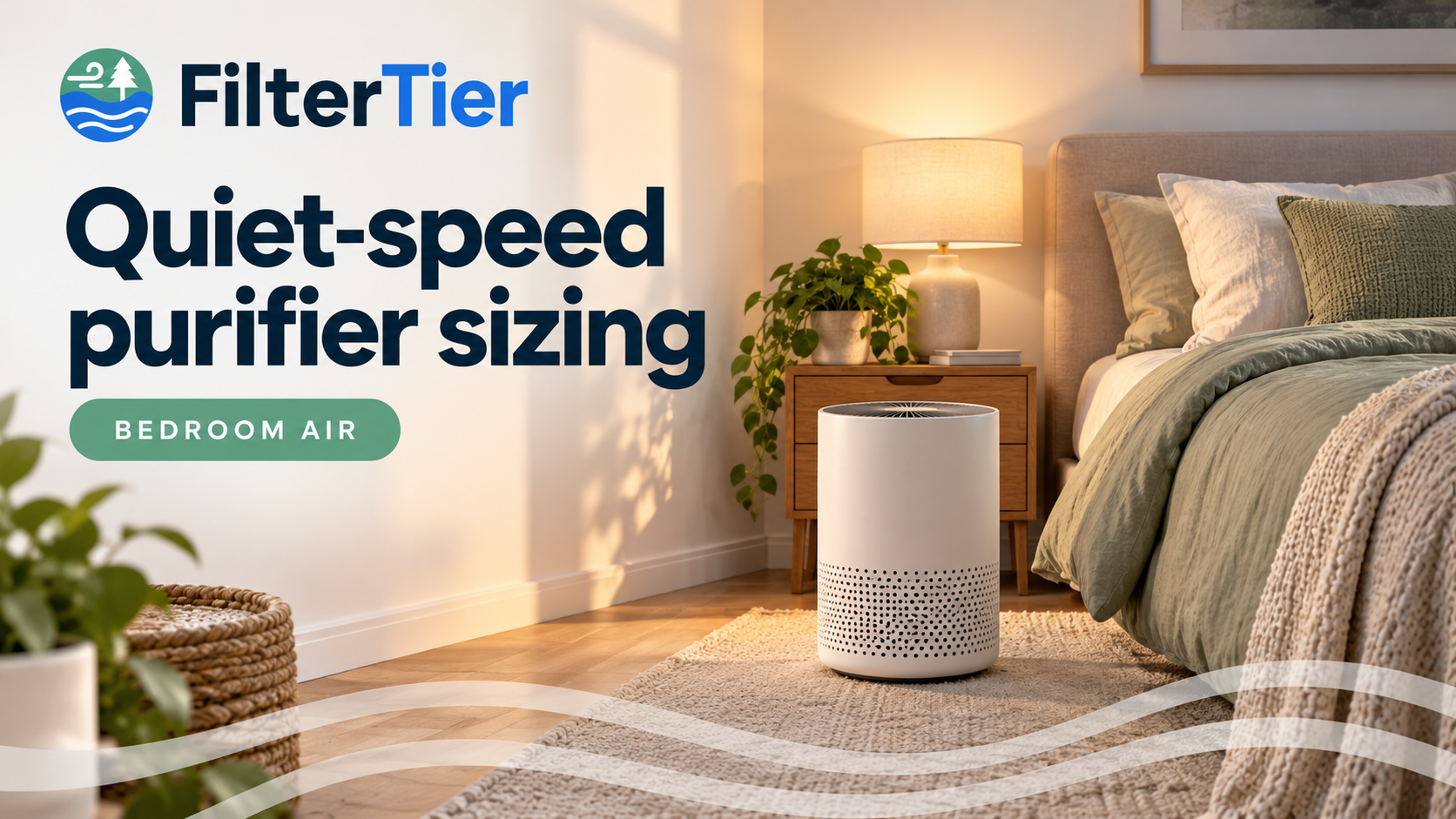
A bedroom purifier needs two kinds of evidence: enough particle-cleaning delivery for the room, and an operating setting you can live with through the night. The largest coverage number on a box answers neither question unless you know its assumptions. The quietest advertised sound level is not proof that the machine delivers its maximum clean air delivery rate at that setting.
This guide helps you connect those missing pieces. You will build a speed-by-speed evidence sheet, interpret coverage claims, separate a comfort trial from a performance test, and decide what to do when lower-speed CADR is not published. It is a buying and setup method, not a list of laboratory-tested winners. FilterTier has not performed independent acoustic or CADR testing for this article.
If you need a complete smoke preparation and ownership-cost plan, start with our smoke-ready bedroom guide. Here the narrower question is whether the setting you will actually use has the evidence needed to support your choice.
The answer in one sentence: size for a supported operating point
An operating point is a particular combination of model, filter configuration, fan setting, and documented delivery. For bedroom use, add your own observation of whether that setting is tolerable beside the bed. Keep these facts together instead of assembling a fictional combination from separate headline specifications.
EPA’s consumer air-cleaner guide explains that CADR is typically measured at the highest speed and that lowering speed reduces the amount of air filtered. That is the central evidence problem: a machine can have a strong maximum rating while its overnight setting remains undocumented.
A useful purchase record therefore says something like, “This exact model has a documented particle CADR at this setting; that setting was acceptable during our bedroom trial.” A less complete record says, “The maximum rating is sufficient on paper, but delivery at our preferred quiet setting is unknown.” Both statements are honest. Only the first closes the performance-and-comfort loop.
Unknown does not mean zero, and it does not prove a product is poor. It means a specific quantitative claim is unsupported. Keep that distinction visible so that a missing number does not become an invented reassurance.
Make a bedroom evidence sheet before comparing products
Start with one page for the room, not one page per retailer. Record the bedroom dimensions, usual door position, attached spaces, possible purifier locations, and the people who need to tolerate its sound. Then choose a consistent comparison basis for every candidate.
For example, a bedroom that must remain open to a hallway is a different planning problem from the same bedroom with its door closed. If you change that assumption halfway through shopping, the apparent winner may change because the room changed, not because the purifier improved. Put the assumption at the top of the sheet.
| Record | What belongs in the box | What does not belong there |
|---|---|---|
| Room served | Measured dimensions and connected spaces | A real-estate listing’s rounded bedroom size |
| Comparison target | A stated clean-air delivery or equivalent-air-change basis | An unexplained “safe air” number |
| Exact equipment | Model suffix, market and installed filter | A similar-looking model from another country |
| Operating setting | Manual speed name or defined mode | “Quiet” without identifying the setting |
| Delivery evidence | Source, units, particle category and applicable speed | Maximum airflow relabeled as CADR |
| Comfort observation | Your dated notes from the intended bed position | A promise that every sleeper will find it quiet |
Leave space for unresolved questions. A blank field is an invitation to check documentation, not a reason to fill the gap with a retailer’s adjective. Keep a screenshot or saved copy of the specification you used so that later changes are easy to recognize.
Decode coverage before using it in a bedroom calculation
A square-foot claim needs a cleaning frequency and a ceiling-height assumption. Without those, two very different claims can look interchangeable. A device described as serving a large area once each hour is not being described on the same basis as one serving a smaller area several times each hour.
AHAM’s explanation of portable cleaners and air changes describes its suggested room size using approximately 4.8 equivalent air changes per hour and an eight-foot ceiling. Equivalent filtered-air changes are not outdoor ventilation, and they do not mean the room is emptied and replaced with perfectly clean air each cycle.
For your comparison sheet, use the relationship: equivalent air changes per hour = CADR in cubic feet per minute × 60 ÷ room volume in cubic feet. Rearranging gives target CADR = room volume × chosen equivalent air changes per hour ÷ 60. These equations are a way to compare stated inputs, not a measurement of actual exposure.
Consider a hypothetical 12-by-14-foot room with an eight-foot ceiling. Its volume is 1,344 cubic feet. At an illustrative five equivalent air changes per hour, the calculated delivery is 112 CFM. If the ceiling is ten feet, volume becomes 1,680 cubic feet and the same illustrative target becomes 140 CFM. The floor area is unchanged; the volume is not.
Five is a convenient example here, not a universal health threshold or a guarantee for wildfire conditions. AHAM separately recommends a higher smoke-CADR sizing rule for wildfire smoke: a smoke CADR numerically equal to the room’s square footage under its stated sizing approach. See its air-filtration standards guidance. Do not quietly substitute a general bedroom example for a smoke-event plan.
The Harvard Healthy Buildings sizing tool also lets users work between room information, a chosen clean-air target and CADR. A calculator makes arithmetic easier; it cannot supply a missing fan-speed rating. If the input is maximum CADR, the result still describes that input, not an undocumented sleep mode.
A real specification example: the numbers do not describe one setting
On October 20, 2026, Levoit’s U.S. Core 300S-P product page listed 141 CFM CADR, a 22–50 dB noise range, and coverage of 1,051 square feet at one air change per hour or 219 square feet at 4.8. Its specification field identified the model as Core 300S. These are manufacturer statements, not FilterTier test results or a purchase recommendation.
The useful lesson is the structure of the information. The page presents one delivery rating, multiple room-size expressions and a sound range. Those entries do not establish 141 CFM at 22 dB. Nor does the largest area establish bedroom suitability at the quietest setting. A buyer should retain the conditions beside each number.
The linked U.S. manual adds an important distinction: Sleep Mode uses a speed below speed I, and a separate Display Off control is available. The manual does not provide a CADR for each of those speeds. Thus “lights off” and “lowest fan setting” should not be treated as the same requirement.
That example illustrates document reading, not a verdict on the product. Specifications and regional variants can change. Before ordering, match the model on the seller’s page to the current manufacturer document and any certification listing you plan to rely on. Do not extend this example’s control behavior to other purifiers.
Build a speed-by-speed table, including the unknowns
Make one row per setting you might use. Keep high speed in the sheet even if you expect to reject it for nighttime comfort. It establishes the documented upper operating point and helps you see exactly where the evidence stops.
| Setting | Delivery entry | Sound entry | Bedroom decision |
|---|---|---|---|
| Maximum | Published CADR and source, if applicable | Same-setting specification or trial note | Can occupants tolerate it? |
| Preferred manual speed | Speed-specific CADR, or “not published” | Observed comfort at the bed | Does evidence support the room target? |
| Sleep/night mode | Defined behavior and any supported delivery | Lights, fan changes and interruptions | Is the mode necessary, or only display dimming? |
| Auto mode | Variable; record control description | Whether changing speeds is disruptive | Do not assign a fixed CADR without support |
Record units carefully. Cubic meters per hour and cubic feet per minute are different units; a number copied without its unit can create a large error. Keep smoke, dust and pollen CADRs labeled when a source provides separate values. A larger rating for a different particle test should not silently replace the one relevant to your comparison.
Also distinguish airflow from clean-air delivery. If a specification says only “air volume” or “fan airflow,” copy that wording rather than promoting it to CADR. Ask what test supports the number and whether the installed filter configuration is the one you intend to use.
When several filter options are offered, note which one accompanies the rating. Do not assume a thicker odor-focused replacement, an aftermarket cartridge or a different regional filter leaves every performance claim unchanged. The appropriate conclusion is to verify compatibility and applicable evidence, not to predict a change without measurements.
Use evidence categories to keep the shortlist honest
Instead of assigning a false precision score, put each candidate into one of three practical categories. Category A has delivery evidence for the setting you plan to use and passes your comfort trial. Category B has adequate maximum delivery but no usable lower-speed rating. Category C fails a necessary practical condition, such as a tolerable documented setting or a safe installation location.
These are FilterTier decision categories for this worksheet, not certifications. A Category B machine might work well in a particular room. The category says you cannot complete the quiet-speed calculation from the information collected. It prevents a polished comparison table from hiding the difference between measured evidence and an assumption.
If two candidates both remain in Category B, compare how the uncertainty could be resolved. Does one manufacturer publish a technical report? Can either provide a written speed-specific answer? Does the seller allow a reasonable home comfort trial? Is a documented setting acceptable even if the branded sleep mode is not the one you use?
A return policy does not solve missing CADR evidence by itself. It solves a different problem: whether you can reject a machine that is inconvenient or uncomfortable. Keep the technical question and the purchasing-risk question separate, even when both influence your final choice.
Ask for the missing number without inviting a vague answer
A precise question is easier to evaluate than “Will this purifier be quiet enough?” Prepare a short request for the manufacturer: identify the exact U.S. model and filter, name the fan setting, ask for the particle CADR at that setting, and request the test method or report supporting it.
For sound, ask whether the quoted value is sound pressure or sound power, what weighting is used, which speed applies, and what measurement conditions accompany it. You do not need to become an acoustics specialist to recognize that an unexplained minimum and an explained same-setting value are different kinds of evidence.
If the reply simply repeats maximum coverage and minimum noise, the original gap remains. Put the answer in the notes field and leave lower-speed CADR marked unknown. If a report arrives, check that its model, filter, voltage market and speed match your intended purchase rather than a related product family.
This article provides a question template only; FilterTier has not contacted manufacturers on your behalf. A written answer can improve your record, but it should still be described accurately as manufacturer-provided evidence unless independent verification is available.
Do not estimate quiet-speed CADR from the wrong proxy
Three shortcuts deserve an explicit “do not use” note on the worksheet. First, do not divide maximum CADR by the number of fan settings. Three buttons do not establish three equally spaced delivery levels. Second, do not treat a displayed fan percentage as the same percentage of CADR. Third, do not derive delivery by scaling watts or decibels.
A number can look mathematically tidy and still begin with an unsupported relationship. If you write “maximum CADR × 50%” because the interface says 50%, the arithmetic is straightforward but the premise is unverified. Label that premise before it becomes a specification in a shopping comparison.
The same caution applies to online sound recordings. A recording can reveal an obvious rattle or changing tone, but playback volume, microphone processing and the original room influence what you hear. It cannot establish how loud the unit will be at your pillow or how much filtered air it delivers.
Use proxies to identify questions, not to manufacture missing answers. An unexpectedly high power draw might prompt a settings check. A distracting recording might prompt a more careful trial. Neither observation supplies the missing CADR row.
Choose a sound trial that answers a household question
The question for a bedroom trial is not whether a phone can reproduce a laboratory result. It is whether the people using the room can tolerate the supported setting, in the intended location, during their normal routine. Write that question down before you start so that the trial has a useful endpoint.
Try the purifier while reading in bed, settling down and waking during the night. Evaluate it from the normal head position, not only while standing at the doorway. If two people share the room, collect both observations. A steady sound that one person ignores may distract another, especially if it contains a noticeable tone.
Use descriptive notes: steady airflow, hum, intermittent clicking, vibration, abrupt speed changes, bright indicator, or uncomfortable draft. Those notes often explain a rejection better than a single number. Do not claim a universal sleep-friendly decibel threshold from one household’s preference.
Test controls in the dark without covering vents or modifying the appliance. Find out whether you can dim the display independently of the fan, whether a timer shuts the machine off, and whether a schedule changes settings overnight. Record the actual configuration you accepted, including any app-dependent functions.
If the device makes an unexpected mechanical noise, follow the troubleshooting instructions and contact the manufacturer as appropriate. Do not open electrical housings, defeat safety features or add homemade acoustic enclosures. A purchase that requires an improvised modification to be tolerable is not a clean solution to the original bedroom problem.
What a phone sound reading can and cannot add
A phone can help you keep a consistent personal comparison log, but its reading is not automatically a certified appliance noise result. NIOSH’s sound-level app documentation describes testing and calibration conditions for its occupational-noise tool, including the use of a calibrated external microphone for specified instrument requirements. That is different from assuming every phone app is accurate at very low bedroom sound levels.
If you use an app, record the phone, app, location and settings, and keep them unchanged between observations. Note the room background before running the purifier. A passing vehicle, cooling system or conversation can alter a short measurement. Treat a small difference cautiously rather than announcing a precise ranking from a casual test.
Do not subtract two decibel readings as though they were ordinary linear quantities to isolate the appliance. Do not compare your bedside reading directly with a manufacturer’s number when you do not know the manufacturer’s distance, room or metric. Keep your observation labeled “home comparison” and the published value labeled with its source.
Most importantly, do not let an app overrule the people using the bedroom. If the documented setting repeatedly bothers a sleeper, a reassuring-looking screen does not make the setup practical. Conversely, a tolerable sound does not establish sufficient particle delivery. These remain separate checks.
Plan placement around the manual, then assess comfort
Before deciding that a higher setting is too loud, check whether the proposed location follows the manual and works with the room. The ENERGY STAR air-cleaner guidance recommends following placement instructions and keeping airflow unobstructed. It also treats energy efficiency as a separate purchasing consideration; an energy label is not a quiet-speed delivery guarantee.
Draw the purifier’s footprint and its required clearances on your room sketch. Include the full position of bedding, curtains, a laundry basket and the chair you actually use. An attractive empty-room photograph can conceal the space needed once normal belongings are present.
Try another manufacturer-permitted position if airflow at the pillow is uncomfortable, but do not hide the device behind furniture to muffle it. Keep the cord out of the walking route and retain normal access to doors. Follow the electrical and surface-placement requirements for the exact unit.
When you change location, repeat the comfort observation. Note whether the new spot introduces vibration, a noticeable draft or a more awkward control routine. The best location is one you can maintain, not one that works only when the room is staged for a test.
Do not borrow a universal wall-clearance number from another purifier. Different intake and outlet arrangements require different instructions. The goal of this sketch is to catch a physical mismatch before the return period ends, not to replace the manufacturer’s installation guidance.
Understand what sleep, display-off and auto actually do
Mode names are not standardized promises of delivery. One device’s night setting may reduce fan speed; another may change lights, sensor behavior or scheduling. Read the manual’s actual description and write down the control behavior that matters to your room.
A useful sequence is to choose the supported fan setting first, then see whether the display can be dimmed while keeping it. If you instead press every button labeled “sleep” and assume performance is unchanged, you may inadvertently choose a different operating point from the one used in your calculation.
Auto mode deserves its own line because it changes the premise of a fixed-speed estimate. A model may increase or decrease output according to its sensor and control logic. Unless the manufacturer provides suitable evidence, do not represent that varying behavior as a constant overnight CADR.
Keep automation convenience separate from emergency judgment. A reassuring indicator is not an instruction to ignore smoke advisories, symptoms or evacuation orders. For a wildfire situation, use the official local guidance and a suitable filtration plan rather than relying solely on a consumer appliance’s automatic response.
Finally, record what happens after an ordinary power interruption according to the manual. A saved app schedule, physical button setting and restart behavior may not be identical. You do not need to create repeated outages as a test; reading the documentation and checking the restored setting when an interruption occurs is a safer routine.
Work through a hypothetical shortlist without invented specifications
Return to the illustrative 1,344-cubic-foot bedroom and its chosen comparison delivery of 112 CFM. Suppose Candidate A has a maximum documented CADR of 180 CFM, but the household cannot tolerate that setting. Its preferred lower setting has no published CADR. Candidate A remains uncertain for this specific overnight plan, even though its maximum number exceeds 112.
Suppose Candidate B has documented delivery of 125 CFM at a named middle setting, and that setting is acceptable in the room. Under the stated assumptions, B clears the arithmetic comparison at that setting. This is a hypothetical evidence example, not a claim that a particular currently sold product offers those values.
Now suppose Candidate C has a maximum of 250 CFM and a very low advertised minimum noise number, but no information tying the two together. C does not automatically outrank B. The larger maximum offers a potential option to investigate; it does not close the missing lower-speed evidence.
| Hypothetical candidate | Known overnight delivery | Comfort result | Conclusion for this example |
|---|---|---|---|
| A | Unknown at preferred speed | Maximum speed rejected | Evidence gap remains |
| B | 125 CFM at the accepted setting | Accepted | Exceeds the chosen 112 CFM comparison |
| C | Unknown at quiet setting | Not yet tried | More investigation, not an automatic winner |
If the bedroom later stays open to an attached space, redo the room assumptions before retaining the conclusion. If a different filter is installed, check whether the supporting rating still applies. The decision is conditional on the recorded setup; it is not a permanent seal of approval attached to a model name.
When one larger unit or two smaller units deserves consideration
A larger purifier might offer a useful documented operating point at a lower setting, but “buy twice the capacity and run it halfway” is not a validated sizing rule. Compare its actual setting-specific evidence and physical fit. A larger cabinet can create its own placement and ownership-cost problems.
Two units can also be worth considering when each has usable evidence at a tolerable setting. For a simple comparison in one shared air volume, supported CADRs at the chosen settings can be added. For example, two hypothetical units each delivering 65 CFM total 130 CFM. This arithmetic does not establish even mixing in every corner or coverage through a closed door.
Do not add maximum ratings and then operate both machines at undocumented low settings while claiming the same total. Likewise, two quiet devices do not necessarily sound like one. Try the combined arrangement, including any tones, changing modes and locations near the bed.
List the second outlet, second filter, extra floor space and extra maintenance task before deciding. Also consider the practical failure case: if one unit is moved elsewhere or switched off, the recorded total no longer applies. A two-unit plan should be simple enough that everyone in the household understands which machines belong in the room and at what settings.
Where the room has separated alcoves or difficult airflow paths, a simple CADR sum is only a first comparison. Do not present it as a room-specific engineering assessment. Choosing a more workable room or getting qualified advice can be more useful than repeatedly adding equipment to an unresolved layout problem.
Use an acceptance checklist before keeping the purchase
Set the acceptance criteria before the box arrives. Otherwise it is easy to gradually relax each requirement because the new device is already in the bedroom. Decide which uncertainties you are willing to retain and which would cause you to return or exchange it.
- Confirm the model and filter match the documentation used for the shortlist.
- Complete setup according to the manual, including removing any filter packaging.
- Place the unit with the specified clearances and a safe cord route.
- Select the operating setting that has the relevant delivery evidence.
- Try normal bedtime activities and, where practical, more than one night.
- Check display controls, timers and any app schedule without changing the intended fan setting unintentionally.
- Review replacement-filter availability and the actual seller’s return conditions.
- Write the accepted configuration or the reason for rejection before the return deadline.
Distinguish a firm failure from an unresolved question. “The supported speed repeatedly woke both sleepers” is a practical failure for that household. “The lower-speed CADR is not published” is an evidence gap. “The machine is broken” requires a different assessment and should not be inferred merely because it is louder than expected.
Do not deliberately burn incense, candles or other materials, spray aerosols, or introduce smoke to make the sensor react. Such a home challenge adds exposure and still does not recreate a controlled CADR test. The acceptance trial here checks setup and usability, not laboratory cleaning performance.
Keep the operating record useful after the first week
Put a short note near the household’s appliance information: the chosen setting, the reason it was chosen, the filter identifier and where the manual is saved. This helps prevent a well-intentioned change to the quietest mode from going unnoticed during a period when the planned delivery matters.
When maintenance is due, follow the exact filter instructions. Do not wash media that is not washable or improvise a replacement because the dimensions seem close. If sound or airflow changes noticeably, check the manual’s troubleshooting steps rather than compensating indefinitely by selecting an unrecorded setting.
A maintenance reminder is not a performance certificate. Nor is the absence of visible dust proof that the filter is operating as originally rated. Keep routine care practical and documented without claiming a home inspection can reproduce the product’s testing conditions.
Revisit the room sheet when the layout changes, another sleeper joins the room, the door is kept open more often or the purifier is moved. A quick review of assumptions is more useful than treating the original square-foot calculation as valid forever.
Keep particle cleaning separate from ventilation and safety
A bedroom purifier is not a substitute for fresh-air planning, source control or working carbon-monoxide alarms. Particle CADR does not establish carbon-monoxide removal or removal of all smoke gases. Do not interpret reduced odor or a lower particle reading as proof that every hazard has been addressed.
During wildfire smoke, EPA’s clean-room guidance emphasizes reducing indoor particle sources and using a suitable cleaner while maintaining a habitable room. If officials order evacuation, leave as directed. If the space becomes too hot or cannot provide a workable refuge, seek an appropriate cleaner-air location. Buying a quieter purifier is not a reason to remain in danger.
For everyday bedroom use, resolve the actual problem you have rather than expecting one appliance to solve moisture, gases, temperature and ventilation. If symptoms persist or a person has a condition that needs individualized advice, use their clinician’s guidance. This worksheet does not prescribe a medical exposure target.
Turn the evidence sheet into a focused next step
Use the room-purifier finder with the measured room assumptions, then check candidates against the speed-specific questions above. The HEPA and HEPASilent purifier comparison is a starting list, not proof that every listed device meets your overnight operating point.
For a smoke-preparation question, use the wildfire-smoke finder and the separate smoke-ready bedroom plan. For central-system filtration, the MERV finder addresses a different equipment decision; do not add an assumed HVAC contribution to the bedroom calculation without evidence of its actual operation.
Use local outdoor air-quality information for regional context, not as a measurement of your bedroom. Our guide to indoor readings versus AirNow explains why those observations answer different questions.
The finished record should be short enough to use: this room, this model and filter, this setting, this delivery evidence, this comfort result, and these remaining uncertainties. If the evidence and the routine agree, you have a defensible selection. If they do not, keep the gap visible and change the plan rather than inventing the missing number.
Sources
Primary sources reviewed October 20, 2026. This is a document-based buying method, not independent product testing. Specifications and availability can change; match the exact model and current manufacturer documents before purchasing.
- EPA: Guide to Air Cleaners in the Home — speed, CADR and filtration limitations.
- AHAM Verifide: Air Filtration Standards — general and wildfire sizing guidance.
- AHAM: Portable Air Cleaners and Air Changes per Hour — room-size and equivalent-air-change basis.
- Harvard Healthy Buildings: Portable Air Cleaner Sizing Tool — calculator input/output structure.
- Levoit: Core 300S-P U.S. product specifications — dated example only, not a recommendation.
- Levoit: linked U.S. manual — Sleep Mode and separate display controls; no per-speed CADR table used.
- CDC/NIOSH: Sound Level Meter App — measurement scope and calibration conditions.
- ENERGY STAR: Air Cleaners — placement, sizing and efficiency context.
- EPA: Create a Clean Room During a Wildfire — official smoke preparation and habitability guidance.