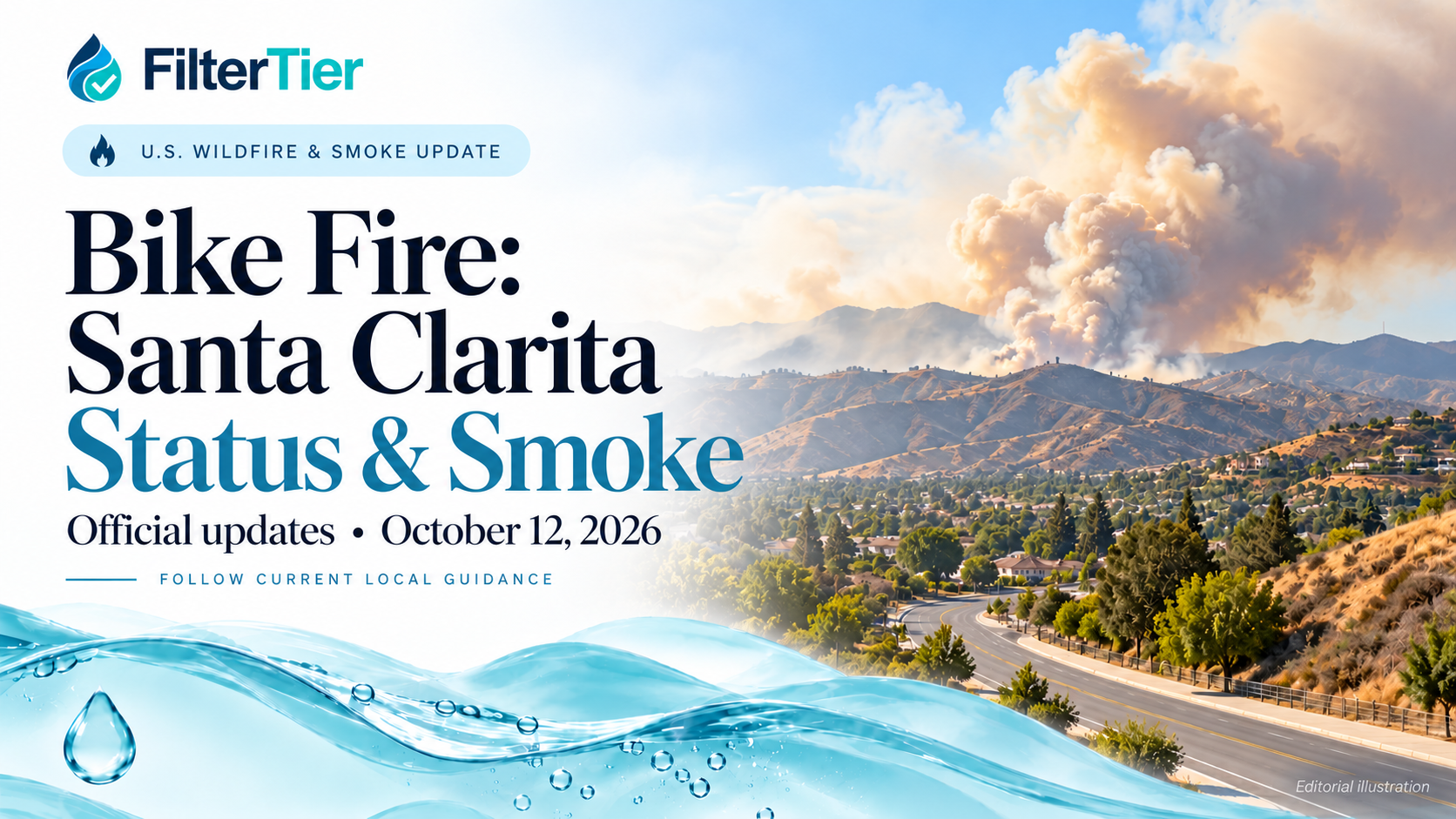
Status checked October 14, 2026, at 6:12 p.m. EDT (3:12 p.m. PDT); official incident update October 14 at 2:11 p.m. PDT: The official Bike Fire page reports 172 acres and 100% containment. Its latest evacuation-status entry remains the October 11 notice that all associated evacuation orders were downgraded to an advisory. Full containment is not an air-quality reading or permission to enter a closed area; verify current local instructions before traveling.
Separate fire-weather preparedness: In an October 14 notice, Los Angeles County warns of Santa Ana winds and dangerous fire weather for October 15–16, with critical conditions potentially lingering into Saturday. Review your evacuation plan and prepare for possible outages. This forecast does not mean Bike Fire has escaped containment or establish a current smoke-AQI measurement.
The mandatory-order and warning zone lists in the earlier October 11 report below are historical and are no longer the current status. An advisory is not an all-clear: remain alert, follow local authorities, and do not enter closed or unsafe areas. The acreage revision from 200 to 172 acres was attributed to more accurate mapping, not presented as a precise measure of area burned back.
Earlier status, verified October 11, 2026 at 2:50 p.m. local time: The Bike Fire was reported at 200 acres and burning with a rapid rate of spread near Camdria Estates Lane and Ravenhill Road in Santa Clarita. The California incident page, which attributes jurisdiction to the Los Angeles County Fire Department, listed mandatory evacuation orders for SCL-SULTUS, NADEU-A, SCL-SANDSOUTH-B, and SCL-MACMILLAN. It listed evacuation warnings for SCL-NADEU-B, SCL-CRYSTALSPRINGS, SCL-WOODLAND, SCL-SANDSOUTH-A, LAC-E119-A, and SCL-FAIROAKSRANCH. The source displayed LAC-E119-A twice; FilterTier has not interpreted that duplicate as a second zone.
If you are in an evacuation-order zone, leave now and follow local authorities. Do not delay departure to seal a house, retrieve an air cleaner, photograph the fire, or wait for a consumer air-quality sensor to change. A portable purifier can reduce some airborne particles in an enclosed room when it is correctly sized and operated, but it does not make a home safe from flames, radiant heat, embers, structural fire, power loss, carbon monoxide, or an evacuation order.
This report is a timestamped public-information summary, not a substitute for an official alert. Fire acreage, direction, road access, and zone status can change faster than a page can be updated. Use the official California incident page and the linked local evacuation map for the newest instructions. Call 911 for an immediate life-threatening emergency.
Historical evacuation zones — October 11 at 2:50 p.m. PDT
These lists describe the earlier response, not current orders. The later 8:06 p.m. official update downgraded all associated orders to an advisory. Check the official map for the newest address-specific instructions.
The official incident page separates orders from warnings. That distinction matters. An evacuation order means authorities are directing people in the named area to leave immediately because there is an immediate threat to life. A warning means there is a potential threat; people who need additional time, and people responsible for pets or livestock, should prepare to leave and may be advised to go early.
Earlier mandatory evacuation orders — superseded
- SCL-SULTUS
- NADEU-A
- SCL-SANDSOUTH-B
- SCL-MACMILLAN
Warnings listed in the earlier report
- SCL-NADEU-B
- SCL-CRYSTALSPRINGS
- SCL-WOODLAND
- SCL-SANDSOUTH-A
- LAC-E119-A
- SCL-FAIROAKSRANCH
The source showed LAC-E119-A twice. We have listed it once rather than inventing a second location. Zone codes are operational identifiers, not neighborhood names. Do not decide that you are outside danger based on a familiar place name, a social-media map, or the apparent direction of smoke. Open the official evacuation map from the incident page and use your exact address. If the map and an alert on your phone differ, follow the newest local instruction and contact the responsible agency if you can do so without delaying departure.
What changed during the first hour
The incident timeline shows why people near a fast-moving fire should keep checking official instructions. At 2:01 p.m., the Bike Fire was reported at approximately 75 acres. At 2:11 p.m., officials reported evacuation warnings. At 2:34 p.m., the evacuation orders were expanded. At 2:36 p.m., incident command reported 200 acres and a rapid rate of spread. At 2:48 p.m., another mandatory evacuation area was added. The fire had started at 1:57 p.m., according to the official page.
Those updates describe fire behavior and evacuation actions, not ground-level smoke measurements. A visible plume can exist while a nearby monitor remains lower, and smoke can reach a community after the most dramatic plume image has passed. Conversely, a smoky-looking sky may include smoke aloft that does not produce the same concentration at breathing level. The correct response is to track fire instructions and air measurements separately.
If you are ordered to leave
Leave by the route authorities direct. Keep vehicle windows closed and set the ventilation to recirculate if smoke is present, but do not let cabin-air settings distract the driver. Headlights can improve visibility. Slow down if visibility drops, allow extra distance, and watch for emergency vehicles and people evacuating on foot. Do not drive toward the fire to look for a clearer view.
Take the people and animals in your care first. If they are already together, bring essential medicines, identification, phones and charging cables, glasses or hearing supplies, mobility aids, water, and the smallest practical set of documents. If gathering an item would put you in danger or materially delay departure, leave it. A go-bag is useful because it shortens this decision when minutes matter.
Tell an out-of-area contact where you are going. Family members can overload local phone networks by repeatedly calling one another. A single contact can relay updates. Keep your phone available for official alerts and conserve the battery. If you have neighbors who may need help and can assist without delaying your own evacuation, share the official instruction—not an unverified rumor.
Do not return until authorities say the order for your area has been lifted. An online map that fails to load is not an all-clear. Neither is the absence of smoke at your current location. Fire can damage utilities, roads, trees, and structures outside the visible burn area.
If you are under an evacuation warning
A warning is the time to convert preparation into a departure-ready state. Park the vehicle facing the direction you expect to leave, but do not block roads or emergency access. Put keys, phones, medications, pet carriers, leashes, sturdy shoes, and water in one place. Confirm where every household member is. Charge devices while power is available.
People who need extra time should not wait for the status to become an order. That includes households moving infants, older adults, people with mobility limitations, people who depend on powered medical equipment, and animals that take time to load. Local officials explicitly advise those with pets and livestock to leave early when warned. If you are uncertain whether you can evacuate quickly, early departure can reduce pressure on both the household and responders.
Choose at least two possible destinations outside the affected area. A relative's home may be practical, but confirm that the route does not cross another closure. Public shelter information can change during an incident, so use the official incident page or local emergency channels rather than an old screenshot. Never assume a shelter accepts every type of animal; confirm current arrangements before diverting.
What we can and cannot say about smoke right now
The early official timeline documents rapid spread and evacuations. The October 11 evening update reported 68% containment and orders downgraded to advisory; the newer October 14 afternoon entry raises containment to 100% without adding a newer evacuation-status statement. These updates do not, by themselves, establish an Air Quality Index value for Santa Clarita, a specific countywide smoke exposure, or a health-protection claim. FilterTier did not find a new official wildfire-smoke advisory from the South Coast air district when the advisory page was rechecked October 12 at approximately 11:39 a.m. EDT. The page did not show an issuance timestamp for that status. That absence must not be read as proof that smoke is absent or that every neighborhood has safe air. Air can vary by block, time, wind, topography, and monitor coverage.
For current observations, use the AirNow Fire and Smoke Map. The map combines regulatory monitors with other layers, including temporary monitors and sensor information. Read the map legend and the timestamp. Regulatory monitor readings and lower-cost sensor estimates are not interchangeable. A sensor can be useful for noticing a local change, but a single device may be influenced by placement, humidity, contamination, or connectivity.
Also check the South Coast Air Quality Management District for official regional advisories and the National Weather Service Los Angeles/Oxnard office for weather information. Fire-weather conditions can affect spread, while an air-quality advisory addresses pollution exposure. A red-flag warning alone does not prove harmful ground-level smoke at your address, and a low particulate reading does not cancel an evacuation order.
How to read the Air Quality Index during a fire
The Air Quality Index is a communication scale, not a measurement of fire distance. During wildfire smoke, fine particle pollution—PM2.5—is often the pollutant people track most closely. AirNow reports categories from Good through Hazardous, each tied to health guidance. Look at the pollutant, time, and location, not only the color.
- Use the most local reliable data available. A monitor many miles away may not reflect a canyon, ridge, or neighborhood plume.
- Watch the trend and timestamp. A value from two hours ago can miss a rapid wind shift.
- Separate observation from forecast. A forecast describes expected conditions; a monitor reports sampled air at a location.
- Consider the household. Children, older adults, pregnant people, and people with heart or lung disease may need to act sooner under official health guidance.
- Use symptoms as a reason to seek help, not as a sensor. Follow medical advice and emergency instructions if someone has trouble breathing, chest pain, severe coughing, or another urgent symptom.
Do not advertise a house as "safe" because one indoor sensor reads lower than outdoors. Consumer monitors can help compare changes in one room when used consistently, but they do not detect every hazard. Most particle sensors do not measure carbon monoxide, oxygen, heat, structural hazards, or all gases in wildfire smoke.
If officials have not told you to evacuate and smoke reaches your home
Close windows and exterior doors when doing so is safe and compatible with the building. Reduce activities that create particles indoors, such as smoking, burning candles, frying, broiling, vacuuming without effective filtration, or using a wood-burning appliance. Run a properly sized portable air cleaner in the occupied room, or use central HVAC filtration if the system and filter slot are designed for it.
Keep the room comfortably cool. A closed room that becomes dangerously hot is not a successful clean-air plan. If the home loses power, cannot stay cool, admits substantial smoke, or is placed under an evacuation order, move to a safer location. EPA guidance on cleaner-air rooms specifically treats comfort, power, and the ability to keep smoke out as part of the decision.
If a central system has an outdoor-air intake, understand how it operates before changing it. Some homes recirculate most air; other systems, especially in larger buildings, intentionally bring in outside air. Do not disable required ventilation, interfere with combustion safety, or force a thick filter into a rack that cannot accept it. Follow the equipment manual or an HVAC professional's advice.
Portable purifiers: what they can help with
A portable air cleaner with particle filtration can reduce airborne particles in the room where it operates. Performance depends on clean-air delivery, room volume, operating speed, placement, filter condition, door position, and how much polluted air enters. Marketing coverage claims may assume one air change per hour, a particular ceiling height, or maximum fan speed; those assumptions may not match smoke conditions or nighttime noise tolerance.
For a practical comparison, start with the room's length, width, and average ceiling height. Multiplying those dimensions gives approximate volume. A device's documented smoke CADR is a clean-air delivery rate for particles under a defined test method. Dividing CADR by room volume and converting minutes to hours gives an approximate equivalent air-change contribution in a simplified, well-mixed-room model. Real homes are not perfectly mixed, so the calculation is a planning tool, not a guarantee.
Choose a unit that can provide useful clean-air delivery at a speed people will actually run. Maximum-speed CADR is valuable for comparison, but a quiet bedroom may use a lower setting with less delivery. If a manufacturer publishes only a large square-foot claim and no independently recognized clean-air delivery, it is harder to compare transparently.
Place the cleaner where air can enter and leave the unit freely. Do not hide it behind curtains, press the intake against a wall, cover it with laundry, or place it in a wet area unless the manual allows that location. Keep cords out of evacuation paths. Avoid devices intentionally producing ozone. Particle filtration does not remove all gases, and a standard purifier is not a carbon-monoxide safety device.
FilterTier's wildfire-smoke purifier finder can help organize room size and smoke-use requirements after immediate safety decisions are handled. The room-purifier finder is a broader option for everyday room sizing. These tools do not replace official evacuation guidance or local air-quality data.
Central HVAC filters and MERV ratings
A higher-efficiency central filter can capture more particles as air passes through, but only if it fits the system, seals reasonably at the rack, and allows acceptable airflow. "Higher MERV" is not automatically better for every installed system. A filter that causes excessive pressure drop, collapses, bypasses around a poor fit, or triggers equipment problems can undermine the plan.
Check the equipment documentation for allowed filter size and efficiency. Match all three physical dimensions; nominal labels can differ from actual size. Inspect arrows so airflow direction is correct. If you are uncertain, ask a qualified HVAC professional. During a smoke episode, inspect filters more often because loading can increase resistance. Replace according to condition and manufacturer guidance rather than waiting for a calendar date that ignores heavy use.
FilterTier's MERV and size finder separates the efficiency decision from the exact-size and brand-compatible replacement step. Use it only after confirming what the equipment can accept. Do not modify a filter rack or bypass a safety control during an active incident.
Respirators for unavoidable outdoor exposure
A well-fitting, NIOSH-approved N95 or P100 respirator can reduce exposure to airborne particles when worn correctly. It does not supply oxygen and does not protect against carbon monoxide or every gas in wildfire smoke. A loose surgical mask, cloth face covering, bandana, or dust mask with poor fit does not provide the same particle protection.
Use the model's instructions, place both straps correctly when the design has two head straps, mold the nose area as directed, and perform a user seal check. Facial hair and some eyewear can interfere with the seal. Children may not fit adult respirators. People with respiratory or cardiac conditions that make breathing difficult should follow clinician guidance because a respirator can increase breathing resistance.
A respirator is not a reason to enter an evacuation-order area or remain near an advancing fire. Its role is limited particle-exposure reduction during necessary outdoor movement, not protection from flames, heat, structural hazards, or oxygen-deficient conditions.
Pets, livestock, and people who need extra time
Put pets in carriers or on leashes before opening exterior doors. Smoke, sirens, and movement can cause animals to hide or bolt. Bring identification, medications, food, water, and a recent photo. If a pet normally resists a carrier, warning time is the moment to start—not when an order arrives.
Livestock evacuation may require trailers, destination confirmation, and more time than a passenger vehicle departure. Follow the specific local animal and livestock instructions linked from official emergency channels. Do not improvise a route that conflicts with closures or blocks firefighting access.
Households using electrically powered medical equipment should identify backup power and an alternate destination before an outage. Bring device information and essential supplies. If power, temperature, smoke, or transportation creates an immediate medical risk, call the appropriate emergency or medical service rather than relying on an air cleaner.
What not to do before leaving
- Do not climb onto a roof or enter heavy smoke to complete last-minute tasks.
- Do not run sprinklers in a way that blocks evacuation or reduces water pressure needed by responders.
- Do not leave a vehicle in a road, gate, or turnaround used by emergency apparatus.
- Do not open windows to photograph smoke or test which direction it is moving.
- Do not rely on an air purifier, HVAC filter, or respirator as protection from an evacuation hazard.
- Do not repeat an unofficial shelter, closure, acreage, or containment figure as confirmed information.
Home-hardening and defensible-space work matter before fire weather. During a rapidly changing evacuation, personal safety and official directions take priority over property tasks.
After an order is lifted
An evacuation order being lifted means officials have determined the immediate reason for the closure has changed; it does not guarantee that every property is undamaged or every utility is operating normally. Follow re-entry instructions. Watch for downed lines, damaged trees, unstable slopes, sharp debris, ash, and hot spots. Keep children and pets away from ash and debris.
Ash is not the same as airborne PM2.5. Avoid dry sweeping or using a leaf blower, which can resuspend material. Use official cleanup guidance and appropriate protective equipment. If asbestos, burned electronics, chemicals, propane cylinders, or structural damage may be present, professional or agency guidance is more appropriate than ordinary household cleanup.
When power returns, inspect equipment according to the manufacturer's instructions. Replace an HVAC filter if it is visibly loaded or damaged and the system documentation calls for replacement. Continue checking official air-quality information because smoke can return with shifting winds even after the flame front moves.
A five-minute household smoke and evacuation check
- Open the official Bike Fire incident page and check its last-updated time.
- Use the linked evacuation map for your exact address and zone.
- Confirm that every household member, pet, medication, key, and vehicle is accounted for.
- Check AirNow for current PM2.5 observations and timestamps; do not use AQI to override evacuation instructions.
- If not ordered to leave, choose one closable, cool room and run correctly sized particle filtration.
- Keep a route and destination ready in case a warning becomes an order.
- Recheck official updates rather than relying on a screenshot or repost.
Which facts are current and which are historical?
The status at the top reflects the latest official incident update available when checked on October 14. The zone lists and first-hour chronology are explicitly historical. Use the official incident page and local alerts for subsequent changes; this article is not a live emergency-alert service.
Containment, evacuation status, and measured air quality answer different questions. A containment percentage does not establish a neighborhood AQI. A missing air observation does not establish safe air. Read the timestamp and geography of each source before applying it to your household.
Detailed questions for Santa Clarita households
Does the reported acreage tell me how dangerous the fire is to my address?
No. Acreage is one part of an incident description. Rate and direction of spread, terrain, wind, fuels, access, and the relationship between the fire and a community all matter. The official page reported rapid spread and expanded evacuations, which is why the zone instruction is more useful for an immediate household decision than acreage alone. A smaller fast-moving fire close to homes can demand urgent action; a larger remote fire can present a different exposure pattern.
Acreage can also change when mapping improves rather than because the perimeter expanded by exactly that amount in real time. Treat every number as a timestamped operational estimate. Do not draw a circle around a point on a consumer map and assume the same distance is safe in every direction.
What does the reported 100% containment mean?
The October 14 afternoon update reports 100% containment, up from 91% that morning. Containment describes progress in controlling the fire perimeter. It is not a direct measure of smoke exposure, property condition, or whether a particular address is subject to an evacuation instruction. Continue to use current official alerts even as containment improves.
Can I use smell or visibility to decide whether to run filtration?
Smell and visibility are warning cues, but they are not quantitative particle measurements. People differ in sensitivity, and some components may be present at concentrations that are not obvious by sight. Conversely, an odor can persist when the measured particle level has changed. Use official air information, a properly maintained monitor if available, and public-health guidance together. If smoke is entering and you are not under an evacuation order, reducing exposure is reasonable even while you seek better data.
Should I tape every window and door?
Do not create a sealed enclosure without considering temperature, ventilation, combustion equipment, and emergency egress. Closing ordinary windows and exterior doors can reduce smoke entry in many homes. Temporary sealing of obvious gaps may help in some situations, but it must not block an exit, a required combustion-air opening, or safe appliance operation. Buildings with gas appliances, attached garages, unusual ventilation systems, or existing moisture problems may require professional advice. EPA's cleaner-air-room guidance is a safer starting point than improvising a permanent seal during an emergency.
What about generators and carbon monoxide?
Never operate a portable generator, charcoal grill, camp stove, or other fuel-burning device inside a home, garage, carport, or enclosed porch. Particle filters and ordinary portable purifiers do not remove carbon monoxide. Maintain working carbon-monoxide alarms according to the manufacturer's instructions, and follow emergency guidance if an alarm sounds or someone develops symptoms consistent with exposure. Power loss during a fire is a reason to reassess whether the home can remain safe and cool—not a reason to bring combustion equipment indoors.
Can a DIY box-fan filter help?
EPA describes correctly constructed do-it-yourself air cleaners as a potential temporary option when commercial units are unavailable or unaffordable. Their performance and safety depend on the fan, filter, construction, placement, supervision, and condition. Use a newer, certified fan with appropriate safety features; follow current official instructions; keep the assembly stable and clear of drapes, water, exits, and children; and replace a damaged or heavily loaded filter. A DIY device remains a particle-control measure for an occupied room, not fire protection and not permission to ignore an evacuation warning or order.
How do I estimate a particle-cleaning target without trusting a coverage badge?
Suppose a closed bedroom measures 12 feet by 15 feet with an 8-foot ceiling. Its simple volume is 1,440 cubic feet. A purifier delivering 120 cubic feet per minute of particle-cleaned air would contribute about 7,200 cubic feet per hour. In the simplified calculation, 7,200 divided by 1,440 equals five equivalent air changes per hour. That is a comparison tool under idealized mixing, not a promise that indoor concentration will fall by a particular percentage.
If the door remains open to a hallway or a bathroom, include the connected volume. If the purifier's clean-air delivery is published only at maximum speed but the household will use a quieter setting, the real operating contribution can be lower. Air leaking in from outdoors and particles generated indoors can also change the result. For smoke planning, oversizing can provide operating flexibility, but noise, cost, filter availability, and electrical demand still matter.
How often should I change a purifier filter during smoke?
There is no single calendar interval that fits every event or device. Follow the manufacturer's instructions, watch the filter indicator, and inspect for visible loading, damage, odor, or reduced airflow without touching contaminated material unnecessarily. A filter can load faster during sustained smoke than during ordinary use. Buying the exact replacement before fire season avoids discovering that a proprietary cartridge is unavailable during an event.
Do not wash a filter unless the manufacturer explicitly identifies it as washable and provides a method. Many high-efficiency particle filters are not designed for washing. Reinstalling a damp or damaged filter can reduce performance or create another problem. After handling a used filter, bag and discard it as directed, wash hands, and clean the surrounding area using methods that avoid resuspending dust.
Does activated carbon solve wildfire gases?
Some air cleaners include activated carbon or another sorbent intended for certain gases and odors. Performance depends on the chemical, media type, media mass, contact time, and saturation. A thin carbon sheet may reduce some odor without providing documented protection against the broad mixture of gases in wildfire smoke. Particle CADR does not establish gas removal. A portable consumer purifier also does not make a structure safe from carbon monoxide or concentrated combustion products.
What should schools, offices, or apartment residents do?
Follow the building operator's and local authority's emergency plan. Large buildings may have mechanical ventilation and pressure relationships that differ from a house. A resident should not enter a mechanical room or change shared equipment. Ask management how outdoor air, recirculation, filter efficiency, and emergency communication are handled. Schools and workplaces should use their established emergency channels and applicable occupational or public-health guidance rather than adapting a household checklist without review.
In an apartment, smoke can enter from corridors, neighboring units, balconies, or an attached garage. Keep the unit door closed if that is consistent with the fire-safety plan, avoid blocking hallways, and report smoke from within the building as a possible structure-fire emergency rather than assuming it came from the wildfire. Never use an elevator during a building fire unless authorities direct it.
What if the official map is slow or unavailable?
Use more than one official channel: wireless emergency alerts, local law enforcement and fire information, the incident page, the city's emergency channel, and local radio. A technical outage does not cancel an order. If you already received a valid order for your zone, leave unless a clearly identified authority issues a newer instruction. Avoid repeatedly refreshing a map while driving; have a passenger check or stop in a safe location outside the evacuation flow.
How should I document a change for later insurance or recovery needs?
Safety comes first. If there is time before an order and no exposure risk, keep existing insurance information and a basic home inventory accessible in secure cloud storage or with an out-of-area contact. Do not stay behind to create a perfect new inventory. After return is authorized, photograph damage before moving items when safe, retain receipts, and follow insurer and local recovery instructions. Do not enter a damaged structure until it is cleared.
How to compare successive official updates
Compare each source's timestamp, acreage estimate, containment, evacuation instructions, and road or shelter information. Keep forecasts separate from observations. A revised acreage estimate may reflect better mapping; it does not necessarily describe new spread or previously burned land becoming unburned.
The latest official Bike Fire update available for this check is the October 14 afternoon report. If a newer official instruction applies to your address, follow it even if the historical zone list in this article names your neighborhood differently. Read the entire update rather than relying on a headline or an older screenshot.
What to save before closing this page
- The official incident URL, not a screenshot of this article.
- Your exact evacuation-zone code and at least two exit routes.
- The location of medications, chargers, keys, pet equipment, and identification.
- The current AirNow map timestamp and nearest reliable monitor, if smoke is the concern.
- The model and replacement-filter number for your purifier or HVAC filter.
- An out-of-area contact who can relay your status.
Then act on the highest-priority instruction. If that instruction is to evacuate, close this page and leave.
Official sources
- Official Bike Fire page, checked October 14, 2026 at 6:12 p.m. EDT; latest incident update displayed October 14 at 2:11 p.m. PDT.
- AirNow Fire and Smoke Map, for current observed and mapped air-quality information.
- AirNow wildfire smoke information, for smoke and AQI guidance.
- U.S. EPA cleaner-air room guidance.
- U.S. EPA Wildfire Smoke and Your Patients' Health course.
- NIOSH guidance on approved filtering facepiece respirators.
- South Coast Air Quality Management District air-quality resources.
- National Weather Service Los Angeles/Oxnard.
Disclosure: FilterTier may earn a commission from some product links elsewhere on the site. Safety instructions and the incident summary do not depend on a purchase. No affiliate links are included in this report.