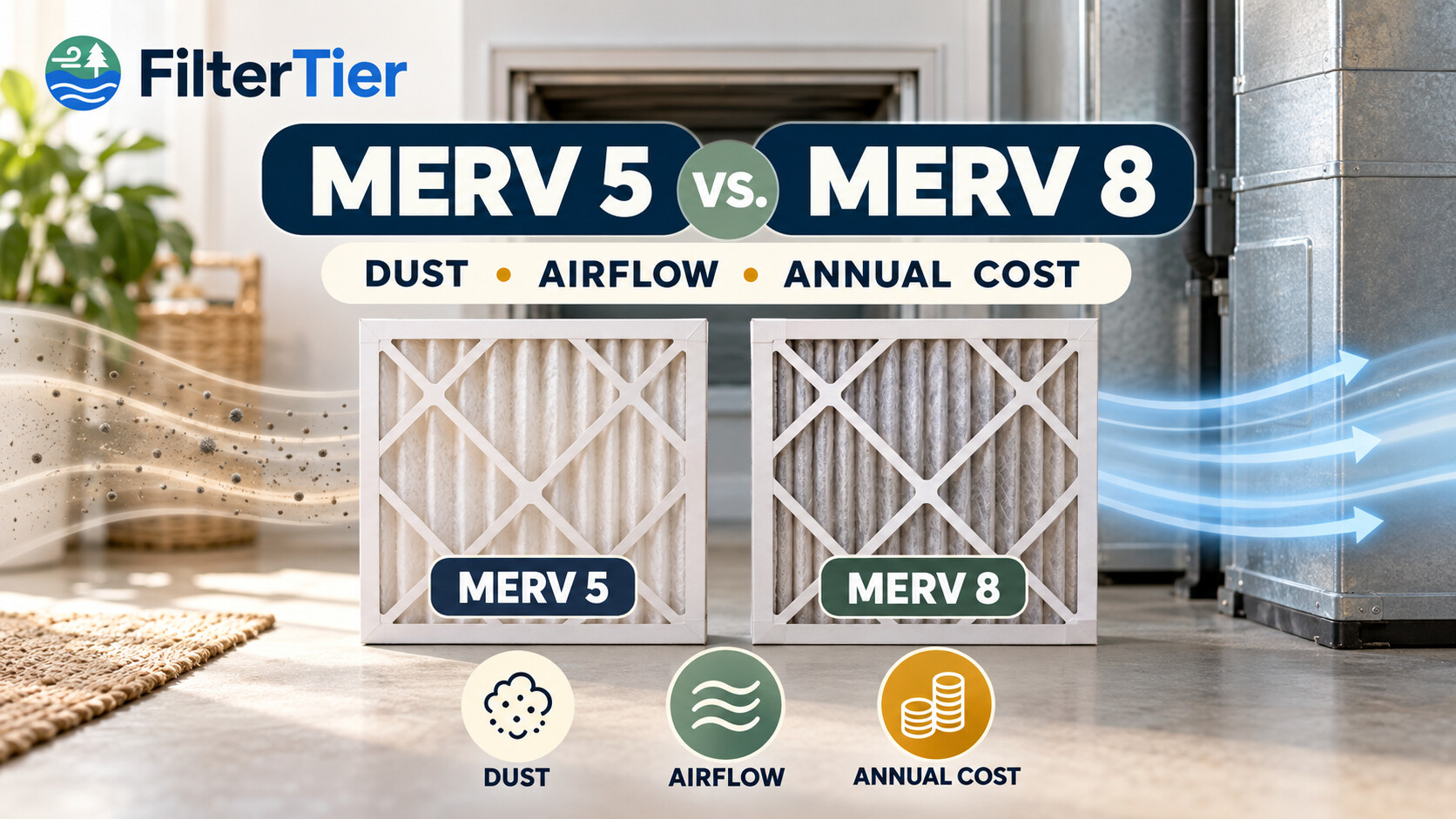
Short answer: for a typical forced-air home dealing mainly with ordinary household dust, a correctly sized MERV 8 filter is usually the more capable starting point. Under the MERV test framework, it must capture substantially more 3–10 micrometer particles than MERV 5 and must also meet a minimum efficiency for 1–3 micrometer particles. But “higher” is not automatically “better for your house.” The filter still has to fit without gaps, stay within the blower and filter-rack limits, and be changed before loading creates an airflow problem. A well-fitted MERV 5 that the system can move air through can be a better real-world choice than a crushed, undersized, or neglected MERV 8.
This guide is for an ordinary-dust household choosing between these two lower-to-mid efficiency levels. It does not treat either rating as a wildfire-smoke solution, a substitute for source control, or a promise of health protection. The U.S. EPA recommends choosing at least MERV 13—or the highest rating the system can accommodate—when the goal is stronger small-particle filtration. If your equipment cannot support that approach, a correctly sized portable air cleaner may be a separate room-level option.
MERV 5 vs. MERV 8 at a glance
| Question | MERV 5 | MERV 8 |
|---|---|---|
| Minimum test performance for 3–10 µm particles | At least 20% | At least 70% |
| Minimum test performance for 1–3 µm particles | No minimum in the EPA summary table | At least 20% |
| Best fit for this article's use case | Basic equipment protection and coarse-dust control where airflow margin or filter design is limiting | Stronger ordinary-dust capture when the system and rack support the specific filter |
| Fine smoke and PM2.5 strategy | Not the target | Still not the preferred target; consider MERV 13 or the highest supported rating |
| What determines airflow impact | The specific filter's resistance, surface area, thickness, loading, dimensions, return design, blower, and duct system—not the MERV number alone | |
| How to compare annual cost | Delivered cost per filter × actual changes per year, plus any verified service or energy consequences | |
The efficiency values above come from the EPA's MERV explanation and comparison table. They are average capture-efficiency thresholds under a standardized test, not a prediction that a particular home will remove exactly that percentage from every room. Real performance also depends on how often the HVAC system runs, how much air bypasses the filter, and how the filter changes as dust accumulates.
What MERV measures—and what it leaves out
MERV stands for Minimum Efficiency Reporting Value. It is based on an ASHRAE test method that evaluates particle capture across defined size ranges. The rating helps shoppers compare the particle-removal performance of filters intended for furnaces and central HVAC systems. In general, higher MERV values require higher minimum capture efficiency for smaller particles.
The comparison is useful because “dust” is not one size. Visible lint and hair are much larger than many of the particles represented in the MERV table. Pollen fragments, mold spores, fine mineral dust, combustion particles, and airborne debris occupy different size ranges. A filter can appear dusty after use while still having limited efficiency for the smaller particles that do not form an obvious gray layer.
MERV does not describe every part of ownership. It does not tell you the filter's pressure drop at your system's airflow, the amount of pleated media in the frame, the quality of the frame seal, how quickly the filter will load in your house, or the replacement price. It also does not rate gas or odor removal. A particle filter may reduce particles that pass through it, but it does not establish removal of carbon monoxide, volatile organic compounds, or every component of smoke.
The number is therefore one column in a comparison, not a complete product verdict. Two MERV 8 filters can have different thicknesses, pleat counts, frame rigidity, pressure-drop curves, and replacement instructions. A MERV 5 and a MERV 8 may also be sold under proprietary retail scales. For the cleanest comparison, confirm the actual MERV value rather than assuming that two similarly named “good” or “better” filters use the same test scale.
The practical efficiency difference
The EPA table lists MERV 5 at a minimum average capture efficiency of 20% for particles from 3–10 micrometers. MERV 8 raises the minimum for that range to 70% and adds a minimum of 20% for the 1–3 micrometer range. That is a meaningful test-performance difference for an ordinary-dust household, especially when particles repeatedly circulate through the return system.
It would be wrong, however, to turn those thresholds into “MERV 8 removes 70% of the dust in your home.” The test value applies to a particle-size range under the test method. Your indoor concentration is shaped by outdoor air, cooking, cleaning, occupants, pets, fabric, open windows, air leakage, settling, resuspension, ventilation, filter bypass, and HVAC runtime. Only the fraction of room air that returns through the operating system has a chance to pass through the central filter.
A central filter also does not vacuum settled dust from a shelf. Larger particles can settle before the return captures them. Regular cleaning, entry mats, shoes-off practices, source control during projects, and a sealed vacuum can matter as much as changing from one modest MERV level to another. If the goal is a cleaner-looking home, combine filtration with control of the sources and surfaces that continuously replenish visible dust.
For the narrow choice here, MERV 8 earns the efficiency advantage. MERV 5 remains a basic option when the system's documented limit, a restrictive one-inch rack, unusual airflow symptoms, or the specific product's resistance makes the higher choice uncertain. The decision should be verified at the product-and-system level rather than reduced to “always buy the higher number.”
Ordinary dust is not the same as wildfire smoke
An ordinary-dust household might be trying to reduce visible accumulation, lint, tracked-in soil, and larger airborne debris while protecting the HVAC equipment. That is different from preparing for wildfire smoke or another fine-particle episode. Smoke contains a large fraction of much smaller particles. MERV 8 has no required minimum efficiency in the EPA table's smallest 0.3–1 micrometer range, while MERV 5 has no listed minimum for either 0.3–1 or 1–3 micrometers.
EPA's broader home air-cleaner guidance recommends MERV 13, or the highest rating the fan and filter slot can accommodate, for stronger small-particle filtration. That recommendation does not mean every homeowner should force a MERV 13 one-inch filter into an existing rack. It means the desired filtration level must be paired with equipment compatibility. An HVAC technician can evaluate the system when the allowable resistance is unknown.
If smoke is the immediate concern, check official local air information and follow emergency directions first. A filter is not a reason to remain in an evacuation area. For a room-level approach where staying home is appropriate, a portable cleaner with a documented smoke CADR can supplement compatible central filtration. FilterTier's wildfire-smoke purifier finder and room purifier finder organize those different decisions.
For this article, the honest conclusion is simple: MERV 8 is stronger than MERV 5 for ordinary particle capture, but neither rating should be marketed as the endpoint for fine-smoke protection. Match the solution to the particle problem instead of treating every dusty-looking filter as evidence of high fine-particle performance.
Why airflow cannot be judged from MERV alone
Every filter creates resistance as air passes through the media. That resistance is commonly described as pressure drop. A loaded filter generally creates more resistance than the same filter when clean. The Department of Energy's Building Science Education guidance warns that a dirty or clogged filter can sharply reduce airflow, lengthen furnace runtime, add motor wear, and increase energy use.
A higher MERV filter often uses media and construction intended to capture more particles, but the rating does not provide a universal pressure-drop value. Surface area changes the equation. A deep pleated filter can provide far more media area than a flat panel or shallow filter with the same face dimensions. More usable area can lower face velocity through the media and reduce resistance compared with a less favorable design.
The DOE's filter-sizing research emphasizes this system context. It describes pressure drop as the resistance contributed by the filter, ducts, coils, bends, grilles, and other components. In a restrictive system, the filter may consume too much of the available pressure budget. Depending on the blower type, the result may be reduced airflow or increased fan energy as the motor tries to maintain airflow.
That is why “MERV 8 chokes airflow” is too broad, and “MERV 8 never affects airflow” is equally careless. The useful question is: what resistance does this specific filter produce at the airflow your system needs, and what is the total external static pressure of the installed system? Homeowners usually do not have enough label information to answer that precisely. A technician can measure static pressure and temperature rise or drop, check airflow, and compare the result with the equipment documentation.
Signs that deserve an airflow check
Do not diagnose a system from a filter rating alone, but do take consistent changes seriously. If a new filter choice coincides with weaker airflow at several registers, new whistling at the return, longer cycles, rooms drifting farther from the thermostat setting, furnace limit trips, coil icing, or a filter bowing into the cabinet, stop treating the issue as a brand preference. Confirm that the filter is installed correctly and have the system evaluated if the symptom persists.
A filter can also be blamed for a problem created elsewhere. Closed or blocked returns, matted pet hair on a return grille, an obstructed supply register, a dirty indoor coil, damaged ductwork, an undersized return, or an incorrect blower setting can all affect airflow. Swapping to a looser filter may hide part of the symptom without fixing the system.
Before changing ratings, inspect the simple items you can safely access. Confirm the arrow points in the direction of airflow. Make sure protective wrapping has been removed. Verify that the frame is not bent and that the access panel closes. Do not stack two disposable filters unless the equipment documentation explicitly calls for that arrangement. Two filters can add resistance and create an improvised setup that was never evaluated as a system.
If the system operated normally with one MERV 8 design but not another, compare thickness, pleat depth, frame size, and the manufacturer's pressure-drop information if available. The shared MERV number does not make the filters physically identical. If no resistance data is published, treat that as missing evidence rather than assuming that price, pleat count, or a premium-looking frame proves better airflow.
Fit comes before the rating
EPA advises that an HVAC filter should fit snugly without being bent or crushed. Air that leaks around the frame bypasses the media, so a higher-rated filter with a substantial perimeter gap can lose much of its real-world advantage. Fit means more than reading the large nominal size printed on the packaging.
A “16 × 25 × 1” filter is usually a nominal description. Actual dimensions vary by manufacturer and product line. The filter that works in one 16 × 25 rack may be slightly loose or impossible to insert in another. Read the existing filter's exact dimensions, measure the slot, and keep the installed orientation. If the cabinet uses a proprietary media filter, use the equipment documentation instead of substituting a common one-inch product because its nominal numbers look close.
Depth matters too. A cabinet designed for a four- or five-inch media filter should not automatically receive a one-inch substitute without the correct frame or adapter. A rack designed for one inch cannot accept a deeper filter by crushing or trimming it. A deeper filter may provide more surface area, but it needs a cabinet built to seal and support it.
Look for the airflow arrow on the frame and point it toward the blower. Seat the filter against the intended stops, reinstall the door or cover, and make sure the frame cannot be pulled into the duct. If the rack has obvious gaps or no gasket where the design expects one, ask whether a proper seal or cabinet repair is appropriate. Tape should not become a permanent substitute for a damaged access panel or an incorrectly sized rack.
The FilterTier MERV finder separates rating, size, and brand compatibility because they are different questions. First determine the rating range your system supports. Then match nominal and actual dimensions, thickness, and the product family intended for the rack.
How often should MERV 5 or MERV 8 be changed?
There is no universal calendar that applies to every filter in every home. EPA notes that manufacturers often recommend replacement every 60–90 days, while ENERGY STAR advises checking monthly, especially during heavy-use seasons, and changing the filter when it appears dirty. The exact interval depends on filter area, construction, runtime, dust sources, occupancy, pets, projects, outdoor conditions, and the system's airflow margin.
Start with the filter manufacturer's instruction and the equipment manual. Write the installation date on the frame or save it in a reminder. Check the filter monthly during the first cycle rather than waiting for a guessed deadline. If it becomes heavily loaded, deformed, damp, or damaged sooner, investigate the reason and replace it as directed. Never wash a disposable filter unless the manufacturer explicitly labels it washable and provides instructions.
Do not use color alone as a calibrated pressure gauge. Some filters darken from normal loading while still operating within their intended range; others may restrict airflow before they look dramatic from the accessible side. A pressure-drop indicator or professional measurement is stronger evidence when the system supports it. In an ordinary home without those instruments, consistent inspection and the manufacturer's interval are the practical starting points.
A MERV 8 may capture more of the particle sizes represented in the test, but that does not guarantee it will always require more frequent replacement than every MERV 5. A deeper MERV 8 with substantial media area may hold more dust than a thin basic filter. Conversely, a high-loading home can overwhelm either filter quickly. Compare the whole product and household, not just the rating printed in large type.
Calculate annual replacement cost correctly
The price on one package is not the annual cost. Compare delivered cost per usable filter and the number of changes your household actually makes. Include required shipping or membership fees only when they truly apply. Do not divide a multipack price by a count that includes filters of the wrong size.
A simple planning formula is:
Annual filter cost = delivered cost per filter × planned changes per year.
If the manufacturer specifies a range, model more than one interval. Four changes per year represents roughly a 90-day schedule. Six changes represents roughly every two months. Twelve changes represents monthly replacement during unusually demanding conditions. The table below is illustrative, not a current market-price claim.
| Illustrative delivered price | 4 changes/year | 6 changes/year | 12 changes/year |
|---|---|---|---|
| $7 per filter | $28 | $42 | $84 |
| $11 per filter | $44 | $66 | $132 |
| $16 per filter | $64 | $96 | $192 |
Replace the example price with the current delivered price for the exact dimensions, rating, and pack you would buy. Then use the interval in the product instructions, adjusted only with documented household experience or professional guidance. A cheaper filter changed on time can be a better ownership plan than a more expensive filter stretched beyond its useful service period.
Energy cost is harder to assign. The difference cannot be estimated reliably from MERV alone because blower type, system pressure, runtime, climate, ducts, filter design, and loading all matter. Avoid claims that one MERV point automatically adds a fixed dollar amount to an annual utility bill. If airflow or fan energy is a concern, a measured system assessment is more useful than a generic calculator.
Three realistic household scenarios
Scenario 1: basic system protection, no special particle goal
The home has no pets, no renovation dust, no recurring smoke, and no occupant asking for stronger particle control. The one-inch rack is restrictive, the equipment literature is unclear, and airflow has been marginal. A correctly fitting MERV 5 may be a reasonable temporary or baseline choice while the system is evaluated. The plan should still include monthly checks and timely replacement. “Basic” does not mean forgotten.
Scenario 2: ordinary dust, compatible equipment, normal airflow
The current filter fits snugly, the system documentation or technician supports MERV 8, and there are no airflow symptoms. MERV 8 is the stronger comparison choice because it has substantially higher minimum efficiency for 3–10 micrometer particles and a minimum requirement in the 1–3 micrometer range. Use the exact approved size and follow the product's replacement interval.
Scenario 3: the actual goal is fine particles or smoke
The household is choosing between MERV 5 and 8 because those are familiar, but the real concern is wildfire smoke, PM2.5, or another fine-particle source. Neither rating should end the analysis. Determine whether the system can support MERV 13 or the highest suitable rating, and consider a portable cleaner with an appropriate smoke CADR for occupied rooms. During a wildfire event, official safety and evacuation instructions come first.
These scenarios are decision paths, not diagnoses. Equipment age alone does not prove incompatibility, and a newer variable-speed system does not guarantee that every filter will be acceptable. Filter area, return design, duct condition, blower setup, and the manufacturer's limits still matter.
When a portable purifier adds more than another MERV step
Central filtration serves air that travels through the operating HVAC system. EPA notes that central filters only filter while that system is running. In mild weather, heating or cooling demand may be low, so the central system may provide limited filtration time unless it has an appropriate circulation mode. Increasing runtime can add electricity use and may affect humidity control.
A portable purifier serves a room or connected area directly. It can be useful when one bedroom, nursery, office, or living space needs more particle-cleaned air than the central system can reasonably provide. The key performance measure is CADR for the relevant particle type, sized to the room and evaluated at a fan setting people will actually use. A maximum-speed number should not be assumed to apply to quiet mode.
This does not turn the purifier into a replacement for the HVAC filter. The central filter still protects equipment and can reduce particles in circulating air. Nor does a portable particle filter remove every gas or solve a source such as smoking, moisture, mold growth, or a combustion problem. Use filtration as a supplement to removing sources and ventilating with clean outdoor air when conditions allow.
If ordinary dust is the only complaint, start by correcting fit, checking returns, controlling sources, and choosing the supported central filter. Add a portable cleaner when there is a room-specific particle goal, not because an appliance badge sounds more advanced than the HVAC rating.
Do not confuse dust capture with cleaning the house
Filters work on airborne particles that reach them. They do not remove dust already settled on floors, fabric, blinds, electronics, or high shelves. A home can use a capable filter and still accumulate visible dust from shoes, pets, open windows, deteriorating materials, unsealed ducts, textiles, fireplaces, cooking, and outdoor soil.
Use entry mats, manage shoes, vacuum with equipment that does not leak captured dust, and damp-wipe suitable surfaces. During sanding or remodeling, isolate the work area, use source capture, and follow safety requirements for the material involved. Do not expect a residential return filter to carry the entire load of an uncontrolled dust-producing project.
If dust appears rapidly around specific supply registers, that does not automatically prove the ducts need cleaning. Look for gaps, nearby air leakage, construction debris, insulation problems, and maintenance history. EPA does not recommend routine duct cleaning as a blanket household service; investigate a specific problem and use qualified guidance.
For ordinary housekeeping, the difference between MERV 5 and 8 is meaningful but bounded. MERV 8 provides stronger standardized particle capture. Source control and cleaning determine how much material becomes airborne in the first place. The best plan uses both approaches instead of asking the filter to compensate for preventable dust generation.
A buying checklist for the exact filter
- Confirm the equipment type. Determine whether the home uses a forced-air furnace, central air handler, heat pump, mini-split, or another system. MERV comparisons apply to filters rated under that system; a washable mini-split screen is not automatically equivalent.
- Read the manual and current filter. Record the manufacturer, model, approved filter type, nominal dimensions, actual dimensions, thickness, and airflow arrow.
- Choose the performance goal. Ordinary dust, pets, allergies, smoke, and equipment protection are not identical problems. This article covers ordinary dust.
- Confirm compatibility. Use the highest useful rating the fan and rack can accommodate. When unclear, ask for a static-pressure and airflow assessment rather than guessing.
- Compare construction. Look at depth, pleat support, frame rigidity, published resistance data, and manufacturer replacement guidance. Do not assume every product with the same MERV behaves identically.
- Verify fit before stocking up. Test one filter. Confirm the cabinet closes and the frame seats without gaps, bending, or trimming.
- Calculate annual cost. Use the delivered per-filter price and realistic changes per year. Record the installation date.
- Inspect monthly. Replace according to the product instruction and sooner when documented conditions require it. Investigate unexpectedly rapid loading.
Common comparison mistakes
- Comparing proprietary scales as if they are MERV. MPR, FPR, and other labels use different methods. Find the actual MERV value or manufacturer cross-reference.
- Buying only by nominal size. Verify actual dimensions and thickness.
- Calling a dark filter “full.” Appearance is useful for inspection but is not a calibrated pressure-drop measurement.
- Stacking filters. Do not improvise a two-filter arrangement unless the equipment was designed for it.
- Assuming higher MERV always means higher resistance. The specific media area and construction matter. Compare published resistance where available.
- Ignoring runtime. A central filter only captures particles while air moves through it.
- Using MERV 8 as a smoke guarantee. Fine-particle goals require a separate compatibility and performance analysis.
- Stretching the replacement interval to save money. Compare annual cost using a realistic schedule, not an idealized package claim detached from household conditions.
FAQ
Is MERV 8 always better than MERV 5?
MERV 8 has stronger minimum particle-capture requirements, so it is the more capable rating in a direct test-performance comparison. It is not automatically the better installed choice if the filter does not fit, the system cannot accommodate the specific product's resistance, or the owner will not replace it properly.
Will MERV 8 reduce airflow?
Any filter creates resistance, and loaded filters add more. The effect of changing to MERV 8 depends on the specific filter's construction, area and resistance plus the entire HVAC system. A measurement is more reliable than a blanket claim based on rating alone.
Is MERV 5 enough for normal dust?
It can provide basic coarse-particle capture and equipment protection, especially where the system or filter design limits the choice. For an ordinary-dust household with compatible equipment, MERV 8 offers a stronger standardized baseline.
Does MERV 8 remove smoke?
It can capture some particles that pass through it, but it has no required minimum in the EPA table's 0.3–1 micrometer range. Do not present it as a complete smoke solution. EPA points households toward MERV 13 or the highest supported rating for stronger small-particle filtration.
Can I replace a one-inch MERV 5 with a four-inch MERV 8?
Only if the cabinet is designed or properly modified for that filter. A deeper filter cannot be forced into a one-inch rack. A compatible media cabinet may provide more surface area, but the equipment and return design must support it.
How many filters should I budget for?
Use the manufacturer's interval and inspect monthly. A 90-day plan implies about four changes per year; a 60-day plan implies about six. Heavy loading can require more frequent replacement. Do not buy a large supply until one filter has been confirmed to fit.
Should I choose MERV 13 instead?
EPA recommends MERV 13 or the highest rating the fan and slot can accommodate when stronger small-particle filtration is the goal. That is a system-compatibility decision, not a reason to force an unsuitable filter into the rack. Use the MERV 13 comparison after confirming support.
The FilterTier verdict
For an ordinary-dust household, choose a correctly fitting MERV 8 when the system documentation or a competent HVAC assessment supports it. The efficiency difference is real: MERV 8 has a much higher minimum for 3–10 micrometer particles and adds a minimum for the 1–3 micrometer range. That makes it the better default comparison for many compatible forced-air systems.
Choose MERV 5 when it is the supported practical option for the installed rack and airflow, or when it serves as a temporary baseline while a restrictive system is evaluated. Do not compensate for a fit problem with a higher number, and do not compensate for a clogged filter with a looser rating without investigating the loading and system condition.
Whichever rating you choose, verify the exact dimensions, install it in the airflow direction, inspect it monthly, follow the replacement instruction, and calculate annual cost from the real delivered price and real change frequency. If the actual concern is smoke or fine particles, move beyond this two-rating comparison and evaluate MERV 13 compatibility or a room purifier with documented CADR.
Disclosure: FilterTier may earn a commission from some links on product-comparison pages. This guide contains no direct retailer purchase links. Ratings, compatibility, prices, and replacement intervals can change; verify the exact filter and equipment documentation before purchase.
Sources
- U.S. EPA: What is a MERV rating? — particle-size efficiency thresholds and compatibility guidance, checked October 14, 2026.
- U.S. EPA: Guide to Air Cleaners in the Home — HVAC filter selection, fit, replacement, runtime and limitations, checked October 14, 2026.
- U.S. Department of Energy Building Science Education: Proper Installation of Filters — airflow, loading and installation, checked October 14, 2026.
- U.S. Department of Energy Building America: Filter Selection and Sizing — pressure-drop and filter-area research context.
- ENERGY STAR: Heat & Cool Efficiently — monthly inspection and dirty-filter airflow guidance, checked October 14, 2026.
- U.S. EPA Indoor airPLUS filtration guidance — MERV 8 construction baseline and higher-efficiency context, checked October 14, 2026.