

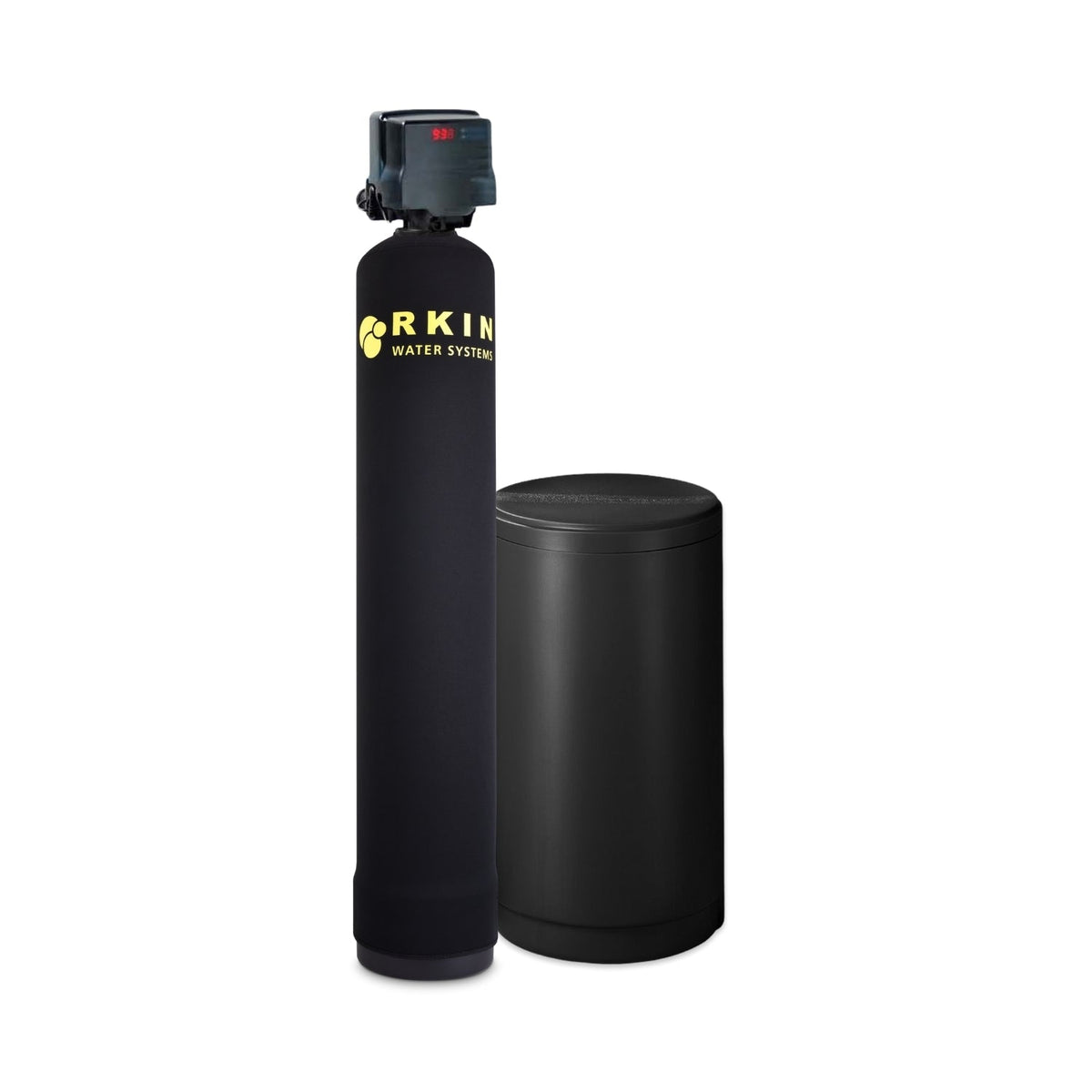
What it actually treats
Ownership reality
Routine
Keep salt or potassium available for regeneration, inspect the brine system periodically, and follow the manufacturer’s service instructions.
Major
No single complete-system replacement interval is published. Softening resin and control-valve components are serviced separately as performance declines, while the tank is treated as a long-life component.
Lifetime warranty on tanks and parts; electronic/mechanical control valves are covered for 7 years. RKIN also advertises a 1-year satisfaction guarantee.
Lifetime warranty on tanks and parts; electronic/mechanical control valves are covered for 7 years. RKIN also advertises a 1-year satisfaction guarantee.
Flow-source qualification (reviewed October 29, 2026): RKIN's own specification table labels WS9 11 GPM / WS10 13 GPM / WS16 34 GPM simply as Flow Rate; it does not identify a separate service-versus-peak figure for these models. These manufacturer-stated sizing figures are not independently established contaminant-removal or hardness-removal performance at that exact flow. Match the actual model and water-test/plumbing conditions before sizing. RKIN's model specifications.
True softening requires regeneration and ongoing salt/potassium maintenance.
WaterScore 87/100 is a calibrated review index. Underlying Research Index: 77/100. The fixed whole-home reference of 84 research points maps to 95; zero remains zero, and the remaining range maps to 100. Treatment facts, evidence credit and missing-data limitations are unchanged. This is not percent contaminant removal, a certification or a safety probability. Scoring methodology.
Where it is made
United States
RKIN states its whole-house treatment systems are assembled/manufactured in the USA.
What it actually costs
$3,499.95
Price for WS16, 120K grains, 1.25-inch connections. Checked 2026-10-05. Source: https://rkin.com/products/rkin-whole-house-salt-based-water-softener-system?variant=49508303929582
Think about your mechanical room
Before your plumber orders it, confirm:
- Main-line size and connection diameter
- Available service flow and incoming pressure
- Drain requirement / backwash routing
- Electrical outlet or UV/controller power
- Tank/cartridge replacement clearance
- Bypass and isolation valves
- Pressure gauges before/after restrictive stages
- Floor drain / leak protection where appropriate