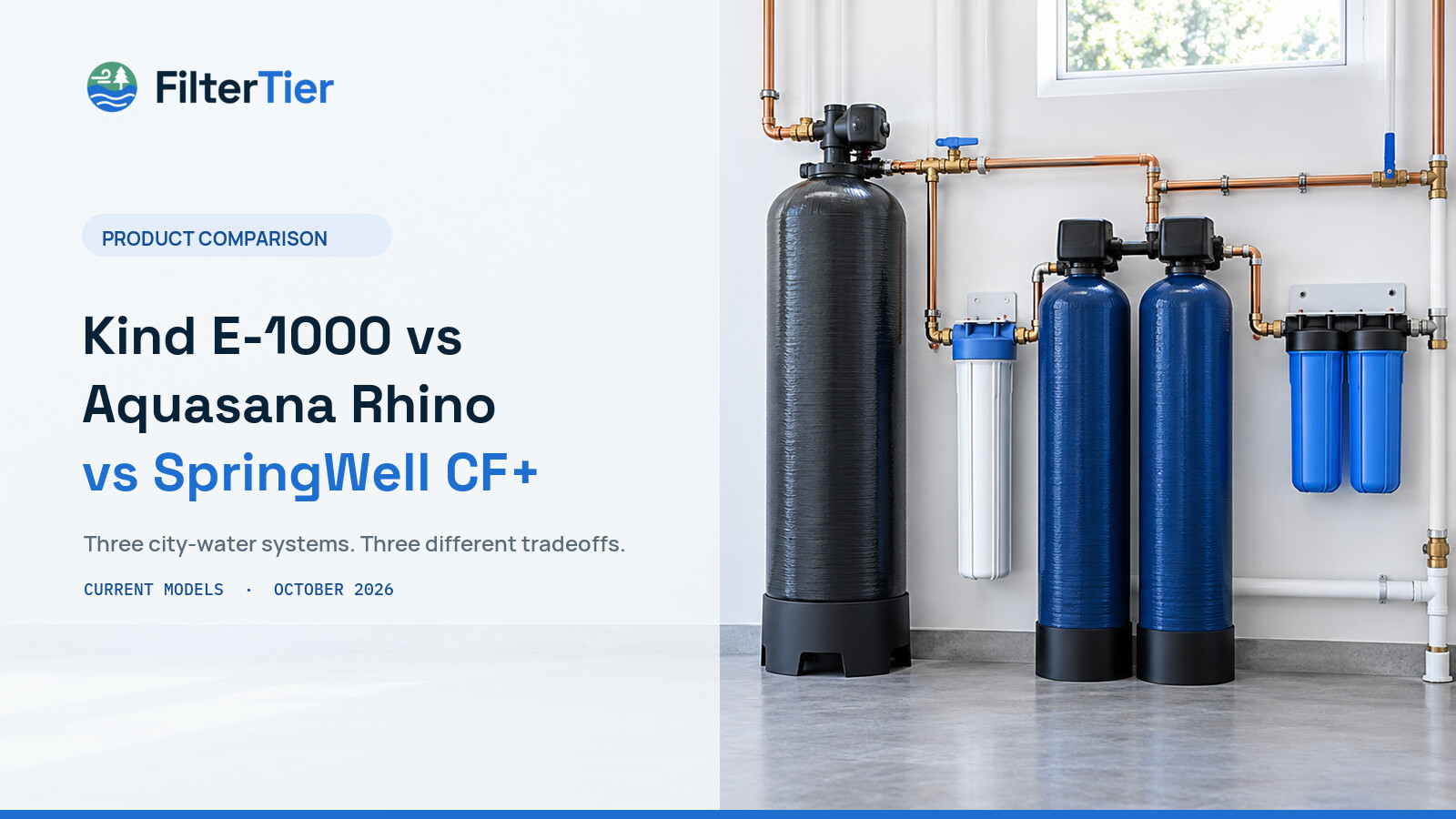
There is no single best system in this three-way comparison. Choose the Aquasana Rhino Max Flow WH-1010 when the most important factor is exact-model, independently tested chlorine performance at whole-house flow. Choose the SpringWell CF+ Max when a very large home needs the highest published service flow and you prefer a long-life media tank with light routine maintenance. Choose the Kind E-1000 when wall space, lower upfront cost, and straightforward cartridge replacement matter more than having a decade-long media tank.
That answer has an important condition: all three are city-water filters, not universal water-treatment solutions. None is a conventional ion-exchange softener, none should be assumed to make microbiologically unsafe water safe, and no broad contaminant list should replace an exact performance document for the contaminant you care about. Start with your utility report and, if the issue could come from household plumbing, a certified laboratory test. Then match the evidence, flow, installation, and upkeep to your home.
Quick verdict
- Best documented chlorine performance: Aquasana Rhino Max Flow. Aquasana publishes exact WH-1010 performance data showing up to 97% chlorine reduction at a 14.0 GPM rated flow and a 1,000,000-gallon capacity. The product page distinguishes that rated test flow from its 14.5 GPM peak flow.
- Best for the largest homes: SpringWell CF+ Max. The CF+ is the 20 GPM, seven-or-more-bathroom version of SpringWell's city-water carbon system. Its routine service is mainly a sediment prefilter every six to nine months, while the primary media is marketed for one million gallons or ten years.
- Best compact and budget-conscious fit: Kind E-1000. The 29-by-15.5-by-8-inch wall-mounted system is much smaller than a floor-standing tank train, lists 15 GPM, and had the lowest one-time system price in our October 21, 2026 storefront check. Its tradeoff is recurring cartridge service every six to twelve months and less exact finished-system performance documentation than Aquasana publishes for chlorine.
If you do not yet know whether your utility uses free chlorine or chloramine, pause before choosing. That distinction can change which carbon formulation and contact time make sense. Use FilterTier's water-by-ZIP tool and your utility's latest Consumer Confidence Report before comparing products.
Kind E-1000 vs Aquasana Rhino vs SpringWell CF+: key specifications
| Factor | Kind E-1000 | Aquasana Rhino Max Flow WH-1010 | SpringWell CF+ Max |
|---|---|---|---|
| Architecture | Wall-mounted two-cartridge system | Dual media-tank system with pre- and post-filters | Large upflow media tank with sediment prefilter |
| Intended source | Municipal/city water | Municipal/city water | Municipal/city water |
| Published flow | 15 GPM; manufacturer sizes it for one to five bathrooms | 14.0 GPM rated test flow; 14.5 GPM peak | 20 GPM service flow; seven or more bathrooms |
| Primary treatment | Sediment cartridge plus carbon block | Activated carbon and copper-zinc media, plus pre/post filtration | KDF, catalytic carbon, and sediment filtration |
| Published life | Cartridges every six to twelve months | Primary media: one million gallons or ten years; pre/post filters more often | Primary media: one million gallons or ten years; sediment filter every six to nine months |
| Connection | 1-inch NPT | Installation kit supports 3/4-inch or 1-inch mains | 1.5-inch connection on CF+ |
| Space | 29 in H × 15.5 in W × 8 in D, plus plumbing/service clearance | Base tanks about 57 in high and 11 in diameter each, plus pre/post housings and piping | 13 in × 54 in tank; approximately 58 in high with head, plus prefilter and plumbing |
| Routine upkeep | Replace two cartridges; manufacturer estimates about ten minutes | Standard prefilter every two months; post-filter every six months; optional low-maintenance prefilter every six months | Replace sediment filter every six to nine months |
| Warranty / trial | Lifetime limited warranty; 120-day satisfaction guarantee | 10-year limited warranty; 90-day satisfaction guarantee | Lifetime limited warranty on covered items; six-month money-back guarantee |
| Observed system price* | $927.64 system-only | $2,798 base system | $2,142 CF+ variant |
| FilterTier WaterScore | 76 | 80 | 80 |
*Prices were observed on the manufacturers' U.S. storefronts on October 21, 2026. Promotions, subscriptions, accessories, tax, and installation can change the checkout total. The Kind page also displayed a lower subscription price tied to recurring replacement-filter shipments; the table uses the one-time system-only option. Confirm the exact configuration and price before purchase.
What we compared—and what we did not
This is an exact-model comparison of three point-of-entry systems positioned for treated municipal water:
- Kind Water Systems E-1000, the two-stage compact cartridge model without the optional UV or salt-free conditioning stages.
- Aquasana Rhino Max Flow WH-1010, the base Max Flow filtration system without the optional salt-free conditioner, UV unit, upgraded prefilter, or pro-grade bypass kit.
- SpringWell CF+ Max, the largest variant in the CF city-water filter family, not the smaller CF1 or CF4 and not a filter-softener combination.
Those boundaries matter. Optional UV changes microbial protection, cost, maintenance, power requirements, and flow. A salt-free conditioner changes scale behavior but does not remove hardness minerals the way an ion-exchange softener does. Comparing an upgraded bundle with a base filter would turn the table into an apples-to-oranges exercise.
These systems also use different architectures. Kind's replaceable-cartridge approach is not simply a smaller version of the two media-tank systems. Cartridges trade recurring hands-on service for compact dimensions and defined replacement parts. Media tanks trade floor space and a higher purchase price for much more media and longer intervals between primary-media replacement. Our guide to cartridge filters versus media tanks explains that design choice in more depth.
How FilterTier evaluated the three systems
We used the same decision factors for every model: exact-product evidence, certification scope, intended treatment, treatment-relevant flow, price and access, maintenance, warranty, installation, and practical tradeoffs. Manufacturer pages, manuals, performance data, and warranty documents were checked against the exact model name. When a manufacturer made a broad claim without a public exact-system performance sheet or certification listing that we could verify, we labeled it as a manufacturer claim rather than silently treating it as independent proof.
WaterScore is one input, not the verdict. A high score cannot tell you whether a 58-inch tank fits your mechanical room, whether you want to change a prefilter every two months, or whether your utility uses chloramine. The best system is the one whose verified treatment, flow, upkeep, and physical requirements all fit the home.
Evidence and certification: Aquasana is the clearest for chlorine
The most meaningful difference in this comparison is not the number of contaminants named on a sales page. It is how directly each claim is tied to the finished product, a stated flow, and a stated capacity.
| Model | Strongest public evidence we found | How to interpret it |
|---|---|---|
| Kind E-1000 | The current product page lists NSF/ANSI 42, 61, and 372 and describes NSF-certified components. It also lists manufacturer claims for sediment, chlorine, chloramine, VOCs, pesticides, and a longer contaminant list. | Component/material compliance and a broad manufacturer claim are not automatically the same as an exact finished-system contaminant-reduction certification at 15 GPM. Ask for the exact listing and performance data for the claim you need. |
| Aquasana WH-1010 | An exact-model performance data sheet supports up to 97% chlorine reduction at 14.0 GPM for one million gallons. Aquasana also states the Rhino tank is WQA certified to NSF/ANSI/CAN 61. | This is the strongest clearly scoped chlorine evidence in the group. Standard 42 chlorine reduction is an aesthetic claim; Standard 61 addresses drinking-water system component health effects, not broad contaminant removal. |
| SpringWell CF+ | The manufacturer states that the CF family uses KDF, catalytic carbon, and sediment filtration for chlorine, chloramine, PFAS/PFOA/PFOS and other city-water concerns. SpringWell also provides a performance guarantee for chlorine/chloramine under its stated terms. | These are useful technology and manufacturer-guarantee signals, but we did not verify a public exact CF+ finished-system certification for those named reductions at 20 GPM. Treat 20 GPM as the published service-flow specification, not proof of every contaminant claim at that flow. |
NSF/ANSI 42 is commonly used for aesthetic effects such as chlorine, taste, and odor. It should not be stretched into proof of health-effect contaminant reduction. Standards 61 and 372 address materials and lead content in drinking-water components; they do not mean the filter removes lead from incoming water. Certification also needs an exact scope: the complete product, a component, the media, or a specific claim may be listed. The Water Quality Association's certification guidance emphasizes that certified products are evaluated against specific standards and claims, which is why the model number and listing details matter.
Why the wording matters for PFAS
PFAS is not a single generic carbon claim. Performance varies by compound, water chemistry, media type, contact time, flow, and capacity. SpringWell currently names PFAS, PFOA, and PFOS on the CF product page, and Kind includes broad contaminant statements, but this review did not find the kind of exact-model, flow-and-capacity PFAS document that would justify calling either system PFAS-certified. Aquasana's WH-1010 evidence is for chlorine—not PFAS. Aquasana itself directs buyers seeking broader certified health-effect reduction to a different product line.
If PFAS is your primary concern, look for an exact-system listing that names the compound or claim, its test flow, and its capacity. A point-of-use reverse-osmosis or certified specialty filter may provide stronger evidence at the drinking-water tap than a high-flow whole-house system. Whole-house treatment may still be appropriate, but it should be selected from evidence rather than a carbon-media assumption.
Flow: service, rated, and peak are not interchangeable
Aquasana provides the cleanest flow vocabulary. The WH-1010 page gives a 14.0 GPM rated flow associated with contaminant testing and a 14.5 GPM peak flow. That small distinction is useful: the chlorine performance belongs to the rated condition, while peak flow describes the upper short-term hydraulic figure.
Kind publishes 15 GPM and sizes the E-1000 for one- to five-bathroom homes, including simultaneous fixtures. The page does not give an exact finished-system performance table that ties every broad reduction claim to 15 GPM. That does not mean the filter cannot treat water at household flow; it means the evidence should be described honestly as a manufacturer flow specification rather than a certified contaminant-reduction flow.
SpringWell publishes 20 GPM service flow for the CF+ and positions it for homes with seven or more bathrooms. This is the largest flow figure in the group, supported by a large tank and 1.5-inch connection. Yet the same evidence rule applies: hydraulic service flow does not automatically prove a stated percentage reduction for every contaminant at 20 GPM.
Estimate real demand instead of counting bathrooms alone
Bathroom count is a convenient shortcut, but simultaneous fixture demand is the better sizing input. A five-bathroom house occupied by two people may never approach 15 GPM, while a three-bathroom home with a large soaking tub, rain shower, irrigation branch, and multiple appliances can create higher bursts. List the fixtures that realistically run together, add their measured or specified GPM, and include a margin for filter loading and future use.
Also check dynamic pressure. A system can advertise enough GPM and still make an upstairs shower disappointing if pressure drop is high, the service line is small, or several restrictive fittings are added. Measure pressure while water is flowing, not just static pressure with every fixture closed.
Treatment fit: start with the disinfectant your utility uses
Free chlorine
If taste, odor, and free chlorine are the main concerns, all three architectures are plausible. Aquasana has the clearest exact-model chlorine evidence. SpringWell brings much more media and low routine maintenance. Kind brings a compact carbon-block cartridge and easy replacement. Your decision then turns on evidence strength, space, flow, and ownership style.
Chloramine
Chloramine is more persistent than free chlorine and often benefits from catalytic carbon and adequate contact time. SpringWell explicitly identifies catalytic carbon and chloramine treatment. Kind's current page names chloramine in its carbon-stage claims. Aquasana's exact WH-1010 performance sheet highlighted in this review documents chlorine; do not automatically transfer that percentage to chloramine. If your utility uses chloramine, request exact chloramine performance at the flow you need.
Sediment
All three include a sediment-control stage, but the roles differ. Kind's first cartridge is a primary sediment stage ahead of its carbon block. Aquasana uses pre- and post-filtration around the Rhino tanks. SpringWell places a replaceable sediment filter with its media system. If your home has unusually heavy rust, sand, or pipe scale, a pressure-gauge pair and a larger dedicated prefilter can make service intervals more predictable.
Hardness and scale
None of the three base models is a conventional softener. Carbon does not remove dissolved calcium and magnesium. Kind, Aquasana, and SpringWell all sell upgrades or combinations aimed at scale, but salt-free conditioning should not be described as hardness removal. If soap performance, hard-water spotting, or appliance scale is the main problem, test hardness and compare a true softener or a clearly defined scale-control system separately.
Microorganisms
These base carbon systems are not a substitute for disinfection when water is microbiologically unsafe. Municipal water under normal operation is disinfected by the utility. Private wells, boil-water situations, and confirmed microbial contamination require source-specific guidance and often a properly sized UV or other disinfection stage. Optional UV changes the configuration and is outside this base-system comparison.
Installation and space
Kind E-1000: the easiest footprint
Kind's strongest practical advantage is its wall-mounted 29-by-15.5-by-8-inch body. It uses 1-inch NPT connections and requires clearance around the housing and below it for plumbing and cartridge changes. In a small garage, closet, crawlspace access area, or mechanical room already crowded by a water heater and HVAC equipment, this can be decisive.
The manufacturer calls the system DIY-friendly and gives a two- to four-hour installation estimate. Treat that as a best-case manufacturer estimate, not a promise for every house. Copper work, code-required bypasses, bonding, drain pans, outdoor exposure, pressure regulators, and a difficult main-line location can turn a short job into professional plumbing work. Shutoff access and leak protection matter more than saving an hour on installation day.
Aquasana: the most components and service points
The Rhino Max Flow uses two approximately 57-inch-tall, 11-inch-diameter tanks, plus pre- and post-filter housings and connecting plumbing. Aquasana includes parts for 3/4-inch or 1-inch main lines and strongly recommends professional installation. The assembly needs a level floor, vertical and horizontal clearance, a place to change cartridges, and a layout that does not put heavy tanks or housings in the way of future water-heater or HVAC service.
Aquasana's optional pro-grade bypass kit is not included in the base price displayed in our check. A well-designed bypass is valuable because it allows service without shutting water off to the entire home for an extended period. Confirm which valves, unions, connectors, and wall supports are included before comparing installation quotes.
SpringWell CF+: simple train, large plumbing
The CF+ is a 13-by-54-inch tank, approximately 58 inches tall with the head, plus a sediment prefilter. Its 1.5-inch connection is designed to support the 20 GPM class, but many homes have smaller service plumbing. Reducing to a smaller main does not create more household flow, and poor reducer or hose choices can add restriction. A plumber should preserve a clean, full-port path and adequate bypass capacity.
The tank does not require electricity or routine backwashing for the base filtration function described by the manufacturer. It still needs a dry, freeze-protected location, stable footing, service clearance, and plumbing that can support the equipment without loading the tank head.
Maintenance: choose the work you will actually do
Maintenance is where these systems feel most different after installation.
Kind E-1000 maintenance
Kind calls for sediment and carbon filter replacement every six to twelve months, with actual life dependent on water use and loading. A cartridge system makes the treatment media easy to remove and replace, but every service requires shutting off water, relieving pressure, opening the housings, managing residual water, inspecting and lubricating seals as instructed, and checking carefully for leaks after repressurization.
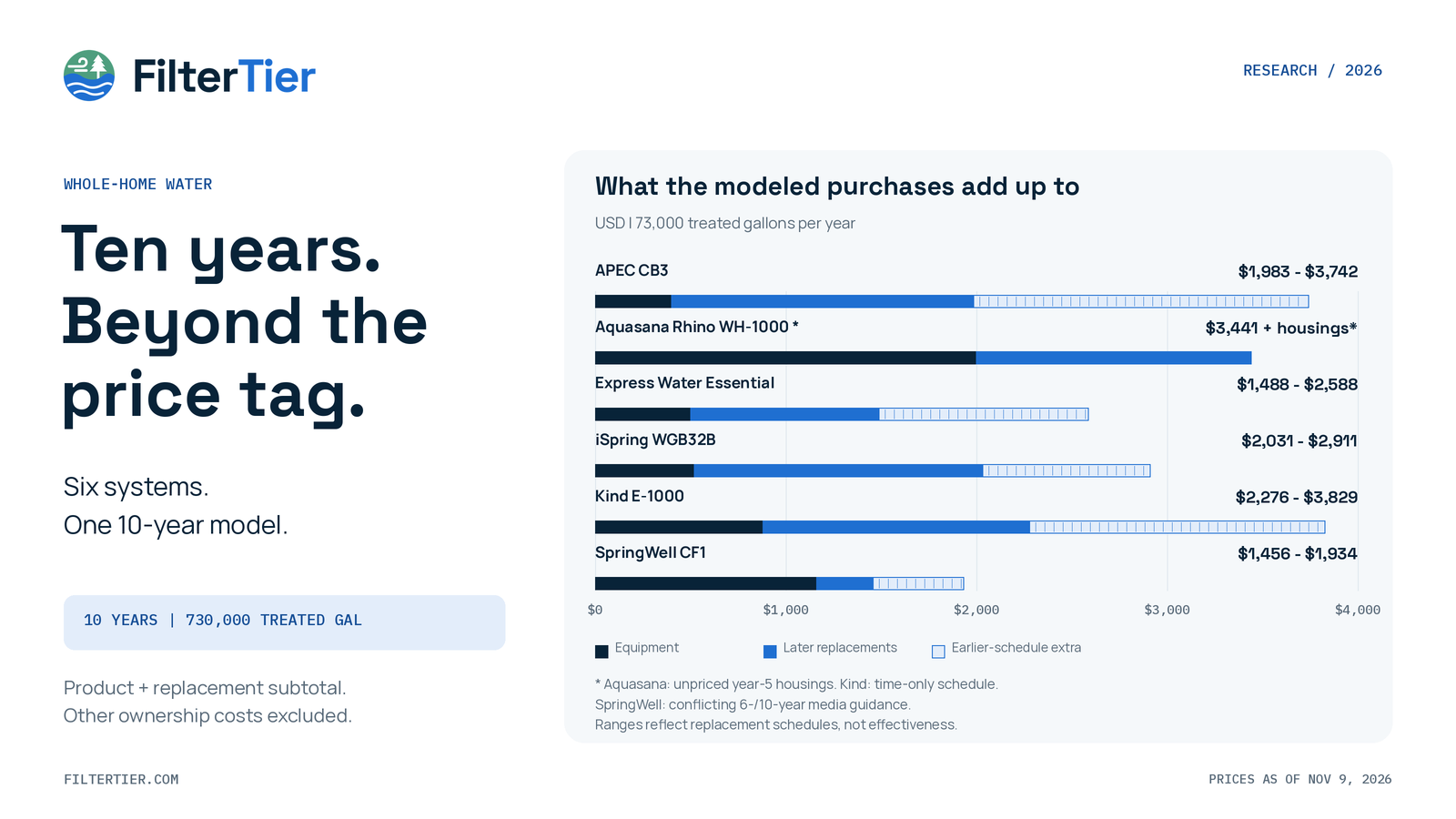
The page estimates about $100 per year and presents an approximately $1,800 ten-year manufacturer comparison. Do not treat that scenario as a guaranteed ownership total. The live storefront also offered a recurring refill subscription with shipments at six- or twelve-month intervals, and the displayed refill amount was higher than $100 for a shipment. Your actual cost depends on interval, current refill price, shipping terms, and whether both cartridges are changed together.
Aquasana WH-1010 maintenance
The primary Rhino media is rated for one million gallons or ten years, but that does not mean ten years without service. Aquasana specifies replacement of the standard 20-inch prefilter every two months and the post-filter every six months. Its optional low-maintenance prefilter extends that prefilter interval to six months. Those are frequent, predictable tasks that protect the tank and downstream plumbing.
For a ten-year ownership estimate, count sixty standard prefilter changes and twenty post-filter changes if the published intervals remain applicable to your water and usage. Add O-rings or housings when needed, labor if you do not service them yourself, and eventual tank replacement. The main media's long life is real value, but it should not hide the recurring filters around it.
SpringWell CF+ maintenance
SpringWell's routine schedule is the lightest of the group: a sediment filter every six to nine months, with the primary media marketed for one million gallons or ten years. That can be attractive for a large household that does not want several service events each year. Actual media life still depends on contaminant load, use, and adherence to product conditions. A ten-year label is not proof that every named contaminant remains below a target level for every household until the final day.
A practical service rule
Install pressure gauges before and after cartridge stages when practical. A growing differential pressure under similar flow is a useful sign of sediment loading. Keep a dated service log and replacement part numbers near the equipment. For health-relevant treatment, use the required capacity or interval rather than waiting for taste or odor to return; sensory changes are not a reliable breakthrough alarm for many contaminants.
Price and ten-year ownership
On October 21, 2026, the Kind E-1000 was $927.64 for the one-time system-only option, Aquasana's base WH-1010 was $2,798, and SpringWell's CF+ variant was $2,142. Kind also showed a promotional subscription entry price, and SpringWell displayed a seasonal promotion banner. These are snapshots, not permanent list prices.
Kind wins the upfront comparison by a wide margin, but purchase price is only the first line of a ten-year model. Build your own estimate with:
- base system and required installation parts;
- professional labor, permits, and code upgrades;
- scheduled cartridges, prefilters, and post-filters at today's price;
- a reasonable replacement-price inflation assumption;
- media tank or cartridge-system replacement at the stated life;
- optional labor for each service event;
- leak protection, pressure gauges, bypass valves, and insulation where needed;
- shipping, tax, and disposal costs.
Do not force false precision. Water quality can shorten a filter's life, future consumable prices are unknown, and promotions come and go. A range built from a conservative and an optimistic replacement interval is more honest than one perfect-looking number.
Warranty and return-policy differences
Kind advertises a lifetime warranty and a 120-day satisfaction guarantee. SpringWell advertises a lifetime warranty on covered items and a six-month money-back guarantee. Aquasana provides a 10-year limited warranty and a 90-day satisfaction guarantee for the WH-1010.
The word “lifetime” is not the end of a warranty comparison. Read who must own and install the product, whether registration is required, which components and consumables are excluded, whether labor and shipping are covered, and which water conditions or installation choices can void coverage. Aquasana's documentation, for example, separates coverage for the main tank, installation kit, housings, and consumable cartridges. A longer headline warranty can still cover fewer real-world costs than expected.
WaterScore: why Aquasana and SpringWell tie at 80
FilterTier's current model records give Aquasana WH-1010 and SpringWell CF+ a WaterScore of 80 and Kind E-1000 a 76. The tie does not mean the two 80-point products are interchangeable. Aquasana earns its clearest advantage from exact-model chlorine evidence. SpringWell's advantage is 20 GPM service and low routine maintenance. Kind offers stronger price and space fit but has a lower maintenance score and a more limited public exact-system evidence trail for its broad claims.
Scores are snapshots based on available evidence and current model data. They should move when a certification listing, performance sheet, price, warranty, or model changes. For a wider market view, see FilterTier's city-water whole-house filter ranking.
Which system is best for your home?
Choose Kind E-1000 if…
- you have limited floor space but accessible wall space;
- the roughly $928 observed system price fits your budget better than a $2,000-plus tank system;
- you prefer replaceable cartridges to eventual tank replacement or rebedding;
- 15 GPM is enough for measured household demand;
- you are willing to service the system every six to twelve months; and
- you can obtain satisfactory exact evidence for the contaminant that drives your purchase.
Do not choose it merely because the page names many contaminants. Choose it because its architecture, flow, service schedule, and documented treatment match your water.
Choose Aquasana Rhino Max Flow if…
- whole-house chlorine reduction is your primary goal;
- you value an exact-model performance sheet tied to 14.0 GPM and one million gallons;
- 14.0 GPM rated flow covers realistic simultaneous demand;
- you have room for two tall tanks plus pre/post filters;
- you accept a two-month standard prefilter schedule or plan to buy the optional longer-life prefilter; and
- the higher purchase price is justified by evidence and fit.
Do not interpret the chlorine test as proof of PFAS, chloramine, lead, or every health-effect claim. Use the performance data sheet exactly as scoped.
Choose SpringWell CF+ Max if…
- measured household demand is too high for a typical 9- to 14-GPM system;
- you have seven or more bathrooms, multiple high-flow fixtures, or another credible reason to need up to 20 GPM service;
- you want catalytic carbon for a chloramine-focused treatment strategy;
- you prefer a six- to nine-month sediment-filter schedule and long primary-media life;
- you have space for the large tank and plumbing; and
- you are comfortable treating the broad reduction claims as manufacturer claims unless an exact independent listing supports your target contaminant.
Do not pay for the CF+ solely because 20 is larger than 15. If your home peaks at 8 GPM, the smaller CF1 or CF4 may be the more rational size, subject to the same evidence review.
Three realistic household examples
Example 1: two adults, three bathrooms, chlorine taste, tight garage
The household measures an 8 GPM realistic peak, the utility uses free chlorine, and floor space is scarce. Kind's compact format and lower price are attractive. Aquasana has stronger exact chlorine documentation but requires much more space and more frequent prefilter changes. The decision becomes evidence versus footprint and cost. If the homeowner wants the documented 97% chlorine result and can make room, Aquasana is stronger; if compactness and affordability dominate, Kind can be reasonable after the buyer verifies acceptable chlorine documentation for the exact cartridge.
Example 2: six-person household, frequent simultaneous showers, chloramine utility
The home reaches 15 to 17 GPM during morning use, and the utility report names chloramine. SpringWell CF+ is the clearest hydraulic fit and explicitly uses catalytic carbon, but the homeowner should request chloramine performance at the expected flow. Aquasana's chlorine result should not be substituted for chloramine evidence. Kind's 15 GPM figure may be too close to measured demand once pressure-drop and filter-loading margin are considered.
Example 3: four bathrooms, chlorine, evidence-first buyer
The home peaks at 11 GPM, has space for tanks, and the buyer wants the most explicit public exact-model evidence among these three. Aquasana is the logical starting point because its 14.0 GPM rated chlorine test covers the home's demand with some margin. The buyer still needs to price pre/post-filter service and confirm installation dimensions.
A seven-step decision process
- Read the current utility report. Identify disinfectant, regulated detections, violations, and treatment changes. Remember that a utility report describes system-level sampling, not every building's plumbing.
- Test when the decision depends on your address. Lead, sediment, and some plumbing-related issues can differ between the treatment plant and your tap. Use an accredited laboratory and an appropriate sampling protocol.
- Define the outcome. Write down the two or three contaminants or aesthetic problems that actually matter. “Cleaner water” is too vague to buy against.
- Verify exact claims. Match product model, standard, contaminant, reduction, flow, and capacity. Separate certified finished-system evidence from components, media, and marketing language.
- Measure demand and pressure. Estimate fixtures used together, measure peak GPM if possible, and check dynamic pressure. Add margin without buying an oversized system by reflex.
- Audit the installation. Measure floor, wall, height, drain, power, bypass, cartridge-change clearance, freeze exposure, and access for future trades.
- Price ten years of ownership. Include every prefilter, post-filter, cartridge, media replacement, and service call—not just the main tank life.
Common comparison mistakes
Counting contaminants instead of checking scope
A list of 155 contaminants can look stronger than one chlorine claim, but a precisely tested claim may be more useful than a long unscoped list. Evidence quality and relevance matter more than list length.
Treating every NSF reference as contaminant certification
Standards cover different things. Materials safety, lead-free component compliance, structural integrity, and chlorine reduction are not interchangeable. Find the exact model in the certifier's listing and read the certified claims.
Using peak GPM as certified treatment flow
Peak flow describes hydraulics unless the document ties it to a treatment result. Aquasana's separate 14.0 rated and 14.5 peak figures show why the labels matter.
Ignoring the filters around a ten-year tank
A long-life media tank can still have prefilters and post-filters several times a year. Count every service event and make sure the housings are accessible.
Buying a filter for hardness
Carbon filtration does not remove calcium and magnesium. If hardness is the problem, compare softening or scale-control technologies explicitly.
Assuming city water means identical water
Disinfectant, source water, seasonal treatment, corrosion control, and distribution plumbing vary. A product that fits one city can be a poor match in another.
Letting a promotion set the deadline
All three brands use promotions or bundles. A temporary discount should not rush a decision that affects household plumbing for years. Save the exact configuration, warranty, price, and source date before ordering.
Frequently asked questions
Which one removes the most contaminants?
There is no defensible single number across the three. The products make different claims with different evidence scopes. Aquasana has the clearest exact WH-1010 chlorine result. SpringWell and Kind name broader treatment targets, but buyers should verify exact-system performance for the contaminant that matters instead of comparing list length.
Is Aquasana worth the higher price?
It can be when free-chlorine reduction evidence is the priority and the installation and maintenance fit the home. It is harder to justify if you need chloramine, PFAS, hardness removal, or 20 GPM and cannot verify that the WH-1010 meets that specific requirement.
Does SpringWell CF+ really need a seven-bathroom home?
No. Bathroom count is the manufacturer's sizing shorthand. A smaller home with unusually high measured simultaneous demand could justify it, while a large home with low occupancy might not. Use actual demand, connection size, and pressure.
Is Kind E-1000 easier to maintain?
The service task is direct and the wall-mounted housings are accessible when installed correctly, but it occurs more often than primary media service on the tank systems. “Easier” depends on whether you prefer predictable cartridge changes or rare but larger tank replacement.
Will any of these soften water?
No, not in their base configurations. They do not remove hardness minerals through ion exchange. Optional conditioner bundles may reduce scale behavior but should not be described as making hard water chemically soft.
Can I install one outdoors?
Only within the manufacturer's environmental limits and with protection from freezing, direct weather, physical damage, and excessive heat. Local plumbing and electrical codes still apply. Outdoor feasibility is not a reason to ignore service access or leak control.
Do I need UV with city water?
Usually not for normally disinfected municipal water, but local circumstances matter. A boil-water advisory, private well, storage tank, recurring microbial problem, or vulnerable plumbing design changes the analysis. UV must be sized to flow and water quality and maintained with lamp and sleeve service.
What if my utility switches between chlorine and chloramine?
Select against the more demanding relevant condition and request exact performance for both disinfectants. Utilities sometimes change treatment seasonally or during operational events, so use the latest official utility information.
Should I filter the whole house for PFAS?
It depends on concentration, exposure goals, budget, and evidence. Drinking and cooking water typically drive ingestion exposure, so a certified point-of-use system may be a more evidence-rich first step. Whole-house treatment can be appropriate when exact performance, capacity, flow, and replacement monitoring support the decision.
Which would FilterTier buy?
For a typical city-water home focused on documented chlorine reduction and needing no more than 14 GPM, Aquasana is the evidence-first choice among these three. For a very large high-demand home, SpringWell CF+ is the flow-first choice. For a small mechanical space and tighter budget, Kind E-1000 is the footprint-and-price choice. The water report, exact claim, and measured demand can reverse any generic recommendation.
Primary sources reviewed
- Kind Water Systems — E-1000 product page, specifications, pricing, and service information
- Aquasana — Rhino Max Flow WH-1010 product page, specifications, pricing, replacement schedule, and documentation
- Aquasana — WH-1010 performance data sheet
- Aquasana — WH-1010 limited warranty
- SpringWell — CF city-water filter product page, variant specifications, pricing, and maintenance
- SpringWell — warranty and money-back terms
- Water Quality Association — standards and product-certification guidance
Bottom line
Aquasana wins on public exact-model chlorine evidence, SpringWell wins on published high-flow capacity and light routine service, and Kind wins on compactness and upfront price. None wins every category. The right purchase follows a sequence: identify the water problem, verify the exact claim, size treatment flow to real demand, confirm the installation, and count the maintenance you will actually perform.
Prices and product documents were checked on October 21, 2026. FilterTier will update this comparison when an exact-model performance sheet, certification listing, price, warranty, or replacement model materially changes the decision.
Sources
- Kind Water Systems — E-1000 product page and specifications
- Aquasana — Rhino Max Flow WH-1010 product page
- Aquasana — WH-1010 performance data sheet
- Aquasana — WH-1010 warranty
- SpringWell — CF city-water filter product page and CF+ variant data
- SpringWell — warranty terms
- Water Quality Association — standards and certification guidance