
Big Blue cartridge filters and large media-tank filters are two of the most common architectures for whole-house water treatment, and neither is automatically better. Big Blue-style housings are modular, inexpensive to install, easy to inspect, and can use many different cartridges. Media tanks usually cost more upfront but hold far more treatment media, support longer service life, and often create less maintenance at high household flow. The better architecture depends on what you are treating, how much water your home uses at once, how often you are willing to change filters, and how much long-term ownership cost matters.
This guide focuses on architecture rather than brand rankings. “Big Blue” is commonly used as a generic description for large-diameter cartridge housings, while media tanks use loose granular media inside a pressure vessel. Both can be excellent. Both can also be undersized, overmarketed, or poorly matched to the water.
What is a Big Blue cartridge filter?
A Big Blue-style system uses a large cylindrical housing that holds a replaceable cartridge. Common sizes are approximately 10 or 20 inches long with a larger diameter than standard slimline housings. The larger cartridge provides more surface area and usually supports better whole-house flow than a small under-sink-style cartridge.
Cartridges can contain sediment media, activated carbon, carbon block, specialty adsorptive media, scale-control media, or combinations of materials. Multi-housing systems place several cartridges in series.
What is a whole-house media tank?
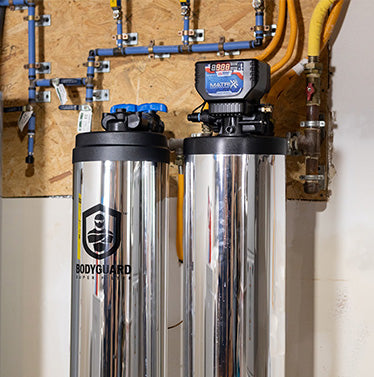
A media-tank filter uses a fiberglass or composite pressure vessel filled with loose treatment media. Common examples include granular activated carbon, catalytic carbon, iron-removal media, acid-neutralizing media, and specialty resins. Water enters through a control head or distributor, flows through the media bed, and exits to the home.
Some tanks are simple upflow or downflow vessels without automatic backwashing. Others use control valves to periodically backwash the media bed.
Quick comparison
| Factor | Big Blue cartridge | Media tank |
|---|---|---|
| Upfront cost | Usually lower | Usually higher |
| Media quantity | Limited by cartridge | Much larger |
| Routine maintenance | More frequent cartridge changes | Often less frequent |
| Flow potential | Varies; dense cartridges can restrict flow | Often strong at whole-house flow when correctly sized |
| Contaminant certification | Exact cartridges may carry strong certifications | Certification is less common on large loose-media tanks |
| Customization | Very modular | Media can be customized but service is less plug-and-play |
| Replacement | Remove and replace cartridge | Rebed tank or replace tank/media |
| Space | Wall-mounted housings | Floor-standing tank |
Why Big Blue systems are popular
They are easy to understand. A homeowner can see the housing, identify the cartridge, buy a replacement, shut off the water, depressurize the housing, and change the filter. There is no need to empty a tank of loose media or understand an automatic control valve.
They are also modular. A homeowner can install a sediment cartridge first, a carbon block second, and a specialty cartridge third. If treatment needs change, the cartridge can often be changed without replacing the plumbing manifold.
Why media tanks are popular
Media tanks solve the scale problem of whole-house treatment. A tank can hold many times more carbon or specialty media than a cartridge. That larger volume can increase contact time, contaminant capacity, and service life while reducing the frequency of maintenance.
For high-flow homes, large media tanks can also offer lower pressure drop than dense carbon-block cartridges.
Cartridge systems make replacement simple
A replaceable cartridge is a defined consumable. That makes maintenance predictable and allows the manufacturer or certification body to tie performance to a specific cartridge part number.
This can be especially useful for health-effect claims such as lead or PFAS. A specialty cartridge may have a clear certified flow and capacity. The tradeoff is that the cartridge may be expensive and may need replacement much sooner than a large loose-media tank.
Media tanks make capacity easier
When the primary treatment depends on adsorption—such as chlorine reduction with carbon—more media generally means more total capacity and more contact time. A large tank can therefore serve a family for years between major media replacements under appropriate conditions.
However, very long-life claims should still be tied to the contaminant. A tank marketed for ten years of chlorine service does not automatically have ten years of PFAS or VOC capacity.
How pressure drop differs
Pressure drop is one of the most important practical differences between the architectures. A dense cartridge can filter very effectively but create noticeable restriction. As it loads with sediment, restriction can increase further.
A large media tank can often support higher flow with less resistance, especially when the valve, distributor, and tank size are generous. But a small tank or undersized valve can still be restrictive.
Carbon block versus loose carbon
Many Big Blue carbon cartridges use carbon block or tightly packed granular carbon. Carbon block can create a controlled flow path and combine adsorption with fine particulate filtration. It can also be certified for specific contaminant-reduction claims.
Media tanks more often use granular activated or catalytic carbon. Water flows through a deep bed of loose media. The bed has much more total carbon, but the exact hydraulic path is less constrained than a block.
Why contact time matters
Carbon treatment needs contact between water and media. A cartridge can create a long flow path through a dense block, while a tank creates contact through bed depth and media volume. Neither architecture wins automatically.
The important question is whether the complete system provides enough contact at your actual household flow.
When Big Blue is a strong fit
- You want low upfront cost.
- Your home has modest peak flow.
- You value exact replaceable cartridges.
- You are comfortable changing filters.
- A certified cartridge exists for the contaminant you care about.
- You want easy modular upgrades.
- Mechanical-room floor space is limited but wall space is available.
When a media tank is a strong fit
- You want lower routine maintenance.
- Your home has higher peak flow.
- You need large carbon capacity.
- You want multi-year media life.
- You prefer lower pressure drop.
- You have floor space for a tank.
- You accept eventual media rebedding or tank replacement.
Why three Big Blue housings can become maintenance-heavy
A three-stage cartridge train may look sophisticated, but every housing adds another O-ring, another pressure vessel, another cartridge, and another pressure-drop source. If each cartridge has a different schedule, maintenance becomes more complex.
That does not make multi-cartridge systems bad. It means the homeowner should calculate ownership burden before buying.
Why one media tank can be too simple
A single carbon tank may be excellent for chlorine but insufficient for sediment, hardness, lead, PFAS, or well-water problems. Some homes still need pretreatment or a specialty stage. The simplicity of a tank should not encourage broad claims beyond what the media actually treats.
Sediment filtration: cartridge usually wins
For mechanical sediment removal, replaceable cartridges are extremely practical. Sediment loading is visible in clear housings, pressure drop can be monitored, and changing the cartridge physically removes captured debris from the system.
Backwashing sediment tanks can also make sense for heavy loading, but for many municipal homes a cartridge is the simplest approach.
Chlorine treatment: media tanks often have an advantage
When free chlorine is the main concern, a large carbon tank can provide long service life and good whole-house flow. A cartridge can still work well, especially for smaller homes or when exact certification matters.
The comparison often comes down to maintenance frequency versus upfront cost.
Chloramine treatment changes the comparison
Chloramine can require catalytic carbon and more contact time. A large catalytic-carbon tank may offer a useful combination of media volume and low pressure drop. A specialty catalytic-carbon cartridge can also work, but household flow and replacement cost deserve close attention.
PFAS treatment can favor specialty cartridges—or large media
PFAS is where evidence becomes critical. A large GAC tank can be a reasonable treatment technology, but exact finished-system PFAS certification is less common than in cartridge or point-of-use systems. A specialty cartridge may offer stronger exact-system evidence at lower flow.
The right architecture depends on whether you prioritize whole-house flow, verified evidence, replacement cost, or treatment scope. See How PFAS Is Removed.
Lead treatment often favors controlled cartridges
Lead reduction frequently relies on certified carbon-block or specialty cartridges. These products may have modest certified flow compared with large media tanks, but the exact performance evidence can be strong.
For lead originating from plumbing, point-of-use treatment can also be a practical option while the source is addressed.
Can a media tank be certified?
Yes, some tank systems carry certifications or listings, but certification scope varies. Do not assume that a tank containing certified media is the same as a complete system certified for the contaminant.
Check the exact model listing in the relevant certification database.
Can a cartridge use certified media without the cartridge being certified?
Yes. Component evidence and complete-product certification are different. A cartridge manufacturer may use media with known performance without the complete cartridge carrying the same certification.
FilterTier separates these evidence levels in product research.
Flow-rate comparison
Big Blue housings can have large plumbing ports, but connection size alone does not determine treatment flow. The cartridge is usually the limiting element. A sediment cartridge may pass high flow with little restriction, while a dense specialty carbon block in the same housing may have a much lower rated flow.
Media tanks are similarly dependent on media, tank diameter, valve size, and treatment goal. Use service flow, not port size.
Dirty-cartridge pressure drop
A new cartridge may perform well on installation day and become much more restrictive months later. Sediment loading and biofilm can increase pressure drop. This is why cartridges should be sized with margin and monitored over time.
A media tank can also foul, but gradual hydraulic restriction is often less dramatic when the tank is properly sized and protected from sediment.
How to monitor cartridge condition
Pressure gauges before and after the housings are useful. Compare differential pressure under similar flow. A growing pressure difference indicates increasing restriction.
Clear housings can also help for sediment stages, although many high-pressure whole-house housings are opaque.
How to monitor media-tank condition
Media tanks are harder to inspect visually. Homeowners rely on capacity estimates, water testing, changes in taste or odor for aesthetic claims, control-valve data, and scheduled media replacement.
For health-effect contaminants, periodic testing or a conservative capacity schedule is more useful than waiting for a taste change.
What happens when a cartridge reaches capacity?
The answer depends on the media. A sediment cartridge becomes clogged. A carbon cartridge can experience contaminant breakthrough. A specialty resin may become exhausted. The cartridge should be replaced according to the specific product instructions and claim.
What happens when a media tank reaches capacity?
Adsorptive media eventually becomes exhausted. Depending on design, the tank can be rebedded or replaced. Automatic valves and distributors can often be reused if they remain in good condition.
Five-year cost comparison example
Consider a simple example. Cartridge System A costs $700 installed and uses two $150 cartridges per year. Media Tank B costs $1,700 installed and requires a $600 rebed after five years.
Over five years, System A has $1,500 in cartridge cost, bringing the simple total to $2,200. System B reaches about $2,300 when the rebed is included. They are surprisingly close—before accounting for labor, pressure drop, water use, and treatment differences.
This is why purchase price alone is a weak comparison.
Ten-year cost can reverse the result
If the same cartridge system continues at $300 per year, ten years of cartridges cost $3,000. If the media tank needs one or two rebeds in that period, it may become less expensive overall.
Use FilterTier’s 10-Year Cost Guide for a full ownership framework.
What about labor?
DIY-capable homeowners can reduce cartridge-service cost. Media rebedding may require a professional, especially when tanks are large and heavy. Conversely, some direct-to-consumer tanks are designed to be replaced as complete units rather than rebedded.
What about disposal?
Cartridge systems produce recurring plastic and spent-media waste. Media tanks produce larger quantities of spent media less frequently. Environmental tradeoffs depend on replacement frequency, shipping, system life, and local disposal practices.
Space comparison
A 20-inch Big Blue manifold can be mounted on a wall but requires clearance below each housing for filter changes. A media tank occupies floor space and needs overhead clearance for plumbing or valve access.
Do not install either architecture where future service is physically difficult.
Leak-risk comparison
Every cartridge housing has a large O-ring and threaded sump that is opened repeatedly. Poor O-ring maintenance, overtightening, or damaged housings can create leaks. Multi-housing systems multiply those service points.
Media tanks are opened less frequently, but control valves, bypass assemblies, and fittings can still leak.
Freeze-risk comparison
Both architectures should be protected from freezing unless specifically designed for the environment. A frozen housing or tank can crack and release significant water when thawed.
Which is easier to bypass?
Both can be installed with bypass valves. Many tank control valves include integrated bypass assemblies. Cartridge manifolds can use three-valve plumbing bypasses or dedicated manifold bypasses.
A reliable bypass simplifies maintenance and troubleshooting.
Which is better for DIY installation?
Big Blue housings are often more approachable because they resemble standard plumbing filters and do not require media loading or control-valve programming. A simple non-backwashing media tank can also be straightforward, but large tanks are heavy and awkward.
Which is better for wells?
It depends on the problem. Sediment cartridges are useful for moderate well sediment. Heavy iron, sulfur, manganese, or acidity often favor backwashing media tanks or treatment systems designed around well chemistry.
See Private Well Water Testing Before a Filter.
Which is better for city water?
For city water with chlorine and modest sediment, either architecture can work. A media tank can provide long carbon life and high flow, while cartridges provide modularity and clear replacement intervals.
If the goal is a certified specialty contaminant claim, cartridges can become more attractive.
What about combined systems?
Many strong treatment trains use both: a sediment cartridge followed by a large carbon tank, or a media tank followed by a specialty health-effect cartridge. This combines high-capacity bulk treatment with a controlled final polishing stage.
The tradeoff is added cost and pressure drop.
How to compare a cartridge system fairly
- Identify cartridge dimensions and part numbers.
- Find exact service or certified flow.
- Find pressure drop when new.
- Find replacement interval and capacity.
- Price replacement cartridges.
- Verify exact contaminant certifications.
- Estimate annual cartridge cost.
- Confirm service clearance and bypass design.
How to compare a media tank fairly
- Find tank diameter and height.
- Find media type and quantity.
- Find normal service flow.
- Find backwash flow if applicable.
- Find contaminant-specific capacity.
- Verify exact certification or testing.
- Estimate rebed or tank-replacement cost.
- Check valve and tank warranty separately.
Common cartridge-system mistakes
Using too-fine sediment filtration first
A very fine first-stage cartridge can clog rapidly on dirty water.
Ignoring total pressure drop
Three restrictive cartridges in series can create a noticeable shower-pressure problem.
Buying proprietary cartridges without checking future cost
Replacement availability is part of the purchase decision.
Assuming a cartridge that fits is equivalent
Physical compatibility does not preserve certification or treatment performance.
Common media-tank mistakes
Buying by tank size without understanding media
A large tank filled with the wrong media is still the wrong treatment.
Ignoring well-pump backwash capability
Backwashing media needs adequate source flow.
Assuming “10-year media” means zero maintenance
Prefilters, valves, and other components can still require service.
Assuming media claims equal finished-system certification
Verify the exact product.
Example: two-person municipal home
A small household with 6–7 GPM peak demand and a chlorine-taste goal may be very happy with a single 20-inch carbon cartridge if annual maintenance is acceptable. The lower upfront cost can outweigh the need for a large tank.
Example: six-person high-flow home
A family with simultaneous showers and 12–15 GPM peak demand may find dense cartridges too restrictive or expensive. A large carbon tank can provide more media and lower pressure drop.
Example: PFAS plus high flow
A high-flow home concerned about PFAS may face a difficult tradeoff. A large GAC tank can provide flow and media volume, while a specialty certified cartridge can provide stronger exact-product evidence at lower flow. A hybrid or professionally designed solution may be appropriate.
Example: well water with iron and sediment
A sediment cartridge can protect the plumbing, but repeated iron fouling may make cartridge-only treatment expensive. A backwashing iron system ahead of final filtration can reduce maintenance.
Frequently asked questions
Is a media tank always better than Big Blue?
No. Media tanks offer more media and often lower maintenance, but cartridges can provide lower upfront cost, modularity, and strong exact-product certification.
How often do Big Blue cartridges need replacement?
It depends on cartridge type, water use, sediment load, and rated capacity. Intervals can range from months to a year or more.
How long does media in a tank last?
It depends on media type and contaminant loading. Carbon may last several years; other media can have very different service lives.
Do media tanks reduce water pressure?
They can, but properly sized tanks often have relatively low pressure drop compared with dense cartridges.
Can I put any 20-inch cartridge in a Big Blue housing?
Many standard-size cartridges fit, but treatment performance, gasket fit, pressure rating, and certification can differ. Use compatible cartridges appropriate for the housing and goal.
Can a media tank remove sediment?
Some backwashing media can handle sediment, but many carbon tanks are better protected by upstream sediment filtration.
Which is easier to maintain?
Media tanks usually need less frequent routine service; cartridges are easier to service when replacement is due.
Which is cheaper long term?
It depends on cartridge price, replacement frequency, media life, labor, and equipment cost. Model the total cost over several years.
Which architecture is better for certification?
Cartridge products more commonly carry exact contaminant-reduction certifications, but certified tank systems exist. Always verify the exact model.
Can I use both?
Yes. Many well-designed whole-house systems combine a cartridge prefilter with a large media tank or add a specialty cartridge after bulk treatment.
Decision framework
Big Blue is usually more attractive when:
- budget is tight;
- flow demand is moderate;
- you want easy DIY cartridge replacement;
- you need a specific certified cartridge;
- you want modularity.
Media tanks are usually more attractive when:
- peak flow is high;
- you want long media life;
- you want fewer routine filter changes;
- you need large carbon capacity;
- you have room for a floor-standing tank.
What this means for you
Choose architecture after you define the treatment goal. If you simply want chlorine reduction at high household flow with low maintenance, a large carbon tank may be the cleaner solution. If you need a specific certified contaminant cartridge, want low upfront cost, or prefer modular service, Big Blue can be excellent.
Do not compare only purchase price. Compare service flow, pressure drop, contaminant evidence, replacement cost, and ten-year ownership burden. Use FilterTier’s system database for exact products, the replacement guide for maintenance planning, and Find My Filter for household-specific matching.
Primary references
How cartridge micron rating changes the ownership experience
Cartridge systems are often chosen by micron rating, but that number needs context. A 5-micron sediment cartridge can remove smaller particles than a 20-micron cartridge, yet it can also clog faster when the water contains a heavy load of larger debris. In a whole-house application, starting with an unnecessarily fine cartridge can cause frequent pressure complaints and short replacement intervals.
Staged sediment filtration can be more practical. A coarse first stage removes larger particles, while a finer second stage handles smaller sediment. The correct combination depends on what is actually present in the water rather than a general belief that “lower micron is always better.”
Nominal versus absolute micron ratings
Not every micron rating is defined the same way. A nominal rating may describe the approximate percentage of particles captured at a given size, while an absolute rating is generally more stringent. Manufacturers use different test methods and language, so a “5 micron” cartridge from one brand is not automatically equivalent to another.
This matters most when particle control is critical. For general household sediment, pressure and maintenance may matter more than chasing the smallest printed number.
Depth cartridges versus pleated cartridges
Pleated sediment cartridges use a folded surface to create large filtration area. They can be washable or disposable depending on material and are useful when sediment is relatively coarse. Depth cartridges capture particles throughout the thickness of the media and can hold substantial dirt load.
Both can fit Big Blue housings. The best choice depends on sediment type, target micron size, flow, and whether reuse is desirable.
Why specialty cartridges can be expensive
A specialty cartridge may contain carbon block, ion-exchange resin, PFAS-targeted media, lead-reduction media, or other engineered treatment materials. The media quantity is limited by the housing, so high household water use can consume capacity quickly. When a cartridge costs several hundred dollars, annual replacement becomes a major ownership factor.
Before buying, translate the rated gallons into months using your actual household use.
Example capacity calculation for a cartridge
Assume a cartridge has a 100,000-gallon rated capacity and a household uses 300 gallons per day. A simple volume-only estimate is about 333 days. A 500-gallon-per-day household would reach the same capacity in about 200 days.
That is only a planning estimate. Pressure drop, contaminant loading, and the product’s time limit may require earlier replacement.
Example capacity calculation for a media tank
A large carbon tank may be marketed with a 600,000-gallon chlorine capacity. At 300 gallons per day, that volume represents more than five years. But do not assume every contaminant shares that capacity. PFAS, VOC, chloramine, and chlorine can have different breakthrough behavior.
How flow distribution inside a tank affects treatment
Media tanks rely on distributors and bed geometry to spread water through the media. Poor distribution can create channeling, where some water takes a shorter path and receives less treatment. Backwashing can help reclassify certain media beds, while non-backwashing upflow systems use other hydraulic strategies.
Tank quality therefore involves more than tank diameter and media weight.
Why media-tank valves matter
Automatic backwashing tanks use a control valve that determines service flow, backwash timing, drain flow, and reliability. A premium media bed paired with an undersized or poorly supported valve can become a service problem.
When comparing backwashing systems, check valve brand, port size, service flow, warranty, and parts availability.
What happens if a backwashing tank cannot get enough drain flow
Backwash lifts and cleans the media. If the water source cannot deliver the required flow, the bed may not expand properly, which can allow fouling or channeling. This is especially relevant on private wells where pump capacity is limited.
More tank is not always better if the well cannot support the cleaning cycle.
Non-backwashing tanks: simpler but not maintenance-free
Upflow or downflow non-backwashing tanks avoid control valves and drain lines, which can simplify installation. However, they still depend on appropriate water quality and may not handle sediment or fouling as well as a backwashing design. Some use sacrificial prefilters to protect the main media.
Which architecture is easier to sample before and after?
Either can be installed with sample ports. This is especially useful when the system is intended to reduce a contaminant that cannot be judged by taste or appearance. A pre-treatment and post-treatment sample allows the homeowner or professional to verify performance under real conditions.
How service technicians view the two architectures
Cartridge systems are straightforward to service but can create repetitive maintenance calls. Media tanks need less frequent major service but can be more specialized when valves fail or media must be replaced. Local service availability can therefore influence which architecture is more practical.
What happens when a cartridge housing is overtightened
Overtightening can distort O-rings, make future service difficult, and potentially damage housings. The sump should be tightened according to manufacturer instructions, with O-rings properly seated and lubricated using an appropriate potable-water lubricant when required.
Why housing age matters
Plastic pressure housings age under pressure, temperature variation, chemical exposure, and repeated service. Manufacturers may publish replacement guidance for housings or components. Do not assume a cartridge housing should remain in service indefinitely because only the cartridge is marketed as replaceable.
Why tank age matters
Composite media tanks can have long structural life, but they still have rated pressure, temperature, and service conditions. Control valves, distributors, and bypasses may wear before the tank shell.
How freezing affects both systems
A frozen housing or tank can crack. Outdoor installations in climates with freezing temperatures require protection, heat, insulation, or indoor placement appropriate to the equipment. A freeze-damaged pressure vessel should not be returned to service casually.
How heat affects both systems
Most residential whole-house filters are designed for cold water. Installing standard housings or tanks on a hot-water line can exceed material ratings. Specialty hot-water housings exist, but they are a different product category.
How cartridge changes affect household downtime
Changing a cartridge requires shutting off or bypassing water, relieving pressure, opening the housing, replacing the filter, reassembling, and checking for leaks. With three or four housings, service can take meaningful time.
A media tank may allow years between major media changes, but valve service or rebedding can take longer when it eventually occurs.
How to build a hybrid system intelligently
A common strong architecture is:
- spin-down or coarse sediment protection;
- replaceable fine sediment cartridge if needed;
- large carbon or catalytic-carbon media tank;
- specialty final cartridge only if an exact contaminant requires it;
- UV or other disinfection only when microbiological treatment is justified.
This sequence uses cartridges where replaceability is valuable and large media where capacity matters.
Why adding more housings is not always the answer
Every housing increases fittings, pressure drop, leak points, replacement cost, and service time. If a new treatment need appears, first ask whether a larger media tank or a different architecture can solve it more efficiently.
Why adding a media tank is not always the answer
Likewise, a giant tank is not automatically superior to a certified specialty cartridge. If the household needs exact lead reduction at a drinking faucet, adding a whole-house tank may be unnecessary. Treatment scope matters.
How to compare published GPM numbers
Check whether the number is a valve maximum, a normal service flow, a flow at a stated pressure drop, or a certified contaminant flow. Cartridge and tank manufacturers often use different terminology. See Rated Flow vs Peak Flow before comparing headline numbers.
What happens when a house has 1.5-inch plumbing
Large homes with 1.25- or 1.5-inch mains can lose much of that hydraulic advantage if treatment is reduced to a small-port cartridge manifold. High-flow media systems or purpose-built large housings may be more appropriate.
What happens when a small house has 3/4-inch plumbing
A very large tank may provide little practical benefit if the home’s plumbing and fixtures limit real demand. Match treatment capacity to the system rather than assuming the biggest equipment is always safest.
Final ownership questions
- Can I safely change the cartridges myself?
- Do I want to handle heavy wet housings?
- Can I buy replacement cartridges locally or only online?
- Is there service available for the media tank valve?
- Can the media tank be rebedded locally?
- Does the well pump support backwash?
- How much pressure margin does the home have?
- What will five and ten years of maintenance cost?
- Which architecture has the stronger evidence for my actual contaminant?
How to choose if you are still undecided
If both architectures can treat your water, let ownership preference break the tie. Choose cartridges if you like visible, replaceable consumables and want to change treatment media without replacing a tank. Choose a media tank if you value long service intervals, lower routine maintenance, and high whole-house flow. Neither choice is more “professional” by default; both are widely used in serious residential treatment.
Then test the choice against a worst-case household moment. Imagine the busiest realistic water use in your home. If several showers and an appliance run together, will the cartridge system still provide acceptable pressure? If you choose a media tank, can the tank deliver the contaminant performance at that flow, and can the source water support any required backwash cycle?
What a good quote or product page should tell you
A strong proposal should identify more than equipment names. It should tell you the cartridge or media type, media quantity where relevant, normal service flow, required backwash flow, plumbing connection size, replacement schedule, cartridge or media cost, exact contaminant claims, and warranty coverage. If the proposal only lists “three-stage whole-house filtration” or “1,000,000-gallon tank” without connecting those claims to your water, ask for more detail.
Why architecture should follow the problem
There is a temptation to start with a favorite hardware platform and force every water problem into it. A dealer that mainly sells tanks may recommend tanks for everything; a cartridge brand may present replaceable filters as the solution to every contaminant. Better treatment design starts in the opposite direction: identify the water problem, define the required flow and evidence level, then choose the architecture that delivers those requirements with reasonable maintenance.
Bottom line
Big Blue and media-tank systems are tools, not quality grades. Big Blue wins on modularity, easy replacement, low entry cost, and access to specialty cartridges. Media tanks win on media volume, flow, and long service intervals. Many of the best treatment trains use both. Choose the architecture that matches the contaminant, household flow, evidence requirement, and maintenance style you are actually willing to live with.
One final rule for comparing systems
Compare the complete treatment train, not just the primary vessel. A media-tank system with a disposable sediment prefilter still has cartridge maintenance. A Big Blue system paired with a long-life carbon tank is not really “a cartridge system” in the simple sense. Count every stage, every replacement part, every pressure-drop source, and every recurring service task. That complete picture is the only fair comparison.