
The three most important residential PFAS treatment approaches are granular activated carbon (GAC), ion exchange, and reverse osmosis (RO), but they solve the problem in different ways. GAC and ion exchange are practical for whole-house treatment because they can support useful flow when properly sized. RO is usually strongest at a drinking-water faucet because it can reject a broad range of dissolved contaminants but produces water more slowly and creates concentrate. The best choice depends on which PFAS are present, whether you want to treat every gallon or only drinking water, household flow, evidence, media capacity, replacement cost, and how the exact system is tested or certified.
This guide explains the treatment technologies themselves. It does not assume that every carbon tank, ion-exchange vessel, or RO unit removes PFAS equally. PFAS performance must be tied to the exact product, media quantity, flow, influent concentration, water chemistry, and verified claim.
What PFAS are
PFAS are a large family of fluorinated chemicals used in industrial and consumer applications because of their resistance to heat, water, oil, and chemical degradation. That persistence is also why they are often called “forever chemicals.” Different PFAS compounds have different chain lengths, functional groups, mobility, and treatment behavior.
For home treatment, this matters because a technology that performs strongly for one PFAS mixture may have different capacity for another. Do not reduce the entire category to a single molecule or a single percentage.
Why PFAS treatment is a capacity problem as well as a reduction problem
A filter can show excellent initial reduction and still have poor long-term value if it reaches breakthrough quickly. For PFAS, homeowners should ask not only “Does it reduce PFAS?” but also “For how many gallons, at what flow, under what water conditions, and for which exact compounds?”
Capacity is especially important in whole-house systems because every shower, toilet fill, and appliance consumes media life.
Granular activated carbon for PFAS
GAC works primarily through adsorption. PFAS molecules are attracted to the large internal surface area of activated carbon and are retained until the media approaches exhaustion. GAC has been used for PFAS treatment at municipal, industrial, and residential scales.
Whole-house GAC is attractive because large tanks can hold substantial media and support high flow with relatively low pressure drop. The tradeoff is that PFAS breakthrough depends heavily on contact time, media selection, competing organic matter, influent concentration, and PFAS chain length.
Why long-chain PFAS often adsorb more strongly to carbon
In general, longer-chain PFAS tend to adsorb more strongly to activated carbon than shorter-chain PFAS. Shorter-chain compounds are often more mobile and can break through earlier. That does not make GAC ineffective; it means capacity and compound mix matter.
A product tested only against one or two legacy PFAS should not be assumed to have equal capacity for every PFAS compound.
How media volume affects GAC performance
More carbon generally provides more adsorption capacity and longer contact time, assuming the tank is hydraulically well designed. A small cartridge can have excellent exact-product certification at modest flow but limited gallons. A large tank can provide years of bulk capacity but may have less exact finished-system certification.
This is the central whole-house tradeoff: evidence precision versus large-scale capacity.
Why contact time matters for GAC
Water needs time in contact with carbon for adsorption to occur. Empty-bed contact time decreases as flow rises through a fixed amount of media. A tank that performs well at 5 GPM may not provide the same PFAS reduction at 15 GPM unless it is designed and tested for that service flow.
Do not equate plumbing maximum flow with treatment flow.
What can shorten GAC life
- high PFAS concentration;
- high household water use;
- short contact time;
- high natural organic matter competing for adsorption sites;
- other organic contaminants;
- poor flow distribution or channeling;
- using the tank on irrigation or other unnecessary high-volume water.
Ion exchange for PFAS
PFAS-targeted ion exchange generally uses anion-exchange resin. The resin contains charged functional groups that attract and retain negatively charged PFAS species. Specialty resins can provide high capacity and may perform well for a broader PFAS range than conventional carbon under certain conditions.
Ion exchange can be used in whole-house or municipal treatment, but exact resin chemistry, competing ions, organic fouling, flow, and regeneration/disposal approach matter.
PFAS ion exchange is not the same as a water softener
A conventional water softener uses cation-exchange resin to remove positively charged hardness ions such as calcium and magnesium. PFAS treatment generally uses specialty anion-exchange media. A standard softener should not be assumed to remove PFAS simply because both technologies are called “ion exchange.”
Why PFAS resins can have high capacity
Specialty PFAS resins can combine electrostatic attraction with hydrophobic interactions. That can create strong affinity for PFAS and allow compact treatment compared with some carbon designs. But the result still depends on exact resin, water chemistry, and compound mix.
Single-use versus regenerable PFAS resin
Some PFAS resins are used once and then removed for disposal or destruction. Others may be regenerable in industrial applications. Residential systems are more likely to treat media as a replaceable consumable than to regenerate it in the home.
Disposal is part of the PFAS treatment problem because captured PFAS have not disappeared; they have been transferred from water to the media.
What can reduce ion-exchange performance
Competing anions, dissolved organic matter, fouling, high flow, and other water chemistry can affect resin capacity. This is why performance data from the exact system is more useful than a generic statement that “anion resin removes PFAS.”
Reverse osmosis for PFAS
RO uses pressure to force water through a semipermeable membrane while rejecting many dissolved contaminants. It can be highly effective for a broad range of PFAS and has the advantage of treating many other dissolved contaminants at the same time.
For most homes, RO is most practical at the kitchen sink rather than for every gallon entering the house.
Why under-sink RO is often the strongest value for drinking water
If the primary goal is reducing PFAS in drinking and cooking water, treating 10 or 20 gallons per day can be much cheaper than treating 300 or 500 gallons per day. Point-of-use RO preserves expensive media and membrane capacity for the water that is actually ingested.
This is why whole-house PFAS treatment and drinking-water PFAS treatment should be evaluated separately.
RO rejection versus adsorption capacity
GAC and ion exchange store PFAS in the media until breakthrough. RO rejects PFAS into a concentrate stream while producing lower-contaminant permeate. The membrane has a service life, but PFAS are not retained in the same way as in a carbon tank.
RO concentrate
RO produces a waste or concentrate stream that carries rejected dissolved material to the drain. The water-recovery ratio varies by system. Efficient modern point-of-use RO can reduce waste compared with older designs, but concentrate is inherent to the process.
Whole-house RO
Whole-house RO is possible but much more complex. It often requires pretreatment, a large membrane system, storage tank, repressurization pump, post-treatment, drain capacity, and careful corrosion/mineral management. It can be appropriate for severe dissolved-contaminant problems but is rarely the first PFAS solution for a typical municipal home.
GAC vs ion exchange vs RO at a glance
| Technology | Best fit | Strengths | Main tradeoffs |
|---|---|---|---|
| GAC | Whole-house or point-of-use adsorption | High flow, large media volume, familiar technology | Breakthrough varies by PFAS type; needs enough contact time |
| Anion exchange | Whole-house or specialty PFAS treatment | High affinity, compact capacity | Specialty resin cost, fouling/competition, disposal |
| Reverse osmosis | Drinking/cooking water | Broad dissolved-contaminant reduction, strong PFAS potential | Lower flow, concentrate, membrane/prefilter maintenance |
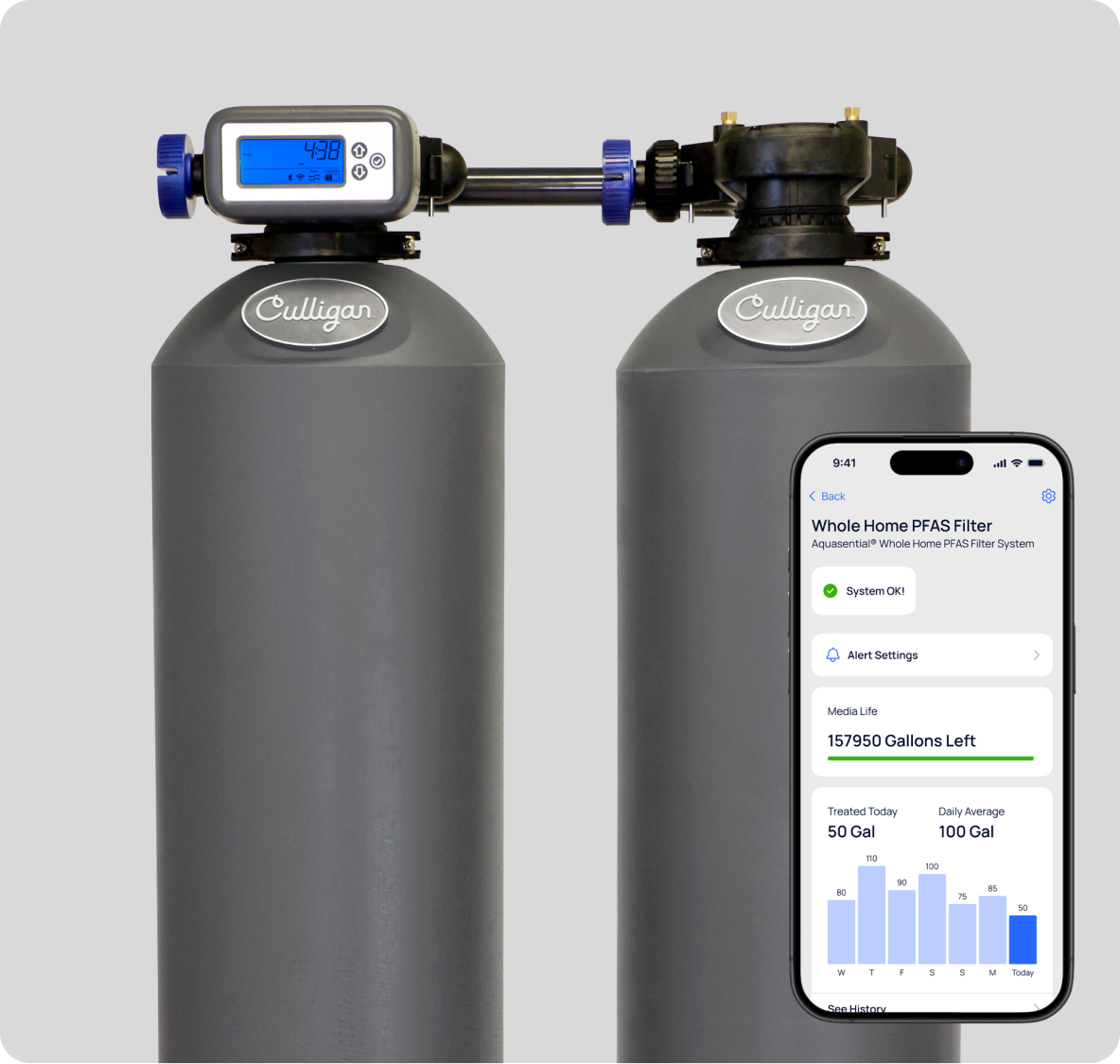
Should PFAS be treated whole-house?
That depends on household goals, exposure priorities, source concentration, budget, and evidence. Drinking and cooking generally represent the most direct ingestion pathway, so point-of-use treatment can provide substantial benefit at lower cost. Some households prefer whole-house treatment to reduce PFAS in all water, but this consumes much more media and increases ownership cost.
When whole-house PFAS treatment makes sense
- the household wants PFAS reduction at every fixture;
- source levels are meaningful and persistent;
- adequate whole-house flow can be maintained;
- the system has credible PFAS-specific evidence;
- replacement capacity and cost are acceptable;
- the homeowner will track media life or test performance.
When point-of-use treatment makes more sense
- the primary concern is drinking and cooking;
- budget is limited;
- whole-house capacity is expensive;
- the home has very high water use;
- exact certified point-of-use products have stronger evidence;
- the household wants broad dissolved-contaminant treatment from RO.
Can you combine whole-house GAC with under-sink RO?
Yes. This is a strong layered strategy for some homes. Whole-house carbon can reduce chlorine, organics, and some PFAS throughout the house, while under-sink RO provides an additional barrier for drinking water. The RO prefilters and membrane may also benefit from upstream chlorine reduction, depending on system design.
Can you combine ion exchange with carbon?
Yes. Treatment trains can use carbon for disinfectant and organic reduction plus PFAS-specific ion exchange for additional capacity. The correct order depends on water chemistry, media design, and manufacturer guidance.
Why exact-product certification matters
A media supplier may publish PFAS performance, but the complete residential system can differ in media quantity, flow, contact time, and plumbing. Finished-system certification or a high-quality independent test provides more direct evidence for the product you are buying.
NSF/ANSI 53 and PFAS
NSF/ANSI 53 is associated with health-effect contaminant reduction claims, including PFAS claims for products evaluated under applicable protocols. The important detail is the specific contaminant claim on the exact model. A system carrying Standard 53 for one contaminant is not automatically certified for PFAS.
NSF/ANSI 58 and RO
NSF/ANSI 58 applies to reverse-osmosis drinking-water treatment systems. Exact PFAS claims still need to be checked on the model listing; the standard number alone is not a universal PFAS guarantee.
Why manufacturer testing is not the same as certification
A manufacturer-sponsored third-party test can be useful evidence, especially when methodology and conditions are published. Certification adds ongoing product/listing requirements and standardized claim language. FilterTier records these evidence levels separately rather than treating them as interchangeable.
How to read a PFAS performance sheet
- Identify the exact model.
- Identify which PFAS compounds were tested.
- Find influent concentrations.
- Find flow rate.
- Find total gallons or test duration.
- Find effluent concentrations or percent reduction.
- Determine whether the test represents a new filter only or end-of-life capacity.
- Check the laboratory and protocol.
Why percent reduction can be misleading without influent concentration
A 95% reduction from a very high challenge concentration can yield a different final concentration than a 95% reduction from a lower source level. Percent reduction is useful, but homeowners should also look at absolute effluent values when available.
Why “PFAS-free” is a risky phrase
No filter should be assumed to make every water sample literally free of every PFAS compound. Detection limits, compound lists, breakthrough, and changing source water matter. More precise language is “reduces specified PFAS under tested conditions.”
How household flow changes whole-house PFAS performance
A family with 7 GPM peak demand places less hydraulic stress on a fixed media bed than a home demanding 18 GPM. If PFAS treatment requires contact time, large homes may need larger tanks, parallel vessels, or a different architecture.
How household gallons change media life
A 500-gallon-per-day home consumes a 200,000-gallon rated capacity in about 400 days. A 200-gallon-per-day home would take about 1,000 days to reach the same volume. The media and claim have not changed; household use has.
Why irrigation should usually bypass expensive PFAS media
Treating lawn irrigation through PFAS-specific media can consume enormous capacity without providing the same household benefit as treating indoor water. When plumbing permits, route nonessential outdoor use before the treatment system.
PFAS and chlorine/chloramine pretreatment
Municipal water may contain chlorine or chloramine. Carbon can address disinfectant while also adsorbing PFAS, but the system must be sized for both jobs. An ion-exchange system may benefit from upstream carbon depending on resin sensitivity and water chemistry.
PFAS and sediment
Sediment can foul cartridges and contribute to channeling or pressure drop. A coarse prefilter can protect expensive PFAS media, especially in older distribution systems or private wells.
PFAS and hardness
Hardness does not automatically prevent PFAS treatment, but mineral scaling can affect RO and some equipment. RO systems often require pretreatment when hardness is high enough to create scaling risk.
PFAS and iron
Iron can foul media, stain equipment, and shorten service life. On a private well with PFAS and iron, iron pretreatment may be necessary before the PFAS stage.
PFAS and natural organic matter
Natural organic matter can compete for carbon adsorption sites and foul certain resins. Source-water chemistry is therefore part of media capacity, not a minor laboratory detail.
What happens at breakthrough?
Breakthrough means the media can no longer retain the contaminant at the previous level, so effluent concentrations rise. Breakthrough is not necessarily visible or noticeable. That is why capacity tracking and conservative replacement matter.
Can PFAS desorb from carbon?
Adsorption systems are complex, and displacement or changing water chemistry can influence retained contaminants. The safe consumer approach is to replace media within verified capacity rather than treating it as permanent storage.
How often should PFAS media be replaced?
Use the exact PFAS-specific capacity, household gallons, water chemistry, and manufacturer instructions. If a system has no credible PFAS capacity data, replacement timing is inherently more uncertain.
Should you test after installing PFAS treatment?
For a health-relevant contaminant, a post-treatment laboratory sample can provide valuable confirmation. Testing becomes especially useful for large media tanks whose service life is being estimated from source conditions rather than a certified cartridge timer.
How often should you retest?
There is no universal residential interval. Consider source-water changes, utility monitoring, media capacity, household gallons, and the cost of testing. Retesting near a planned replacement point can help validate the maintenance schedule.
What happens when PFAS regulations change?
Treatment technology does not instantly become obsolete when a regulatory threshold changes, but the performance target may become more stringent. Review high-traffic PFAS content and exact product evidence as federal or state requirements evolve.
Municipal PFAS treatment versus home treatment
If a utility installs centralized PFAS treatment, household source concentrations can fall substantially. A homeowner may still choose a point-of-use filter, but the economics and replacement interval may change. Keep the treatment plan connected to current source data.
Private-well PFAS
Private well owners do not receive a utility’s ongoing PFAS treatment. If local contamination is possible, testing the well is the starting point. Do not buy PFAS treatment because of regional headlines without knowing whether your well is affected.
Example: municipal PFAS, moderate home
A four-person home uses 250 gallons per day and wants lower PFAS at every indoor fixture. A large GAC or PFAS-specific resin system may be reasonable if it supports peak flow and has credible capacity. An under-sink RO can provide an additional drinking-water barrier.
Example: very high-flow home
A home peaks above 15 GPM. A single residential PFAS cartridge rated at modest flow may create unacceptable pressure drop or exceed tested conditions. Larger media tanks or parallel treatment may be required if whole-house PFAS treatment is the goal.
Example: renter or short-term homeowner
Point-of-use certified treatment may be more practical than a large plumbing modification. Under-sink or countertop systems can concentrate spending on drinking water and move with the household.
Example: PFAS plus nitrate on a well
Under-sink RO can address multiple dissolved contaminants at the drinking faucet, while whole-house GAC or ion exchange may reduce PFAS throughout the home. The treatment train should be based on the complete laboratory panel.
Example: PFAS plus hardness
A softener does not replace PFAS treatment. If a whole-house PFAS system and softener are both needed, order and sizing should consider media protection, pressure drop, and household flow.
Common PFAS treatment mistakes
Assuming all carbon removes PFAS equally
Carbon type, quantity, contact time, and capacity differ.
Assuming a standard softener removes PFAS
PFAS ion exchange uses specialty anion resin, not conventional cation softening resin.
Buying by percent reduction only
Capacity and final effluent values matter.
Ignoring short-chain PFAS
Different compounds can break through at different rates.
Treating outdoor water unnecessarily
This can consume expensive media rapidly.
Using chlorine capacity as PFAS capacity
They are different treatment claims.
Ignoring pressure drop
A specialty cartridge must still support household flow.
Never retesting a large media system
Invisible breakthrough can occur.
How to choose between GAC, ion exchange, and RO
Choose GAC when: you want large-scale adsorption, useful whole-house flow, and a technology that can also reduce chlorine and many organics. Verify PFAS-specific evidence and capacity.
Choose PFAS-specific ion exchange when: you want high affinity and compact whole-house media, and the resin/system has evidence for your treatment goal. Check replacement and disposal.
Choose RO when: drinking/cooking water is the priority, you want broad dissolved-contaminant reduction, and point-of-use flow is acceptable.
PFAS treatment buying checklist
- Confirm PFAS are actually present.
- Identify which compounds are reported.
- Decide whole-house versus drinking-water scope.
- Estimate peak whole-house flow if treating point-of-entry.
- Estimate daily gallons.
- Verify exact product PFAS evidence.
- Find PFAS-specific capacity.
- Find flow used for the claim.
- Check replacement media price.
- Plan sediment/iron/hardness pretreatment if needed.
- Bypass irrigation when practical.
- Consider post-installation testing.
Frequently asked questions
Does activated carbon remove PFAS?
It can reduce many PFAS, especially when enough media and contact time are provided. Exact system evidence and capacity matter.
Is ion exchange better than carbon for PFAS?
It can provide high capacity and strong affinity, but “better” depends on the exact resin, water chemistry, flow, cost, and evidence.
Does RO remove PFAS?
RO can provide strong PFAS reduction at point of use when the exact system is appropriately designed and maintained.
Will a water softener remove PFAS?
A standard cation-exchange softener should not be assumed to. PFAS treatment uses different specialty media.
Should I treat the whole house?
Not automatically. Point-of-use drinking-water treatment can be more cost-effective, while whole-house treatment serves broader household goals.
How long does PFAS media last?
Use PFAS-specific capacity, household gallons, and water chemistry. Generic media-life claims are not enough.
Can I tell when PFAS media is exhausted?
No reliable taste or odor signal exists. Track capacity and consider testing.
Does a Standard 53 listing guarantee PFAS removal?
Only if the exact model listing includes the relevant PFAS claim.
Can PFAS treatment remove chlorine too?
GAC often reduces chlorine, but PFAS-specific ion-exchange and RO systems have different functions. Check exact system design.
What is the lowest-maintenance PFAS option?
That depends on household flow and capacity. Large media systems can have long intervals; point-of-use systems treat fewer gallons but require periodic cartridges.
What this means for you
There is no single PFAS technology that wins every home. GAC offers scalable adsorption and whole-house flow. Ion exchange offers specialty high-affinity treatment. RO is often the strongest value at the drinking-water tap. The right choice starts with current water data and ends with exact-product evidence, capacity, and maintenance—not a generic statement that a media type “removes forever chemicals.”
Use What’s in My Water? to review public-system context, PFAS Certification vs Marketing Claims to evaluate evidence, and FilterTier’s PFAS rankings for current product comparisons.
Primary references
How GAC media selection changes PFAS performance
Activated carbon is not one uniform material. Feedstock, activation conditions, pore-size distribution, surface chemistry, particle size, hardness, and ash content can all influence adsorption. A coconut-shell carbon and a coal-based carbon can behave differently even when both are marketed as “premium GAC.” For PFAS, the most useful evidence is not the feedstock label by itself but the tested capacity of the finished system or media under realistic conditions.
Smaller carbon particles can increase accessible surface area and improve kinetics, but they can also increase pressure drop. A whole-house design therefore balances adsorption performance with hydraulic performance.
Bed depth, tank diameter, and PFAS contact
Tank geometry affects how water moves through media. A deeper bed can increase contact length, while a wider tank reduces linear velocity at the same total flow. Good distributors reduce channeling and help use the entire bed. These hydraulic details matter because a large quantity of carbon can still perform poorly if water bypasses much of the media.
Lead-lag carbon vessels
Municipal and commercial PFAS treatment sometimes uses two vessels in series. The first tank carries most of the contaminant load while the second acts as a polishing barrier. When the lead vessel approaches breakthrough, the second vessel provides protection and the tanks can be rotated. Residential systems rarely use sophisticated lead-lag monitoring, but the concept explains why multiple media vessels can provide more predictable PFAS control than one tank operated to exhaustion.
Parallel tanks for high-flow homes
Another architecture places vessels in parallel to split household flow. Each tank sees lower flow, preserving contact time while allowing the home to maintain high total GPM. Parallel treatment is more complex and expensive but can be more technically sound than forcing 20 GPM through a single small vessel.
How specialty PFAS cartridges differ from large tanks
Specialty cartridges can pack adsorptive media into a tightly controlled path and are easier to certify as exact finished products. Their capacity is limited by cartridge volume, but the evidence can be very clear. Large tanks trade that precision for much more media and higher household flow. The best choice depends on whether the household values exact certification, total gallons, whole-house pressure, or service interval most.
Why prefilter micron size matters
A sediment prefilter should protect expensive PFAS media without becoming the main restriction in the house. Very fine filtration is not automatically better. If city water is already clear, a moderate sediment stage may be enough. On a private well, heavier particulate loading can justify staged sediment treatment before PFAS media.
How chloramine affects a PFAS carbon system
When a utility uses chloramine, a carbon tank can be asked to do two demanding jobs at once: chloramine reduction and PFAS adsorption. Catalytic carbon and larger media volume may improve chloramine performance, but PFAS capacity still needs independent consideration. A system sized only around chloramine may not have documented PFAS life, and vice versa.
How organic solvents can consume carbon capacity
VOC contamination and natural organic matter can occupy carbon adsorption sites that might otherwise be available for PFAS. A site with multiple organic contaminants can experience shorter PFAS life than a clean laboratory-water test suggests. This is why well owners near industrial or fire-training sites should evaluate the complete laboratory panel.
Why ion exchange can be useful for shorter-chain PFAS
Specialty anion resins can have strong affinity for compounds that may be more difficult for conventional GAC. That can make ion exchange attractive when a source contains a mixture of long- and shorter-chain PFAS. However, not every anion resin is a PFAS resin, and performance still depends on competing anions and organic fouling.
How chloride, sulfate, and other ions can matter
Water contains many anions besides PFAS. High concentrations of sulfate, nitrate, bicarbonate, and chloride can compete with some ion-exchange sites or influence resin behavior. Specialty PFAS resins are engineered to favor PFAS, but water chemistry should still be considered when estimating capacity.
Organic fouling of PFAS resin
Dissolved organic matter can coat or foul resin surfaces and reduce usable capacity. Upstream carbon or other pretreatment may sometimes protect resin, but adding more stages also adds cost and pressure drop. The treatment train should be designed around the actual water rather than assuming every PFAS system needs every available pretreatment technology.
Why standard softener resin should not be repurposed for PFAS
Conventional cation resin is designed around positively charged ions. PFAS treatment typically relies on anion-exchange chemistry and hydrophobic interactions. A softener that happens to change a laboratory PFAS concentration should not be marketed as a PFAS treatment unless the exact product has credible evidence.
RO membrane type and PFAS
Residential RO systems commonly use thin-film composite membranes. Their PFAS performance depends on membrane condition, pressure, recovery, temperature, and pretreatment. A membrane with excellent nominal rejection can underperform if it is damaged by chlorine or fouled by hardness and sediment.
Why RO pressure matters
RO performance depends on pressure across the membrane. Low incoming pressure can reduce production and potentially affect rejection. Booster pumps are used on some systems to provide consistent operating pressure. Whole-house RO especially depends on engineered pressure and storage rather than direct faucet flow through the membrane.
RO storage tanks and PFAS
Most under-sink RO systems store permeate in a small tank so water is available quickly at the faucet. The membrane treats water slowly; the storage tank supplies short-term flow. Tank size, pressure, and system recovery determine user experience.
Tankless RO
High-flow tankless RO systems use larger membranes and pumps to produce water on demand. They can reduce storage footprint and may provide higher faucet flow, but they require electricity and contain more electronics. PFAS evidence should still be checked for the exact unit.
RO remineralization
RO reduces many dissolved minerals along with contaminants. Some systems add a remineralization stage to adjust taste and alkalinity. That stage does not improve PFAS rejection; it changes the finished-water mineral profile.
Why RO should not discharge to a septic system without thought
Point-of-use RO concentrate is generally modest, but whole-house RO can discharge substantial water. On private well and septic properties, the added wastewater volume should be considered in system design.
PFAS treatment and disposal
GAC and ion-exchange media capture PFAS and eventually become spent waste. Disposal practices vary by jurisdiction, media type, and concentration. Homeowners generally follow manufacturer and local disposal guidance. The important conceptual point is that treatment transfers PFAS out of water; it does not destroy the chemical.
What “destruction” means in PFAS treatment
True PFAS destruction requires breaking strong carbon-fluorine bonds, typically through specialized high-energy or chemical processes. Residential filters are separation technologies, not destruction technologies. Marketing that says a home filter “destroys forever chemicals” deserves careful scrutiny unless a credible destruction mechanism and evidence are provided.
How to think about replacement if source concentrations fall
If a utility installs centralized PFAS treatment and source concentrations drop, existing home media may last longer because influent loading is lower. Do not automatically extend beyond a certified product’s time limit, but update the household treatment plan with current source data.
How to think about replacement if source concentrations rise
The opposite is also true. New detections or changing source water can consume capacity faster. A filter purchased years ago based on lower source concentrations may need a shorter replacement interval or a new treatment design.
PFAS testing methods and household interpretation
PFAS laboratory testing is more specialized and expensive than common hardness or bacteria testing. Use a laboratory and method appropriate to drinking water, and interpret results with the reporting limit and compound list in mind. A “non-detect” means the compound was not detected above the method’s reporting capability; it is not a philosophical guarantee of absolute zero molecules.
When a home treatment result conflicts with utility data
Utility results represent the public system at defined sample points and times. A home sample can differ because of timing, local distribution conditions, plumbing, sampling method, or analytical variation. If a result is surprising, repeat or confirm with an appropriate lab before making a major treatment decision.
How to calculate rough PFAS media cost per gallon
If a $600 replacement media set is supported for 300,000 gallons of PFAS treatment under relevant conditions, the media cost is roughly $0.002 per rated gallon. A $300 cartridge rated for 75,000 gallons costs about $0.004 per rated gallon. This comparison is useful only when the treatment evidence and claims are genuinely comparable.
How to compare whole-house and point-of-use cost
Suppose a family uses 300 gallons per day throughout the house but drinks and cooks with 8 gallons. Treating all water consumes roughly 37 times more volume than treating only ingestion water. Even if the whole-house media is cheaper per gallon, point-of-use treatment can have a large total-cost advantage.
Why shower exposure is a separate decision
Homeowners sometimes choose whole-house PFAS treatment because they want to reduce all exposure pathways. The scientific importance of dermal and inhalation pathways varies by compound and activity, and FilterTier does not convert that uncertainty into a medical recommendation. The practical point is that whole-house treatment serves a broader exposure preference but at much higher water volume and cost.
PFAS treatment in homes with infants or vulnerable residents
PFAS concerns can be especially stressful in households with infants, pregnant residents, or medical vulnerability. Use authoritative health guidance and verified treatment rather than escalating to the most complicated system by default. Point-of-use certified treatment can be a strong immediate step while broader whole-house decisions are evaluated.
What a professional PFAS proposal should contain
- source PFAS data;
- treatment scope: whole-house or point-of-use;
- exact media or membrane;
- media quantity;
- service flow;
- PFAS-specific performance evidence;
- PFAS-specific capacity or replacement logic;
- pretreatment requirements;
- replacement media price;
- sampling or monitoring plan.
Questions that reveal weak PFAS marketing
Ask, “Which exact PFAS were tested? At what flow? For how many gallons? Was the complete system tested? Where is the certification listing? What is the replacement interval for PFAS specifically?” If the answer returns only to “our carbon is known to remove chemicals,” the claim is not yet strong enough.
Final technology comparison
GAC, ion exchange, and RO are all legitimate PFAS technologies. Their roles are different enough that “which one is best?” is the wrong first question. Ask where treatment is needed, how much water must be treated, what compound mix is present, what evidence level you require, and what maintenance you can sustain. Then choose the architecture that answers those constraints.
For consumers, the safest rule is simple: match the technology to the treatment scope, then verify the exact product at the flow and capacity you actually need. PFAS treatment is strongest when chemistry, hydraulics, evidence, and maintenance all agree.