
A PFAS marketing claim is not the same thing as a PFAS-certified filter. A manufacturer can truthfully say that activated carbon, ion exchange, or reverse osmosis can reduce PFAS in principle, while the exact product being sold has never been independently tested or certified for a PFAS claim. Consumers should separate five evidence levels: finished-system certification, finished-system independent testing, manufacturer testing, certified or tested media/components, and unsupported or generalized marketing. Those levels are not interchangeable.
This guide explains how to verify PFAS claims without dismissing useful products that lack formal certification or over-crediting products that borrow credibility from media science. The goal is simple: understand exactly what evidence belongs to the exact filter you are considering.
Why PFAS claims are especially easy to overstate
PFAS is a large chemical family, treatment performance changes by compound, and many legitimate treatment media can adsorb or reject at least some PFAS. That creates room for vague statements such as “removes forever chemicals” even when the finished system has not been evaluated across its claimed service life.
The fact that a technology can work is only the first step. The consumer still needs to know whether the exact design provides enough media, contact time, flow, capacity, and verified performance.
Evidence level 1: finished-system third-party certification
The strongest consumer evidence is typically a current listing from an accredited certification organization for the exact model and PFAS claim. The listing connects the complete product to a standard, contaminant claim, flow, capacity, and specified replacement element or configuration.
Certification does not mean a product is automatically the best fit for every home, but it makes the PFAS claim highly traceable.
What to verify in a certification listing
- manufacturer name;
- exact model;
- PFAS claim or specific compounds;
- standard and certification body;
- rated service flow;
- rated capacity;
- replacement cartridge or media;
- current listing status;
- any footnotes or operating limits.
Why a certification logo alone is not enough
A brand may have several certified products and several uncertified products. One logo on a website header cannot tell you which model or claim it represents. Search the public listing.
Standard 53 and PFAS
NSF/ANSI 53 is associated with health-effect contaminant reduction claims and can include PFAS claims for products evaluated under applicable protocols. The standard number itself is not a universal PFAS badge. The exact listing must contain the PFAS claim.
Standard 58 and PFAS
Reverse-osmosis systems can be certified under NSF/ANSI 58 and may carry PFAS claims depending on the exact model. Again, verify the specific contaminant listing rather than assuming all RO products with Standard 58 have identical PFAS evidence.
Evidence level 2: independent finished-system laboratory testing
A high-quality independent lab report can be strong evidence even when the product is not formally certified. The report should identify the exact system and test conditions clearly enough that a consumer can understand what was proven.
What a strong PFAS lab report includes
- exact model and configuration;
- laboratory identity;
- test protocol;
- influent PFAS concentrations;
- individual PFAS compounds tested;
- flow rate;
- total gallons or duration;
- sample schedule;
- effluent results;
- detection/reporting limits;
- media or cartridge age at each sample.
Why a one-hour test is weak capacity evidence
A brand can demonstrate excellent reduction on a new carbon bed during a short test and still provide little information about when breakthrough occurs. PFAS capacity matters because homeowners need a defensible replacement schedule.
Evidence level 3: manufacturer testing
Manufacturer-run tests can provide useful engineering data, especially when the methods, samples, and conditions are transparent. The conflict is that the seller controls the test and the marketing interpretation. Manufacturer evidence is therefore useful but should generally receive less confidence than independent finished-system verification.
When manufacturer testing is still valuable
It can fill important gaps for large whole-house products that are costly to certify, especially when the brand publishes complete reports, realistic flow, end-of-life data, and source conditions. Dismissing all manufacturer testing would throw away useful information.
Evidence level 4: certified or tested media
A system may use granular activated carbon, catalytic carbon, ion-exchange resin, or another media with published PFAS data. That supports the mechanism of treatment but does not prove the finished system provides the same performance.
Why media evidence does not equal system evidence
The complete system controls media quantity, contact time, bed depth, flow distribution, pressure drop, bypass behavior, and replacement interval. A small amount of excellent media can underperform a large, well-designed bed.
Evidence level 5: generalized marketing
Statements such as “carbon is known to remove PFAS,” “designed for forever chemicals,” or “targets PFOA/PFOS” can describe treatment intent without proving actual performance. These claims deserve the lowest confidence until supported by exact-product evidence.
“Targets PFAS” versus “certified to reduce PFAS”
“Targets” is marketing language. “Certified” should connect to a current third-party listing. Do not let the first phrase borrow the credibility of the second.
“PFAS-ready”
This phrase has no single standardized consumer meaning. It might mean the system uses media associated with PFAS adsorption, accepts an optional PFAS cartridge, or has been designed with future testing in mind. Ask for the evidence behind the exact phrase.
“Removes PFAS”
This is stronger language. A responsible claim should identify which PFAS, how much reduction, how many gallons, and under what conditions. “Removes” without context can sound like absolute elimination forever, which is not how media breakthrough works.
“Up to 99% PFAS reduction”
Percent reduction needs context. Was 99% measured on a fresh filter? At the end of capacity? For which compounds? At what flow? What were the influent and effluent concentrations? The phrase can be accurate and still incomplete.
Initial reduction versus end-of-life reduction
A new adsorptive filter often performs best at the beginning. The important consumer question is whether reduction remains strong through the rated service life. Certification protocols are valuable because they evaluate performance over a defined capacity rather than only at startup.
Why influent concentration matters
A 95% reduction from 100 parts per trillion leaves 5 ppt. The same percentage from 20 ppt leaves 1 ppt. Percentages should be read together with absolute concentrations and reporting limits.
Why reporting limits matter
If the laboratory reports “non-detect,” find the reporting limit. A non-detect below 2 ppt provides different information than a non-detect below 20 ppt. This is especially important as PFAS standards and analytical sensitivity evolve.
Which PFAS were actually tested?
Legacy claims often focus on PFOA and PFOS because those compounds received early regulatory and scientific attention. Newer monitoring includes several other PFAS. A PFOA/PFOS claim should not be converted into “all PFAS” without evidence.
Long-chain versus short-chain PFAS
Longer-chain PFAS often adsorb more strongly to activated carbon than shorter-chain compounds. Ion exchange and RO can have different performance profiles. A media test using only one long-chain PFAS may not describe the full challenge of a mixed source.
Why total PFAS is difficult
“Total PFAS” can mean different compound lists depending on the method. A filter cannot be meaningfully described as removing “total PFAS” unless the analytical scope is defined.
Flow rate is part of the claim
Adsorption depends on contact time. A whole-house carbon tank tested at 5 GPM should not be assumed to provide the same PFAS reduction at 15 GPM unless there is evidence. Check the flow associated with the claim.
Maximum flow versus PFAS treatment flow
A valve may physically pass 20 GPM while the media is evaluated for PFAS at 7 GPM. The larger number describes hydraulics, not necessarily contaminant treatment.
Capacity is part of the claim
PFAS filters need a PFAS-specific service life. A product might advertise “1,000,000 gallons” for chlorine while its PFAS cartridge is rated for far fewer gallons. Use the claim-specific capacity.
Time limit versus gallon limit
A filter can have both. Follow whichever applicable limit comes first. Low-use households should not assume a cartridge can remain wet indefinitely because gallon capacity is unused.
Replacement cartridge matters
Certification and testing are often tied to a specific cartridge. A generic replacement can fit physically but use different media, flow, or sealing. When PFAS reduction is the reason for treatment, preserve the verified configuration.
Whole-house tanks and PFAS claims
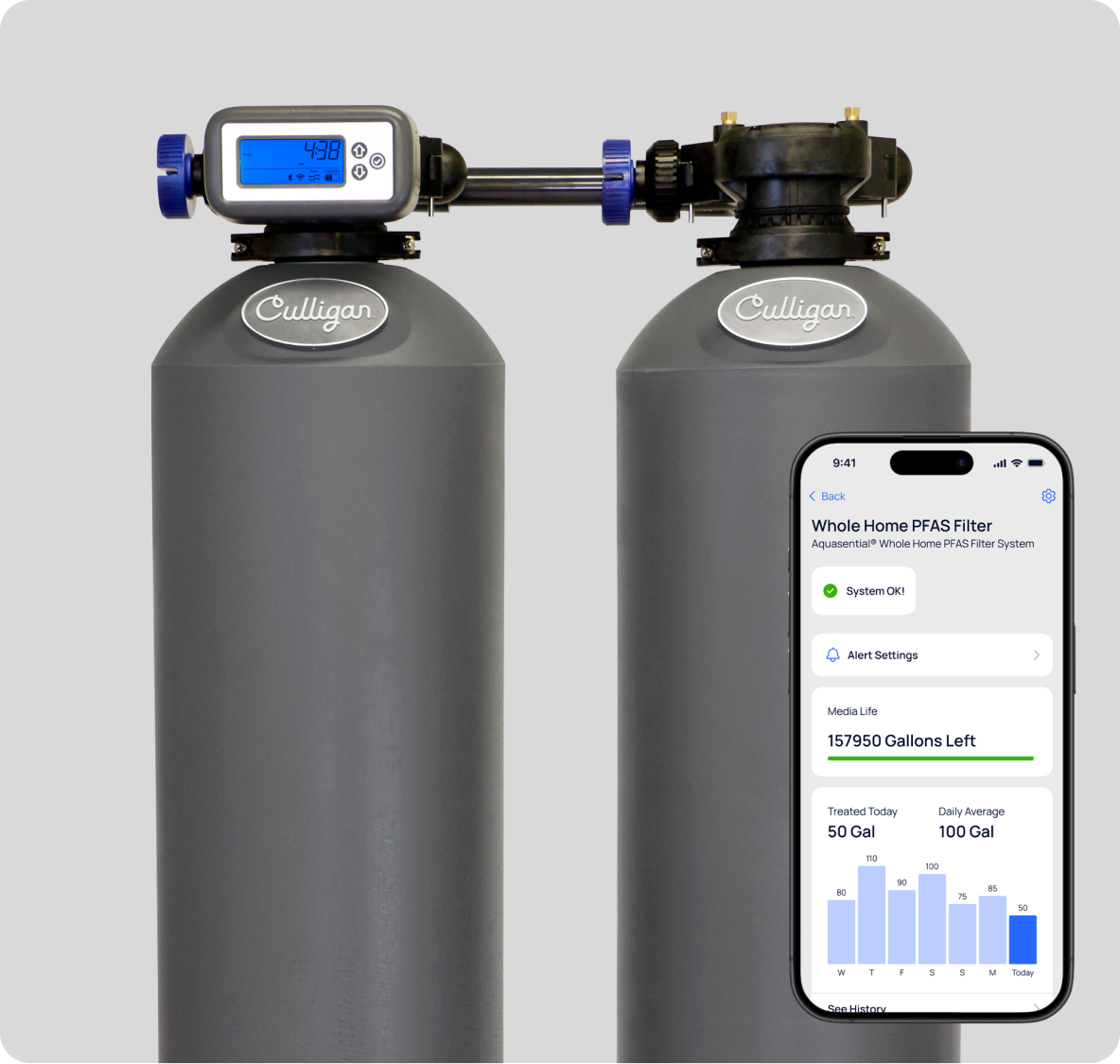
Large media tanks can be technically credible PFAS treatment even without finished-system certification. They may hold much more GAC than a certified cartridge and support higher flow. The correct description is evidence-based: media science plus exact system testing if available, not a false statement that the system is certified.
Why large tanks are harder to certify
Whole-house systems have many tank sizes, valves, media volumes, and flow configurations. Certification across variants can be expensive. This helps explain the evidence gap but does not erase it.
How FilterTier handles uncertified whole-house PFAS systems
We do not automatically score them as ineffective. We credit the strength of exact testing, media, flow documentation, capacity, and transparency. But we do not label them as finished-system certified when they are not.
Component-certified carbon
Carbon can meet material or performance specifications as a component. That is useful evidence for media quality but not proof that the assembled residential system meets a PFAS finished-product claim.
Certified tank or valve
A pressure tank or valve can carry material or structural certification. That says nothing by itself about PFAS reduction.
How product pages blur certification types
Brands sometimes display a row of NSF-related logos without explaining which refer to material safety, structural components, or contaminant reduction. Consumers can mistakenly add them together into a broad “NSF-certified PFAS system” impression. Read each listing separately.
How to verify a claim in five minutes
- Copy the exact model number.
- Find the certification-body database.
- Search the model.
- Look for PFAS/PFOA/PFOS claims.
- Record flow and capacity.
- Confirm replacement element.
- If no listing exists, ask for the lab report.
- If only media data exist, classify it as media evidence.
What if the manufacturer says the certification is pending?
Treat the product as not currently certified until the listing is public. Pending testing may be encouraging but should not be marketed as completed certification.
What if certification expired?
Determine why. The product may be discontinued, reconfigured, or no longer participating in the program. Historical certification should be described as historical, not current.
What if the exact model is missing but a similar model is listed?
Do not transfer the claim without confirmation. Tank size, media quantity, flow, and cartridge can differ. Ask the manufacturer or certifier whether the model is covered by the family listing.
What if the product uses a certified replacement cartridge inside an uncertified housing?
The cartridge may have its own claim, but the assembled system should be checked for whether that use is within the cartridge listing. Housing geometry and flow can affect performance.
Marketing language that deserves caution
- “NSF-grade media”;
- “tested using NSF methods” without the report;
- “independently verified” without naming the lab;
- “removes forever chemicals” with no compound list;
- “up to 99%” with no capacity;
- “lifetime PFAS media”;
- “certified components” presented as finished-system certification.
Marketing language that is more useful
Precise claims identify the exact model, certifier, standard, PFAS compounds, flow, capacity, replacement schedule, and direct link to the public listing or complete report.
How to compare a certified cartridge with an uncertified tank
| Factor | Certified cartridge | Large media tank |
|---|---|---|
| Exact PFAS claim | Often very clear | Varies |
| Whole-house flow | Can be limited | Often stronger |
| Media quantity | Smaller | Much larger |
| Rated PFAS capacity | Often explicit | May be uncertain |
| Replacement frequency | Potentially frequent | Potentially multi-year |
| Evidence confidence | High when exact listing exists | Depends on testing/transparency |
Why neither column automatically wins
A certified cartridge can be the strongest choice for drinking water or modest-flow whole-house use. A large tested tank can be the more practical choice for a high-flow house. The evidence level should be stated honestly, then household fit decides.
PFAS certification and point-of-use RO
RO systems often have strong exact-product evidence because they are standardized point-of-use products. Their lower flow is not a disadvantage at a kitchen faucet. For households prioritizing ingestion exposure, this can be more efficient than pushing every shower gallon through expensive PFAS media.
PFAS certification and pitchers
Certified pitchers can provide low-cost PFAS reduction for drinking water, but cartridge capacity is modest and users must refill them. They are useful emergency or renter-friendly options when maintained correctly.
PFAS certification and faucet filters
Faucet-mounted products provide treated water on demand with less storage inconvenience than pitchers. Check faucet compatibility, flow, PFAS claim, and cartridge capacity.
PFAS certification and under-sink carbon
Under-sink carbon blocks can combine useful flow with strong certification and larger capacity. They treat drinking water without whole-house media cost.
PFAS certification and whole-house cartridges
Large specialty cartridges can provide exact claims at higher flow than point-of-use filters, but annual replacement cost can be substantial in high-use homes. Calculate gallons.
PFAS certification and whole-house ion exchange
Specialty resin can provide high capacity but finished-system consumer certification is less common than in point-of-use products. Look for exact testing, media quantity, service flow, and replacement logic.
Why installation can invalidate performance assumptions
A certified filter installed backward, bypassed, operated above pressure limits, or pushed beyond rated flow may not perform as certified. Evidence assumes correct installation.
Why multiple filters in parallel need careful interpretation
Parallel housings can increase total flow, but the combined assembly may not be the exact configuration tested. If certification is critical, verify whether the manufacturer supports the parallel arrangement.
Why prefilters can help PFAS media
Sediment pretreatment can protect media and pressure performance. It does not replace PFAS evidence. A system with five stages is not automatically better than a simple certified PFAS cartridge.
Why carbon feedstock marketing is secondary
Coconut shell, coal-based, and specialty carbons can have different pore structures. Feedstock can matter, but PFAS capacity and finished-system testing matter more than a “premium coconut” label.
Why catalytic carbon does not automatically mean PFAS certification
Catalytic carbon is still activated carbon with enhanced catalytic properties for certain reactions. It can adsorb PFAS, but its presence does not create a certified PFAS claim.
Why ion-exchange media claims need specificity
A standard softener resin is not the same as PFAS-selective anion resin. “Ion exchange” is a broad technology family. Ask which resin and what PFAS data support it.
How source water can make lab performance optimistic
Real water contains natural organic matter, disinfectant, hardness, sulfate, nitrate, and other competing substances. A laboratory challenge designed for certification is standardized; field capacity can vary. This is why conservative replacement and source-specific testing can be valuable.
How source water can make lab performance conservative
Certification challenge water can also be intentionally demanding. A household with much lower influent PFAS may achieve longer useful life than the test capacity. Do not extend beyond a certified time/gallon limit without appropriate evidence, but understand that test conditions are designed for standardized verification rather than personalized prediction.
PFAS filter claim checklist
- Exact model?
- Finished system or component?
- Certification body?
- Specific PFAS compounds?
- Influent concentration?
- Effluent concentration?
- Flow rate?
- Capacity?
- Replacement element?
- Current listing?
- Whole-house or point-of-use scope?
- Annual replacement cost?
Common PFAS claim mistakes
Equating carbon with certification
Carbon is a treatment mechanism, not a finished-product claim.
Equating component certification with system certification
They are different evidence levels.
Using startup reduction as lifetime performance
Capacity matters.
Using chlorine capacity for PFAS
Claim-specific gallons matter.
Using the largest GPM number
PFAS treatment flow may be lower.
Assuming PFOA/PFOS means all PFAS
The chemical family is much larger.
Treating “pending” certification as complete
Wait for the public listing.
Ignoring replacement cost
Strong evidence can still be expensive to maintain.
Frequently asked questions
Does NSF 53 mean PFAS?
Only if the exact model listing includes the relevant PFAS claim.
Is independent lab testing good enough?
It can be strong evidence when the test is transparent, exact-system, and capacity-based, but it is not identical to certification.
Can certified media make the whole system certified?
No.
Can an uncertified filter still reduce PFAS?
Yes. The evidence confidence is simply different.
Why do some large tanks lack certification?
Whole-house configurations are expensive and complex to certify across variants. That explains the gap but does not erase it.
What is the best proof of PFAS performance?
A current exact-product certification with flow and capacity is among the strongest consumer evidence, supplemented by transparent real-world data when available.
Should I trust a 99% claim?
Only after checking compound, flow, challenge concentration, capacity, and test source.
Can a filter remove PFAS forever?
No adsorptive media has infinite capacity.
Should I test after installation?
For a health-relevant contaminant, post-treatment testing can provide valuable confirmation, especially for large media systems.
Does certification mean the filter fits my home?
No. Household flow, pressure, treatment scope, and maintenance still matter.
What this means for you
Treat PFAS claims as an evidence ladder. Finished-system certification is the clearest. Independent finished-system testing can be strong. Manufacturer tests and media data add useful support. General technology statements explain why a system might work but should not be presented as proof that it does. Once the evidence level is clear, compare household flow, capacity, replacement cost, and treatment scope.
Use the PFAS technology guide for treatment mechanisms, FilterTier’s PFAS rankings for current systems, and the certification hub for standards and databases.
Primary references
- U.S. EPA — PFAS
- NSF — PFAS and Drinking Water
- WQA — Certified Product Listings
- IAPMO R&T — Product Listings
How to evaluate a PFAS claim on a product page line by line
Start with the headline claim, then look for the evidence link. If the page says “PFAS reduction,” find the footnote or certification record. If it says “certified,” identify the certifier. If it says “independently tested,” identify the laboratory. If it says “uses PFAS-reducing media,” determine whether the evidence belongs to the media or the finished system. Each phrase should lead to a document you can inspect.
Why product-family pages can create confusion
A manufacturer may have one page for an entire family of systems with several tank sizes or cartridge configurations. One configuration may be tested while another is simply inferred. When the claim matters, match the evidence to the exact SKU or model you are buying.
Why variant size can change PFAS performance
A larger tank can hold more media and provide longer contact time at the same flow. A smaller tank can use the same media and still have different capacity and service flow. Product families should not automatically share identical PFAS life unless the evidence supports the relationship.
Why service flow must be tied to the exact configuration
A brand may advertise 20 GPM for the largest tank and show the same marketing badge on a smaller model. If the PFAS test was performed at 7 GPM on one configuration, consumers need to know whether that performance transfers to the others.
Why claim language should change when evidence changes
If a product once had a current certification and later loses or changes that listing, the website should update. If a new model replaces an older one, the old model’s PFAS evidence should not silently migrate to the replacement. FilterTier treats product status and evidence as time-sensitive data.
What a good manufacturer response looks like
When asked for PFAS evidence, a strong manufacturer can provide a public certification link or complete report, identify the exact model and media, state flow and capacity, and explain replacement. A weak response repeats generic statements about activated carbon or sends a brochure with no test conditions.
What a good dealer response looks like
A dealer should distinguish the manufacturer’s claim from the dealer’s own recommendation. If the system is custom-configured, the dealer should explain which components have evidence and which claims apply to the finished installation. “Our media is NSF certified” is not enough when the sales proposal implies full PFAS certification.
Why third-party badges need source links
Review sites and retailers sometimes create “tested,” “verified,” or “certified” badges that resemble formal certification marks. The consumer should always be able to trace a health-effect badge to the underlying organization and document. A decorative badge created by a seller is marketing, not independent certification.
What laboratory accreditation can tell you
Laboratory accreditation can increase confidence that analytical methods and quality systems are controlled, but accreditation alone does not tell you whether the test design was appropriate for end-of-life PFAS performance. Review both laboratory credibility and protocol.
How challenge concentration can make a test easier or harder
Very low challenge concentrations can make percentage reduction difficult to interpret near reporting limits, while very high concentrations can stress media differently from normal household water. A standardized protocol gives context. When a custom test is used, the report should explain why the chosen concentration is relevant.
How test water chemistry can affect interpretation
PFAS adsorption competes with natural organic matter and other dissolved substances. A test using purified water plus PFAS can demonstrate mechanism but may overstate capacity compared with complex real water. A test using challenging organic content may be more conservative. The water matrix belongs in the evidence discussion.
How temperature affects test comparability
Adsorption and membrane performance can change with temperature. Certification protocols control temperature so products can be compared. A field installation in very cold source water can behave differently, especially for membrane production.
Why a PFAS filter can have strong reduction and weak value
A cartridge can be impeccably certified and still be expensive if a large family reaches rated capacity every few months. Evidence and ownership value are separate. FilterTier gives credit for the strong claim while also scoring maintenance and long-term cost.
Why a PFAS filter can have weaker evidence and strong practical design
A large whole-house GAC system may have enormous media volume, low pressure drop, and credible treatment theory but limited finished-system testing. That can make it a practical system with lower evidence confidence. The responsible description is nuanced rather than binary.
How to explain evidence to a consumer without overwhelming them
A useful summary can use four labels: Certified, Independently tested, Manufacturer tested, and Media/marketing claim. Then provide the direct source. This tells the reader how much confidence to place in the claim without requiring them to become a certification expert.
How to compare evidence across brands
Use the same hierarchy for everyone. Do not accept component certification as finished-system certification from one brand while demanding complete certification from another. Consistency is essential for trustworthy rankings.
Why retailer exclusives and renamed products need extra checking
A product sold under a retailer-exclusive name can be mechanically identical to a certified model, but that relationship should be documented. Search model numbers and certification listings rather than assuming identical appearance equals identical listing status.
How bundles complicate PFAS claims
A bundle can include a certified PFAS cartridge plus an uncertified carbon tank, softener, or UV stage. The PFAS claim belongs to the certified component at its rated flow and capacity. The bundle as a whole should not be described as independently PFAS-certified unless the listing covers the complete configuration.
Why add-on PFAS cartridges need clear flow rules
Some brands offer an optional PFAS stage for an otherwise general whole-house system. The add-on can become the flow-limiting component. Check whether the base system’s 15 or 20 GPM headline still applies when the PFAS cartridge is installed.
Why replacement reminders matter more than marketing percentages
A 99% startup claim is useless after the cartridge is exhausted. A good PFAS system makes maintenance obvious with a gallon meter, timer, subscription, service reminder, or conservative schedule. The most important long-term feature may be the one that prevents an overdue cartridge.
How to treat unpublished proprietary data
If a manufacturer says it has internal PFAS data but will not share the report, consumers cannot independently evaluate it. FilterTier can note the manufacturer claim but should not give it the same evidence weight as public documentation.
How to treat testimonials and user water tests
A homeowner posting before-and-after PFAS results can be interesting real-world evidence, but sampling and laboratory conditions are uncontrolled and the filter age may be unknown. Testimonials should never replace formal performance data for a health-effect claim.
How to treat academic studies of media
Peer-reviewed studies can strongly support the treatment mechanism and compare media types. They still do not prove that a particular residential tank with a particular flow and media quantity delivers the same result. Academic evidence supports technology confidence, not finished-product certification.
How to treat municipal treatment data
Municipal GAC or ion-exchange performance shows that the technology can work at scale, but municipal vessels are engineered differently from residential systems. Use municipal data to understand the mechanism, not to assign a household product a claim it has not earned.
How to handle a manufacturer who updates its PFAS test
Use the newest credible data, but keep the historical context when it explains older product claims. If the new test uses a different model, flow, or media, do not overwrite the old record as though nothing changed.
How to handle conflicting tests
When one test shows strong PFAS reduction and another shows weaker performance, compare water chemistry, flow, capacity, sample timing, model configuration, and laboratory method. The disagreement may be explainable rather than evidence that one test is fraudulent.
Why source links belong on FilterTier pages
Consumers should be able to move from our summary to the certifier, lab report, or manufacturer document. Source transparency makes rankings auditable and prevents our own wording from becoming the only evidence.
Evidence grading example
| Claim | Evidence grade | How to describe it |
|---|---|---|
| Exact model in current certifier database for PFAS | Highest | Certified for the listed PFAS claim |
| Exact finished system tested by independent lab through capacity | Strong | Independently tested; not necessarily certified |
| Exact system tested by manufacturer with transparent protocol | Moderate | Manufacturer-tested |
| Media has PFAS research/certification | Supporting | Uses PFAS-capable media; finished-system claim unverified |
| General “targets PFAS” marketing | Low | Manufacturer claim without supporting product data |
What not to say about PFAS filters
- “Removes all forever chemicals forever.”
- “NSF certified” when only a component is listed.
- “Zero PFAS” when the test result is merely below a reporting limit.
- “Lifetime capacity” for an adsorptive medium without a defensible basis.
- “Same as certified” because the media is similar.
What better wording looks like
Say: “The exact model is certified by [body] for [claim] at [flow/capacity],” or “The complete system has independent laboratory data for PFOA/PFOS through [gallons], but we did not find a current finished-system certification.” Precise wording is more useful than a stronger-sounding claim.
Final consumer workflow
- Confirm PFAS in your water.
- Choose whole-house or point-of-use scope.
- Shortlist products that fit flow.
- Grade each product’s PFAS evidence.
- Compare PFAS-specific capacity.
- Calculate annual media cost.
- Verify replacement availability.
- Save the evidence source.
- Consider post-installation testing.
- Recheck evidence when the product or source water changes.
Bottom line
PFAS-capable media, PFAS testing, and PFAS certification are three different levels of proof. A strong consumer decision names the level instead of blurring them together. The filter does not become bad because it lacks certification, and it does not become excellent simply because a certification logo exists. Evidence should be precise, then household fit, flow, capacity, maintenance, and value decide whether the product is right for you.
How to think about uncertainty when no certified whole-house option fits
Sometimes the product with the strongest exact certification cannot support the home’s required whole-house flow. That does not force an all-or-nothing choice. A household can use a large, well-documented GAC or ion-exchange system for broad point-of-entry reduction and add a certified point-of-use RO or carbon filter for drinking water. This layered strategy acknowledges the evidence gap rather than pretending it does not exist.
The same logic applies to maintenance. If a whole-house certified cartridge would need replacement every few months, a larger media system can reduce bulk PFAS load while the point-of-use stage provides the highest-confidence final barrier for ingestion.
How to communicate claim confidence on a product page
A useful FilterTier product page should show the claim, evidence type, source, test flow, and capacity together. Consumers should not have to infer whether “PFAS” means certified, tested, or merely media-capable. Clear evidence labeling is part of product transparency and should influence how much confidence a ranking assigns to the claim.
One final rule for PFAS marketing
If the sentence sounds stronger after the source document is removed, rewrite it. The evidence should be able to support the exact wording on its own. “Uses activated carbon associated with PFAS adsorption” is weaker but more accurate than “certified PFAS removal” when no finished-system listing exists. Precision is not anti-product; it is what makes a good product’s real evidence believable.
Why this matters for rankings
PFAS is one of the easiest categories for rankings to become misleading because a product with aggressive marketing can appear stronger than a quieter product with better documentation. FilterTier’s job is to normalize those claims. Finished-system certification receives more evidence credit than a component claim. Transparent independent testing receives more credit than an unsupported percentage. A large media bed receives appropriate architecture and capacity credit without being mislabeled as certified.
That separation lets consumers compare two products honestly: one may have better evidence, the other may have better flow or ownership cost. A ranking should expose that tradeoff rather than hide it behind one score.
Closing checklist
Before accepting a PFAS claim, verify the exact product, exact contaminant, exact evidence source, exact flow, exact capacity, and exact replacement element. If one of those is missing, note the uncertainty instead of filling it with marketing assumptions. That six-part check prevents most of the common PFAS-claim mistakes consumers encounter.
When those six pieces are documented, the claim becomes auditable. When they are not, the right response is not necessarily to reject the product; it is to describe the evidence accurately and lower confidence accordingly. That is the standard FilterTier should apply consistently across every brand and every PFAS ranking.
PFAS evidence should be precise, public, and tied to the exact system consumers are actually buying and maintaining.
That is the standard we use.
Always verify.