
Whole-house water filters do not share one replacement schedule. A sediment cartridge might need service every few months, a carbon cartridge may last six to twelve months or longer, a specialty PFAS or lead cartridge may be limited by a specific gallon capacity, and a large media tank can often run for years before the main media is replaced. UV lamps, softener resin, and reverse-osmosis membranes have completely different maintenance cycles again. The correct interval comes from the exact component, household water use, contaminant loading, pressure drop, and the performance claim you are trying to maintain.
This guide is a reference for replacement frequency across common whole-house treatment architectures. It is not a substitute for the instructions for your exact system. If your filter has a certified contaminant-reduction claim tied to a specific capacity, that capacity should take priority over a generic calendar estimate.
Why “change it every six months” is too simple
Six months is a common rule of thumb for disposable filters, but it can be far too early for one cartridge and far too late for another. A clean city-water sediment cartridge in a low-use home might last a year. The same cartridge on a well with heavy sediment might clog in six weeks.
Replacement should be based on the type of filter and the job it is performing.
The four main replacement triggers
- Time: the manufacturer says replace every X months or years.
- Gallons: the filter is rated for a specific volume.
- Pressure drop: the filter becomes hydraulically restrictive.
- Treatment performance: testing, alarms, or return of the treated condition shows the media is exhausted.
Some components use more than one trigger. A cartridge may be labeled “12 months or 100,000 gallons, whichever comes first.”
Why household water use matters
A gallon-based filter is consumed by water volume. A two-person home and a six-person home using the same cartridge will not normally get the same service life.
Use utility-meter data when available. Average daily use is far more useful than guessing from number of bathrooms.
Simple gallon-capacity calculation
Rated gallons ÷ average daily household gallons = approximate days to rated volume.
Example: a 100,000-gallon cartridge in a 250-gallon-per-day home reaches 100,000 gallons in about 400 days. At 500 gallons per day, it reaches that volume in about 200 days.
This is a planning estimate, not a performance guarantee.
Sediment filter replacement
Sediment cartridges are often replaced when pressure drop becomes noticeable or when the cartridge is visibly loaded. Time intervals vary enormously because sediment loading varies enormously.
On clean municipal water, a sediment cartridge may last many months. On a private well with sand, silt, rust, or seasonal sediment, service can be much more frequent.
Spin-down sediment filters
Reusable spin-down filters usually need flushing or screen cleaning rather than complete replacement at every service. The flushing interval can range from frequent on dirty wells to occasional on cleaner water.
The screen eventually wears or becomes damaged and may need replacement, but its service pattern is different from a disposable depth cartridge.
Pleated sediment cartridges
Pleated cartridges provide large surface area and can often be cleaned when the material is designed for reuse. They work well for relatively coarse particles but can foul with fine sediment or biological material.
Replace when cleaning no longer restores acceptable flow or when the cartridge is damaged.
Depth sediment cartridges
Depth filters capture particles through the thickness of the media. They can hold a large dirt load but are usually disposable. Pressure drop is often the most practical replacement signal.
Micron rating and service life
Finer filters usually load faster when the incoming water contains many larger particles. Using a 1-micron cartridge where a 20-micron first stage is appropriate can create unnecessary replacement cost.
Staged filtration can extend service life.
Carbon cartridge replacement
Carbon cartridges are replaced based on time, gallon capacity, or contaminant-specific rating. Unlike sediment cartridges, they can look physically clean after their adsorption capacity has been consumed.
Do not use appearance as the primary replacement method for chemical treatment.
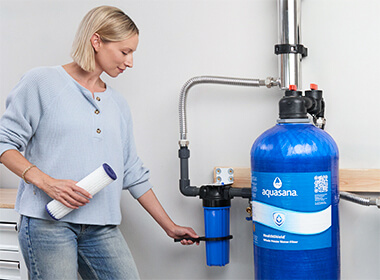
Chlorine carbon filters
When chlorine taste or odor is the main goal, return of chlorine can indicate carbon exhaustion, but relying only on taste is imprecise. Follow the system’s rated capacity and maintenance guidance.
Chloramine carbon filters
Chloramine can require more contact time and catalytic media. The replacement interval should be based on chloramine performance, not a generic chlorine rating.
PFAS cartridge replacement
PFAS has no taste or odor that tells you the cartridge is exhausted. If the product has a certified or tested PFAS capacity, follow it conservatively.
A cartridge that still flows normally after the rated capacity should not be assumed to maintain the same PFAS reduction.
Lead cartridge replacement
Lead-reduction cartridges can also have claim-specific capacities. Do not wait for pressure drop or taste changes to determine replacement. Use the exact rated service life and certified configuration.
Large carbon media tanks
Large granular-carbon tanks commonly have multi-year service lives because they contain much more media than a cartridge. Replacement can mean rebedding the tank or replacing the entire media vessel, depending on the system design.
“Ten-year media” should not be interpreted as proof of ten-year performance for every contaminant.
How to know when tank carbon is exhausted
For chlorine treatment, testing before and after the tank can provide evidence of breakthrough. For invisible contaminants, laboratory testing or conservative capacity tracking may be more appropriate.
A whole-house flow meter can make gallon-based media tracking easier.
Media tank rebedding
Rebedding involves removing spent media and installing new media, often while reusing the pressure vessel and valve. It can be cost-effective but messy and labor-intensive.
Professional service may be appropriate for large tanks.
Non-backwashing carbon tanks
These systems may have simple plumbing and no electronic valve. Major maintenance is often prefilter replacement plus eventual media or tank replacement.
Backwashing carbon tanks
Automatic backwashing can reduce channeling and flush particulates, but the control valve becomes another maintenance component. Media still eventually reaches chemical capacity.
Water-softener resin replacement
Softener resin can last many years, but service life depends on chlorine exposure, iron fouling, regeneration, water chemistry, and resin quality. Resin is not replaced on the same calendar as a cartridge.
Softener maintenance more commonly involves salt, brine-system care, valve service, and occasional cleaning.
How chlorine affects softener resin
Strong oxidants can degrade certain ion-exchange resins over time. Upstream carbon can reduce chlorine exposure and potentially extend resin life, but the carbon stage has its own maintenance schedule.
Iron fouling and softener resin
Iron can foul resin and reduce performance. Heavy well-water iron may justify separate pretreatment instead of repeatedly cleaning or replacing softener resin.
Salt-free conditioner media replacement
Salt-free conditioners do not use brine regeneration, but their media still has a finite service life. Replacement intervals vary by technology and manufacturer.
Do not assume “salt-free” means “lifetime media.”
Iron and sulfur media replacement
Backwashing iron/sulfur systems can use catalytic media with multi-year life. Actual service depends on contaminant load, pH, oxidation conditions, backwash quality, and media type.
When odor or staining returns, investigate before assuming the media alone needs replacement. A valve, injector, air-charge system, or pump condition may be responsible.
Acid-neutralizer media
Calcite and other neutralizing media dissolve over time as they raise pH. These systems may need periodic media top-up rather than complete replacement.
Consumption rate depends on water acidity and household volume.
UV lamp replacement
UV lamps are typically replaced on a time schedule rather than when they stop glowing. Germicidal output declines with lamp age.
Follow the exact manufacturer interval. Many residential systems use an annual-type schedule.
UV quartz sleeve replacement
Quartz sleeves can last longer than lamps but need cleaning. Replace them when cracked, permanently clouded, etched, or otherwise unable to transmit UV adequately.
UV sensor maintenance
Systems with UV intensity sensors may require sensor cleaning or calibration/service. A fouled sensor can trigger alarms even when the lamp is operating.
Reverse-osmosis prefilters
RO prefilters protect the membrane from sediment and disinfectants. Their replacement schedule is usually more frequent than the membrane’s.
RO membrane replacement
Membranes can last several years under good conditions but may fail sooner with poor pretreatment, scaling, chlorine exposure, or high water demand.
Production rate and rejection performance help indicate membrane condition.
RO postfilters and remineralization filters
These are commonly replaced on their own schedule, which may be annual or otherwise specified by the manufacturer.
Why multi-stage systems have multiple clocks
A system with sediment, carbon, softening, and UV does not have one replacement date. Each stage ages differently.
| Component | Common replacement/maintenance trigger |
|---|---|
| Sediment cartridge | Pressure drop, loading, time |
| Carbon cartridge | Capacity, time, treatment breakthrough |
| PFAS/lead specialty cartridge | Claim-specific capacity/time |
| Large carbon media | Capacity, testing, long-term interval |
| Softener resin | Performance decline/fouling over years |
| UV lamp | Time |
| UV sleeve | Condition |
| RO membrane | Performance + long-term interval |
Pressure gauges make cartridge replacement objective
Install gauges before and after restrictive stages. Record pressure differential at a known flow when the filter is new. Over time, increasing differential shows loading.
This is more useful than waiting until showers feel weak.
Flow meters make capacity tracking easier
When a contaminant claim is tied to gallons, a flow meter can track actual use instead of estimating from calendar time.
This is particularly useful for high-cost specialty cartridges.
Write the install date on the housing
A simple marker date on the housing or service tag prevents guesswork. Include the cartridge part number so future replacements are easier.
Use calendar reminders
Set a reminder before the expected service date. If the filter is gallon-based, use the reminder as a check-in rather than an automatic replacement trigger.
Keep one critical replacement on hand
If your system relies on a proprietary health-effect cartridge, keeping one spare can prevent downtime when supply is delayed. Store it according to manufacturer instructions.
Do not overstock filters
Buying a decade of cartridges can backfire if the product is updated, storage conditions are poor, or the system changes. Keep reasonable spares rather than excessive inventory.
How seasonal water use changes replacement frequency
Homes with irrigation, pools, guests, or seasonal occupancy can see large swings in gallons. If outdoor water passes through treatment, summer can consume filter capacity much faster.
Bypass irrigation when appropriate
There is often little reason to use expensive carbon or softening capacity on lawn irrigation. Plumbing outdoor water ahead of treatment can extend replacement intervals.
Vacation homes and low use
Low gallons can extend capacity, but age-based components such as UV lamps may still need replacement. Stagnation and seasonal startup maintenance also matter.
Rental properties
Frequent cartridge maintenance can be unreliable when tenants are responsible. A lower-maintenance media tank may have a higher upfront cost but reduce missed service.
What happens if you replace too late?
Possible consequences include:
- pressure loss;
- contaminant breakthrough;
- loss of certified treatment conditions;
- downstream fouling;
- unexpected service interruption;
- higher energy or pump stress from restriction.
What happens if you replace too early?
You spend more money and create more waste without necessarily improving treatment. The goal is a defensible interval, not maximum replacement frequency.
Why “better safe than sorry” can be expensive
Replacing a $300 cartridge every three months when capacity supports twelve months can waste thousands of dollars over a decade. Conservative replacement is reasonable for health-effect claims, but it should still be grounded in product data and actual use.
Why extending a health-effect cartridge is risky
The opposite mistake is using a filter far beyond its certified capacity because water still tastes fine. Invisible contaminants provide no sensory warning.
How water testing helps establish real replacement frequency
For large media tanks, periodic before-and-after testing can help verify treatment and refine service intervals. Testing can be especially useful on wells with changing chemistry.
What to do when filter life is much shorter than advertised
Investigate the reason:
- higher household water use;
- heavy sediment;
- iron fouling;
- unexpected contaminant loading;
- undersized cartridge;
- pressure changes;
- system installed on irrigation or other high-volume use.
The answer may be better pretreatment or a different architecture rather than buying filters more often forever.
What to do when filter life is much longer than advertised
Do not automatically extend it indefinitely. Time-based hygiene, media aging, and certified capacity can still apply even when the cartridge looks clean.
How to build a replacement log
Track:
- component;
- part number;
- install date;
- meter reading;
- replacement date;
- pressure differential;
- reason for replacement;
- cost;
- water-quality notes.
After two or three cycles, you will know your household’s real pattern.
Replacement frequency and ten-year cost
Every replacement interval has a financial consequence. A cartridge changed twice per year instead of once per year doubles that consumable cost.
Use FilterTier’s 10-Year Cost Guide to turn maintenance frequency into ownership cost.
Replacement frequency and pressure drop
Dense cartridges may reach a hydraulic end of life before chemical capacity. This is one reason filter size and flow matter when choosing the system.
Replacement frequency and certification
Certified performance can depend on using the specified replacement cartridge. Substituting a generic cartridge because it fits the housing may invalidate the basis for the claim.
Replacement frequency and warranty
Some warranties require maintenance according to the manufacturer’s schedule. Keep receipts and service records when warranty coverage matters.
Example: municipal chlorine cartridge
A household uses 250 gallons per day and has a 100,000-gallon carbon cartridge. The simple gallon estimate is 400 days. If the manufacturer also specifies twelve months, the homeowner would follow the earlier applicable limit.
Example: high-use family
A six-person home uses 500 gallons per day. The same 100,000-gallon cartridge reaches rated volume in about 200 days. The exact same product has a very different replacement pattern.
Example: sediment-heavy well
A 20-inch sediment cartridge clogs every six weeks. Rather than accepting eight or nine cartridges per year, the homeowner investigates and installs a coarse spin-down stage plus better well sediment management. The fine cartridge now lasts months.
Example: large carbon tank
A municipal-water home uses a large GAC tank for chlorine. A prefilter is replaced every six months, but the main tank media is serviced after several years based on capacity and testing. “Filter replacement” means two completely different schedules in the same system.
Example: UV-equipped well
The well system has a sediment cartridge, iron filter, softener, and UV. Sediment is changed quarterly, salt is added regularly, the UV lamp is changed annually, the sleeve is cleaned, and iron media lasts years. A single “annual maintenance” label would hide most of the real work.
Common replacement mistakes
Mistake 1: using one schedule for every stage
Multi-stage systems have multiple service intervals.
Mistake 2: replacing by appearance only
Carbon can be exhausted while looking clean.
Mistake 3: replacing by taste only
Invisible contaminants provide no reliable taste signal.
Mistake 4: ignoring gallons
High-use homes consume capacity faster.
Mistake 5: ignoring pressure drop
Hydraulic life can end before chemical life.
Mistake 6: using generic cartridges on certified systems
Physical fit does not preserve certification.
Mistake 7: ignoring upstream water problems
Heavy sediment or iron can destroy filter life.
Replacement-frequency checklist
- List every serviceable component.
- Record time and gallon limits.
- Identify claim-specific capacity.
- Measure household water use.
- Install pressure gauges where helpful.
- Track service dates.
- Keep critical spare parts.
- Review actual intervals after each replacement.
- Investigate unusually short life.
- Update the ten-year ownership estimate.
Frequently asked questions
How often should I change a whole-house sediment filter?
Replace based on loading, pressure drop, and the product schedule. Actual intervals vary from weeks to many months.
How often should I change a carbon cartridge?
Use the exact time and gallon capacity, adjusted for household use and treatment goal.
How often do PFAS filters need replacement?
Follow the PFAS-specific rated capacity or certified interval for the exact cartridge.
How often does a large carbon tank need new media?
Often after several years, but the interval depends on media quantity, contaminant loading, household volume, and the claim being maintained.
How often should UV lamps be replaced?
Follow the manufacturer’s schedule; many residential systems use an annual-type interval.
How often is softener resin replaced?
Usually after many years rather than on a short cartridge schedule, depending on resin condition and water chemistry.
Can I wait until pressure drops?
For sediment, pressure drop is useful. For health-effect adsorptive filters, capacity may be reached before pressure changes.
Can I replace early?
Yes, but unnecessary early replacement increases cost and waste.
Can I extend the interval if I use little water?
Sometimes gallon-based life extends, but time limits and manufacturer guidance can still apply.
Do filters expire in storage?
Storage requirements vary. Avoid extreme heat, moisture, contamination, and very long stockpiling.
Build a maintenance map for each stage
There is no useful universal answer to “How often do whole-house water filters need replacement?” The correct answer is a maintenance map for the exact system. Track each stage separately, connect gallon capacity to household use, watch pressure drop, respect contaminant-specific limits, and keep records.
Browse exact maintenance details in the FilterTier system database, compare ownership burden in Lowest-Maintenance Whole-House Filters, and use Find My Filter if maintenance tolerance is a major buying priority.
Detailed planning for changing water and household conditions
The stage-by-stage guidance above establishes the basic schedule. The following sections explain how to adjust that schedule when water conditions, household use, equipment or service arrangements change.
How replacement frequency changes with city water versus well water
Municipal water usually arrives relatively clear and treated, so sediment cartridges often last longer and maintenance is more predictable. The main recurring tasks may be carbon replacement, softener salt, or specialty cartridges. Private wells can be much more variable because sediment, iron, manganese, sulfur, hardness, and seasonal changes can load equipment unpredictably.
This does not mean well systems are always harder to maintain. A properly designed backwashing treatment train can reduce cartridge use dramatically. The key is matching architecture to the source.
Why a well that clogs cartridges quickly should be investigated
If sediment cartridges plug every few weeks, the filter may be acting as a symptom collector for a larger problem. Sand can indicate well-screen or pump issues. Rust can come from plumbing. Fine silt may require different pretreatment. Replacing disposable filters forever can cost more than correcting the source or installing a better first-stage separator.
How municipal main flushing changes sediment life
Utilities periodically flush mains, and construction or hydrant use can disturb sediment. A city-water home may see a temporary increase in cartridge loading even if normal water is very clean. If filter life suddenly drops, check for utility work before redesigning the whole system.
How construction inside the home changes filter life
New plumbing, water-heater replacement, and remodeling can release debris into the water line. A temporary period of heavy sediment does not necessarily mean the normal replacement schedule has permanently changed.
Why new carbon media may require flushing rather than replacement
Carbon fines can appear after installation or media disturbance. Proper startup flushing clears them. Dark water immediately after a new carbon cartridge or tank is installed does not necessarily mean the media has failed.
How pressure-regulator problems can look like filter clogging
If household pressure falls, the filter is an obvious suspect—but a failing pressure regulator, partially closed valve, well-pump issue, or plumbing restriction can create the same symptom. Bypass testing and pressure gauges help isolate the real cause.
How to use bypass testing safely
If the treatment system has a proper bypass, compare flow and pressure with the filter in service and bypassed. A large improvement suggests the treatment train is restrictive. Do not leave the system bypassed when it is required for a known health-related contaminant.
When a cartridge should be replaced after a contamination event
After certain boil-water advisories, well contamination events, or plumbing sanitization procedures, filter cartridges may need replacement because microorganisms or disinfectants can affect the media. Follow the filter manufacturer and local health guidance rather than assuming the existing cartridge can always remain in service.
Why stagnant filters deserve attention
Filters in vacation homes or unused buildings can sit wet for months. Long stagnation can create hygiene concerns even when gallon capacity is barely used. Time-based replacement and proper seasonal startup procedures can matter more than volume in these properties.
Why refrigerator-style reminders are not enough for whole-house systems
Simple timers do not know how many gallons were used or whether sediment loading changed. Smart reminders are useful, but they should support—not replace—capacity tracking, pressure data, and product instructions.
Smart flow meters and filter life
Whole-house flow monitors can track cumulative gallons and peak use. When a filter has a gallon-based capacity, this data can make replacement timing much more accurate. It can also reveal leaks that consume filter capacity without providing household benefit.
Leak detection can extend filter life
A silent toilet leak can send thousands of unnecessary gallons through a whole-house filter and softener. Fixing the leak reduces water bills and slows consumption of filter capacity, salt, and other consumables.
Why outdoor water should be considered
If irrigation, pool fill, or hose bibs run through treatment, they can dominate total gallons. A homeowner may think a cartridge “failed early” when outdoor use actually consumed the rated capacity. Plumbing nonessential outdoor water before expensive treatment can extend service life.
How a growing family changes the schedule
Replacement patterns should be recalculated when occupancy changes. A home that grows from two residents to five can use far more water, shortening gallon-based service life even though the equipment is unchanged.
How home additions change the schedule
A second laundry, new bathroom, guest suite, or large tub can increase both average gallons and peak flow. Filter replacement and system sizing should be reviewed after major renovations.
When pressure drop is acceptable but capacity is gone
Adsorptive media can reach chemical capacity while still passing water easily. This is common for carbon and specialty resins. A filter that “still has great pressure” is not proof of contaminant performance.
When capacity remains but pressure drop is unacceptable
The opposite can happen with sediment loading. A cartridge may still have theoretical chemical capacity but be so clogged that household flow becomes unacceptable. Hydraulic end-of-life can arrive first.
Why certified capacity should be treated conservatively
A certification provides evidence through defined test conditions and rated capacity. Extending use beyond that capacity moves the product outside the verified range. For health-related claims, a conservative replacement plan is appropriate.
Can laboratory testing justify extending a cartridge?
A clean sample near the end of rated capacity is reassuring but does not necessarily prove how long the cartridge will continue performing. Media breakthrough can accelerate. Laboratory testing is more useful for verifying performance than for creating an indefinite extension beyond the product’s rating.
How to estimate a service window instead of one exact date
For noncritical filters, establish an expected window. For example, a sediment cartridge may usually last four to six months. Begin checking pressure and condition at month four, then replace when the objective indicator says it is time.
This is more rational than replacing on an arbitrary day regardless of actual condition.
How to plan maintenance around travel
If a critical cartridge is expected to reach capacity while you are away, replace it before the trip or arrange service. Running a specialty filter past capacity because the replacement date was inconvenient defeats the purpose of tracking it.
How to budget a full year of consumables
List the maximum likely replacements for each stage. If a sediment filter might need four changes, budget four. If a PFAS cartridge is expected annually, budget one plus a contingency. Annual budgeting makes the true ownership burden visible.
How replacement frequency influences product rankings
FilterTier separates treatment evidence from maintenance burden. A cartridge can have excellent contaminant evidence and still score lower on maintenance if it requires frequent expensive replacement. A long-life tank can score well on maintenance but should not receive contaminant credit it cannot support.
What a low-maintenance system really means
Low maintenance usually means fewer service events, simple service, widely available parts, long media life, and low recurring cost. It does not mean no maintenance. Even simple tanks have valves, bypasses, prefilters, or eventual media replacement.
How to compare replacement burden between two systems
| Question | System A | System B |
|---|---|---|
| Routine replacements per year | Count | Count |
| Annual consumable cost | $ | $ |
| DIY difficulty | Low/Med/High | Low/Med/High |
| Heavy service event | Interval | Interval |
| Special tools required | Yes/No | Yes/No |
| Proprietary parts | Yes/No | Yes/No |
| Claim-specific capacity | Gallons | Gallons |
What to ask a dealer about replacements
- Which exact parts are consumables?
- What do they cost today?
- How often does a household like mine replace them?
- Can I buy them without a service contract?
- Can I replace them myself?
- What happens if the part is discontinued?
- Which replacement parts preserve certification?
- What annual service is required for warranty coverage?
What to ask a direct-to-consumer brand
Ask the same questions. Online purchase does not eliminate ownership complexity. Confirm replacement availability, shipping cost, instructions, housing O-rings, valves, and customer-support options before purchase.
What to do when a replacement cartridge is discontinued
First determine whether a verified compatible replacement exists. Do not substitute based solely on dimensions when a health-effect certification matters. If no supported replacement exists, the system may need modification or replacement.
Why FilterTier removes discontinued products from active recommendations
A system with excellent historical specifications is not useful to a buyer who cannot purchase equipment or replacement parts. Current availability and serviceability are part of ownership quality.
Set a replacement policy for your home
Good maintenance is neither blindly frequent nor aggressively delayed. Replace mechanical filters when loading demands it, replace health-effect media within verified capacity, service lamps on schedule, and use testing where appropriate. Track what your house actually does. After a few service cycles, your own data becomes the best guide to normal replacement frequency.
How replacement schedules change when treatment is added in stages
Homeowners often install treatment over time. A sediment filter may be added first, then carbon, then a softener, then UV. Each addition changes the operating conditions of the stages downstream. For example, adding better sediment pretreatment can extend carbon life, while adding whole-house carbon ahead of a softener can reduce chlorine exposure to resin.
After changing the treatment train, treat the old replacement schedule as provisional. Watch the next service cycle and update your records.
How to prepare for a filter change without creating a leak
Shut off water, relieve pressure, follow the manufacturer’s service procedure, inspect the O-ring, clean the housing, and restore pressure slowly while checking for leaks. Many post-service leaks come from twisted, dirty, dry, damaged, or incorrectly seated O-rings rather than from the cartridge itself.
Why spare O-rings matter
A $5 seal can prevent a service interruption if the old O-ring tears during a cartridge change. Keep the correct size with your spare filters and use only lubricant approved for potable-water equipment when the manufacturer recommends it.
Why maintenance access should influence product choice
A cartridge that is theoretically easy to replace can become frustrating when installed against a wall with no clearance. A UV lamp can become a major project if there is no room to pull it from the chamber. A media tank can be impossible to rebed in place if the mechanical room is too tight.
Good installation design reduces the practical cost of every future replacement.
How to hand off the maintenance schedule when selling a home
Leave the manuals, part numbers, service dates, and current filter age for the new owner. Water-treatment equipment with no service history is difficult to trust. Clear documentation protects the value of the system and reduces the chance that the next owner runs critical filters far beyond their intended life.
Give every service item a replacement trigger
If you cannot explain what makes a particular component “due,” the maintenance plan is too vague. Every service item should have a reason: time, gallons, pressure drop, condition, performance, or testing. Once those triggers are defined, whole-house filter maintenance becomes much easier to manage and much less expensive than replacing everything on the same arbitrary calendar.
Replacement frequency in one practical example
Consider a four-person home with municipal water. The treatment train has a 20-micron sediment prefilter, a large carbon tank, a true water softener, and a UV reactor used as an optional final barrier. The sediment cartridge may be checked every few months and replaced based on pressure drop. The carbon tank may run for several years. Salt is added throughout the year, but softener resin is not replaced annually. The UV lamp is serviced on its own time schedule. Four pieces of equipment, four very different maintenance patterns.
This is why “How often do I replace my whole-house filter?” is really a system-inventory question. Once you identify each component and its trigger, the answer becomes specific instead of generic.
Apply the example to your own system
Build maintenance around evidence, not habit. A cartridge that protects against an invisible contaminant should be replaced within its verified capacity even if it still looks clean. A sediment filter should not be thrown away early if pressure and loading remain acceptable. A media tank should not be forgotten simply because it has a long life. The best schedule is the one that preserves treatment, flow, and reliability without wasting consumables.
A simple service log makes that possible. Record the date, gallons when available, pressure difference, cartridge condition, cost, and reason for replacement. After a few cycles, you can predict maintenance far more accurately than a generic manufacturer calendar. That household-specific record is especially valuable when water conditions change, new occupants move in, or the system is expanded with additional treatment stages.
In other words, replacement frequency is not one number. It is a set of measured service intervals for the exact equipment and exact water in your home.
When in doubt, use the most conservative applicable limit for a health-related contaminant and the most objective condition indicator for a nuisance or sediment filter. That balance protects performance without turning maintenance into unnecessary waste.
Document the reason for every service event. That one habit turns maintenance from guesswork into a reliable operating history for the entire treatment system.
Measure, record, replace, and verify. That is the maintenance cycle.
Stay current.
How to create a maintenance schedule that actually works
A useful maintenance schedule should be based on the exact components in your system rather than a generic reminder to “change filters.” Write down each stage, its replacement part number, the manufacturer’s time limit, gallon capacity, and any pressure-drop or testing trigger. Then add a calendar reminder before the expected service window so you have time to order parts and inspect performance.
For cartridge systems, record the pressure before and after replacement. For gallon-rated filters, record the water-meter or flow-monitor reading. For media tanks, record any before-and-after chlorine or contaminant testing. For UV, record the lamp and sleeve service date. Within a year or two, the maintenance schedule becomes specific to your home instead of relying on marketing estimates.
Why maintenance records matter when troubleshooting
When water pressure falls or a treatment issue returns, service history can reveal whether the problem is normal exhaustion or something unusual. If a cartridge that normally lasts nine months suddenly clogs in six weeks, the record points toward a change in source water, plumbing, or household use. If a UV intensity alarm appears soon after sleeve cleaning, the issue may be lamp output, UV transmittance, or the sensor rather than routine fouling.
Without records, every problem feels new. With records, you can see patterns.
How to prioritize replacement when several stages are overdue
If multiple components have been neglected, prioritize stages connected to health-related treatment and stages that protect downstream equipment. A severely clogged sediment filter can starve the rest of the system of flow. An overdue PFAS or lead cartridge may no longer be within its verified capacity. An overdue UV lamp may still glow while delivering less germicidal output.
After critical stages are restored, service the remaining components and reset the schedule so future work is staggered and manageable.
When replacement is not the right fix
Replacing a cartridge repeatedly will not solve an undersized system. If pressure drop returns quickly, household demand exceeds the design flow, or media capacity is consumed far faster than expected, the correct answer may be a larger housing, more media, a different treatment technology, or better upstream pretreatment. Maintenance data should inform system design rather than trap the homeowner in an expensive replacement cycle.
How to know whether your replacement schedule is reasonable
A reasonable schedule has three characteristics: it keeps the treatment within its verified performance window, it preserves acceptable household flow, and it does not require unnecessary early replacement. If you can explain the trigger for each service event—capacity, pressure, time, testing, or condition—the schedule is probably grounded in evidence rather than habit.
Match the replacement trigger to the treatment job
Replace based on the job each component is doing. Mechanical filters are often governed by loading and pressure drop. Adsorptive and health-effect cartridges are governed by capacity and claim-specific limits. Media tanks are governed by long-term capacity and testing. UV is governed by lamp age and sleeve condition. Softening and specialty media have their own service patterns. Treating all of them as “filters that get changed every six months” is the fastest way to either overspend or under-maintain the system.
How replacement schedules change by treatment goal
A replacement schedule should always be tied to the job the filter is doing. A carbon cartridge used mainly for chlorine taste and odor can often be monitored with a combination of rated capacity, time, and simple chlorine testing. A cartridge used for lead or PFAS should be replaced according to the exact health-effect claim and capacity because there is no reliable sensory warning. A sediment filter is mostly hydraulic: when loading creates unacceptable pressure drop, the cartridge has reached its useful limit even if the calendar says it should last longer.
This distinction is why a single “replace every six months” sticker cannot accurately manage an entire treatment train. The homeowner needs a different replacement rule for each stage.
How to create a household maintenance calendar
Start with a one-page inventory of every treatment component. Record the model number, cartridge or media part number, installation date, manufacturer interval, gallon capacity, and the signal that actually determines replacement. Then assign each item to one of three maintenance categories: scheduled, condition-based, or capacity-based.
- Scheduled: UV lamps, certain annual cartridges, sanitation tasks.
- Condition-based: sediment filters, quartz sleeve cleaning, pressure-drop service.
- Capacity-based: PFAS cartridges, lead cartridges, certain carbon media.
Review the calendar every few months rather than waiting until something fails. A simple maintenance record is one of the cheapest ways to preserve treatment performance.
Why replacement frequency belongs in the buying decision
Homeowners often compare systems on contaminant claims and purchase price, then discover later that the winning product needs $300 cartridges twice per year. Replacement burden should be evaluated before purchase. A system with a lower WaterScore or higher initial price can still be a better fit if it is far easier to maintain correctly.
FilterTier therefore separates evidence, flow, maintenance, and long-term value. A product does not earn a high maintenance rating just because the manufacturer calls it “low maintenance.” We look at the number of service events, part cost, difficulty, proprietary components, media life, and availability.
When a service contract makes sense
A service contract can be worthwhile for homeowners who do not want to manage cartridges, salt, testing, or UV service themselves. It is especially useful for elderly owners, rental properties, complex well systems, and homes where missed maintenance would create a meaningful health or property risk. The contract should clearly state what is included, what parts are extra, how often the technician visits, and whether testing is part of the service.
Do not confuse a service contract with a requirement for good water treatment. Many systems can be maintained by an informed homeowner. The value is convenience and continuity.
When DIY maintenance is reasonable
DIY replacement is often practical for sediment cartridges, standard Big Blue filters, many UV lamps, and salt refilling when the homeowner can safely isolate, depressurize, and restart the system. Keep replacement O-rings, housing tools, food-grade lubricant when specified, towels, and a flashlight near the equipment. Photograph the plumbing and valve positions before the first service.
If the equipment is heavy, electrically complex, under unusually high pressure, or part of a critical health-treatment application, professional service may be safer.
What to do if you do not know when the filter was last changed
When moving into a home with unknown treatment history, identify every component and assume the consumable history is uncertain. Replace disposable cartridges, inspect housings and O-rings, service UV equipment, and have long-life media evaluated if necessary. Record the new baseline so future maintenance is no longer guesswork.
For a health-effect filter with no known installation date or gallon history, replacing the cartridge is generally more defensible than assuming unknown remaining capacity.
Final maintenance rule
The best replacement interval is the one you can defend with product data and household conditions. Replace sediment when loading requires it. Replace health-effect cartridges within verified capacity. Replace UV lamps on schedule. Service long-life media from capacity, testing, and documented system history. If a filter is repeatedly reaching end of life much sooner than expected, investigate the water or the architecture rather than accepting permanent over-maintenance.