
The real cost of a whole-house water filter is the purchase price plus installation, replacement cartridges or media, salt or chemicals when applicable, electricity, water used for regeneration or backwash, service calls, and eventual component replacement. A system that looks cheap on day one can cost more over ten years than a higher-priced tank with low routine maintenance. The only fair comparison is total ownership cost for the exact treatment job your home needs.
This guide provides a framework for estimating ten-year cost without pretending every household will spend the same amount. It uses formulas and illustrative examples rather than claiming one universal price. Actual costs vary by brand, water quality, household water use, installation complexity, labor rates, and replacement-part pricing.
What counts as total ownership cost?
For a whole-house treatment system, total cost can include:
- equipment purchase;
- shipping;
- installation labor;
- permits or plumbing upgrades;
- sediment prefilters;
- carbon cartridges;
- specialty PFAS or lead cartridges;
- media replacement;
- water-softener salt;
- resin cleaner;
- UV lamps and sleeves;
- reverse-osmosis membranes and filters;
- electricity;
- backwash or regeneration water;
- control-valve repairs;
- pumps or electronics;
- professional service;
- tank or pressure-vessel replacement.
Not every system has every cost. The purpose of the list is to prevent a purchase-price-only comparison.
Start with a ten-year timeline
Break ownership into years 0 through 10. Year 0 usually includes the equipment and installation. Later years include recurring maintenance and major replacement events.
| Year | Typical cost categories |
|---|---|
| 0 | Equipment, installation, plumbing changes |
| 1 | Cartridges, salt, lamp, routine service |
| 2 | Routine consumables |
| 3–5 | Routine consumables + possible media, valve, membrane, or sleeve replacement |
| 6–10 | Second major media cycle, electronics/valve aging, continued consumables |
The basic ten-year formula
A useful planning formula is:
10-year ownership cost = purchase + installation + recurring annual costs + scheduled major replacements + estimated service/repair costs.
For more detailed comparison, divide the total by 120 months to calculate a monthly ownership cost.
Why purchase price can be misleading
Imagine System A costs $700 and System B costs $1,800. System A looks dramatically cheaper. But if System A uses $300 of cartridges per year and System B uses $80 of prefilters per year plus a $600 media replacement at year five, the gap changes quickly.
Ten-year illustrative totals:
- System A: $700 purchase + $3,000 cartridges = $3,700 before installation.
- System B: $1,800 purchase + $800 prefilters + $600 media = $3,200 before installation.
The more expensive system on day one becomes less expensive by year ten.
Installation can be a major percentage of total cost
Installation can be simple when the home already has an accessible main line, drain, electrical outlet, bypass, and adequate space. It can be expensive when plumbing must be rerouted, large pipes must be modified, drains added, or equipment installed in a difficult mechanical room.
Before comparing products, get realistic installation assumptions for each architecture.
DIY installation changes the calculation
A capable homeowner can reduce installation cost significantly. However, DIY only saves money when the system is installed correctly. Leaks, undersized plumbing, incorrect drain design, unsupported tanks, or poor bypass configuration can create expensive problems.
If you are not comfortable modifying the main water line, professional installation can be part of the value rather than simply an expense.
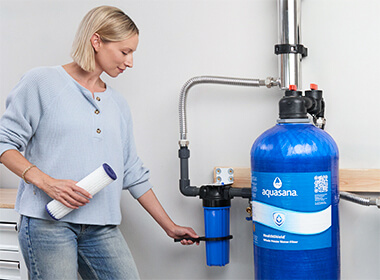
Cartridge cost is one of the easiest recurring costs to calculate
Find the exact replacement part, current price, and replacement frequency. Then multiply.
Example:
- Cartridge price: $125
- Replaced twice per year
- Annual cost: $250
- Ten-year cost: $2,500
This can dwarf the original housing price.
Why household water use changes cartridge cost
Many cartridges have a gallon capacity. A household using 500 gallons per day will consume that capacity faster than one using 150 gallons per day. Time-based schedules can still apply, but gallon-based limits make household use financially important.
How to convert capacity into replacement frequency
Use:
Rated gallons ÷ average daily water use = approximate days to capacity.
A 100,000-gallon cartridge in a 250-gallon-per-day home reaches that volume in roughly 400 days. In a 500-gallon-per-day home, it reaches the same capacity in roughly 200 days.
This is a planning estimate, not a promise. Water chemistry, pressure drop, time limits, and contaminant-specific capacity can require earlier replacement.
Why contaminant-specific capacity matters
A filter may have one capacity for chlorine and a different tested capacity for PFAS, lead, or another health-effect contaminant. Use the capacity tied to the treatment claim you actually care about.
Do not calculate ten-year PFAS ownership cost from a chlorine-capacity headline.
Media tanks change recurring cost
Large tanks can hold much more media than cartridges and may run for years before major replacement. Routine costs can therefore be lower, but media replacement becomes a larger periodic expense.
A $700 media replacement every five years has a different cash-flow pattern from $140 cartridges every six months, even if the ten-year totals are similar.
Annualize large media replacements
For comparison, divide a major media replacement by its expected service interval. A $600 replacement every six years is roughly $100 per year when annualized.
This makes tank systems easier to compare with cartridge systems.
What does rebedding a media tank cost?
Cost depends on media type, quantity, labor, and whether the control valve or distributor also needs service. Specialty media can cost much more than standard carbon.
Some direct-to-consumer systems are designed for complete tank replacement rather than rebedding. Include shipping and disposal when that is the service model.
Water-softener salt cost
Traditional ion-exchange softeners require salt or potassium chloride for regeneration. Annual consumption depends on hardness, household water use, resin size, and settings.
To estimate:
- Find average pounds of salt used per regeneration.
- Estimate regenerations per year.
- Multiply by salt price.
A properly sized demand-initiated softener can use much less salt than an inefficient or incorrectly programmed system.
Regeneration water has a cost too
Softeners and backwashing filters use water during cleaning cycles. If your utility charges for both water and sewer, the financial cost can be larger than the water rate alone.
On a private well, there may be no utility bill for the water itself, but pumping energy, septic loading, and well capacity still matter.
Backwashing filter water use
Iron filters, carbon filters, neutralizers, and other media systems may backwash automatically. Frequency and duration vary. Backwashing is necessary for certain equipment, so the goal is correct programming—not eliminating it simply to reduce water use.
UV lamp cost
Whole-house UV systems commonly use scheduled lamp replacement. If a lamp costs $120 and is replaced annually, ten years of lamps is roughly $1,200 before sleeve or controller costs.
Premium systems may have more expensive lamps but stronger monitoring and certification. Compare total value, not lamp price alone.
Quartz sleeve cost
Sleeves can last multiple years when maintained carefully, but they can break, become etched, or foul beyond practical cleaning. Include at least one replacement in a long-term budget when appropriate.
UV controller and sensor cost
Electronic components can fail over ten years. A system with an expensive proprietary controller or UV intensity sensor should be evaluated for replacement-part availability and warranty coverage.
Reverse-osmosis maintenance
Whole-house RO is a complex system with prefilters, membranes, pumps, storage, and post-treatment. Point-of-use RO is cheaper to maintain but still requires cartridges and membrane replacement.
If a whole-house treatment bundle includes RO, long-term ownership cost should include all membrane and pump components.
Electricity cost
Many filters use no electricity. Softeners and automatic valves use small amounts. UV runs continuously. Pumps in RO or pressure systems can use more.
Electricity may be a small percentage of total cost, but ten-year comparisons should include it when the systems differ significantly.
Professional service cost
Some homeowners change cartridges and salt themselves. Others pay for annual service. Dealer systems may include service plans or require dealer maintenance.
For apples-to-apples comparison, decide whether you are comparing DIY ownership or professional service for both systems.
Travel or delivery charges
Dealer-installed systems in remote areas can incur service-call or travel fees. Direct-to-consumer systems can incur shipping for heavy media or proprietary cartridges. These costs are easy to overlook when comparing equipment prices online.
Permit and inspection cost
Local codes may require plumbing permits or inspections for certain installations. This is location-specific and not part of every project, but it belongs in a realistic installation quote when applicable.
Plumbing upgrades
A high-flow home may need larger valves, bypass plumbing, or pipe modifications. A softener may require a drain. UV needs power. RO may need storage and a pump. Treat these as system costs, not unrelated surprises.
Drain-line installation
Backwashing and regeneration systems need an appropriate drain connection. Adding one can be a meaningful cost in finished basements or mechanical rooms without nearby drainage.
Electrical installation
UV, electronic valves, pumps, and smart monitoring may require nearby outlets. Extension cords should not become a permanent substitute for proper electrical installation.
Replacement-part availability affects long-term cost
A proprietary cartridge can become more expensive over time or disappear. Standard-size housings provide more replacement flexibility, but generic substitutions may not preserve exact contaminant certifications.
Availability risk deserves consideration on a ten-year horizon.
Inflation and price changes
No ten-year estimate can predict future cartridge, salt, labor, or electricity prices perfectly. Use current pricing to compare relative ownership burden, then include a reasonable contingency rather than pretending the number is exact.
The purpose of the model is not forecasting to the dollar; it is seeing which cost categories dominate.
Warranty can shift some costs—but not all
A strong warranty can cover tanks, valves, electronics, or structural defects. It usually does not cover consumables such as cartridges, media, salt, lamps, or routine labor.
“Lifetime warranty” does not mean “zero cost for life.” See Whole-House Water Filter Warranty: What Lifetime Actually Means.
Tank warranty versus valve warranty
Many systems provide a longer warranty on the pressure vessel than on the control valve or electronics. The valve may be the more likely expensive repair during a ten-year period.
Break warranty coverage into components before assigning financial value to it.
Labor exclusions
A manufacturer may provide a free replacement part while the homeowner still pays shipping, diagnosis, and installation labor. Those exclusions matter on large equipment.
Transferability
If you sell the house, some warranties transfer and others do not. Transferability can affect resale value but should not be treated as guaranteed cash savings.
How to model a cartridge-based whole-house system
Example assumptions:
- Equipment: $900
- Installation: $600
- Sediment filters: $80/year
- Carbon cartridges: $280/year
- One housing replacement or repair over ten years: $250
Illustrative ten-year total: $900 + $600 + $800 + $2,800 + $250 = $5,350.
This is not a market price quote. It demonstrates the structure of the calculation.
How to model a large carbon tank
Example assumptions:
- Equipment: $1,700
- Installation: $700
- Prefilters: $100/year
- Media replacement in year 6: $700
- Valve service allowance: $300
Illustrative ten-year total: $1,700 + $700 + $1,000 + $700 + $300 = $4,400.
How to model a softener
Example assumptions:
- Equipment: $1,400
- Installation: $700
- Salt: $160/year
- Resin cleaner/maintenance: $40/year
- Valve repair allowance: $300
Illustrative ten-year total: $1,400 + $700 + $1,600 + $400 + $300 = $4,400.
Actual salt use can vary dramatically with hardness and settings.
How to model a carbon + softener bundle
Add the two systems together, but avoid double-counting installation or shared prefilters. Bundles can cost substantially more because they solve two separate problems: filtration and hardness removal.
How to model a UV add-on
Example assumptions:
- UV equipment: $900
- Additional installation: $350
- Lamp: $110/year
- Sleeve replacement: $150 twice in ten years
- Controller allowance: $250
Illustrative ten-year UV cost: $900 + $350 + $1,100 + $300 + $250 = $2,900.
This helps homeowners decide whether optional UV redundancy on city water is worth the ownership burden.
How to model a specialty PFAS cartridge
If the cartridge costs $350 and lasts 100,000 gallons, calculate replacement frequency from household water use. A 300-gallon-per-day household reaches 100,000 gallons in about 333 days. That could mean roughly one $350 cartridge per year, or around $3,500 over ten years before price changes.
This is why PFAS capacity can dominate ownership cost.
Point-of-use treatment can reduce whole-house cost
If a contaminant matters mainly for drinking and cooking, an under-sink system may reduce long-term cost dramatically compared with treating showers, toilets, laundry, and irrigation.
Treatment scope is a financial decision as much as a technical one.
Outdoor water can consume media unnecessarily
If irrigation or pool fill runs through expensive whole-house treatment, it can consume capacity rapidly. Plumbing outdoor water before the treatment system can reduce cartridge, salt, and media cost when treatment is unnecessary outside.
Why peak flow can increase equipment cost
Large homes need larger tanks, valves, housings, or parallel treatment to preserve flow. A system that is inexpensive for an 8 GPM home may become much more expensive at 18 GPM.
See What GPM Do I Need?.
Water quality can increase ownership cost
Heavy sediment shortens cartridge life. Iron can foul softeners and carbon. Hardness can scale UV sleeves. Low pH can damage plumbing. Treating the actual water correctly often costs less long term than repeatedly replacing consumables that are being overloaded.
Why testing can save money
A laboratory test or accurate city-water report can prevent buying unnecessary treatment stages. Spending money on testing before a multi-thousand-dollar system can have a high return.
What not to include in the cost model
Do not assign imaginary savings to health outcomes, appliance life, or home value unless you have a defensible basis. Those benefits may be real, but the financial comparison becomes misleading when speculative savings are used to justify expensive equipment.
Cost per treated gallon
Another comparison method is:
Total ownership cost ÷ total gallons treated = cost per gallon.
This can help compare a high-capacity tank with a cartridge system, but remember that the treatment claims may differ.
Cost per year
Divide ten-year total by ten. This is a simple way to translate a large upfront purchase into an annual household budget.
Cost per month
Divide by 120. A $6,000 ten-year system costs an average of $50 per month before unexpected repairs or price changes. This framing can make product comparisons easier.
Do not compare systems solving different problems
A $1,000 carbon filter and a $3,000 carbon + softener + UV bundle are not alternatives if your water needs all three treatment functions. Compare systems that solve the same defined problem.
Common cost-comparison mistakes
Mistake 1: comparing purchase price only
Consumables can dominate long-term cost.
Mistake 2: ignoring household water use
Capacity-driven replacement changes with gallons.
Mistake 3: using chlorine capacity for PFAS cost
Use contaminant-specific capacity.
Mistake 4: assuming lifetime warranty covers maintenance
Consumables are usually excluded.
Mistake 5: ignoring labor
Dealer service can change ownership cost substantially.
Mistake 6: forgetting water and sewer cost
Backwash and regeneration water can be billable.
Mistake 7: ignoring replacement availability
Proprietary parts can create future risk.
Mistake 8: treating optional stages as mandatory
Every extra stage adds cost and maintenance.
A ten-year worksheet
| Cost category | Year 0 | Annual | Major interval | 10-year total |
|---|---|---|---|---|
| Equipment | Enter cost | — | — | Same as Year 0 unless replacement |
| Installation | Enter cost | — | — | Same as Year 0 |
| Cartridges | Optional | Enter annual | — | Annual × 10 |
| Media | Included | — | Enter interval | Replacement events |
| Salt | — | Enter annual | — | Annual × 10 |
| UV lamps | — | Enter annual | — | Annual × 10 |
| Service | Enter if needed | Estimate | Repairs | Total allowance |
How FilterTier uses ownership cost
FilterTier separates initial price from maintenance burden and long-term value. A low-cost product can still score well when replacement parts are affordable and evidence is strong. A premium system can justify higher upfront cost when flow, evidence, maintenance, and warranty are materially better.
We do not assume the highest price means the highest quality.
Frequently asked questions
How much does a whole-house water filter cost over ten years?
There is no single number. Depending on architecture and treatment scope, consumables and service can equal or exceed the original purchase price.
Are media tanks cheaper than cartridges long term?
Often, but not always. Media tanks have higher upfront cost and larger periodic service events. Cartridge systems can be cheaper for small homes or narrow treatment goals.
How much should I budget for annual maintenance?
Calculate from the exact replacement parts and your household water use. Do not rely on a generic percentage of purchase price.
Does a lifetime warranty reduce ten-year cost?
Potentially for covered failures, but it does not eliminate consumable, labor, or excluded-component costs.
Is DIY always cheaper?
Only if the work is done correctly and safely. Mistakes can create expensive leaks or treatment failures.
Should I include water use from regeneration?
Yes, especially where water and sewer rates are high or where a private well/septic system has capacity constraints.
Do I need to include electricity?
Include it for UV, pumps, RO, or other powered equipment. It may be small but is part of ownership.
How do I compare a dealer quote with an online system?
Add installation, service, consumables, warranty differences, and any required professional maintenance to both options.
How can I reduce long-term cost?
Treat only confirmed problems, bypass unnecessary outdoor water, size equipment correctly, maintain prefilters, and choose systems with reasonably priced available consumables.
Is the cheapest ten-year system automatically best?
No. It still needs to deliver the required treatment, flow, evidence, and reliability.
Ten-year buying checklist
- Define the treatment goal.
- Identify exact model and configuration.
- Get realistic installation cost.
- List every consumable.
- Find current consumable price.
- Estimate replacement frequency from actual use.
- Identify major media or membrane replacement events.
- Estimate salt, water, and electricity.
- Read warranty component by component.
- Include likely service labor.
- Check parts availability.
- Calculate 10-year total, annual cost, and monthly cost.
What this means for you
The best financial comparison is not “Which system is cheapest today?” It is “Which system solves the same water problem at the lowest reasonable total cost while meeting my flow, evidence, and maintenance requirements?”
Use the system database for catalog-level system information, verify current prices and availability directly with the manufacturer or retailer, and consult the replacement guide to estimate recurring service.
Primary references
How to compare financing with paying cash
Dealer-installed systems are sometimes financed over several years. Financing can make a premium system easier to purchase, but interest increases total cost. When comparing a financed dealer quote with a cash online purchase, compare the full amount paid over the financing term—not only the monthly payment.
Also remember that cartridge, salt, lamp, and service costs continue while financing payments are being made.
How tax credits and rebates affect cost
Some local utilities or programs occasionally offer incentives for water-efficiency, lead-service-line work, well improvements, or other infrastructure, but residential treatment rebates are highly location-specific. Do not build a ten-year model around a rebate unless you have confirmed eligibility and terms.
Why plumbing replacement can be cheaper than filtration
If the problem is lead from a service line or corroded plumbing, replacing the source may provide more durable value than paying for specialty cartridges indefinitely. Filtration can be a useful interim or supplemental solution, but source correction should be included in the financial comparison.
Why treatment can protect appliances—but do not overstate the savings
Softening hard water can reduce scale and may help water heaters and fixtures operate more efficiently. Sediment treatment can protect valves and appliances. Those benefits can have financial value, but exact appliance-life savings are difficult to guarantee. Treat them as potential secondary benefits rather than using speculative numbers to justify the purchase.
How water heaters change the economics of hardness treatment
Hardness scale can accumulate in tank and tankless water heaters. In very hard water, a softener can reduce scale maintenance. If a household already spends money descaling a tankless heater or replacing scaled fixtures, those existing costs can be included in a personal ownership comparison because they are real documented expenses.
How cleaning-product use changes after softening
Softened water can reduce soap and detergent demand for some households. Again, the savings vary by behavior. If you want to count them, use your actual household purchases rather than a generic marketing percentage.
How bottled-water spending changes the comparison
If a household currently spends $40 or $60 per month on bottled water because of taste or contaminant concerns, an effective drinking-water treatment system may replace some of that spending. Include only expenses you genuinely expect to stop. Do not assume every family will abandon bottled water after installing a filter.
Point-of-use versus whole-house economics
A high-performance under-sink system treats only drinking and cooking water, so consumable capacity lasts much longer than whole-house treatment of showers, toilets, and laundry. For contaminants where point-of-use treatment meets the household goal, ten-year cost can be dramatically lower.
Whole-house treatment becomes economically rational when the benefit is needed throughout the home—chlorine in showers, hardness affecting appliances, sediment throughout plumbing, or a conscious decision to reduce a contaminant at every fixture.
How a prefilter can save money downstream
A low-cost sediment prefilter can extend the life of expensive carbon or specialty media by removing particulate load. The prefilter adds its own cost, but the net result can be lower if it protects a much more expensive downstream stage.
How an unnecessary prefilter can add cost
Conversely, adding multiple cartridges “just in case” creates recurring expense and pressure drop. Every stage should solve a real problem.
Why oversizing can increase ten-year cost
Larger tanks, valves, UV reactors, and cartridges cost more. Oversizing can also increase backwash demand or salt use when a system is programmed poorly. Add a reasonable capacity margin, but do not buy commercial-scale equipment for a modest household without a hydraulic reason.
Why undersizing can also increase cost
An undersized cartridge clogs faster, a small softener regenerates too often, and an undersized iron filter may foul or fail prematurely. Paying less upfront can create more maintenance and early replacement.
How to model an expected repair allowance
No one can predict every failure, but a ten-year budget can include a modest repair allowance for valves, controllers, pumps, sensors, or housings. This is especially useful when comparing a simple non-electric tank with a feature-rich system containing several electronic components.
How smart features affect ownership cost
Wi-Fi monitoring, leak shutoff, flow meters, and app-connected controllers can add real value. They also create electronics that may age faster than a pressure tank. Check whether the system still works normally if the smart features fail and what replacement electronics cost.
Subscription filter plans
Some brands offer automatic cartridge subscriptions. These can simplify maintenance and sometimes reduce unit price, but calculate the ten-year subscription total. Make sure shipments can be paused when actual water use does not justify the scheduled replacement.
Dealer service plans
Annual dealer plans can include testing, filter changes, sanitization, salt delivery, or priority service. They may be worthwhile for homeowners who do not want DIY maintenance. Compare the actual included work with buying parts and service separately.
How home sale timing affects the math
If you expect to move in three years, a ten-year ownership model is still useful for understanding the system, but your personal cash outlay may be different. A system with low upfront cost may make more sense if you will not own the home long enough to realize long-term maintenance savings—unless the equipment adds meaningful resale value.
Can water treatment add home value?
A professionally installed system can be attractive to buyers, especially in hard-water or well-water markets, but resale value is difficult to quantify. Do not assume you will recover the purchase price dollar-for-dollar.
Rental-property ownership cost
Landlords should account for tenant behavior, service access, missed maintenance, and leak risk. A low-maintenance tank system may be preferable to frequent tenant-managed cartridge changes even if the equipment costs more upfront.
Vacation-home ownership cost
Low water use can extend gallon-based filter capacity, but calendar-based lamp and cartridge limits still matter. Service trips to a remote property can make labor and travel more expensive than the parts themselves.
Private-well ownership cost
Well treatment often includes more equipment because multiple chemistry problems can coexist. Iron, hardness, low pH, sediment, sulfur, bacteria, and nitrate may require separate stages. The cost of treating only one symptom can be wasted if the rest of the chemistry quickly fouls the equipment.
Testing first is one of the best ways to control long-term cost.
City-water ownership cost
Municipal-water treatment can be simpler because the source is already treated. Many homes need only carbon for disinfectant/taste and perhaps a softener for hardness. Avoid turning a simple city-water problem into a six-stage system without evidence.
How inflation-resistant an architecture is
Systems using proprietary cartridges are more exposed to brand-specific price increases. Standard-size housings and rebeddable tanks can provide more supplier flexibility. However, switching replacement parts can affect certification, so flexibility must be balanced with treatment evidence.
How discontinued products create ownership risk
A system can become expensive if proprietary cartridges or controllers are discontinued. Before buying, look at how long the brand has supported replacement parts and whether the architecture uses standard components.
How FilterTier treats discontinued systems
FilterTier removes discontinued products from active recommendation lists and keeps catalog cleanup separate from current rankings. That prevents a low historical price from making an unavailable system look like a good current buy.
Build three cost scenarios, not one
A useful ten-year model has:
- Low-use case: conservative water consumption and long replacement intervals.
- Expected case: your best estimate.
- High-use case: more occupants, higher water use, or earlier service.
If one system is still affordable in the high-use case, it carries less financial risk.
Example: PFAS cartridge sensitivity to water use
A $400 cartridge with 100,000-gallon capacity costs about $0.004 per rated gallon before installation. A household using 150 gallons per day may replace it roughly every 22 months; a 500-gallon-per-day household may reach the same capacity in under seven months. The product has not changed—the economics have.
Example: softener salt sensitivity to hardness
A home at 8 grains per gallon hardness uses far less softening capacity per gallon than a home at 30 grains. The harder-water household can consume substantially more salt and regeneration water unless the system is larger and efficiently programmed.
Example: UV cost sensitivity to lamp price
Two UV reactors may cost nearly the same, but one uses an $80 lamp and the other a $190 lamp. Over ten annual replacements, the difference is $1,100 before sleeves or electronics. Consumable price deserves the same attention as reactor price.
How to compare system A and system B in a spreadsheet
Create columns for year 0 through year 10. Add each expected expense in the year it occurs. Then add a total row and a monthly-average row. This makes periodic costs visible and prevents a five-year media replacement from disappearing inside a vague “low maintenance” claim.
What if you cannot find replacement prices?
Treat that as a transparency problem. Contact the manufacturer or dealer before buying. A product should not require a leap of faith about future consumables.
What if the replacement interval is vague?
Ask whether the interval is time-based, gallon-based, contaminant-specific, or based on testing. “Up to ten years” should have conditions behind it.
What if a system claims no maintenance?
Every physical treatment system has some service consideration. Even a non-backwashing carbon tank eventually reaches media end of life. “No maintenance” often means “no frequent cartridge replacement,” not literally zero ownership work.
Final ten-year comparison questions
- What exact problem does each system solve?
- What is the installed price?
- What does the home use per day?
- Which consumables are required?
- What is the contaminant-specific capacity?
- What major service occurs in years 3–10?
- What does the warranty actually cover?
- How much DIY maintenance can I realistically do?
- Are replacement parts likely to remain available?
- What happens to cost if household water use rises 50%?
How to turn the estimate into a buying decision
Once you have ten-year totals for two or three systems, do not simply pick the lowest number. Put the totals beside treatment evidence, service flow, pressure drop, maintenance effort, and warranty. A system that costs $400 less over ten years but has weaker contaminant evidence or inadequate flow is not the better value. Cost is one dimension of fit.
It is also useful to mark which expenses are optional and which are required. A homeowner may choose professional annual service even though DIY maintenance is possible. That is a lifestyle preference, not an inherent system cost. Separating required from optional expenses makes the comparison more transparent.
Bottom line
Whole-house filtration should be budgeted like long-lived home equipment, not like a one-time appliance purchase. The equipment price gets the attention, but recurring filters, salt, lamps, media, labor, water, and eventual repairs determine what ownership actually feels like. Build the ten-year model before you buy, use realistic household gallons, and compare systems solving the same problem. The best-value system is the one that delivers the treatment and flow you need with an ownership plan you can afford and maintain.
Keep the model updated
A ten-year estimate is most useful when you revisit it after the first year. Replace assumed cartridge life with your actual replacement history, update salt or lamp consumption, and note any service calls. After two or three years you will know far more about the real ownership pattern than any product page could tell you. Those records also make the next treatment purchase easier because you can compare a new system against documented household cost rather than guesses.
For a homeowner who keeps records, the system itself becomes a source of data: gallons treated, filters consumed, service frequency, pressure changes, and actual annual spending. That is the strongest basis for deciding whether to keep, upgrade, or replace the equipment.
That kind of recordkeeping turns a vague “filter cost” question into a real household operating-cost history. Over time, it also makes marketing claims easier to challenge because you know exactly what your home uses, what the system consumes, and what maintenance actually costs.
Use real records, not optimistic assumptions, whenever possible.
Track everything.
Close the cost comparison with an assumptions register
Before treating a ten-year total as a buying answer, write down the assumptions that create it. Separate a current quoted expense from an estimate and an unknown. For every recurring item, record the exact replacement part, the price date, the assumed frequency and whether labor, shipping or tax is included. An empty cell should say “not included” or “not established,” not quietly contribute zero to an apparently complete total.
Run one ordinary-use case and one explicitly different case. For example, calculate what changes if a consumable needs replacement twice as often as your initial assumption, while leaving the other inputs unchanged. That is a sensitivity test, not a prediction that the part will fail early. It shows which assumption deserves the most attention before purchase and prevents a small uncertain input from disappearing inside a precise-looking grand total.
Finish by asking the seller to confirm the quoted configuration and the first maintenance cycle in writing. Keep installation exclusions separate from routine ownership expenses, and distinguish warranty coverage from work that you still pay for. Compare systems using the same time period and treatment objective. The useful result is not merely a lower number: it is a cost estimate whose limits you can explain and update when a real price or service requirement changes.