
UV is often one of the most useful final treatment stages for a private well when microbiological contamination is a real concern, but it should not be installed blindly. A UV reactor can inactivate bacteria, viruses, and other microorganisms when it delivers the required UV dose through sufficiently clear water. It does not remove sediment, iron, manganese, hardness, nitrate, arsenic, PFAS, or most dissolved chemicals. For a well, the right sequence is usually: test the water, correct well or source problems when possible, pretreat the water so UV can work reliably, then size the UV system for realistic household peak flow.
Private wells are different from municipal water because the homeowner is responsible for monitoring and treatment. That makes UV more relevant—but also makes testing more important. A UV system should be the last step in a diagnosis, not the first response to an unknown well-water problem.
Why private wells have different microbiological risk
Municipal water systems use regulated treatment and distribution practices. A private well draws groundwater for one property and does not have a utility maintaining a disinfectant residual, sampling network, or treatment plant.
Microbial risk can enter a well through poor construction, damaged caps, shallow casing, flooding, nearby septic systems, surface runoff, plumbing contamination, or groundwater conditions. A well can test clean for years and then change after a storm, construction, or maintenance event.
What should you test before buying UV?
At minimum, well owners commonly evaluate microbiological indicators such as total coliform and E. coli along with locally relevant water-quality parameters. EPA and state/local guidance can recommend additional testing such as nitrate, pH, total dissolved solids, and contaminants associated with local geology or land use.
For UV specifically, also pay attention to:
- turbidity;
- sediment;
- iron;
- manganese;
- hardness;
- color or tannins;
- flow rate;
- UV transmittance when available.
These parameters affect how well UV light reaches microorganisms and how quickly the quartz sleeve fouls.
Why a positive bacteria result is not the end of the diagnosis
A positive sample tells you a microbiological problem may be present, but you should still investigate the source. Sampling errors, contaminated faucet aerators, poor sample handling, and recent plumbing work can affect results. Confirmatory testing and proper well inspection can be appropriate.
If the well has a cracked cap, damaged casing, poor grading, or another obvious pathway for contamination, repair that problem instead of relying only on UV.
UV does not repair a bad well
This is the most important limitation. A UV reactor can inactivate organisms passing through it, but it cannot stop contaminated surface water from entering a poorly constructed well. It cannot fix a failing septic system or restore a damaged casing.
Use UV as a barrier after source correction—not as permission to ignore the source.
What UV does
UV exposes water to germicidal ultraviolet light. The light damages microbial genetic material so organisms cannot reproduce normally. Effective treatment depends on the UV dose delivered to the water.
Dose is a function of intensity and exposure time. Higher flow reduces exposure time. Fouled sleeves and poor UV transmittance reduce effective intensity.
What UV does not do
UV does not physically remove contaminants. It should not be chosen as the primary treatment for:
- iron staining;
- manganese;
- hardness;
- sulfur odor from dissolved hydrogen sulfide;
- arsenic;
- nitrate;
- PFAS;
- lead;
- sediment;
- low pH;
- high total dissolved solids.
Those problems may need other treatment before or after UV.
Why pretreatment is so important on well water
Well water can be much harder on a UV system than treated municipal water. Suspended sediment can shield microorganisms from UV light. Iron, manganese, and hardness can coat the quartz sleeve. Tannins and natural color can reduce UV transmission.
If the water entering the reactor is not suitable, buying a more powerful UV system does not necessarily solve the problem.
Turbidity and UV performance
Turbidity describes suspended particles that make water cloudy. These particles can absorb or scatter UV light and physically shield microorganisms.
A sediment stage is often installed before UV. The required micron rating depends on the water conditions and UV manufacturer requirements.
Iron and sleeve fouling
Dissolved or oxidized iron can form deposits on the quartz sleeve. As the sleeve becomes coated, less UV reaches the water. A system may still show a glowing lamp even while delivered dose falls.
When iron is significant, treat the iron before UV.
Manganese and UV
Manganese can also create staining and deposits. Like iron, it should be addressed upstream when concentrations are high enough to foul treatment equipment.
Hardness and scale
Hard water can leave mineral scale on the sleeve. In a moderately hard-water home, periodic sleeve cleaning may be enough. In very hard water, upstream softening can reduce maintenance.
Do not buy a softener solely because the UV system exists; evaluate hardness as its own treatment issue.
Tannins and color
Natural organic color can absorb UV even when water has little visible sediment. Tea-colored well water deserves additional evaluation before selecting a UV reactor.
What is UV transmittance?
UV transmittance, or UVT, describes the percentage of UV light that passes through a sample over a defined path length. Higher UVT means the water is more transparent to UV.
Manufacturers often rate reactors using an assumed UVT. If your water has lower UVT, the same flow can result in a lower delivered dose.
How to interpret UV flow ratings
A reactor can have more than one GPM rating because different applications use different dose targets. A product might show a large headline flow at a lower dose and a smaller flow at a higher dose.
For a private well, compare the flow at the dose and validation level appropriate to your microbial concern—not the biggest number in the brochure.
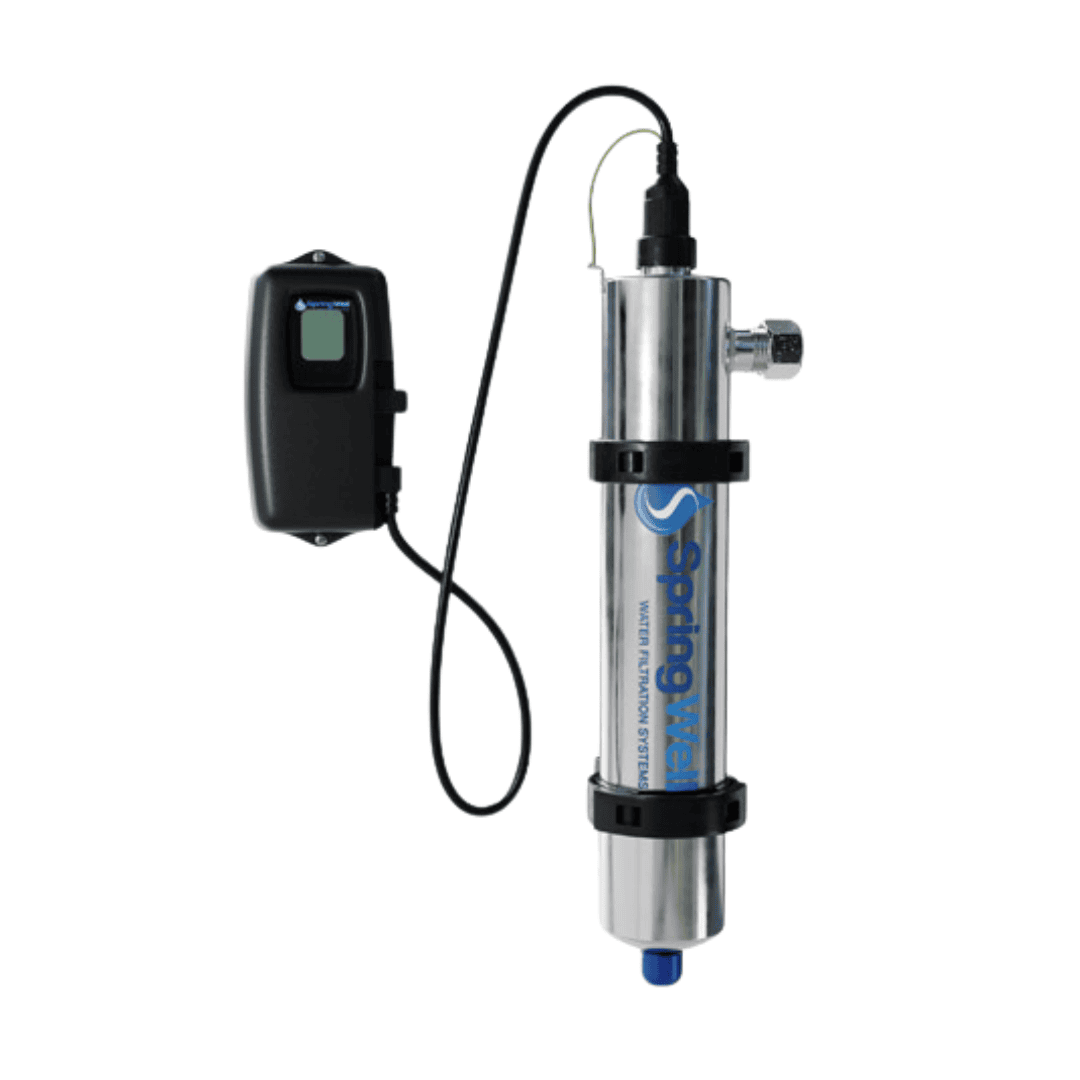
How to size UV for a well-water home
Start with realistic simultaneous household demand. Count showers, laundry, faucets, and appliances that can operate together. Then compare that peak flow with the reactor’s dose-specific rating.
If the home peaks at 10 GPM and the desired UV dose is verified only to 7 GPM, the reactor is undersized even if the plumbing port is large enough to pass 10 GPM.
Why bathroom count is not enough
A two-bathroom home with a large rain shower can use more water than a four-bathroom home occupied by two people. Use actual fixture demand and occupancy.
See What GPM Do I Need for a Whole-House Water Filter?.
Well-pump capacity also matters
Your treatment train cannot deliver more sustained flow than the well pump and pressure system provide. A large UV reactor does not create water. If the pump delivers 8 GPM, a 20 GPM reactor may offer little practical household benefit.
Pressure drop through pretreatment
UV itself can have relatively modest hydraulic restriction, but sediment filters, iron filters, softeners, and other stages add pressure drop. Evaluate the complete treatment train under flow.
Where UV should be installed
UV is generally installed near the end of the treatment train so the water is as clear and stable as practical before disinfection.
A typical sequence might be:
Well → sediment/iron/pH treatment as needed → softener if needed → fine filtration → UV → household distribution.
This is only an example. The exact order depends on water chemistry and equipment.
Why UV is usually the final treatment stage
Putting UV after fouling-removal stages protects the sleeve and improves UV transmission. It also means water receives disinfection immediately before entering household plumbing.
Should carbon go before UV?
When carbon is needed for taste, organics, or other contaminants, it is often installed before UV so the final water receives disinfection after carbon. Carbon can support microbial growth if neglected, so final UV can provide an additional barrier.
Should a softener go before UV?
In hard-water homes, softening before UV can reduce sleeve scale. But a softener is only warranted when hardness treatment makes sense for the household.
Iron filter before UV
When iron or manganese is significant, treatment before UV is usually preferable to repeatedly cleaning a fouled sleeve.
Acid neutralizer before UV
Low-pH water can corrode plumbing and equipment. Neutralization may be part of the treatment train before other stages. pH adjustment can also change hardness or sediment behavior, so the system should be designed as a whole.
UV and sulfur odor
UV is not a universal sulfur-odor treatment. Hydrogen sulfide gas often needs oxidation or specialty media. Sulfur bacteria can be part of some odor problems, but the correct solution depends on source and chemistry.
If odor appears only in hot water, inspect the water heater before adding a whole-house UV reactor.
UV and iron bacteria
Iron bacteria can form slime and deposits in wells and plumbing. UV can inactivate organisms passing through the chamber, but it does not remove established biofilm or iron deposits. Well cleaning, disinfection, and iron treatment may also be required.
NSF/ANSI 55 and private wells
NSF/ANSI 55 covers ultraviolet microbiological water-treatment systems. Exact certification class and application matter.
For a private well with potential microbial contamination, verify that the exact model is appropriate for the intended use rather than relying on a generic “UV purifier” label.
Class A systems
Class A systems are associated with higher-level microbiological treatment of contaminated but otherwise suitable water. They have more stringent dose requirements than supplemental systems.
Check current certification listings and manufacturer documentation for exact model scope.
Class B systems
Class B systems are intended for supplemental bactericidal treatment of water that is already considered safe. They should not be treated as equivalent to Class A in a private-well contamination scenario.
Why exact certification matters
A manufacturer can sell several UV models with similar names and different flow ratings. One may carry certification while another does not. Always verify the exact model number.
Monitoring features that matter on a well
Because the homeowner may rely on UV as a primary microbiological barrier, monitoring matters more than it does in a purely optional city-water installation.
Useful features include:
- lamp-status indicator;
- audible alarm;
- lamp-life countdown;
- UV intensity sensor;
- low-intensity alarm;
- automatic shutoff option;
- remote notifications on some systems.
Why intensity monitoring is valuable
A simple lamp-on light tells you only that the lamp circuit is operating. It does not directly tell you whether sleeve fouling or low UVT is reducing delivered intensity. A calibrated UV sensor can provide more useful operational information.
Automatic shutoff: useful or annoying?
A shutoff valve can stop water if the UV system cannot maintain treatment. This improves fail-safe behavior, but it can also leave the house without water during a lamp, sensor, or controller fault.
On a well where UV is genuinely required for microbial safety, a shutoff may be easier to justify.
Power outages
UV requires electricity. During an outage, the well pump may also stop unless backup power exists. If a generator powers the well pump but not the UV reactor, untreated water could flow.
Critical UV installations should include the reactor in the backup-power plan or use a shutoff strategy.
How often should the lamp be replaced?
Follow the exact manufacturer schedule. Many residential low-pressure mercury lamps are replaced around an annual interval because germicidal output declines over time even if the lamp still emits visible light.
Quartz sleeve maintenance
Inspect and clean the sleeve according to the manufacturer’s guidance. Iron, manganese, hardness, and other deposits can reduce UV transmission. Replace the sleeve if it becomes damaged, permanently clouded, or etched.
Why gloves and careful handling matter
UV lamps and quartz sleeves are fragile. Oils from hands can contaminate surfaces, and broken lamps require appropriate handling. Follow product instructions during maintenance.
Prefilter replacement
If a cartridge filter protects the UV system, that cartridge has its own schedule. A clogged prefilter can reduce household pressure and may cause the homeowner to bypass treatment, undermining the entire system.
How to sanitize plumbing after installation
Installing UV does not automatically disinfect existing downstream plumbing. When a well has a confirmed microbial problem, plumbing sanitation may be recommended as part of the corrective process. Follow appropriate professional or health-department guidance.
How to sample after UV installation
A post-treatment sample can help confirm that the system is performing under real conditions. Consider sampling immediately downstream of UV and, when relevant, at a distant faucet to understand downstream plumbing.
Why one clean test does not eliminate maintenance
A clean post-installation result is reassuring, but it does not guarantee future performance. Lamp aging, sleeve fouling, flow changes, and source-water changes can alter treatment. Continue maintenance and periodic testing appropriate to the well.
How often should a private well be tested?
Testing recommendations vary by jurisdiction and household circumstances. EPA encourages private-well owners to test regularly and after events such as flooding, repairs, or changes in water quality. Local health departments can provide location-specific panels and frequency guidance.
See Private Well Water Testing: What to Test Before Buying a Filter.
What if bacteria keeps coming back?
Repeated positive tests after shock disinfection or UV installation suggest the source needs deeper investigation. Potential causes include well construction, septic influence, surface intrusion, downstream plumbing, improper sampling, or treatment malfunction.
Do not respond only by installing a larger UV reactor.
What if the well is shallow?
Shallow wells can be more influenced by surface conditions than deeper protected aquifers. This does not automatically make them unsafe, but well construction and local hydrogeology deserve attention.
What if the well floods?
Floodwater can carry microorganisms and chemicals into a well. Follow local health guidance for inspection, disinfection, and testing before returning the water to normal use. UV alone should not be used as a shortcut around flood-recovery procedures.
What if the water suddenly becomes cloudy?
Investigate the source before relying on UV. New turbidity can reduce UV transmission and may indicate well or pump problems, sediment disturbance, or surface intrusion.
What if the well has nitrate?
UV does not remove nitrate. Nitrate requires appropriate treatment such as reverse osmosis or selective ion exchange depending on the scope and application. Elevated nitrate can be an important health concern, especially for infants.
What if the well has arsenic?
UV does not remove arsenic. Arsenic treatment depends on water chemistry and the form of arsenic present. Laboratory testing and appropriately designed adsorptive, oxidation, or membrane treatment may be required.
What if the well has PFAS?
UV does not remove PFAS. Whole-house GAC or ion exchange and point-of-use RO are among the technologies used for PFAS treatment. Exact system evidence and capacity matter.
Example: clean well with periodic coliform detections
A household has clear water, moderate hardness, no iron problem, and occasional confirmed coliform detections despite well maintenance. After the well is inspected and source issues are addressed, UV can be a logical final barrier. A sediment prefilter may be enough pretreatment if UVT is good.
Example: iron-rich well with bacteria
A different well has 3 mg/L iron, orange staining, sediment, and a bacteria detection. Installing UV directly on the raw water would be poor design. Iron and sediment should be addressed first so the sleeve remains clear and the reactor receives suitable water.
Example: very hard well water
A well has high hardness and otherwise clean water but the homeowner wants UV redundancy. Softening before UV can reduce sleeve scale and maintenance. The UV reactor is then sized to household peak flow.
Example: sulfur odor and bacteria concern
Hydrogen sulfide odor and a positive bacteria test can represent multiple issues. The system may need oxidation or sulfur treatment, sanitization, and UV. One technology does not replace diagnosis.
Five-year ownership cost
Include:
- UV reactor;
- installation;
- annual lamps;
- quartz sleeve replacement;
- sediment cartridges;
- sensor or controller service;
- electricity;
- any pretreatment installed specifically to protect UV.
Why the cheapest UV unit may not be the cheapest system
Replacement lamp cost, sleeve cost, controller availability, and required prefilters can dominate long-term ownership. A more expensive certified system with widely available parts may be easier to own than a low-cost reactor with proprietary consumables.
How to compare two well-water UV systems
| Factor | What to compare |
|---|---|
| Validated flow | GPM at the relevant UV dose |
| UVT assumption | Water clarity behind the rating |
| Certification | Exact model and application |
| Intensity sensor | Whether delivered UV is actively monitored |
| Shutoff option | Fail-safe behavior |
| Lamp interval | Replacement frequency and price |
| Sleeve service | Cleaning burden and replacement cost |
| Warranty | Reactor, controller, sensor, electronics |
Common mistakes on well-water UV
Mistake 1: buying UV before testing
You may miss iron, nitrate, arsenic, hardness, or another treatment priority.
Mistake 2: ignoring turbidity
Particles can shield microorganisms.
Mistake 3: ignoring iron and hardness
Fouling can reduce UV intensity.
Mistake 4: sizing by maximum GPM
Use dose-specific flow.
Mistake 5: treating UV as a well repair
Fix structural contamination pathways.
Mistake 6: forgetting downstream sanitation
Existing plumbing can remain contaminated.
Mistake 7: ignoring backup power
No electricity means no UV disinfection.
Mistake 8: never retesting
A maintained well still deserves periodic verification.
Well-water UV buying checklist
- Test the raw well water.
- Inspect the well if microbial contamination is confirmed.
- Identify sediment, turbidity, iron, manganese, hardness, and color.
- Choose pretreatment that protects UV.
- Estimate household peak flow.
- Compare flow at the desired UV dose.
- Verify exact certification or validation.
- Choose monitoring appropriate to the risk.
- Plan for power outages.
- Budget for lamps and sleeves.
- Plan downstream plumbing sanitation when needed.
- Retest after installation and periodically thereafter.
Frequently asked questions
Does every private well need UV?
No. The need depends on testing, well construction, local risk, household preferences, and whether microbiological contamination is a concern.
Can UV make unsafe well water safe by itself?
Not if the water has chemical contaminants, heavy turbidity, or untreated well problems. UV addresses microorganisms only when operating conditions are suitable.
Does UV remove iron?
No.
Does UV remove sulfur?
Not dissolved hydrogen sulfide as a general treatment objective.
Does UV remove arsenic?
No.
Does UV remove nitrate?
No.
Does UV remove PFAS?
No.
Can I install UV after a softener?
Yes, and softened water can reduce scale on the sleeve when hardness is high.
How often should the lamp be changed?
Follow the exact manufacturer schedule, commonly around an annual interval for many residential systems.
How do I know whether the UV is working?
Controller status, alarms, intensity monitoring, maintenance records, and periodic water testing provide different layers of verification.
What this means for you
UV is often an excellent final barrier for private wells, but only when it is part of a complete water-treatment plan. Test first. Repair well problems. Remove sediment, iron, scale, or color that can interfere with UV. Size the reactor by dose-specific peak flow. Maintain the lamp and sleeve. Retest the water.
Use Find My Filter to combine microbial treatment with the other needs revealed by your well test, and browse current UV and well-water systems for exact model details.
Primary references
How private-well risk changes after heavy rain
Heavy rainfall can alter groundwater conditions and increase the chance of surface influence, especially for shallow or poorly protected wells. A well that normally tests clean may show microbial contamination after a major storm or flooding event. This is one reason periodic testing and event-driven testing are both important.
A UV reactor can provide an ongoing barrier, but it should not be used as the only response to a well that repeatedly changes after rain. Inspect grading, casing, cap condition, and nearby contamination sources.
How drought can change well-water conditions
Drought can lower groundwater levels and change the proportion of water entering a well from different zones. Mineral concentrations, sediment, or other water-quality characteristics can shift. UV itself may continue operating normally, but upstream pretreatment settings and maintenance needs can change.
How a new well pump can change flow through UV
Replacing a weak pump with a larger pump can increase available household flow. If the UV reactor was sized to the old pump, the new system may be capable of pushing water through the reactor faster than the validated flow. After major pump or pressure-system changes, recheck the UV sizing assumptions.
How a pressure-tank change can affect peak flow
A new pressure tank or pressure-switch setting can change dynamic pressure and short-term flow. UV performance depends on actual flow through the chamber, not just the nominal plumbing size. Any major pressure-system change is a good time to verify the treatment train.
Why raw-water sampling should be accessible
A well-treatment installation is easier to troubleshoot when it includes a sample point before treatment and another after UV. Without access to raw water, it can be difficult to determine whether a changing result is caused by the well or the treatment system.
Why homeowners should know how to bypass the UV—but rarely leave it bypassed
A bypass is useful for lamp or sleeve service. It should be clearly labeled and returned to normal operation after maintenance. If UV is relied on for microbial safety, leaving the bypass open defeats the purpose of the system.
What a good well-water treatment record should include
- laboratory results;
- well inspection notes;
- shock-disinfection dates;
- UV model and serial number;
- lamp replacement dates;
- sleeve-cleaning dates;
- prefilter changes;
- controller or sensor service;
- post-treatment bacteria results;
- changes in pump or pressure settings.
This history makes future troubleshooting faster and helps a new homeowner understand the treatment system.
How to think about UV if the well is only used seasonally
Seasonal cabins and second homes can have long stagnation periods, winterization, and intermittent electrical service. At startup, inspect the reactor, confirm lamp life, service filters, flush plumbing, and follow appropriate sanitation/testing guidance. Do not assume a system that was working six months ago is automatically ready after a long shutdown.
How to think about UV in a home with infants
UV addresses microbial risk, but infants can also be especially vulnerable to contaminants such as nitrate. A UV installation should not create a false sense that all well-water risks have been solved. The broader well test remains essential.
How to think about UV in an immunocompromised household
Households with increased medical vulnerability may want more conservative water-management strategies. UV can be one barrier, but treatment and testing decisions should be coordinated with appropriate medical and water-quality professionals. FilterTier provides treatment information, not individualized medical advice.
UV and storage tanks on well systems
Some well properties use atmospheric storage or cisterns. If untreated well water sits in storage before UV, the tank must be maintained appropriately. If UV is installed before storage, the stored water can be re-contaminated because there is no residual disinfectant. Placement should be considered as part of the whole system.
Why UV after atmospheric storage is often logical
When a storage tank is necessary, placing UV after the tank and final filtration can provide disinfection immediately before household distribution. However, the storage tank still needs inspection, cleaning, and protection from contamination.
How to think about multiple buildings on one well
A property may supply a main house, guest house, barn, or accessory dwelling unit from one well. Peak flow and downstream plumbing complexity can increase substantially. One central UV reactor can work if sized for total demand, but long distribution runs and building-specific plumbing can still create downstream issues.
Should each building have its own UV?
In some multi-building layouts, separate final UV treatment near each occupied building can provide redundancy and easier sizing. In others, a single point-of-entry reactor is simpler. The correct design depends on plumbing, storage, flow, and how critical the treatment is.
How to evaluate low-cost UV systems
Budget UV reactors can provide basic disinfection, but compare more than lamp wattage. Look for dose-specific flow, certification or validation, controller reliability, replacement lamp price, sleeve availability, warranty, and alarms. A low purchase price is less attractive if proprietary consumables are difficult to find.
How to evaluate premium UV systems
Premium systems may add intensity sensors, sophisticated controllers, remote alerts, automatic shutoff, stronger certification, and better support. Those features can be valuable when the household relies on UV as a primary barrier, but they are not automatically necessary for every well.
When a flow restrictor is important
A properly selected flow-control device can prevent water from exceeding the reactor’s validated flow. Homeowners should not remove a restrictor simply to increase shower performance without understanding the effect on UV dose.
When a larger reactor is the better fix
If a home consistently needs more flow than the current reactor supports at the desired dose, upsizing the reactor is better than bypassing, removing flow control, or accepting unverified treatment.
Why whole-house UV should not be hidden in inaccessible plumbing
Lamps and sleeves require service. Leave enough clearance to remove the lamp and sleeve without cutting pipe or dismantling nearby equipment. Mechanical-room planning has a direct effect on whether maintenance actually happens.
Installation orientation matters
Some UV chambers can be mounted vertically or horizontally; others have preferred orientations. Follow the manufacturer’s instructions to ensure proper flow, air removal, and service access.
How UV works with whole-house carbon on a well
Carbon can remove organic compounds and improve taste, but it can also become a biological growth surface if neglected. Installing UV after carbon can provide a final microbial barrier. The carbon stage should still be maintained and sized appropriately.
How UV works with reverse osmosis
Whole-house UV and under-sink RO often complement each other. UV addresses microbial risk throughout the home, while RO can reduce dissolved contaminants at the drinking-water faucet. Neither replaces the other.
How UV works with nitrate treatment
If nitrate is present, a point-of-use RO or nitrate-selective ion-exchange system may be required in addition to UV. This is a good example of why a complete well test should drive the treatment train.
How UV works with arsenic treatment
Arsenic treatment may require oxidation and specialty adsorptive media or RO depending on chemistry. UV can be installed as the final microbial stage after those processes.
How UV works with PFAS treatment
PFAS treatment with GAC, ion exchange, or RO addresses a chemical concern. UV addresses microbes. A home can legitimately need both, but each stage should have separate evidence and maintenance.
A homeowner’s annual UV service day
One practical approach is to schedule an annual treatment-system service day. Replace the lamp, inspect and clean the sleeve, change protective cartridges as needed, inspect for leaks, check alarms, verify bypass position, review the well cap and visible plumbing, and schedule any recommended water testing. Bundling tasks makes maintenance easier to remember.
When to call a professional
Professional help is especially useful when the well repeatedly tests positive, has complex iron/sulfur chemistry, uses multiple backwashing tanks, has unusual storage, serves multiple buildings, or requires treatment for health-relevant chemical contaminants in addition to microbes.
Final well-water decision test
A well-water UV recommendation is strong when you can answer four questions clearly: What microbial risk exists? What pretreatment makes the water suitable for UV? What dose-specific flow does the household need? How will the system be monitored and maintained? If those answers are vague, more testing or design work should happen before the equipment is purchased.
Questions to ask before signing a UV installation quote
- What laboratory result or well condition justifies UV?
- What contaminants still need separate treatment?
- What is the raw-water turbidity, iron, manganese, hardness, and pH?
- What pretreatment will protect the quartz sleeve?
- What household peak flow was used for sizing?
- What UV dose applies at that flow?
- Is the exact model certified or independently validated?
- Does the system monitor UV intensity or only lamp status?
- What happens during a lamp or controller failure?
- How much do the lamp and sleeve cost?
- Will the installation include sample ports and a bypass?
- What annual testing and maintenance will be recommended?
A good proposal should answer those questions directly. If the quote is based only on “number of bathrooms” or a generic statement that every well needs UV, ask for a more specific treatment rationale.
How to know when UV is doing a defined job
Imagine removing the UV reactor from the treatment train. If that would eliminate the only microbiological barrier after a well with documented bacteria risk, UV has a clear purpose. If nothing about the water test or well history changes and the system was added only because “UV sounds safer,” the value is less clear.
Private-well treatment works best when every piece of equipment can be tied to a measured condition or an explicit precaution. That makes maintenance easier too, because the homeowner understands what is at stake if a stage is bypassed or overdue.
Final perspective
UV is one of the strongest technologies for a narrow job: microbial disinfection. On private wells, that job can be genuinely important. The mistake is allowing that strength to become a claim that UV “purifies everything.” Test the well, fix structural problems, pretreat the water, size the reactor to real flow, verify the evidence, maintain it, and keep testing. That is the difference between owning a glowing tube and operating a real disinfection barrier.
That approach also protects the rest of the treatment system. When iron, sediment, hardness, or low pH are corrected for their own reasons, the UV reactor receives cleaner water, lamp output is used more effectively, and sleeve maintenance becomes more predictable. A well-designed system is therefore not a collection of unrelated tanks; it is a sequence in which each stage prepares the water for the next one and every stage has a measurable purpose.
For that reason, the most useful UV purchase is rarely the one with the brightest lamp or largest headline GPM. It is the reactor that fits the tested well water, verified household flow, pretreatment plan, and maintenance routine you can sustain for years. That is the standard FilterTier uses when comparing UV systems.
When those pieces line up, UV becomes a dependable final barrier instead of an expensive accessory. When they do not, more testing and system design should come before installation.
Test first, then design the barrier.