Bottom line: Cloud RO, Waterdrop G3P800 and iSpring RCC7AK suit different households. Compare exact-model certification evidence, space, electricity, maintenance and transparent five-year consumable costs before deciding.
The short answer
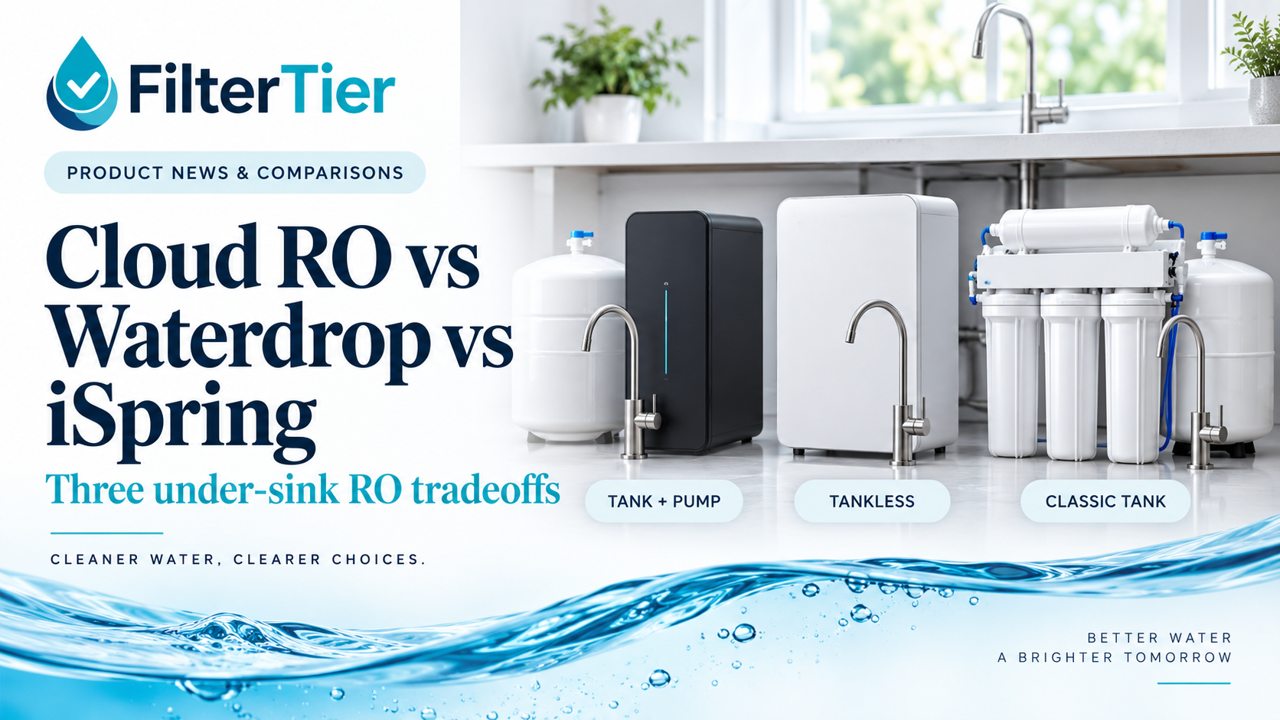
For a buyer comparing Cloud RO, Waterdrop G3P800, and iSpring RCC7AK, the meaningful choice is not simply which system lists the largest gallons-per-day number. These systems represent three different ownership approaches: Cloud emphasizes a premium managed drinking-water experience; Waterdrop G3P800 emphasizes a compact, electrically powered tankless form factor; and iSpring RCC7AK uses a conventional storage-tank architecture with an alkaline post-filter. The best fit depends on cabinet space, access to electricity, maintenance preferences, verified contaminant claims, and what replacement parts will cost across five years. This comparison distinguishes verified source facts from claims that still require exact-model confirmation. A number advertised for one model cannot automatically be transferred to another variant. Nor does a general description of reverse osmosis establish certification for every possible contaminant. This October 2026 review is deliberately about current buying and ownership decisions, not the evergreen question of whether to install any reverse-osmosis system at all. Readers who need that broader decision should first consult FilterTier's whole-house versus under-sink RO guide.
What is actually being compared?
Cloud RO, Waterdrop G3P800, and iSpring RCC7AK should be evaluated as exact configured products, not interchangeable brand names. Waterdrop's G3P800 is an 800-gallon-per-day nominal tankless unit marketed with an electric pump, a smart faucet and UV features. Those features add electronic convenience but also require a nearby appropriate electrical outlet. The iSpring RCC7AK is a more traditional multi-stage under-sink system with a storage tank and a remineralization stage. It is important not to confuse RCC7AK with RCC7AK-UV, which adds ultraviolet treatment, or with other iSpring systems in the RCC family. Cloud has its own cartridge ecosystem and design priorities; verify the exact current Cloud package, accessories and support terms when obtaining a quote. A storage tank supplies a reserve of already-treated water, while a tankless system must produce water as it is dispensed. Those architectures create different patterns of noise, refill behavior, peak dispensing and maintenance. A tankless label does not prove superior contaminant reduction; a tank does not prove greater waste; and a larger advertised production figure is not the rate coming out of a faucet.
At-a-glance comparison table
| Buying dimension | Cloud RO | Waterdrop G3P800 | iSpring RCC7AK |
|---|---|---|---|
| Decision emphasis | Premium ecosystem and ownership experience | Tankless design and powered high-output production | Conventional storage-tank RO and replaceable cartridges |
| Tank architecture | Confirm exact package specification | Tankless | Pressurized storage tank |
| Electrical needs | Check current package | Requires electricity | Conventional non-UV RCC7AK generally operates without a powered boost pump; verify configuration |
| Nominal output | Verify on current technical sheet | Manufacturer lists 800 GPD under rated conditions | Verify exact RCC7AK membrane rating on current sheet |
| Remineralization | Check selected configuration | Optional bundles differ from standard unit | Alkaline remineralization post-filter |
| Replacement planning | Confirm proprietary cartridges and subscription terms | Model-specific twist-in cartridges | Multiple conventional filter stages and membrane |
| Evidence approach | Require exact-model performance sheet | Check exact certification listing and reduction claims | Check RCC7AK listing, not RCC7AK-UV |
The table avoids unsupported rankings and avoids treating manufacturer marketing as an independent test. Before ordering, save the current manual and performance data sheet for the precise SKU in your cart. Retailer bundles can change the number of cartridges or the included faucet without changing the family name.
Why a high GPD figure is not faucet flow
Gallons per day is a membrane-production concept. It does not mean a user can dispense that amount continuously from a faucet. In a tank-based system, the membrane refills stored water, often slowly, while the tank delivers a faster initial draw. As the tank empties, the delivery rate can change. In a tankless pumped system, the unit has to produce permeate while it is being consumed, so pump performance and incoming-water conditions become important. When someone asks whether an RO system can fill a large cooking pot, the most useful test is timed delivery at their sink. Fill a known-size vessel, note the temperature and incoming pressure, and repeat after the storage tank has partly emptied if the system has one. Manufacturer production ratings are measured under specified laboratory conditions. Water temperature, feed pressure, dissolved solids and cartridge age all influence real-world output. A chilly kitchen supply can slow reverse osmosis. The G3P800's nominal 800 GPD therefore should not be compared directly with an RCC7AK tank's initial dispensing rate. Ask for faucet flow data and test conditions. Avoid buying solely on a much larger GPD number if the household only fills a few glasses each day.
What under-sink space really means
Measure before you buy. The width of the open cabinet is only one constraint; the real installation envelope must allow tubing bends, filter removal, drain access and the movement needed to service the unit. Photograph the existing disposal, dishwasher hose, hot- and cold-water stops, plumbing trap and electrical outlet. A compact tankless box can free the footprint otherwise occupied by a cylindrical tank, but it may have restrictions on orientation, wall clearance or mounting. A traditional setup can use more floor area but distribute parts around awkward plumbing. For RCC7AK, the tank may sit beside the filter rack or at another permitted location if tubing length and pressure are acceptable. This flexibility can be more useful than a nominally slimmer machine in an irregular cabinet. For Waterdrop, review the required power and the installation manual's minimum clearances rather than assuming it fits because the marketing photograph looks small. For Cloud, confirm the current chassis and all accompanying parts. Leave room to see and wipe up leaks, to reach shutoff valves, and to change filters without removing half the cabinet. A design that barely fits on installation day can become expensive at the first cartridge change.
How the five-year ownership calculation works
Five-year cost should include more than the checkout price. A useful formula is purchase price plus initial plumbing and electrical work plus replacement cartridges and membranes plus service calls plus consumable accessories plus the cost of water and electricity, minus any included replacements. Do not add a filter to the five-year bill when it is already included in a subscription or bundle. Likewise, do not count a sixth-year cartridge installed after the end of the comparison. Start the clock on installation day and list replacements occurring before month 60. Model each stage separately: a nominal six-month prefilter may require nine or ten purchases during the first five years depending on whether the supplied cartridge covers the initial period; a twelve-month stage may mean four replacement purchases; and a twenty-four-month membrane may mean two replacements. The precise count changes when capacity in gallons is reached earlier than its time limit. Real prices also change, especially when retailers bundle cartridges or run seasonal promotions. For fair comparison use manufacturer-listed replacement prices and dates, then verify today's cart price before publication or purchase. A single five-year total without transparent assumptions gives false precision.
Waterdrop replacement-filter example
Waterdrop lists three specific G3P800 replacement filters on its current product page: a G3-N1CF prefilter advertised at $29.99 and up to six months or 550 gallons, a G3-N3CB stage at $29.99 and up to twelve months or 1,100 gallons, and a G3P800-N2RO membrane at $139.99 and up to twenty-four months or 2,200 gallons. These are illustrative manufacturer storefront prices, not locked-in future prices. For a five-year ownership worksheet, assuming the first set is included at installation and each element reaches its time interval rather than its gallon limit, nine prefilter changes would total $269.91, four annual carbon changes would total $119.96, and two membrane changes would total $279.98. The sum is approximately $669.85 in those three cartridges alone over five years, before tax, shipping, price increases, optional remineralization filters, and any earlier capacity-based replacements. This example is arithmetic under stated assumptions; it is not a guarantee of what any buyer will spend. Some Waterdrop bundles include extra cartridges and use different SKUs. The optional remineralization version has additional maintenance. The correct comparison is standard configuration against standard configuration, or upgraded against upgraded, never a mix.
Cloud replacement costs need an actual quote
A fair Cloud five-year number requires a current verified schedule, exact cartridge pricing, and clarity on subscription or monitoring services. It would be misleading to invent that total from an old promotional price or assume its cartridge architecture matches Waterdrop's. Ask Cloud for an itemized package: base unit, included faucet, optional accessories, each consumable's SKU, replacement intervals in both time and gallons, shipping, warranty, and any subscription fees. If a subscription is optional, calculate both with and without it. If a service includes filter shipments or monitoring, count the value as an included service but do not subtract imaginary cash savings. Cloud's appeal may be partly the simplicity of keeping up with replacements and tracking the system rather than doing everything manually. That convenience has value to some buyers and little value to others. A comparison that treats all forms of service as equally unnecessary would miss an important part of the buying decision. Conversely, do not pay for a premium ecosystem without understanding the ongoing commitments. Write the quote date beside the total and update it whenever Cloud changes cartridges or packages.
iSpring replacement costs need stage-level accounting
Conventional RO systems often make replacement shopping easier because several prefilter housings may accept widely distributed cartridges. But compatibility and performance are not guaranteed merely because a third-party cartridge fits a housing. Different sediment grades, carbon formulations and seals can affect operation. For RCC7AK, obtain the current official replacement-kit list and confirm how often the manufacturer recommends changing each stage in your water conditions. The alkaline cartridge should not be ignored: it affects the output-water taste and mineral addition and adds maintenance cost. A membrane can last longer than an initial set of prefilters under suitable conditions, but the replacement interval is not universal. A family that consumes more treated water or has more challenging incoming water may reach cartridge capacity sooner. When comparing aftermarket filter packs, assess the full kit price, shipping, the number of pieces, and whether the exact filter is covered by a manufacturer or certifier's performance listing. A low-priced generic pack that changes the certified system configuration may save money while weakening the evidence behind the original contaminant claim. Record the actual installed part numbers every time you service the system.
How much water does each system send to drain?
A reverse-osmosis membrane separates feed water into treated permeate and reject concentrate. The concentrate carries substances the membrane has rejected and is sent to a drain. That process consumes water, and efficiency varies significantly among designs. EPA explains that a typical point-of-use system may send five or more gallons of reject water to drain for one gallon of treated water, while WaterSense-labeled products meet a much tighter maximum waste-to-treated threshold of 2.3 to 1. That benchmark is important but should not be attributed automatically to any one of the three systems. Waterdrop markets the G3P800 with a 3:1 pure-to-drain ratio, which, if achieved under the applicable conditions, means three gallons of treated water per gallon of reject water. That is the inverse orientation of the common waste-to-product wording. In ordinary notation it would equal about 0.33 gallons of drain flow for every gallon produced; actual household efficiency may differ. Cloud and iSpring need their own exact-model tested figures. Do not borrow water-efficiency numbers from a similar product, from a promotional chart, or from the broader category.
A household water-use example
Suppose a household uses three gallons of RO drinking and cooking water each day. Over a 365-day year that is 1,095 gallons of treated water, not a prediction of any specific family's consumption. Using EPA's illustrative typical 5:1 waste-to-product ratio yields about 5,475 gallons of reject water annually; using a hypothetical 2.3:1 ratio yields roughly 2,519 gallons; using a hypothetical 0.33:1 ratio yields around 365 gallons. The differences are meaningful, but these figures are scenarios, not measured output for Cloud, G3P800 or RCC7AK. Actual operating cost depends on combined water and wastewater tariffs and on how the specific system behaves over its full cycle. Tank systems may display different behavior during short tank refills versus lengthy production runs. A water-saving upgrade is not financially compelling merely because a ratio looks dramatic: in a low-cost water district, the absolute dollar amount may be modest. In a drought-prone region, avoiding several thousand gallons can matter even when bills are not high. If conservation is a primary goal, prioritize independent efficiency evidence and check EPA's WaterSense product directory.
Certification is model-specific, not a brand halo
NSF/ANSI 58 covers reverse-osmosis drinking-water treatment systems. A certification to the standard should be read alongside the exact certified performance claims and the model or configuration listed. Certification of a component or a materials standard is not equivalent to certification of a finished system for a given contaminant. NSF/ANSI 42 addresses aesthetic effects and NSF/ANSI 53 addresses specified health-effect reduction claims; NSF/ANSI/CAN 372 is a lead-content requirement, not a contaminant-removal certificate. A website displaying several standard numbers does not establish which optional claims were evaluated. The independent listing is the place to confirm it. Waterdrop states certifications for the G3P800 on its current product pages; before attributing any particular contaminant percentage, inspect the current certifier entry or product data sheet. NSF maintains an official listing search for iSpring models, including RCC7AK-related entries, but the exact name, facility and performance claims matter. Ask Cloud for its corresponding current listing and data sheet. Where evidence cannot be matched to the actual purchased variant, the responsible conclusion is 'not independently verified here', not 'the product does nothing' and not 'it removes everything'.
PFAS, lead, arsenic and other targets
A household interested in PFAS should begin with the actual compounds of concern, the incoming-water evidence, and the treatment claim. PFOA and PFOS are not a substitute for every PFAS; similarly, a broad mention of heavy metals does not tell a reader the tested performance for lead, arsenic or chromium. Reverse osmosis can be an effective technology for many dissolved contaminants, but real claims require exact-system documentation. Check whether the performance sheet specifies the influent concentration, reduction percentage, treated-water capacity and replacement conditions. If local water data flags an issue, do not assume a standard kitchen filter fixes every exposure pathway. Treat the drinking and cooking water that matters, and obtain qualified advice where necessary. For a localized starting point use FilterTier's What's in My Water reports, then read the utility's current consumer confidence report and any open advisories. For an explanation of certification versus advertising language, use FilterTier's PFAS filter-claims guide. This comparison intentionally avoids assigning unsupported contaminant-removal percentages to the three models.
Why TDS readings cannot confirm PFAS removal
A smart faucet that displays total dissolved solids may be useful for noticing changes in bulk ionic content, but its number is not a PFAS test. TDS includes a mixture of dissolved salts and minerals and is measured indirectly using conductivity. Trace contaminants can be present at concentrations too small to dominate the TDS number. A low TDS reading therefore cannot prove that lead, pesticides or specific PFAS compounds are absent. Equally, an elevated TDS reading after a remineralization cartridge may reflect intentionally added minerals rather than failure of the RO membrane. For system monitoring, compare readings with the manufacturer's expected behavior and maintenance guidance, and use laboratory testing for contaminant-specific decisions. This matters particularly when choosing Waterdrop's smart faucet or Cloud's connected experience: the technology can improve maintenance awareness without replacing independent tests. A dashboard should communicate what it measures, not imply universal purity. Ask what events trigger filter alerts and whether those alerts are based on elapsed time, estimated water volume, sensor measurements or a combination.
Remineralization: taste feature, not a purity score
The iSpring RCC7AK includes an alkaline remineralization stage. Waterdrop sells G3P800 bundles that add mineral or alkaline accessories, but those are not necessarily included with the base configuration. Cloud's current package must also be checked rather than assumed. A remineralization filter can change taste and raise measured dissolved solids by adding selected minerals after the RO membrane. Whether a particular person prefers that taste is subjective. Remineralization should not be scored as an automatic health advantage without evidence tied to the product and household context. It also should not be described as another contaminant-removal stage merely because it follows purification. Consumers who prefer a relatively neutral taste may like the output of one system; others may prefer the added mineral profile. If you're comparing taste, try samples served at similar temperatures in clean containers and ideally without knowing which system produced which glass. For families with medical or dietary reasons to manage mineral intake, product-marketing descriptions are not individualized medical advice. Verify the chemistry and consult an appropriate professional when necessary.
Electricity, noise and reliability
A tankless, pump-driven RO unit may make mechanical sound while producing water. Its faucet display, pump and optional UV components also introduce electronic parts that need power and may eventually need service. A conventional non-pumped RCC7AK has fewer electrically dependent functions, though any added UV, booster or monitoring module changes that picture. In a blackout, a conventional tank may still dispense some stored water, subject to pressure and how the installation was configured. A powered tankless unit may not. Cloud's precise power and backup behavior should be confirmed against the current configuration. Noise claims made in advertising are difficult to compare without a standardized test at the same cabinet and feed conditions. Ask whether the pump runs after the faucet is closed, whether the product has a leak detector, and what happens when a sensor or power supply fails. Households with open kitchens or bedrooms near the kitchen may prioritize sound and vibration. A professional installation can reduce rattling by securing tubing and keeping the chassis from contacting cabinet panels, but it cannot change the inherent architecture.
Installation plumbing and drain safety
All three categories require careful connection to the cold-water supply and safe disposal of concentrate water. The drain saddle must be installed where permitted by the product instructions and local plumbing rules, with attention to dishwasher connections and drain geometry. Do not connect to hot water unless the exact manufacturer instructions explicitly allow it. Confirm operating pressure; low pressure can reduce RO production, while overly high pressure may exceed the unit's limits. Verify the supply shutoff operates before opening plumbing, protect the cabinet base, and follow the maker's flushing procedure before using water for drinking. A powered system needs an appropriate outlet in a dry, permitted location. Never solve an outlet issue with an unsafe extension cord in a damp sink cabinet. A professional installer may be worthwhile when the sink has a garbage disposal, tight clearances, stone countertops or difficult drain access. Installation estimates should be included in five-year calculations. One low purchase price can lose its advantage if significant carpentry or electrical work is required.
Faucets, refrigerators and ice makers
A household may want treated water at the kitchen faucet, a refrigerator, a coffee machine and an ice maker. That is more complicated than buying a box with a high daily production rating. A refrigerator connection may require additional tubing, a tee fitting, pressure controls or a suitable storage arrangement. Long tubing runs add friction loss, and high-demand ice machines may expose weak output or insufficient tank capacity. If the household plans to feed multiple outlets, obtain written confirmation from the product manufacturer that the selected system and accessories support the setup. Consider the existing refrigerator's internal filter and whether it should be bypassed under the appliance maker's instructions. Check that the RO system's output quality is appropriate for the connected device and that installation won't void warranties. Under-sink RO is usually a point-of-use drinking-water solution, not a substitute for the home's whole-house flow capacity. Do not equate 800 GPD with the ability to supply a shower or whole-building plumbing. For broader treatment, consult FilterTier's rankings and relevant system categories.
Water pressure and feed-water limitations
The best RO system can perform poorly when installed on unsuitable feed water. Before comparing brands, measure supply pressure at the proposed connection and identify whether your home uses municipal or private well water. Review incoming hardness, iron, manganese and sediment as potential pretreatment issues. Different membranes and valves may tolerate these differently, and heavy scaling can shorten service life. If the house has a softener upstream, check compatibility and whether that changes product warranty or servicing recommendations. Cold water slows membrane production, which matters more in winter. Some manufacturers specify feed-water temperature and TDS ranges, while other contaminants may require a different treatment approach or professional evaluation. A large production rating quoted at warm laboratory conditions should not be assumed in a cold basement with low incoming pressure. Ask the company for its technical operating envelope and a realistic performance estimate using your measured numbers. Never exceed the listed pressure or temperature limits to force a faster flow.
How much maintenance work will you do?
Maintenance has two forms: routine planned replacement and unexpected troubleshooting. Waterdrop's twist-in cartridge approach may reduce the handling associated with opening separate filter housings. Conventional multi-stage systems may demand more deliberate replacement steps and flushing but can make it easier to understand each treatment stage. Cloud may trade hands-on scheduling for a more managed experience depending on the purchased service. Decide what you are willing to do each year. A buyer comfortable recording maintenance dates and changing several cartridges may value conventional parts availability. Someone who will neglect replacements without automated reminders may value connected status alerts. Neither preference demonstrates better water quality. Keep a log with installation date, part number, meter reading where available and any change in taste or output. Maintain spare O-rings or tools only if the maker recommends them. Never extend a cartridge interval simply because the water still tastes acceptable; some contaminants do not noticeably affect smell or flavor.
Warranty and long-term support
A warranty's nominal length is only part of its value. Review exclusions for installation errors, unusual feed-water chemistry, improper pressure, modifications and non-approved replacement parts. Read who pays return shipping or labor and whether support will diagnose a problem using photographs or sensor data. For a conventional system, confirm replacement availability for the membrane housing, tank bladder, automatic shutoff valve, tubing and faucet. For an electronic unit, confirm availability of the power adapter, display faucet, pump and main control components. Cloud, Waterdrop and iSpring should be assessed under the current warranty terms for the exact SKU, not a warranty quoted in an old review. Also ask what happens when a model is revised. Will compatible replacement filters be supplied for several years? Are subscriptions transferable when moving home? Can the system continue filtering without a connected app? These questions often matter more over five years than an introductory discount.
How to compare the true five-year bill
Build one spreadsheet row per expense and separate verified figures from assumptions. For every model, list the initial system price, any coupon that is reliably available, installation, included replacement cartridges, each future scheduled filter purchase, electricity estimate if relevant, water and sewer costs, optional subscriptions, and contingency for repairs. Do not use an unsupported point estimate when a supplier hasn't published a price: record 'quote required' with a link and leave the total provisional. Create both a baseline and a high-use scenario. In the baseline, cartridges reach their advertised time interval before rated gallon capacity; in the high-use scenario, they may reach gallon capacity sooner. Include price-increase sensitivity because replacement consumables can rise over five years. A reasonable comparison might show a verified-cost subtotal and a separate unknown-cost column instead of pretending every cell is equally certain. For Waterdrop, the three-filter replacement example above is useful only under its listed assumptions. For iSpring, use actual kit SKU prices. For Cloud, use the current manufacturer's quote. A published ranking that substitutes guesses for missing inputs would reward incomplete documentation, which is the opposite of evidence-first research.
Scenario one: a small apartment with a crowded cabinet
Consider a renter or condo owner with limited under-sink storage, a disposal and only a narrow open strip beside the plumbing. A tankless Waterdrop can be appealing because it avoids an extra cylindrical storage tank, but the cabinet must have the necessary power and service clearance. The higher initial product price may be acceptable if the saved cabinet footprint matters. RCC7AK may still fit if the storage tank can be placed to one side with compliant tubing, and it may suit someone who prizes mechanical simplicity. A Cloud package is worth assessing if its size, included accessories and maintenance ecosystem fit the apartment's setup and the owner values that experience. None of these choices is automatically suitable for a rental: drilling countertops, connecting drains and adding electrical service may require landlord or condo approval. Before buying, sketch the cabinet footprint and service envelope at scale. Check that a replacement cartridge can be removed after installation, not merely that the housing can be squeezed through the door.
Scenario two: a family that fills many bottles
A family preparing lunches, filling reusable bottles and using filtered water for cooking may care more about convenient delivery and predictable daily output than the cosmetic size of the equipment. A tankless unit with a relatively high rated production capacity can be appealing, but verify real faucet fill time, noise and behavior when several water draws follow each other. A well-sized storage tank can also deliver satisfying bursts of water before the membrane needs to refill it. The family should estimate actual filtered-water consumption in gallons per day, then convert that into annual output to see whether cartridge capacities will be reached earlier than their advertised months. Waterdrop's stated gallon limits on each filter are particularly important here. For Cloud, obtain the same capacity information before using a simple annual cartridge budget. For iSpring, check tank reserve and refill performance. Add a refrigerator or coffee-maker line to the test plan if the family expects one. The winner is the system that handles daily routines without introducing inconvenient downtime.
Scenario three: a buyer targeting a specific contaminant
Imagine a home whose utility report documents a contaminant concern and whose owner wants extra protection at the kitchen tap. The first step is not choosing the best-looking RO machine. It is verifying what is present, whether the utility has issued a current advisory, and which treatment claims independently apply. For PFAS, look for the exact compound or defined group on the product's certified data sheet. For lead, address possible household plumbing sources and test appropriately. Do not use a TDS number as a substitute for lead or PFAS results. Compare certified contaminant reductions across Cloud, Waterdrop and iSpring only if the independent listings cover the exact systems being sold. If the data sheet is missing or a certification is limited to material safety, mark that evidence as unknown instead of declaring a winner. Some contaminants may be adequately addressed by other, less water-intensive technologies. EPA does not recommend RO for every home. A professional or state-approved laboratory can help clarify what the household actually needs before a costly purchase.
Scenario four: the buyer who wants minimal fuss
A buyer who would rather pay more than remember multiple replacement dates should compare complete maintenance experiences. Does the faucet or mobile dashboard warn about cartridges, and does the warning estimate actual remaining capacity or merely track time? Are future filters automatically shipped? Can replacements be installed without special tools? How does support handle leaks or sensor errors? Waterdrop advertises fast twist-in replacements, while Cloud may appeal for its ownership ecosystem. Traditional RCC7AK is not inherently inconvenient, but its multiple-stage servicing takes attention. A set of calendar reminders can close some of that gap at no product premium. On the other hand, an electronic interface can fail or create dependence on an adapter, proprietary part or app. The best low-fuss solution is one the owner understands, can maintain, and can obtain replacement filters for. Ask to see the maintenance instructions rather than relying on the phrase 'easy replacement'. If the installation is so tight that ordinary servicing requires a plumber, no cartridge technology is genuinely low-maintenance.
Scenario five: the lowest defensible total cost
A budget-minded homeowner should compare the cost to own, not the lowest sticker price or the most aggressive coupon. Conventional RO may be competitive when replacement parts are accessible and the owner can perform routine maintenance. But a bargain unit with a poor water-efficiency ratio or a costly installation can narrow the advantage. Conversely, a premium tankless system with proprietary cartridges may be worth paying for if compact size and convenience are substantial benefits. Treat manufacturer replacement schedules as upper bounds subject to local water and consumption; do not extend them to make a budget spreadsheet look better. Confirm that any less expensive compatible part preserves the performance claims you rely upon. Factor in an appropriate, leak-safe installation. Run the five-year calculation before searching for coupons. If actual component pricing is missing from a brand, compare only the known subtotal and identify the unknowns rather than silently making them zero.
A practical decision checklist
- Identify the precise SKU and included accessories in each quote.
- Measure your under-sink space and allow cartridge-service clearance.
- Check feed-water pressure, temperature and unusual chemistry.
- Decide whether you can provide a safe electrical outlet.
- Choose the contaminant claims that matter based on local evidence.
- Verify the exact finished system in independent certification listings.
- Record flow, efficiency and output claims with their test conditions.
- List every replacement cartridge's SKU, time interval, gallon capacity and price.
- Add installation, subscription, service, electricity and water costs.
- Check the manufacturer's warranty, parts availability and return policy.
- Calculate a baseline and high-consumption five-year scenario.
- Compare convenience, noise and faucet features only after the evidence and cost picture is clear.
This sequence prevents the common mistake of buying the largest advertised GPD or the cheapest initial bundle and discovering later that the cabinet, drain connection or consumables were overlooked. It also turns a marketing-heavy product comparison into a repeatable decision anyone can audit.
Questions buyers should ask before checkout
Ask these questions directly, preferably in writing: Is this the exact model covered by the linked performance sheet? Which contaminants are independently certified for reduction, and at what capacities? What is the measured drain-to-treated ratio under the certified conditions? Which faucet and accessories ship with the selected listing? Will the system operate when power is unavailable? How much space is necessary to change filters? Are replacements restricted to one manufacturer? What are the replacement intervals in gallons as well as months? Is any subscription required for alerts or warranty support? What installation issues can void coverage? Does the price include shipping, tax and professional installation? If the maker directs you to a broad category page rather than the exact model documentation, treat the response as incomplete. This does not prove the system is bad; it simply means the evidence is insufficient for a precise comparison. Retain screenshots or PDFs because storefront details change. A careful buyer can often eliminate a poor fit with these questions before spending anything.
Common comparison mistakes
The first mistake is comparing a standard G3P800 with a remineralization bundle as though they have identical filters and costs. The second is mixing RCC7AK with RCC7AK-UV or another RCC variant. The third is calling a component's materials certification a certified removal claim for the entire installed RO assembly. The fourth is treating an online TDS readout as a PFAS or lead laboratory result. The fifth is confusing a pure-to-drain ratio with its inverse drain-to-pure ratio. The sixth is applying a gallons-per-day rating to momentary faucet delivery. The seventh is assuming a tank-based system works at its best output until the very last drop of stored water. The eighth is treating cartridge replacement intervals as guarantees regardless of daily gallons or feed quality. The ninth is pricing all five years using an introductory bundle discount that may never recur. And the tenth is ignoring space for future service. An honest comparison explicitly names its missing values and identifies what documentation would resolve them.
Best for each buyer: conditional verdict
Waterdrop G3P800 is the most straightforward option to shortlist if your main constraints are a tankless layout, electrical power is available, you want smart-faucet conveniences, and you accept model-specific cartridge costs. iSpring RCC7AK is a logical shortlist for someone who prefers a conventional storage-tank arrangement, remineralization, and a maintainable multi-stage configuration without making electronic features the central value proposition. Cloud RO deserves consideration from the buyer who values the premium ownership approach, but a responsible five-year value judgment requires current Cloud package and consumable figures as well as its exact-system treatment evidence. This is a fit-based verdict, not a declaration of universally superior filtration. If contaminant-specific performance is the primary concern, independent claims can override all three convenience preferences. If there is no identified need for reverse osmosis, EPA advises checking whether another treatment approach would deliver the desired outcome with less water use. The most defensible purchase is the one whose specific claims, service assumptions and costs you can verify.
What this means for you
Start by gathering three documents for each finalist: the current installation manual, the exact model's certified performance information, and an itemized consumables schedule. Put them beside measurements of your cabinet and your household's expected daily RO use. If you have a local water concern, compare the exact target compounds rather than vague phrases such as 'hundreds of contaminants'. Calculate an initial purchase plus five-year operating scenario, and keep the unknown cells visibly unknown. Do not reject a model merely because an unverified number is absent; request it. Do not award imaginary points for marketing superlatives. After that, rank the features you experience every day: usable counter space, faucet speed, taste, noise, electricity dependence and maintenance effort. FilterTier's under-sink RO catalog and rankings can provide additional model context, but the checkout SKU and current manufacturer data sheet remain the final sources for configuration and price. Your household's answer may differ from someone else's, even when both start with the same city water.
Sources and methodology
Source standard: manufacturer pages are used for stated configurations and storefront replacement prices; EPA is used for WaterSense policy and efficiency concepts; independent certifier listings are the appropriate final authority for exact certified claims. Manufacturer specifications are not presented as independent test results.
- Waterdrop G3P800 product page, configurations, replacement SKUs and manufacturer prices.
- Waterdrop G3P800 specifications and water-ratio explanation.
- NSF official product listing search for RCC7AK.
- EPA WaterSense: point-of-use reverse osmosis systems.
- EPA directory of WaterSense-labeled RO systems.
- EPA WaterSense RO specification.
Research limitations: this article does not assign unverified Cloud cartridge prices, unverified exact-model contaminant reductions, or unsupported certification seals. Listed manufacturer prices and options change. The Waterdrop five-year cartridge example is a transparent scenario, not a quotation. Published and reviewed October 9, 2026; update figures and source listings when product configurations change.
Sources
Sources: Waterdrop G3P800 official product and replacement-filter listings; NSF certified drinking-water treatment unit database; U.S. EPA WaterSense point-of-use reverse osmosis guidance, certification requirements and efficiency directory. See source links and limitations in article.