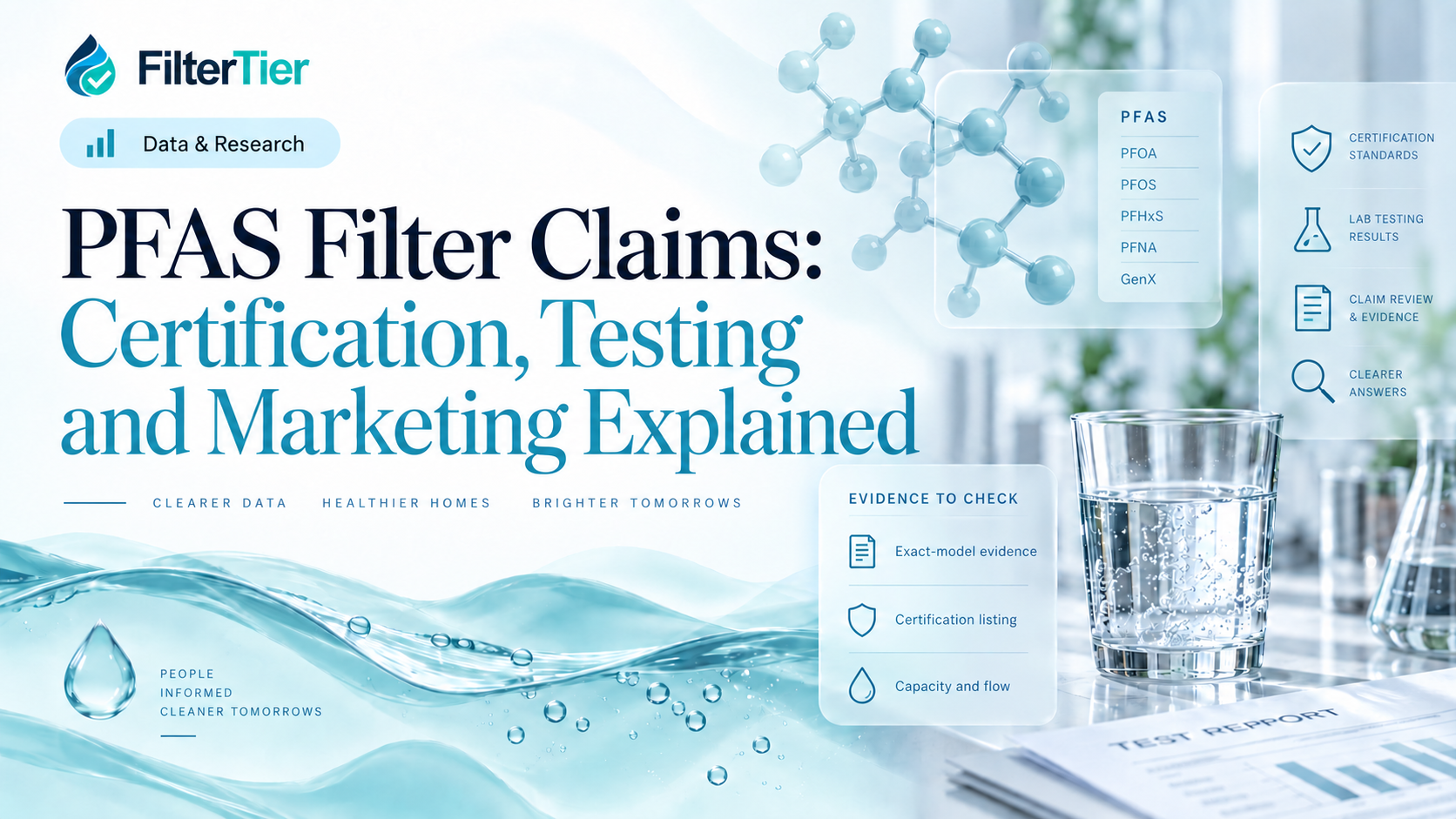
“Removes PFAS” can describe very different levels of evidence. One product may have an exact-system certification tied to a specific PFAS compound, flow rate and capacity. Another may use a carbon block or specialty media that was tested separately. A third may simply repeat a manufacturer performance claim. Those statements should not be treated as equivalent.
PFAS treatment is one of the clearest examples of why FilterTier separates the product, the evidence and the marketing language. A filter can use a technology that is broadly capable of reducing PFAS and still lack exact-system verification. A media can test well in a laboratory while the installed whole-house system operates at a very different flow. A brand can truthfully say a component is certified without the complete system being certified for the same claim.
The goal of this guide is not to say that only certified systems work. It is to show how to judge the strength of a claim so you know what you are actually buying.
Start with the exact product, not the media category
Activated carbon, specialty ion-exchange media and reverse osmosis can all be used for PFAS reduction in appropriate applications. But the fact that a technology can reduce PFAS does not prove that every product using that technology will perform the same way.
Whole-house treatment adds another complication: flow. A small drinking-water cartridge may operate at a fraction of a gallon per minute, while a whole-house system may need to maintain 8, 10, 15 or more gallons per minute during simultaneous use. Higher flow changes contact time and can change treatment performance.
That is why the right question is not “Does this system contain carbon?” but “What evidence exists for this exact system, at the flow and capacity relevant to the claim?”
PFAS is a family of chemicals, not one contaminant
PFAS is an umbrella term for a large family of fluorinated compounds. Product pages may refer generally to “PFAS” while underlying tests or certifications cover only specific compounds such as PFOA or PFOS.
This matters because a broad phrase like “removes forever chemicals” can sound wider than the actual evidence. When the product matters enough to influence a major purchase, identify the exact compounds named in the test or certification.
A system with evidence for PFOA and PFOS should be described accurately as having evidence for those compounds. It should not automatically be presented as verified for every PFAS compound.
Four common levels of PFAS evidence
1. Exact-system third-party certification
This is generally the strongest and easiest evidence to interpret. The assembled system is listed by a recognized certification body for a specific contaminant-reduction claim under a defined standard.
Exact-system certification helps answer several important questions at once:
- Which exact model was evaluated?
- Which contaminant or contaminants were included?
- At what rated flow?
- Through what capacity or service life?
- What replacement components maintain the listing?
Certification is not a universal endorsement of every marketing statement on the product page. It is evidence for the claims and conditions included in the listing.
2. Exact-product independent laboratory testing
An independent laboratory may test the exact product and report PFAS reduction. That can be useful evidence, especially if the test conditions are clearly disclosed.
However, one-time laboratory testing is not automatically the same as formal certification. Ask about test protocol, flow, challenge concentration, total gallons treated and whether the test represented the full assembled product.
3. Component or media evidence
A product may contain a carbon block, resin or specialty media that has been independently tested or certified. That tells you something useful about the treatment material, but it does not always prove performance of the complete installed system.
Housing size, media quantity, bypass behavior, flow distribution and total system flow can all influence performance.
4. Manufacturer claim
A brand may state that its system removes or reduces PFAS without making a third-party listing or complete test report easy to verify. The claim may still be based on internal testing or known media properties, but the evidence level is lower from the consumer’s perspective.
FilterTier does not automatically call such a product ineffective. We label the evidence type so it is not confused with formal exact-system certification.
“NSF certified” is incomplete unless you know what is certified
Water-treatment products can be certified under different standards for different purposes. A product might have certification related to structural integrity, materials, chlorine reduction or another claim while PFAS is not part of the certified scope.
Therefore, the phrase “NSF certified” by itself does not prove PFAS reduction.
Look at the certification listing and identify:
- the exact model;
- the standard;
- the specific PFAS compound or claim;
- the rated flow;
- the replacement cartridge or media configuration;
- the rated capacity.
FilterTier’s water-filter certification guide explains how to interpret certification language more broadly.
“Tested to NSF standards” is not the same phrase as “certified”
Manufacturers sometimes say a product was “tested to” a standard. That may mean a laboratory used a protocol modeled on the standard. It does not necessarily mean the product is currently listed by a certification body.
That distinction matters because formal certification typically includes defined product identity and an ongoing listing structure, while a one-time test report represents the sample and conditions tested.
Both can be useful. They are simply different evidence categories.
Why whole-house PFAS treatment is more demanding
Whole-house PFAS treatment must handle all or most of the water entering the home. That means showers, washing machines, dishwashers, faucets and other fixtures can create high simultaneous flow.
A filter that performs well at one gallon per minute may not have enough contact time or media volume for equivalent performance at 15 gallons per minute.
This is why whole-house PFAS systems often need large media tanks, large specialty cartridges, parallel configurations or other designs that provide enough media and contact time.
Contact time matters
Adsorptive treatment such as activated carbon relies on water contacting the media long enough for contaminants to be captured effectively. If flow rises without increasing media volume or improving system design, contact time can decrease.
Manufacturers may use different terms and design metrics, but the principle is simple: household flow cannot be ignored when evaluating contaminant reduction.
Service flow vs. peak flow
A product page may advertise “up to 20 GPM,” but that number may represent hydraulic flow rather than contaminant-reduction flow. Another product may have a lower certified flow tied directly to the health-effect claim.
Those numbers should not be compared as though they mean the same thing.
FilterTier distinguishes service, certified, rated and peak flow when source data supports that distinction.
Why capacity matters as much as the initial reduction percentage
A filter that removes a very high percentage of PFAS at the beginning of a test can still have limited useful capacity. Adsorption media has finite capacity, and treatment performance can decline as media becomes exhausted.
For certified products, use the capacity tied to the certification. For independent testing, ask how many gallons were treated and whether the test continued through an end-of-life condition.
A strong “99% reduction” headline without meaningful capacity context is incomplete.
What happens when media reaches capacity?
In adsorptive media, available treatment sites become occupied over time. Eventually contaminant breakthrough can occur. That is why replacement schedules should be based on capacity and use, not merely on whether water still tastes normal.
PFAS has no taste or odor you can use as a reliable breakthrough indicator.
Why household water use changes replacement cost
Suppose two homes use the same PFAS cartridge:
- Home A uses 150 gallons per day.
- Home B uses 450 gallons per day.
If replacement is based on total gallon capacity, Home B may consume that capacity roughly three times as fast.
This can dramatically change annual ownership cost. A product with an affordable cartridge may become expensive in a high-use household if its rated capacity is relatively low.
Translate gallon capacity into time before buying
Use a simple estimate:
Rated gallons ÷ average daily household gallons = approximate days to capacity.
This does not replace manufacturer guidance, but it lets you compare products in practical terms.
If a cartridge is rated for 100,000 gallons and your household uses 300 gallons per day, the simple estimate is about 333 days. A 500,000-gallon system under the same use would be about 1,667 days before considering other limits.
Carbon type matters
Not every carbon product is identical. Granular activated carbon, carbon block, catalytic carbon and other carbon formulations can differ in structure, pressure drop and treatment characteristics.
System design matters just as much as the media name. Large tanks can provide significant media volume, while high-density carbon blocks can provide controlled contact in cartridge systems.
Do not rank products solely by the word “carbon.”
What about ion-exchange media for PFAS?
Specialty ion-exchange resins can be designed to target PFAS and other contaminants. As with carbon, exact-product evidence, capacity, flow and replacement requirements matter.
The phrase “ion exchange” can also describe ordinary water-softening resin, which should not automatically be assumed to provide verified PFAS reduction. Media chemistry and intended application matter.
Reverse osmosis and PFAS
Reverse osmosis can be effective for many dissolved contaminants, including certain PFAS, and is commonly used at the drinking-water point. It treats a relatively small volume of water compared with a whole-house system.
Whole-house reverse osmosis is possible but is a much more complex design involving pretreatment, storage, pumps, waste/reject water and post-treatment.
For many households, point-of-use RO plus whole-house treatment for other goals can be more practical than whole-house RO solely for PFAS.
Whole-house vs. point-of-use PFAS treatment
Decide where treatment is needed.
Point-of-use treatment
Treats drinking and cooking water at a specific faucet. Advantages can include lower flow, lower equipment cost and access to high-performance drinking-water certifications.
Whole-house treatment
Treats water used throughout the home. This may be desirable when the homeowner wants broader exposure reduction or additional whole-house benefits such as chlorine or VOC treatment.
The best choice depends on the contaminant concern, household priorities and cost.
Do you need whole-house PFAS treatment?
There is no universal answer. Some households primarily care about drinking-water exposure and prefer point-of-use treatment. Others want PFAS reduction throughout the home.
Before spending several thousand dollars, confirm whether PFAS is present in your utility or well data and whether the concentration is relevant to your decision.
Use What’s in My Water? for public-system context and consider home testing when needed.
PFAS in public utility data vs. your faucet
Utility monitoring tells you what was found in samples from the public system. It may not reflect the exact concentration at your faucet at every time.
However, unlike lead, PFAS usually does not originate from household plumbing materials, so system-level source and treatment data can be especially relevant.
PFAS in private wells
Private wells are not monitored like public water systems. If PFAS contamination is a local concern, laboratory testing is the direct way to understand your well.
Nearby airports, fire-training areas, industrial sites, landfills and other sources can influence local PFAS concern, but proximity alone does not prove contamination at a particular well.
Do not use a generic home test strip for PFAS
PFAS is measured at very low concentrations and requires appropriate laboratory methods. Consumer test strips are not a substitute for a qualified PFAS laboratory analysis.
How to read a PFAS product page
When you open a product page, look for these phrases and ask what they really mean:
| Marketing phrase | What to verify |
|---|---|
| “PFAS removal” | Which compounds? What evidence? What flow and capacity? |
| “Certified carbon” | Is the carbon certified, the cartridge certified, or the whole system certified? |
| “NSF certified” | To which standard and which contaminant? |
| “Third-party tested” | Which lab, protocol, product and test conditions? |
| “99% reduction” | At what point in the test and through how many gallons? |
| “1,000,000 gallon capacity” | Is that capacity tied to PFAS performance or another claim? |
Why a chlorine capacity is not automatically a PFAS capacity
A carbon system may have a very large published capacity for chlorine reduction. That number should not automatically be reused as the PFAS capacity unless the evidence specifically ties PFAS performance to that gallon rating.
Different contaminants can break through at different times.
Why a structural certification is not a contaminant certification
Some standards address materials safety or structural integrity. Those are valuable certifications, but they do not prove a specific PFAS reduction claim.
Always match the certification to the claim.
Why exact model numbers matter
A manufacturer may sell several similar systems with different tank sizes, cartridges or flow ratings. One model may have a certification while another does not.
Do not transfer evidence between variants unless the certification listing specifically includes them.
Replacement cartridges can change the evidence
If a certified PFAS system requires a specific replacement cartridge, substituting a generic cartridge may remove the basis for the certified claim even if the new cartridge physically fits.
Compatibility and certification are separate questions.
What about systems sold in multiple sizes?
Whole-house product families often include small, medium and large variants. Larger tanks may increase flow or capacity, but not every variant necessarily has the same third-party evidence.
FilterTier tries to keep exact variants separate when size changes materially affect flow, capacity or treatment evidence.
Installation can affect performance
Even a good PFAS filter can underperform if installed incorrectly. Important factors include:
- correct flow direction;
- bypass configuration;
- proper flushing;
- correct cartridge installation;
- appropriate pretreatment;
- avoiding excessive service flow;
- timely replacement.
Follow the product’s installation instructions and use professional help when needed.
Sediment pretreatment can protect PFAS media
Heavy sediment can increase pressure drop and interfere with cartridges. A sediment stage ahead of the PFAS media may help protect the system, especially on well water.
However, adding a prefilter also adds another maintenance item and some pressure drop.
Hardness and PFAS are separate treatment problems
A PFAS filter does not automatically soften water, and a softener does not automatically treat PFAS. If a home needs both, the treatment train may require separate stages.
See Water Softener vs. Salt-Free Conditioner for the hardness side of the decision.
Chlorine and PFAS can sometimes be treated by the same carbon stage
Activated carbon may provide both disinfectant reduction and PFAS adsorption depending on system design and evidence. But the capacity for each claim may differ.
Do not assume the system’s chlorine life equals its PFAS life.
Pressure drop is part of whole-house PFAS design
Dense specialty cartridges can provide strong contaminant treatment but also create more resistance than large open media tanks. A high-quality PFAS system still needs enough flow to support the household.
When comparing products, look at both evidence and service flow.
High flow does not automatically mean better PFAS treatment
Hydraulic capacity and contaminant performance are different. A filter that passes 20 GPM with low pressure drop may not have verified PFAS performance at 20 GPM.
Use the flow tied to the treatment evidence whenever available.
What does FilterTier mean by evidence score?
FilterTier’s evidence scoring considers the strength and specificity of product documentation. Exact-product certification and clearly documented performance generally provide stronger evidence than broad family claims or unverified marketing language.
This does not mean a non-certified product cannot work. It means uncertainty should be visible.
Why FilterTier does not automatically rank the highest percentage first
A “99% reduction” headline is only one part of the decision. A lower headline percentage with strong exact-system certification, practical service flow, clear capacity and predictable maintenance can be a better consumer choice than a dramatic percentage with weak documentation.
Rankings also consider ownership burden, flow, value and fit for the category.
What WaterScore can and cannot tell you
WaterScore is a product-comparison framework, not a laboratory result. It helps summarize evidence, performance, maintenance, value and other tradeoffs.
It does not replace testing your water or reading the exact certification for a contaminant that matters to you.
Questions to ask a manufacturer
- Is the exact assembled model certified for PFAS reduction?
- If yes, which compounds?
- Which certification body lists it?
- What is the rated PFAS flow?
- What is the rated PFAS capacity?
- If not certified, is there an independent exact-product test report?
- Were the full system and exact cartridge tested?
- What replacement cartridge is required?
- How often should the PFAS media be replaced?
- What pretreatment is required?
A reputable manufacturer should be able to answer these questions without relying only on general claims about the media.
Questions to ask a dealer or installer
- What exact model are you installing?
- Where can I verify the PFAS claim?
- What flow should I expect at my household demand?
- How much will replacement media cost?
- Who performs the replacement?
- How do we know when capacity is exhausted?
- Can the system be sampled before and after installation?
Should you test after installing PFAS treatment?
If PFAS reduction is the main reason you purchased an expensive system, post-treatment testing can provide useful confirmation. It is especially valuable for non-certified systems or unusual water conditions.
Testing does not eliminate the need to replace media on schedule because a single sample does not guarantee future performance.
How to compare two PFAS systems fairly
Use the same criteria:
| Criterion | System A | System B |
|---|---|---|
| Exact-system PFAS certification | Yes / No | Yes / No |
| Named PFAS compounds | List | List |
| Verified service flow | GPM | GPM |
| PFAS capacity | Gallons | Gallons |
| Replacement cost | $ | $ |
| Prefilter required | Yes / No | Yes / No |
| Warranty | Terms | Terms |
| Installation burden | Low / Medium / High | Low / Medium / High |
This prevents marketing percentages from dominating the comparison.
Example: certified cartridge vs. uncertified large media tank
Imagine a certified cartridge system with a lower flow and a clearly defined PFAS capacity. Compare it with a large media tank that offers much higher flow and very low maintenance but only manufacturer PFAS claims.
The “better” system depends on priorities. If verified exact-system evidence is the top priority, the certified cartridge may win. If very high flow and low maintenance matter more and the homeowner accepts weaker PFAS evidence, the media tank may still be attractive.
The tradeoff should be explicit rather than hidden.
Example: point-of-use RO vs. whole-house PFAS filter
A homeowner mainly concerned with drinking water may achieve strong treatment more economically with certified point-of-use RO. Another household may want treatment at every fixture and accept the higher cost of a whole-house PFAS system.
Neither choice is automatically superior. They treat different scopes of water.
Common PFAS marketing mistakes
Mistake 1: “Uses activated carbon, so it removes PFAS”
Technology capability is not exact-product evidence.
Mistake 2: “NSF certified” without naming the standard or claim
Certification may be for something unrelated to PFAS.
Mistake 3: using component certification as whole-system certification
The complete assembly may not be listed.
Mistake 4: showing a reduction percentage with no capacity
Initial performance does not tell you how long treatment lasts.
Mistake 5: using a chlorine capacity as a PFAS capacity
Different contaminants can have different breakthrough behavior.
Mistake 6: quoting maximum hydraulic flow as verified PFAS flow
Those numbers may represent different conditions.
Frequently asked questions
Does activated carbon remove PFAS?
Activated carbon can reduce certain PFAS under appropriate conditions, but exact performance depends on media, system design, flow, water chemistry and capacity. Verify the exact product claim.
Does every carbon filter remove PFAS?
No assumption should be made without evidence for the product or application.
Is reverse osmosis good for PFAS?
RO can be an effective treatment for many PFAS compounds, especially in point-of-use drinking-water applications. Check exact-product certification or testing.
Does a water softener remove PFAS?
A standard hardness softener should not be assumed to provide verified PFAS reduction.
What is better: certified cartridge or large tank?
It depends on evidence, flow, capacity, maintenance and household priorities. Exact-system certification provides stronger certainty; larger tanks may offer better flow and lower maintenance.
Should PFAS filters be installed before or after a softener?
System order depends on the exact treatment train, water chemistry and manufacturer requirements. Follow the equipment instructions and design around pressure drop and protection of downstream media.
How often should a PFAS filter be replaced?
Follow the exact product’s PFAS capacity and replacement instructions. Do not use taste or odor as the primary indicator.
Can I test whether my PFAS filter is working?
Yes, with appropriate laboratory testing. Sample collection and detection limits matter.
Should I buy a PFAS system if my utility has no detection?
Not automatically. Review current utility data and your goals before making an expensive treatment decision.
Does a PFAS detection mean my utility is violating the law?
Not necessarily. Monitoring results and formal compliance determinations are separate questions. Use current regulatory and utility context.
A practical PFAS filter buying checklist
- Confirm PFAS is relevant to your water.
- Decide whether you need point-of-use or whole-house treatment.
- Identify the exact compounds covered by the product evidence.
- Verify whether evidence is certification, independent testing, component evidence or manufacturer claim.
- Check service flow at the treatment claim.
- Check capacity tied to PFAS performance.
- Translate capacity into replacement frequency for your household.
- Calculate replacement cost over five to ten years.
- Check pressure drop and installation requirements.
- Verify the correct replacement cartridge or media.
- Consider post-installation testing when PFAS is the primary reason for purchase.
How FilterTier evaluates PFAS products
FilterTier looks at the exact system, not just the brand. We separate:
- formal exact-system certification;
- third-party exact-product testing;
- component or media evidence;
- manufacturer claims;
- missing or unclear evidence.
We also consider household flow, maintenance burden, price, warranty and product transparency. That is why a PFAS ranking is not simply a list sorted by one reduction percentage.
See the current Best Whole-House Water Filters for PFAS and the broader FilterTier methodology for how evidence is incorporated.
What this means for you
PFAS treatment is a category where precise language matters. “Contains carbon,” “tested,” “certified component,” “certified system” and “manufacturer says 99%” are different evidence statements.
Start by confirming the PFAS concern in your water. Then choose the treatment scope—drinking water or whole house. Finally, compare products using exact-system evidence, flow, capacity and ownership cost.
If a product has excellent evidence but cannot meet your household flow, it may be the wrong whole-house solution. If a product has huge flow but weak evidence for PFAS, understand that uncertainty before buying.
Use What’s in My Water? to review public-system data, compare exact products in the FilterTier database, and use the PFAS ranking to see how current systems balance evidence, flow and maintenance.
How source-water chemistry can change PFAS treatment
PFAS media does not operate in a vacuum. Other organic compounds, dissolved minerals and water chemistry can compete for adsorption sites or influence media behavior. That is another reason laboratory performance under standardized conditions may not perfectly predict every home.
Exact-product certification and conservative replacement schedules reduce some of this uncertainty.
Why shorter-chain and longer-chain PFAS can behave differently
Different PFAS compounds can have different treatment behavior. A media that performs strongly for one compound should not automatically be assumed to have identical capacity for every other PFAS.
This reinforces the need to look at named compounds in test data rather than a broad “PFAS” label.
What to ask when a brand publishes only a media data sheet
A media data sheet can be useful, but ask how much media is in the residential system, what contact time is achieved at household flow, what the expected capacity is, and whether the complete product has been independently evaluated.
What to ask when a manufacturer says “non-detect”
“Non-detect” depends on the laboratory method and reporting limit. It does not mean absolute zero. Ask what detection limit was used, what the starting concentration was, how many gallons had been treated and whether the result came from the beginning or end of the test.
Why independent listings should be checked directly
Certification claims can become outdated as products change or listings expire. When the claim is important, verify it in the certification body’s current database rather than relying only on a retailer screenshot or old brochure.
How to compare dealer claims with manufacturer documentation
Dealers may paraphrase performance claims. Use the manufacturer’s current product documentation and independent certification listing as the primary evidence. A dealer’s broader statement should not override the exact published scope.
How PFAS treatment affects internal linking and research
When FilterTier publishes a PFAS article, it should connect readers to the relevant contaminant page, certification guide, exact system pages, PFAS ranking and local water data. This creates a research path rather than leaving the reader with a generic recommendation.
PFAS evidence hierarchy at a glance
- Exact-system current certification for the named compound.
- Exact-product independent testing with transparent conditions.
- Component or cartridge certification/testing.
- Media data applied to the system by inference.
- Manufacturer claim without accessible supporting detail.
- No verified evidence.
This hierarchy is not a guarantee of real-world performance, but it is a useful way to compare confidence.