
A whole-house water filter and an under-sink reverse-osmosis system solve different problems. Whole-house treatment is designed to handle high flow for showers, laundry, appliances and every faucet in the home. Under-sink RO treats a much smaller amount of water for drinking and cooking, which allows it to provide more intensive treatment without being sized for the entire house.
For many homes, the best answer is not “whole-house filter or RO.” It is “which contaminants matter at every fixture, and which only need to be treated at the kitchen sink?” Once you separate those two questions, the choice becomes much easier.
What a whole-house filter is designed to do
A whole-house filter is installed near the point where water enters the home. Depending on the exact system, it can target sediment, chlorine, chloramine, taste and odor, certain organic chemicals, PFAS, lead or other contaminants.
The defining challenge is flow. A whole-house system may need to treat ten or more gallons per minute while multiple fixtures operate at once. That changes filter size, contact time, pressure drop and cost.
Whole-house treatment is most useful when you want the benefit throughout the home rather than at one drinking faucet.
What an under-sink reverse-osmosis system is designed to do
Reverse osmosis uses a semi-permeable membrane to separate many dissolved substances from water. Under-sink systems typically treat a dedicated drinking-water faucet and sometimes a refrigerator line.
Because the demand is small, the system can operate at a much lower flow than a whole-house unit. That makes deep treatment of drinking water practical without requiring giant membrane arrays, storage tanks and pumps.
RO is especially attractive when the concern involves dissolved contaminants that are difficult to address with simple carbon filtration.
The core decision: treat every gallon or only the gallons you drink?
This is the most important question.
If your primary concern is chlorine taste at showers, sediment throughout plumbing or whole-house PFAS treatment, a point-of-use RO system does not address the water used everywhere else.
If your main goal is high-purity drinking water at the kitchen sink, it may be wasteful to install complex whole-house treatment for every gallon used in toilets, laundry and outdoor hose bibs.
Why many homes use both
A common design is broad whole-house treatment plus under-sink RO for drinking and cooking.
For example:
- Whole-house carbon filter: chlorine, chloramine, taste/odor and certain organic contaminants throughout the home.
- Water softener: hardness throughout the home.
- Under-sink RO: additional dissolved-contaminant treatment at the drinking-water faucet.
This layered approach can be more practical than trying to make one technology do everything.
Whole-house filtration and RO solve different engineering problems
A whole-house system is primarily a high-flow treatment challenge. An under-sink RO system is primarily a high-purity, low-flow treatment challenge.
Those design goals affect:
- media quantity;
- membrane size;
- storage;
- pressure requirements;
- waste/reject water;
- installation cost;
- maintenance;
- household pressure.
What whole-house carbon filtration does well
Large carbon filters can be effective for chlorine, chloramine in appropriately designed systems, taste and odor, some VOCs and certain other compounds.
Carbon can also be used for PFAS treatment, but exact-product evidence, capacity and service flow matter. A large carbon tank with a chlorine claim should not automatically be assumed to have verified PFAS performance through the same capacity.
What reverse osmosis does well
RO can reduce many dissolved contaminants, depending on the exact system and membrane. It is commonly used for drinking-water treatment where low flow is acceptable and a storage tank or tankless production system can meet demand.
RO can also reduce dissolved mineral content, which changes taste and total dissolved solids. That is one reason some systems add remineralization after the membrane.
What whole-house carbon does not do well
Standard carbon filtration is not a water softener and should not be assumed to remove hardness. It also should not be assumed to remove every dissolved inorganic contaminant such as nitrate or arsenic without specific evidence.
What under-sink RO does not do for the rest of the home
A kitchen RO system does not protect showers, washing machines, water heaters or bathroom faucets because those fixtures are not connected to the RO outlet.
If the goal involves equipment protection, whole-house hardness treatment or contaminant reduction throughout the home, point-of-use RO alone is not enough.
Whole-house RO is a different category entirely
Whole-house reverse osmosis exists, but it is much more complex than installing a large version of an under-sink unit.
Whole-house RO often requires:
- pretreatment;
- high-capacity membranes;
- large storage tank;
- repressurization pump;
- reject-water management;
- post-treatment or remineralization;
- careful corrosion considerations;
- professional design.
It can make sense for difficult source water, high dissolved solids or special applications, but it is rarely the default answer for ordinary municipal water.
Why whole-house RO needs storage
RO membranes do not usually produce water instantaneously at the same high flow a house can consume. The system therefore produces treated water into storage and then uses a pump to deliver that water at household pressure.
A home may need a large storage volume to handle simultaneous showers, laundry and fixtures.
Why RO produces reject water
RO separates contaminants by allowing a portion of water to pass through the membrane while another portion carries concentrated dissolved material away as reject water.
Modern systems vary in efficiency, but reject water remains part of the process. This matters much more at whole-house scale than at one drinking faucet.
Which is better for PFAS?
Both technologies can be relevant.
At the drinking-water point, certified RO or carbon systems can provide strong treatment with relatively low flow and manageable replacement cost.
At whole-house scale, PFAS treatment typically requires much larger media volume or specialty cartridges to maintain performance at household flow.
If PFAS is the reason you are shopping, verify exact-product evidence rather than assuming all carbon or all RO systems provide equivalent performance. See FilterTier’s PFAS evidence guide.
Which is better for lead?
Lead often originates from service lines or home plumbing. Point-of-use treatment can be a cost-effective way to protect drinking and cooking water, especially while plumbing replacement is being addressed.
Whole-house lead filtration is possible but needs strong exact-product evidence and sufficient flow.
Before buying treatment, identify whether lead is present at your tap and whether plumbing replacement is the more direct long-term solution.
Which is better for chlorine taste and odor?
Whole-house carbon often makes more sense if you want chlorine taste and odor reduced at showers and every faucet. Under-sink carbon or RO can improve drinking water but will not change shower water.
Which is better for chloramine?
Chloramine can be more challenging than free chlorine for some carbon filters. If your utility uses chloramine, look for an exact system designed and evidenced for chloramine reduction.
Under-sink RO systems often include carbon stages that protect the membrane and can contribute to chloramine treatment, but exact performance still depends on the product.
Which is better for hardness?
Neither a standard whole-house carbon filter nor a point-of-use RO system replaces a whole-house water softener when the objective is hardness removal throughout the home.
RO can reduce hardness at the drinking-water faucet, but appliances, showers and the water heater still see hard water.
If hardness is the main issue, consider a true softener or salt-free conditioner depending on your goal. See Water Softener vs. Salt-Free Conditioner.
Which is better for nitrate?
Reverse osmosis is commonly used for nitrate reduction at the drinking-water point when the exact product has appropriate evidence. Standard carbon should not be assumed to remove nitrate.
Whole-house nitrate treatment can require specialized ion-exchange or RO systems depending on the application.
Which is better for arsenic?
Arsenic treatment depends on arsenic form, water chemistry and system design. RO can be part of the solution at point of use, while whole-house treatment may use specialty media or other methods.
Testing and proper system design are especially important for private wells.
Which is better for sediment?
Whole-house sediment filtration is the logical choice because sediment affects plumbing, fixtures and appliances throughout the home. RO prefilters at the sink should not be asked to handle the entire house’s sediment problem.
Which is better for microorganisms?
Neither carbon filtration nor RO should automatically be used as the sole whole-house disinfection strategy for microbiologically unsafe well water.
UV or chemical disinfection may be more appropriate for a point-of-entry microbial concern. RO can provide additional drinking-water treatment but should not replace source correction or whole-house disinfection when those are needed.
Cost comparison
| Cost factor | Whole-house filter | Under-sink RO |
|---|---|---|
| Equipment | Moderate to high | Low to moderate |
| Installation | Main-line plumbing | Local under-sink plumbing |
| Media/cartridges | Can be large or expensive | Smaller but more frequent stages |
| Membrane | Usually not applicable unless whole-house RO | Periodic replacement |
| Flow requirement | High | Low |
| Water treated | Entire home | Drinking/cooking point |
Why whole-house filter price varies so much
A simple sediment housing may cost a fraction of a large carbon tank or certified PFAS system. Do not compare “whole-house filters” as one category without identifying treatment purpose.
Price depends on:
- media volume;
- certification;
- flow;
- valve design;
- cartridge replacement;
- installation;
- brand and sales channel.
Why RO price varies
Under-sink RO systems can range from basic tank-based designs to high-output tankless systems with pumps, sensors, remineralization and smart monitoring.
Replacement cartridge cost can vary just as much as purchase price.
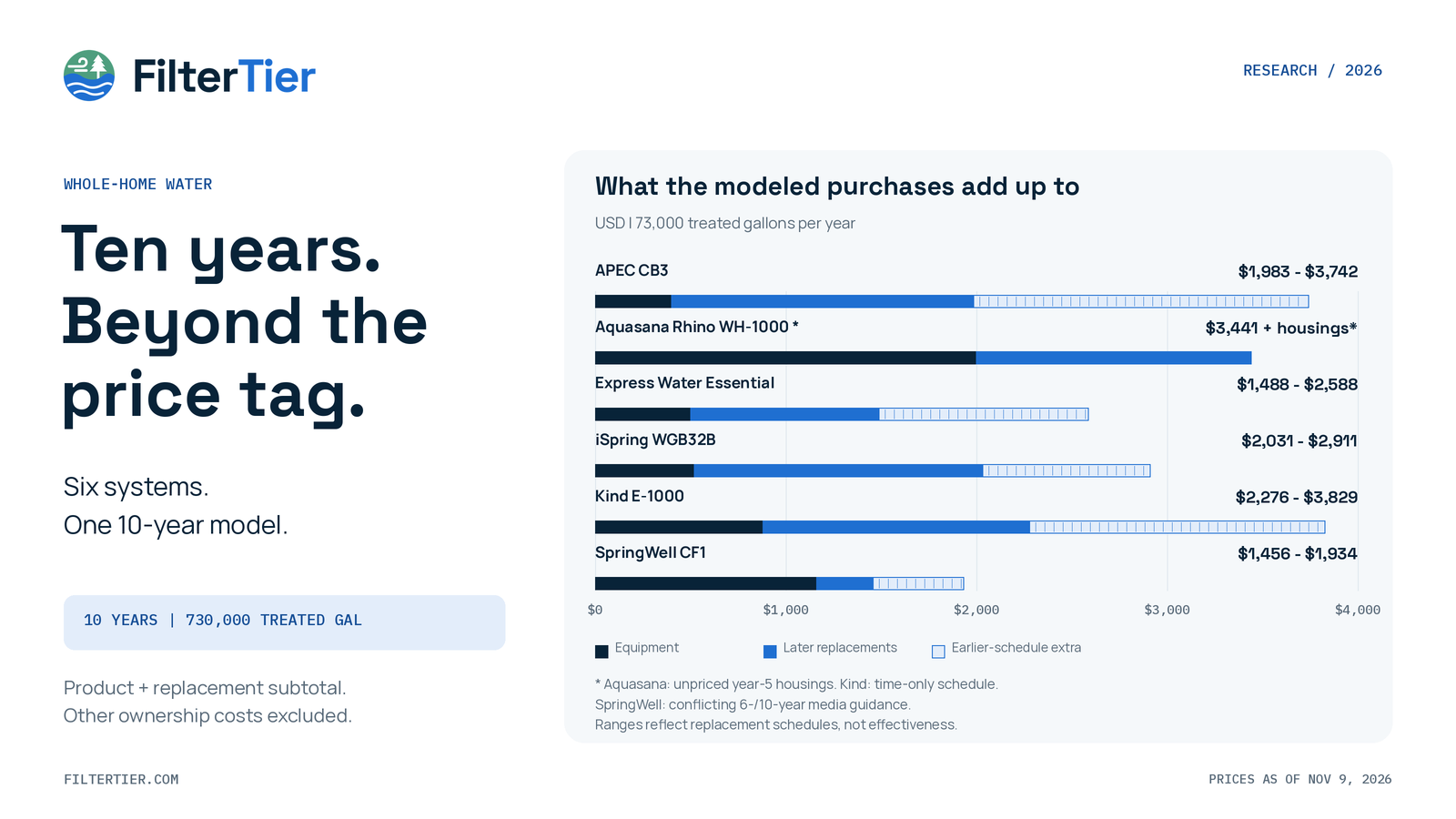
Five-year ownership cost matters more than purchase price
For a whole-house filter, calculate:
- equipment;
- installation;
- sediment prefilters;
- carbon or specialty media;
- service calls;
- major tank/media replacement.
For RO, calculate:
- equipment;
- installation;
- prefilters;
- membrane;
- postfilters;
- remineralization cartridges;
- pump/electronics service.
FilterTier’s system catalog and rankings offer model comparisons. Check current seller prices and replacement costs before purchasing.
Maintenance comparison
Whole-house filters
Maintenance depends heavily on design. A large tank may have a long media life but still use a sediment prefilter. Cartridge systems may require frequent changes. Backwashing systems have valves and drain cycles.
Under-sink RO
RO maintenance usually includes prefilters, membrane and postfilter. Tankless systems may package these into proprietary cartridges with electronic life tracking.
Do not assume under-sink means no maintenance.
Pressure drop: much more important whole-house
A whole-house filter sits in the main water line, so excessive restriction affects showers and appliances. Service flow and pressure drop are therefore major selection criteria.
An under-sink RO unit affects only the dedicated faucet, and storage can buffer production rate.
Why service flow matters more than “household gallons per day”
Your house might use 300 gallons across a full day but still require 10 to 15 GPM for a short period when several fixtures run simultaneously.
Whole-house filters must handle peak simultaneous flow, not merely daily total volume.
See How to Size a Whole-House Water Filter.
RO production rate is a different number
RO systems may be rated in gallons per day rather than gallons per minute because they produce treated water into storage over time.
A 75 GPD RO system is not designed to deliver 75 gallons instantly. The storage tank supplies short bursts while the membrane refills it.
Tank-based vs. tankless RO
Tank-based RO
Produces water gradually into a pressurized storage tank. It is a mature, common design and can deliver good faucet flow while the tank is full.
Tankless RO
Uses a higher-output membrane and pump to produce water on demand. It can save cabinet space and offer faster continuous production, but it depends more on electronics and power.
What does remineralization do?
RO reduces many dissolved minerals. Some systems add a post-filter designed to reintroduce minerals or adjust taste and pH. This is a preference and water-chemistry issue rather than proof that RO water is inherently “too pure.”
Do you need alkaline RO?
Marketing around “alkaline water” can be exaggerated. If you prefer the taste of remineralized water, a remineralization stage can be useful. Do not assume a higher pH alone makes drinking water universally healthier.
Whole-house treatment can protect RO
A whole-house sediment or carbon system can reduce loading on the RO prefilters. A softener can also protect the membrane in hard-water homes depending on system design.
This can extend maintenance intervals and improve RO performance.
RO can complement whole-house treatment
Even a strong whole-house carbon system may not target every dissolved contaminant a homeowner cares about. Adding RO at the kitchen sink can provide a second treatment barrier without treating every gallon with membrane technology.
Which approach is better for renters?
Renters often cannot install main-line equipment, so under-sink or countertop point-of-use systems may be more practical. Check lease requirements before modifying plumbing.
If the concern is a building-wide plumbing issue such as lead, point-of-use treatment may be a useful interim step while the property owner addresses the source.
Which approach is better for large homes?
Large homes with high simultaneous flow can make whole-house filtration expensive because equipment must be sized generously. Point-of-use RO cost is less affected by house size because it serves only drinking-water demand.
Many large homes use a high-flow whole-house system for broad treatment and RO at selected faucets.
Which approach is better for wells?
Well water often requires treatment tailored to chemistry: sediment, iron, sulfur, hardness, pH or microorganisms. A generic carbon filter plus under-sink RO may not be enough.
RO can be useful for drinking-water contaminants after the well water is appropriately pretreated.
Which approach is better for city water?
City water often has disinfectant taste, hardness and occasionally contaminants of concern such as PFAS. A whole-house carbon filter can improve water throughout the home, while RO can provide deeper drinking-water treatment.
The exact utility data should guide the decision. Start with What’s in My Water?.
What about wastewater and conservation?
Standard filtration does not create a continuous reject stream, although backwashing systems can use water during cleaning cycles.
RO produces reject water as part of membrane separation. Modern efficiency varies by system. At point-of-use scale, total reject volume may be manageable; at whole-house scale, it becomes a major design consideration.
What about mineral waste and cartridge waste?
All treatment systems have environmental tradeoffs. Cartridge systems create spent cartridges. Media tanks eventually require media replacement. Softeners use salt and water. RO uses replacement filters and reject water.
The goal is to choose treatment that solves a real problem rather than installing unnecessary stages.
Certification considerations
For both whole-house and RO systems, match certification to the exact claim. A system can be certified for materials or structural integrity without being certified for the contaminant you care about.
Review FilterTier’s certification guide before treating a logo as proof of broad performance.
Exact model vs. product family
Brands often sell multiple RO or whole-house variants. Flow, membrane size, cartridge configuration and certifications can differ.
Do not transfer evidence from one model to another unless the certification or performance data includes both.
Example: chlorine taste and hard water on city supply
A homeowner has hard municipal water and dislikes chlorine taste. Their drinking water is otherwise acceptable.
A logical treatment train could be whole-house carbon plus a true softener. Under-sink RO may be optional rather than necessary.
Example: PFAS concern plus hard water
A different home has public PFAS detections and significant hardness.
Options could include:
- whole-house PFAS treatment + softener;
- softener + point-of-use certified RO for drinking water;
- whole-house carbon with PFAS evidence + RO at kitchen sink.
The right choice depends on desired treatment scope, evidence, flow and budget.
Example: private well with nitrate and iron
A well has iron staining and elevated nitrate. A simple whole-house carbon filter is not the answer.
The iron may require dedicated whole-house treatment, while certified RO may address nitrate at the drinking faucet. Depending on nitrate level and household goals, broader treatment may also be considered with professional design.
Example: apartment with old plumbing
A renter is concerned about lead from building plumbing. Installing a whole-house system is not practical. An exact point-of-use filter certified for lead or an appropriate RO system may be a realistic interim measure.
Common buying mistakes
Mistake 1: buying RO because “RO removes everything”
No treatment literally removes everything under all conditions. Check exact claims and maintenance.
Mistake 2: buying a whole-house carbon filter for hardness
Carbon is not a conventional water softener.
Mistake 3: buying a small cartridge for a high-flow home
Whole-house service flow can become a major pressure bottleneck.
Mistake 4: treating the entire house when only drinking water needs advanced treatment
Point-of-use treatment can be much more economical.
Mistake 5: treating only the kitchen sink when the problem affects showers or appliances
Some treatment goals genuinely require point-of-entry treatment.
Mistake 6: ignoring recurring filter cost
Proprietary cartridges can make a cheap system expensive over time.
Frequently asked questions
Is RO better than a whole-house filter?
Not generally. They solve different problems. RO is stronger for many dissolved drinking-water contaminants, while whole-house filtration treats water throughout the home.
Do I need both?
Many homes benefit from both, but only when each stage solves a real need.
Can I drink water from a whole-house filter?
Yes, assuming the source water is potable and the system is properly designed and maintained. A whole-house filter does not automatically guarantee removal of every contaminant.
Does RO remove beneficial minerals?
RO reduces many dissolved minerals along with contaminants. Whether you prefer remineralization is largely a taste and water-chemistry decision.
Does a whole-house filter reduce TDS?
Most carbon and sediment filters do not significantly reduce total dissolved solids. RO does.
Can RO remove hardness?
RO reduces dissolved hardness at the treated faucet, but it is usually not the best whole-house hardness solution.
Can a whole-house filter remove PFAS?
Some exact systems have PFAS evidence or certification. Verify the specific model, flow and capacity.
Should RO be installed before or after a softener?
Under-sink RO is commonly fed with softened water in hard-water homes because softening can reduce membrane scaling, but follow the exact system instructions.
Will whole-house filtration improve shower water?
Yes if the system targets something relevant to shower water, such as chlorine or sediment. Point-of-use RO does not treat the shower.
Can I connect RO to the refrigerator?
Many systems can supply a refrigerator line if pressure and distance are suitable. Check manufacturer guidance.
A practical decision framework
Choose whole-house treatment first if:
- the problem affects every fixture;
- you want chlorine or sediment treatment throughout the home;
- you need hardness treatment;
- you want broad PFAS treatment at all fixtures;
- you need to protect appliances or plumbing.
Choose point-of-use RO first if:
- your main concern is drinking and cooking water;
- you want treatment for dissolved contaminants at one faucet;
- you rent or cannot modify the main line;
- whole-house treatment would be unnecessarily expensive.
Consider both if:
- you want broad whole-house improvements plus higher-purity drinking water;
- hardness or chlorine affects the entire home while a separate contaminant matters mainly for drinking;
- whole-house pretreatment can protect and extend the RO system.
What this means for you
Do not start by choosing a product. Start by deciding where treatment needs to happen.
If the concern affects showers, appliances, water heaters or every fixture, evaluate whole-house treatment. If the concern is mainly drinking and cooking, under-sink RO can provide powerful treatment at much lower system flow and cost.
Many of the best-designed homes use layered treatment: point-of-entry equipment for broad household needs, then point-of-use RO for drinking-water refinement.
Use What’s in My Water? to identify your utility profile, browse exact products in the FilterTier system database, and use Find My Filter to match treatment to your water source and household demand.
How taste preferences can change the best setup
Some people prefer the mineral taste of their tap water and only want chlorine reduced. Others prefer the lower-TDS taste of RO. A technically “better” treatment system is not better if the household dislikes the water and stops using it.
Where health-effect treatment is not driving the choice, taste can legitimately influence the final design.
Why refrigerator filters complicate the comparison
A refrigerator filter is another point-of-use stage. If the kitchen already has RO, connecting the refrigerator to the RO line can eliminate the need for a separate refrigerator contaminant filter in some setups. Check appliance pressure requirements before doing this.
Can whole-house treatment extend RO membrane life?
Yes. Removing sediment, chlorine and hardness upstream can reduce the load on RO prefilters and membrane, depending on the system. However, over-treating the entire house solely to protect one RO unit may not be cost-effective.
Why whole-house RO needs post-treatment
RO permeate can be low in mineral content and may require pH adjustment or remineralization before being distributed through household plumbing. Whole-house RO design therefore includes more than the membrane itself.
How to decide which water uses deserve premium treatment
List household uses in three groups:
- Drinking/cooking: highest priority for many dissolved contaminants.
- Bathing/laundry/appliances: may benefit from chlorine, hardness or sediment treatment.
- Toilets/irrigation: often do not need expensive advanced treatment.
This simple exercise can reduce equipment size and replacement cost.
Comparison checklist before buying either system
- Identify the contaminant or problem.
- Decide whether it matters at one faucet or every fixture.
- Verify exact-product evidence.
- Compare service flow or production rate.
- Calculate five-year cartridge and membrane cost.
- Check installation space.
- Check pressure requirements.
- Check wastewater or backwash needs.
- Verify replacement-part availability.
- Plan how performance will be monitored.
When whole-house treatment is probably overkill
If your public water is otherwise acceptable and the only concern is a specific drinking-water contaminant, whole-house treatment may cost far more than necessary. Point-of-use treatment can focus the budget where it matters.
When point-of-use treatment is probably too narrow
If chlorine bothers you in every shower, sediment clogs fixtures, hardness damages appliances or a contaminant exposure concern applies throughout the home, a kitchen-only system may leave the main problem untouched.
How drinking-water volume changes the economics
A household may use hundreds of gallons per day but drink and cook with only a small fraction of that total. This is why point-of-use treatment can be economically powerful: advanced media or membranes are reserved for the water where the household values them most.
Whole-house treatment makes more sense when the benefit matters for bathing, laundry, fixtures or appliances as well.
How to combine whole-house carbon, softening and RO
A common city-water treatment train is carbon filtration followed by a water softener, with under-sink RO on the softened cold-water line. The carbon stage improves whole-house taste and disinfectant exposure, the softener handles hardness, and RO provides drinking-water refinement.
The exact order can vary by equipment and water chemistry, so follow manufacturer requirements.
How to combine well treatment and RO
On a well, RO usually works best after the source water has been stabilized. Sediment, iron, hardness or sulfur problems can damage or overwhelm a small RO system. Whole-house pretreatment can therefore be essential even when the main drinking-water goal is point-of-use RO.
Why RO storage-tank pressure matters
Tank-based RO faucet flow depends partly on storage-tank pressure and fill level. If the tank loses its air charge or the membrane is clogged, faucet performance can decline even when household main pressure is normal.
Why tankless RO needs electrical power
Many high-output tankless systems use a booster pump and electronic monitoring. They can provide strong production but will not operate normally during a power outage. A traditional tank-based RO may still dispense stored water temporarily.
Why membrane rejection should be checked rather than guessed
For RO systems, comparing feed-water and permeate total dissolved solids can provide a rough indicator of membrane performance. This does not verify every contaminant claim, but it can help identify a membrane that is no longer performing normally.
When a carbon filter alone is enough
If the only concern is chlorine taste and odor and the exact carbon system has adequate flow and capacity, RO may add unnecessary complexity. Treatment should be proportional to the problem.
When RO alone is enough
If the utility water is otherwise acceptable and the household only wants advanced drinking-water treatment, an under-sink RO system may be all that is needed. There may be no reason to filter every shower and toilet gallon.
Final comparison table
| Goal | Whole-house filter | Under-sink RO | Often best approach |
|---|---|---|---|
| Chlorine throughout home | Strong | Kitchen only | Whole-house carbon |
| Hardness | Needs softener stage | Kitchen only | Whole-house softener |
| Advanced drinking treatment | Can be expensive | Strong | RO |
| PFAS at every fixture | Possible with evidence | Kitchen only | Whole-house PFAS treatment |
| PFAS mainly for drinking | May be overkill | Strong with evidence | Point-of-use treatment |
| Sediment protection | Strong | Too narrow | Whole-house sediment filter |