
A whole-house water filter, a water softener, and a salt-free conditioner solve different problems. Filtration removes or reduces contaminants and particles. A true ion-exchange water softener removes hardness minerals such as calcium and magnesium. A salt-free conditioner generally leaves hardness in the water but changes how those minerals form scale. Many homes need only one of these technologies; some need two or three in a treatment train. The mistake is assuming they are interchangeable or buying a bundle without understanding which stage does what.
This guide explains the roles, limitations, sizing, maintenance, and common combinations so you can decide whether your home needs filtration, softening, conditioning, or a combination.
What a whole-house water filter does
A whole-house filter treats water as it enters the home. Depending on the exact media and evidence, it can reduce sediment, chlorine, chloramine, taste, odor, certain VOCs, PFAS, lead, iron, sulfur, or other contaminants.
What a whole-house filter does not automatically do
“Filter” is a broad category. A carbon tank does not automatically soften water, disinfect bacteria, remove nitrate, or reduce every PFAS compound. The exact system and claim matter.
What a water softener does
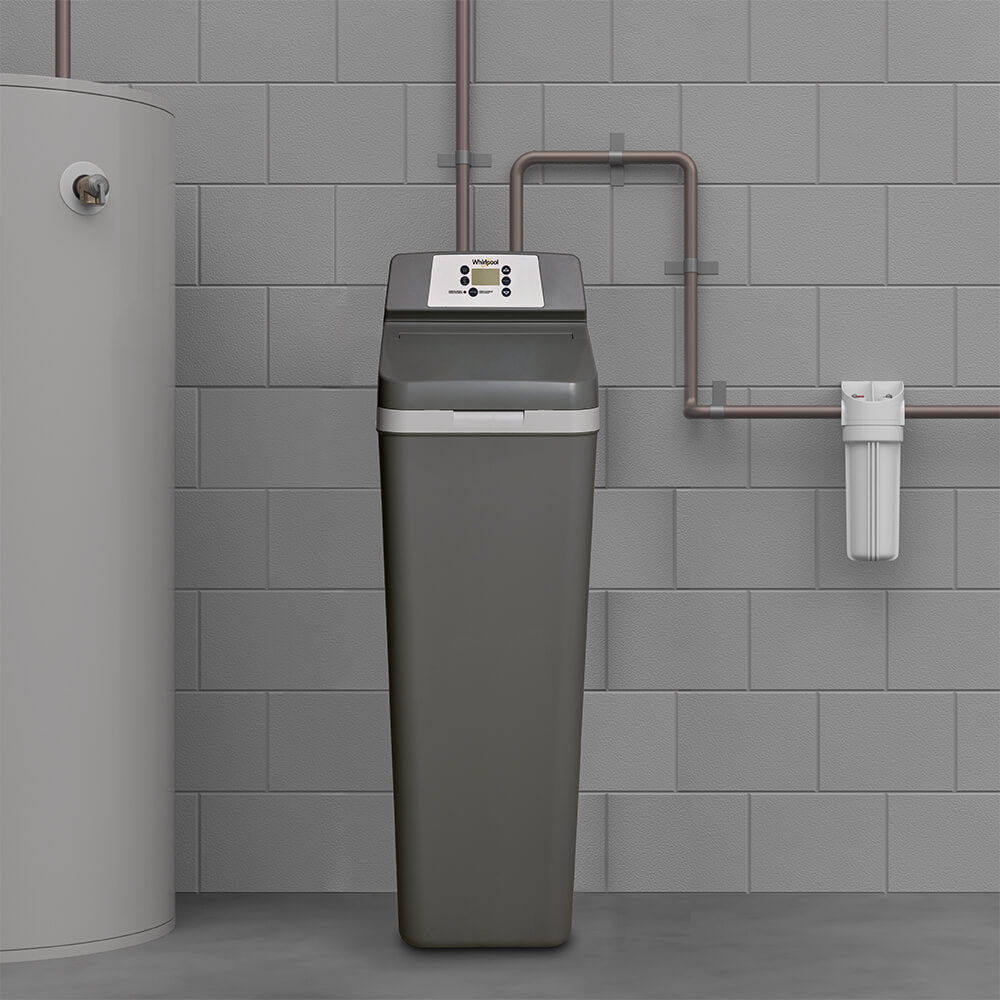
A conventional cation-exchange softener removes calcium and magnesium hardness ions and exchanges them for sodium or potassium ions. It produces conventionally soft water.
What a softener does not automatically do
A standard softener should not be assumed to remove PFAS, lead, chlorine, bacteria, arsenic, or nitrate unless the exact product has separate verified treatment stages.
What a salt-free conditioner does
A conditioner is designed primarily to reduce the tendency of hardness minerals to form adherent scale. Hardness usually remains measurable in the water.
What a conditioner does not do
It generally does not provide true hardness removal. It also does not automatically provide contaminant filtration unless paired with separate media.
Why the names cause confusion
Marketing phrases such as “salt-free softener,” “whole-house conditioner,” and “filter-softener combo” can blur the underlying technology. Always separate the physical treatment stages.
Filtration versus softening
| Question | Whole-house filter | Softener |
|---|---|---|
| Removes sediment? | Depending on design | No |
| Reduces chlorine? | Carbon systems can | No standard claim |
| Removes hardness? | No standard carbon filter | Yes |
| Reduces PFAS? | Some exact systems | Not standard softener |
| Regenerates with salt? | Usually no | Yes |
Softening versus conditioning
Softening removes hardness. Conditioning changes scale behavior. The treated-water result is therefore different even when both products are marketed for “hard water.”
Filtration versus conditioning
Filtration addresses contaminants or particles. Conditioning addresses scale behavior. A carbon + conditioner bundle combines two jobs.
Why many city-water homes use filter + softener
Municipal water can have chlorine or chloramine plus hardness. Carbon filtration improves disinfectant/taste concerns while the softener removes hardness.
Why many city-water homes use filter + conditioner
Homeowners who want chlorine reduction and scale control without salt may choose carbon plus salt-free conditioning.
Why many well-water homes need more stages
Wells can contain sediment, iron, manganese, sulfur, low pH, hardness, bacteria, and health-related chemicals. The treatment train should be built from test results rather than one generic “well system.”
Carbon filtration
Activated or catalytic carbon is common for chlorine, chloramine, taste, odor, and some organics. PFAS claims require exact evidence and capacity.
Sediment filtration
Spin-down or cartridge filters remove particles and protect downstream equipment. Sediment filtration does not soften water.
PFAS filtration
GAC, specialty ion exchange, and RO are relevant technologies. A softener or scale conditioner should not receive PFAS credit without separate evidence.
Lead filtration
Exact certified cartridges or RO can reduce lead. A generic carbon tank is not automatically a lead system.
Iron filtration
Iron treatment can involve oxidation and backwashing media. A softener can handle limited dissolved iron in some conditions but is not always the best primary iron treatment.
Sulfur treatment
Hydrogen sulfide can require oxidation, catalytic media, or other well-water treatment. Carbon alone may not be sufficient at higher concentrations.
UV disinfection
UV is another separate category. It inactivates microorganisms and does not replace filtration, softening, or conditioning.
RO treatment
Reverse osmosis is especially useful for drinking-water treatment of dissolved contaminants and is distinct from a whole-house carbon filter or softener.
How to choose the first treatment stage
Protect downstream equipment from the contaminants most likely to foul it. Heavy sediment, iron, or low pH can need correction before carbon, PFAS media, softeners, or UV.
Common city-water sequence
One example is sediment protection → carbon → softener or conditioner → optional UV/point-of-use RO depending on goals. Exact order varies by equipment.
Common well-water sequence
One example is sediment/oxidation → iron/sulfur treatment → neutralization if needed → softener → specialty filtration → UV. The laboratory result determines the actual sequence.
Why order matters
Chlorine can shorten resin life. Iron can foul softeners. Hardness can scale UV sleeves. Sediment can clog cartridges. A good sequence protects each stage.
Hardness testing
Measure hardness before choosing a softener or conditioner. Use grains per gallon or mg/L as CaCO3.
City-water report
Use the utility report to identify disinfectant, violations, PFAS, source, and sometimes hardness. See How to Read Your City Water Quality Report.
Well-water testing
Use laboratory testing before buying treatment. See Private Well Water Testing.
Flow sizing
Every whole-house stage must support household peak flow. See GPM Sizing.
Why the smallest stage controls the bundle
A 15 GPM carbon tank plus an 8 GPM cartridge creates an 8 GPM bottleneck for that cartridge’s claim.
Pressure drop
Multiple stages in series add restriction. High-flow homes need larger housings, valves, and tanks to preserve pressure.
Maintenance of filters
Cartridges are replaced; tanks are rebedded or replaced; sediment filters load; backwashing valves require service.
Maintenance of softeners
Salt, brine-system care, valve service, resin cleaning, and eventual resin replacement.
Maintenance of conditioners
Prefilter and media replacement, with no brine regeneration in most designs.
Annual operating cost
Filters consume cartridges/media; softeners consume salt and water; conditioners consume replacement media/prefilters. Compare total ownership rather than sticker price.
Installation complexity
Carbon tanks can be simple. Softeners require a drain and brine tank. Conditioners can be simpler if non-backwashing. Bundles require more space and plumbing.
Water use
Non-backwashing filters and conditioners use little process water. Softeners and backwashing media use water during cleaning/regeneration.
Electricity
Simple tanks may not need power. Softeners, UV, pumps, and smart controllers may.
Warranty
Different stages can have different tank, valve, electronics, and media warranties. Read each component separately.
Example: chlorine + hard city water
Carbon + true softener is a straightforward combination when the household wants both disinfectant reduction and soft water.
Example: chlorine + moderate hardness, no salt preference
Carbon + salt-free conditioner can match a homeowner who wants scale control without brine.
Example: clean city water, only hardness complaint
A filter may be unnecessary. Choose softening or conditioning based on desired outcome.
Example: city water, only chlorine taste
A softener or conditioner is unnecessary if hardness is not a concern. Carbon may be enough.
Example: well water with iron + hardness
Iron treatment may come first, then a softener. A generic carbon/conditioner bundle may fail quickly.
Example: well water with bacteria
UV or another disinfection stage may be needed after pretreatment. A softener does not disinfect.
Example: PFAS concern + hardness
PFAS treatment and hardness treatment are separate stages. Choose whole-house PFAS media plus softening/conditioning, or point-of-use PFAS/RO depending on scope.
Example: lead service line + hard water
Lead needs source removal/certified treatment; hardness needs softening/conditioning. One does not solve the other.
How to avoid unnecessary bundles
Ask which water result justifies every stage. Remove stages that do not address a measured problem or explicit preference.
How to compare hybrid products
Separate each function: filtration evidence, hardness capacity, service flow, maintenance, replacement media, and warranty. One product can be strong in one function and average in another.
What “2-in-1” actually means
It can mean one cabinet contains resin and carbon, or one media bed claims several functions. Read the architecture before assuming full performance in both categories.
What “whole-house solution” means
It can simply mean point-of-entry installation, not that the system treats every possible water problem.
Common filter mistakes
Assuming carbon softens water
It does not.
Assuming all carbon removes PFAS
Exact evidence matters.
Common softener mistakes
Assuming it filters chemicals
A standard softener does not.
Choosing by grain label alone
Flow and efficiency matter.
Common conditioner mistakes
Expecting soft-water hardness tests
Hardness remains.
Ignoring iron limits
Well chemistry matters.
How to decide what your home needs
- Identify source: city or well.
- Review report/test.
- List confirmed problems.
- Separate health, equipment, and comfort goals.
- Choose treatment for each goal.
- Size every stage to peak flow.
- Check interactions/order.
- Calculate maintenance and ten-year cost.
Technology selection matrix
| Problem | Primary treatment category |
|---|---|
| Chlorine/chloramine | Carbon/catalytic carbon |
| Sediment | Mechanical filtration |
| Hardness removal | Ion-exchange softener |
| Scale control without salt | Salt-free conditioner |
| PFAS | GAC/specialty IX/RO |
| Lead | Certified specialty filtration/RO + source correction |
| Bacteria | UV/disinfection + source correction |
| Iron/sulfur | Well-water oxidation/media |
Technology questions
Do I need both a filter and softener?
If you have both a filtration concern and hardness, often yes.
Can a conditioner replace a filter?
No, not for contaminant filtration.
Can a filter replace a softener?
Not for true hardness removal.
Can a softener remove PFAS?
Not a standard softener.
Can a conditioner remove chlorine?
Only if a separate carbon stage is included.
Which comes first?
Depends on water chemistry and equipment. Pretreatment should protect downstream stages.
Do I need UV too?
Only when microbial disinfection is a real goal.
Can one tank do everything?
No single technology should be assumed to solve all water problems.
Your first decision: the treatment goal
Do not start by choosing between brands. Start by identifying whether your problem is contamination, hardness, scale, microbes, or a combination. A filter treats contaminants, a softener removes hardness, and a conditioner manages scale. Combine them only when your water and preferences justify each stage.
Use What’s in My Water?, Find My Filter, and FilterTier’s system database to match the architecture to your actual water.
Detailed planning: technology, installation and ownership
The sections above explain the basic differences. Use the detailed comparison below when planning a combination of treatment stages, comparing installation needs, or deciding which tradeoffs matter in your home.
The three technologies solve different problems
A whole-house filter, a salt-based water softener, and a salt-free conditioner are often sold next to each other because they all connect to the main water line. That does not make them interchangeable. A filter is generally used to reduce contaminants such as chlorine, sediment, organics, or other target compounds. A conventional softener removes calcium and magnesium hardness through ion exchange. A salt-free conditioner changes how hardness minerals behave so scale is less likely to stick, but the hardness minerals remain in the water.
The most important buying question is therefore not “Which system is best?” It is “What is wrong with the water, and which treatment mechanism actually solves that problem?”
What whole-house filtration means
Whole-house filtration is a broad category. It can include sediment cartridges, activated-carbon tanks, catalytic carbon, PFAS media, iron filters, specialty resins, and combinations of treatment stages. The term tells you where the filter is installed—not what it removes.
A carbon whole-house filter can reduce chlorine without softening water. An iron filter can address well-water staining without removing chlorine. A specialty PFAS filter can target PFAS while leaving hardness unchanged. Always define filtration by the exact media and contaminant claim.
What a salt-based water softener does
A conventional softener uses cation-exchange resin. Calcium and magnesium ions are exchanged for sodium or potassium ions as water passes through the resin. When the resin becomes loaded with hardness, the system regenerates with a concentrated brine solution.
The practical result is actual hardness removal. Soap lathers more easily, scale is greatly reduced, water can feel different on skin, and appliances no longer receive the same calcium and magnesium load.
How conditioning changes scale without removing hardness
Salt-free conditioners use technologies such as template-assisted crystallization or other scale-control approaches to alter how hardness minerals form deposits. They do not conventionally remove calcium and magnesium from the water.
That difference matters. A hardness test taken after a salt-free conditioner can still show essentially the same hardness concentration as before treatment, even if scale behavior improves.
Quick comparison
| Goal | Whole-house filter | Salt softener | Salt-free conditioner |
|---|---|---|---|
| Reduce chlorine/chloramine | Yes, with appropriate carbon | No | No |
| Remove sediment | Yes, with sediment media | Not primary purpose | No |
| Remove hardness minerals | No, unless combined with softening | Yes | No |
| Reduce scale formation | Not generally | Yes | Yes, by conditioning |
| Regenerate with salt | Usually no | Yes | No |
| Change sodium content | No by itself | Can increase sodium | No conventional ion exchange |
Why “whole-house water filter and softener” bundles exist
Many homes have more than one water problem. Municipal water can contain chlorine while also being hard. A carbon filter solves the disinfectant/taste issue; a softener solves hardness. Combining them in series is logical because each stage has a different job.
Private wells can also need multiple stages: sediment, iron or sulfur treatment, softening, and UV can all appear in one treatment train. The presence of multiple tanks is not redundancy if each tank addresses a measured condition.
When filtration alone is enough
If hardness is modest and your main concern is chlorine taste, odor, sediment, PFAS, or another contaminant with appropriate filter evidence, filtration may be all you need. Adding a softener or conditioner without a scale or hardness problem increases cost and maintenance.
When a softener alone is enough
If the water is otherwise acceptable but severe hardness causes scale, spotting, soap use, and appliance problems, a softener can solve the main household issue. A carbon tank is optional unless you also want disinfectant or contaminant reduction.
When a salt-free conditioner is a better fit
A conditioner can make sense when the household wants scale control but wants to avoid salt, brine discharge, regeneration water, and the slippery feel some people associate with softened water. The tradeoff is that hardness minerals stay in the water and some classic soft-water benefits are not reproduced.
Why salt-free products are often marketed confusingly
Some products are described as “salt-free softeners.” That phrase can blur the core distinction. If the product does not remove calcium and magnesium through ion exchange or another hardness-removal process, it should be evaluated as a conditioner rather than assumed to create conventionally softened water.
How hardness affects the decision
At mild hardness, many homeowners do not need any hardness treatment. At moderate to high hardness, the value of softening or conditioning increases. Extremely hard water can push salt-free systems harder and may make conventional softening more predictable if the goal is near-complete scale prevention.
Use an actual hardness value rather than choosing from city reputation alone.
Why grains per gallon matter
Water hardness is commonly expressed in grains per gallon (gpg) or mg/L as calcium carbonate. Approximately 17.1 mg/L equals one grain per gallon. Knowing the actual value helps size softener capacity and makes conditioner expectations more realistic.
How iron changes softener sizing
Small amounts of dissolved iron can sometimes be handled by certain softeners, but iron consumes capacity and can foul resin. Significant iron on a private well usually deserves separate treatment. A softener should not become the default iron filter simply because it can remove some iron under favorable conditions.
How chlorine affects a softener
Municipal oxidants can degrade some ion-exchange resin over time. A carbon filter before a softener can reduce chlorine exposure and may extend resin life. That makes carbon + softener a common city-water arrangement.
Why filter order matters
Treatment order should protect downstream equipment and preserve the desired chemistry. A typical city-water train might place sediment protection and carbon before a softener. A well-water system may need iron or pH treatment before softening. The correct sequence depends on actual water chemistry.
Can a carbon filter reduce scale?
Standard activated carbon does not remove hardness. Some multi-media products combine carbon with scale-control media, but the scale-control function comes from the additional media rather than the carbon itself.
Can a softener remove chlorine?
A standard ion-exchange softener is not a chlorine filter. Chlorine may affect the resin, but treatment should not rely on the softener to provide certified chlorine reduction.
Can a conditioner remove chlorine?
Not unless the system includes a separate carbon or filtration stage. Conditioning media addresses scale behavior, not disinfectant reduction.
Can a filter remove hardness?
Most filters do not. A sediment filter can remove visible particles, and carbon can adsorb organic compounds, but dissolved calcium and magnesium pass through. If a product claims hardness treatment, identify the actual technology responsible.
Which system helps white scale on faucets?
A softener is the most direct solution because it removes hardness minerals. A salt-free conditioner can reduce adherence and scale formation, but spotting and dissolved mineral content can remain. Carbon filtration alone generally will not solve hardness scale.
Which system helps dry-feeling skin?
Water feel is subjective. Some households notice softer-feeling water after ion exchange because hardness minerals are removed. Chlorine reduction can also change perceived skin and hair feel. There is no universal cosmetic outcome, so identify whether hardness, disinfectant, or another factor is the target.
Which system helps soap lather?
Conventional softening has the strongest direct effect because calcium and magnesium no longer react with soap in the same way. A conditioner that leaves hardness minerals in the water generally does not reproduce the same soap behavior.
Which system helps chlorine taste and odor?
Activated carbon or catalytic carbon is the relevant technology. Softening and scale conditioning are separate.
Which system helps PFAS?
PFAS treatment can use GAC, specialty ion exchange, or reverse osmosis depending on the application. Standard softener resin and scale-conditioner media should not be assumed to provide PFAS reduction.
Which system helps lead?
Lead often requires a product with a specific lead-reduction claim and may also justify source correction such as service-line replacement. Softening and conditioning are not substitutes for lead-certified filtration.
Which system helps iron?
Well-water iron can require oxidation and backwashing media, air injection, catalytic media, or other treatment. Some softeners can handle low levels of dissolved iron, but heavy iron should usually be addressed separately.
Which system helps sulfur odor?
Hydrogen sulfide often needs oxidation, catalytic media, or another well-water treatment. Carbon can polish odor in some conditions, but conventional softening and scale conditioning are not primary sulfur technologies.
Maintenance comparison
Whole-house filters can require sediment cartridges, carbon replacement, or media rebedding. Softeners require salt and periodic brine-system service, plus eventual resin or valve maintenance. Salt-free conditioners avoid salt and regeneration but still have finite media life or replacement components.
Water-use comparison
Backwashing filters and softeners can use water during service cycles. Non-backwashing carbon tanks and many salt-free conditioners may use little or no additional water. Cartridge filters use no backwash water but create replacement waste.
Drain requirements
Traditional softeners need a drain for regeneration. Many backwashing filters also need a drain. Non-backwashing filters and conditioners may not. This can materially affect installation cost in finished spaces.
Electricity requirements
Electronic softener and backwashing-filter valves need power, though consumption is small. Simple non-backwashing tanks and cartridge housings may require no electricity. Smart monitoring adds electronics and service considerations.
Space requirements
A combined filter + softener can need two tanks plus a brine tank. Salt-free conditioning usually avoids the brine tank. Cartridge systems mount on walls but need clearance for service. Mechanical-room layout should be part of the decision.
How pressure drop differs
Dense cartridges can create more restriction than large media tanks. Softener and conditioner tanks also have service-flow limits. Compare the complete treatment train at realistic peak flow rather than evaluating each stage in isolation.
How high-flow homes should think about the bundle
A large family may need 12–20+ GPM during peak use. Every treatment stage must support that flow. A carbon tank sized for 15 GPM paired with a small softener rated for much less creates a bottleneck.
How small homes should avoid overbuying
A two-person home with moderate hardness and mild chlorine taste may not need three large tanks. A simple carbon system plus a modest softener—or even point-of-use carbon if whole-house treatment is not important—can be more efficient.
City-water example
A home has 12 gpg hardness and chloramine. The household wants softer water and less disinfectant odor. A catalytic-carbon stage followed by a conventional softener addresses two separate goals. UV would be optional redundancy, not a solution to either primary complaint.
Well-water example
A well has 3 mg/L iron, 18 gpg hardness, sediment, and no bacteria. A sediment/iron treatment stage followed by a softener may be appropriate. Adding a city-water carbon tank solely because a bundle includes one could be unnecessary unless testing identifies an organic or taste issue.
Salt-free city-water example
A home has 8 gpg hardness and chlorine, but the homeowner wants no salt or regeneration. A carbon tank plus salt-free conditioner may improve taste and reduce scale behavior while keeping hardness minerals in the water. Expectations should be set accordingly.
When a combination unit is attractive
Single-cabinet or hybrid systems can save space and simplify installation. They can make sense when the integrated media and service flow match the water. The tradeoff is that one cabinet can be harder to customize or service when one media stage reaches end-of-life before another.
When separate tanks are better
Separate tanks allow independent sizing, maintenance, and replacement. A carbon tank can be rebedded without disturbing the softener, and the softener can be upgraded without replacing filtration. This modularity is valuable in complex homes.
How to compare long-term cost
Calculate the carbon media or cartridges, softener salt, conditioner media, regeneration water, service, and eventual valve/resin replacement. The lowest purchase price can become the highest ten-year cost if consumables are expensive.
See FilterTier’s 10-Year Cost Guide.
How warranties differ
Tanks may have long structural warranties while control valves, electronics, resin, cartridges, and media have shorter coverage. A “lifetime system warranty” should be broken into actual components.
Common buying mistakes
Mistake 1: buying a softener to remove chlorine
Use the correct filtration technology.
Mistake 2: buying carbon to fix hardness
Carbon is not conventional hardness removal.
Mistake 3: calling conditioning softening
The minerals remain in the water.
Mistake 4: buying a bundle before testing a well
Well chemistry should determine the stages.
Mistake 5: ignoring service flow
The slowest stage controls the treatment train.
Mistake 6: assuming more tanks mean better water
Every stage should have a defined job.
How to choose in five steps
- Test or identify the actual water conditions.
- Separate contaminant filtration from hardness treatment.
- Decide whether you want hardness removal or only scale conditioning.
- Size every stage to realistic household peak flow.
- Compare evidence, maintenance, cost, and installation for the complete treatment train.
Installation and ownership questions
Do I need a filter and a softener?
Only if you have separate filtration and hardness goals. Many hard city-water homes legitimately need both.
Is a salt-free conditioner a filter?
Not necessarily. It is primarily a scale-control technology unless the product includes separate filtration media.
Is a softener a filter?
It is a water-treatment device using ion exchange, but it should not be assumed to remove contaminants outside its hardness/ion-exchange role.
Can I put carbon before a softener?
Yes. This is common on chlorinated municipal water and can protect resin from oxidants.
Can I put a softener before carbon?
Sometimes, but treatment order should be designed around media protection and target contaminants.
Which is lowest maintenance?
It depends on architecture. Salt-free conditioning avoids salt, while long-life carbon tanks avoid frequent cartridges. Every system still has a service life.
Which gives the biggest change in hard-water feel?
Conventional ion-exchange softening generally creates the clearest change because it actually removes hardness minerals.
Decision framework
| If your main goal is… | Start with… |
|---|---|
| Chlorine/chloramine, taste, odor | Carbon/catalytic-carbon filtration |
| Sediment | Sediment filtration |
| PFAS or lead | Exact contaminant-certified/tested filtration |
| Hardness removal | Salt-based ion-exchange softener |
| Scale control without salt | Salt-free conditioner |
| Several problems at once | Purpose-built multi-stage treatment train |
Put the treatment stages together
Stop comparing these systems as if they were three brands of the same appliance. They are different treatment categories. Define the water problem first, choose the technology that actually addresses it, and combine stages only when the water justifies them.
Use What’s in My Water? for municipal context, test a private well before treatment, browse exact products in Systems, and use Find My Filter to match treatment goals and household flow.
How treatment scope changes the answer
A household may not need every treatment goal applied to every gallon. For example, an under-sink drinking-water filter can address a drinking-water contaminant while a whole-house softener addresses hardness. Conversely, chlorine in showers is a whole-house preference, so point-of-use treatment at the kitchen sink would not solve that goal. Separating treatment scope can reduce cost and complexity.
Why water testing should come before bundles on private wells
Well-water symptoms overlap. Orange staining can suggest iron, black staining can involve manganese, rotten-egg odor can involve hydrogen sulfide or a water-heater issue, and white scale points toward hardness. A generic “filter + softener” bundle may treat some of those issues and miss others. Laboratory testing gives the treatment train a factual starting point.
Why utility data is enough for some city-water decisions
On public water, a current utility report can often confirm disinfectant type, hardness, and broad source-water context. Household testing becomes more important for plumbing-specific concerns such as lead or unusual building conditions. Not every city-water homeowner needs a broad laboratory panel before buying a simple chlorine filter.
How to think about sodium from softening
Ion-exchange softening replaces hardness ions with sodium or potassium. The amount added depends on incoming hardness. For most household decisions this is a treatment characteristic rather than a reason to call softened water unsafe, but people following medically directed sodium restrictions should discuss their specific situation with an appropriate health professional. A common design is to keep an unsoftened or RO-treated drinking-water faucet when desired.
How reverse osmosis fits into this comparison
RO is a separate point-of-use or whole-house membrane technology. It can reduce many dissolved contaminants and salts, including hardness minerals at the membrane, but it is not normally used as a direct substitute for a conventional whole-house softener because whole-house RO is much more complex. Under-sink RO often complements whole-house filtration or softening.
Can a salt-free conditioner protect a water heater?
Scale-control media can reduce the tendency for hardness scale to adhere, which may help equipment in some water conditions. It does not remove hardness loading from the water. If the household wants the most direct reduction in scale-forming minerals entering a heater, conventional softening is the clearer mechanism.
What about tankless water heaters?
Tankless units can be sensitive to scale because heat-exchanger passages are narrow and operate at high temperatures. In hard-water areas, manufacturers may specify descaling maintenance. Softening can materially reduce hardness scale. A conditioner may reduce scale adherence but should be evaluated against the heater manufacturer’s requirements and actual water hardness.
How dishwashers and glassware reveal the difference
A softener often reduces mineral spotting because hardness minerals are removed. A conditioner may reduce hard scale on surfaces but can still leave dissolved minerals that dry onto glassware. If spotless glassware is a major goal, this difference matters.
How laundry reveals the difference
Hardness reacts with soaps and detergents. Conventional softening changes that chemistry directly, which can reduce detergent demand and mineral residue. A salt-free conditioner generally does not create the same soft-water laundry behavior because calcium and magnesium remain present.
How to compare environmental tradeoffs
Softeners use salt and regeneration water. Salt-free conditioners avoid brine discharge but still require media manufacturing and eventual replacement. Filters use cartridges or tank media, and some backwash. There is no zero-impact option; compare the treatment benefit with the resources and consumables required to achieve it.
How to compare ownership effort
Think in tasks, not labels. A softener needs salt replenishment and periodic brine maintenance. A cartridge filter needs physical cartridge changes. A media-tank filter needs less frequent rebedding. A conditioner may require little routine work but eventual media replacement. The best system is partly the one your household will actually maintain.
Why installers should explain each tank
If a quote includes two or three vessels, ask the installer to identify the job of each one in one sentence. “This tank removes chlorine. This tank removes hardness. This cartridge protects both from sediment.” If the purpose of a stage cannot be explained clearly, it may be unnecessary or poorly documented.
How to avoid buying duplicate treatment
Some packages contain a carbon filter, a hybrid softener/filter, and another carbon polishing stage. That can be appropriate in a specific design, but it can also duplicate media and cost. Review what each stage already does before adding another product with overlapping claims.
What to verify on a hybrid product
- Which media removes or reduces each contaminant?
- Which media removes hardness?
- Is the product truly softening or only conditioning?
- What is the service flow for the complete unit?
- What media or cartridges are replaced, and when?
- Which claims are certified for the exact model?
- Can individual treatment media be serviced separately?
Final buying rule
A whole-house filter is for contaminants or particles its media is designed to reduce. A softener is for hardness removal. A salt-free conditioner is for scale-behavior control without conventional hardness removal. If your water has two of those problems, you may need two technologies. If it has only one, buying all three does not make the water three times better.
That is the simplest way to keep the treatment train honest: every stage should have a measured or clearly defined job, enough flow for the household, evidence for its claims, and a maintenance plan the homeowner can sustain. Start with the water problem, then choose the technology—not the other way around.
Use that rule and the right combination becomes much easier to identify, size, compare, and maintain over the life of the home.
Match technology to the problem.