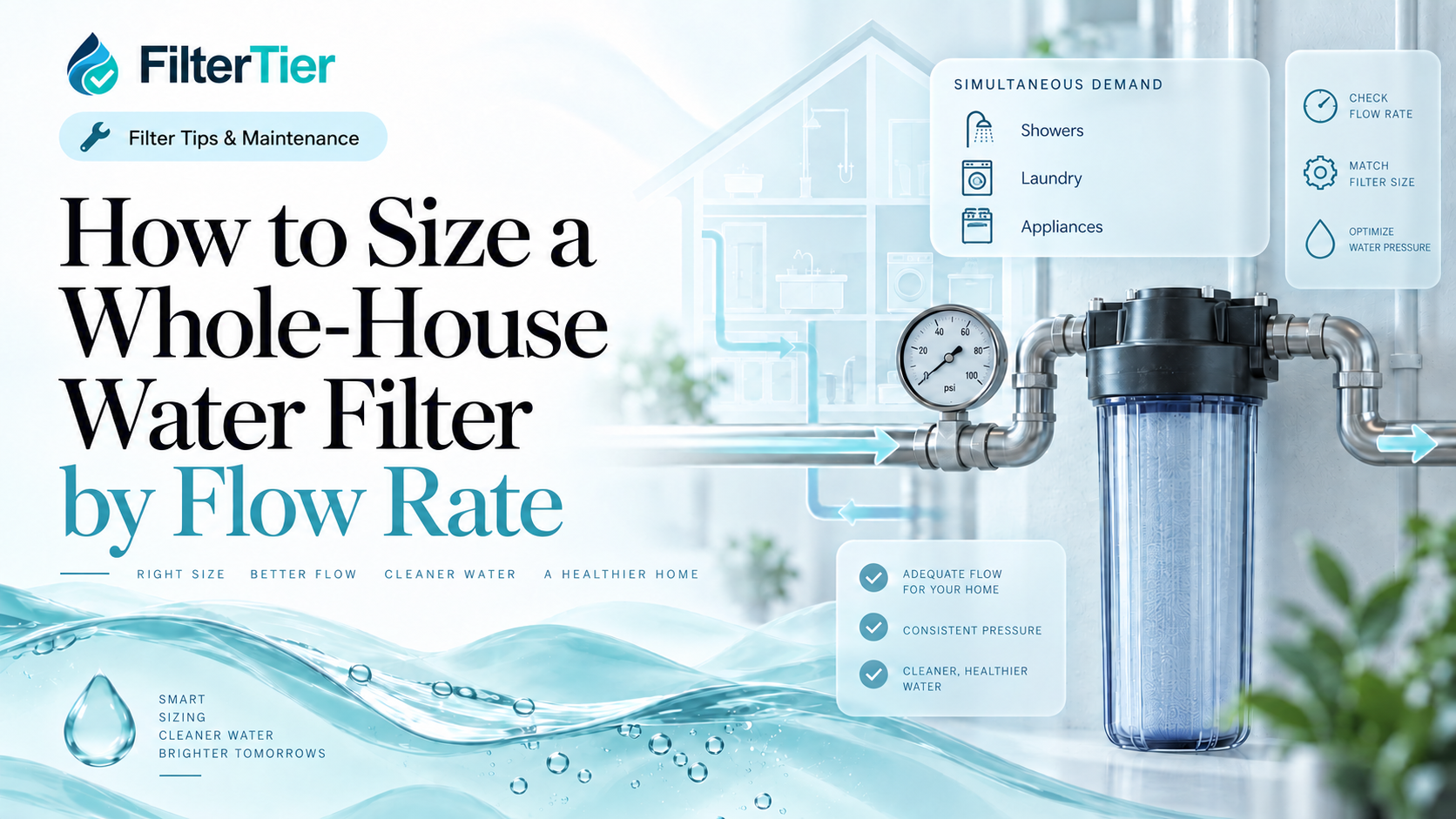
A whole-house water filter should be sized for the water your home may use at the same time, not just for the number of bathrooms or the average number of gallons used in a day. The biggest sizing mistake is treating household demand as a daily-volume problem when pressure complaints are usually caused by short periods of high simultaneous flow.
Two showers, a washing machine and a kitchen faucet operating at the same time can create a much higher demand than the household’s average daily use suggests. If the treatment system is too restrictive, you may notice weak showers, slow tub filling and appliance frustration even though the system’s contaminant media is technically appropriate.
The best sizing process therefore combines three things: realistic simultaneous demand, the treatment system’s true service or certified flow, and the total pressure drop of every stage in the treatment train.
Why average daily water use is not enough
A home may use 300 gallons across 24 hours but still need 10 or 12 gallons per minute for a few minutes when several fixtures overlap. Whole-house equipment has to handle that short peak without creating unacceptable pressure loss.
Daily volume is useful for estimating media capacity, salt use, filter replacement and storage. Peak flow is what determines whether the house feels normal when people actually use water.
Think in terms of simultaneous fixtures
Start with your busiest realistic moment, not the theoretical case where every faucet in the house is fully open.
Ask:
- How many showers might run at once?
- Could the washing machine fill at the same time?
- Could the dishwasher draw water?
- Could someone use a kitchen or bathroom faucet?
- Do you have a large soaking tub?
- Do you have body sprays or multiple showerheads?
- Do any appliances or specialty fixtures have unusually high flow?
This is a much better sizing question than “How many bathrooms do you have?”
Bathroom count is useful—but only as a shortcut
Bathroom count is popular because it is easy. A manufacturer may say a particular tank is for one to three bathrooms and a larger one is for four to six bathrooms.
That can be a reasonable starting point, but it ignores occupancy and lifestyle. A five-bathroom home occupied by two people may have less real simultaneous demand than a three-bathroom home with six people getting ready at the same time every morning.
Use bathroom count as a screening tool, then refine the decision with realistic fixture overlap.
What is service flow?
Service flow is the rate a treatment system can handle during normal operation while delivering acceptable hydraulic and treatment performance.
Unfortunately, manufacturers do not all use the term the same way. You may see:
- service flow;
- rated flow;
- continuous flow;
- maximum flow;
- peak flow;
- certified flow;
- flow at a stated pressure drop.
These numbers are not always equivalent.
What is peak flow?
Peak flow is usually a higher short-duration number. It can tell you what the system can physically pass for a limited period, but it may not represent the flow at which contaminant performance is tested or the pressure drop is comfortable.
A system advertised at “20 GPM peak” may have a much lower normal service flow.
What is certified flow?
Certified flow is tied to the conditions under which a product was evaluated for a specific certified performance claim. For health-effect filtration, this can be particularly important.
If a PFAS or lead cartridge is certified at 5 GPM, you should not assume the same contaminant reduction is verified at 10 GPM simply because the housing can physically pass that much water.
What is hydraulic maximum flow?
Some manufacturers publish a maximum flow based mainly on plumbing or valve capacity. This can be useful for understanding restriction but may say little about treatment performance.
Always ask what the flow number actually represents.
Pressure drop is the missing half of flow
A filter can pass water at a high flow while creating a large pressure drop. That may be technically possible but practically unpleasant.
For example, if a filter passes 15 GPM but drops pressure significantly at that rate, showers may feel weak. A lower-flow rating tied to a smaller pressure drop may be more meaningful for real household use.
What creates pressure drop in a treatment system?
Every restriction in the water path contributes:
- sediment cartridges;
- carbon blocks;
- media tanks;
- softener valves;
- UV reactors;
- check valves;
- small-diameter plumbing;
- undersized fittings;
- partially closed valves;
- dirty cartridges.
The total pressure drop across the entire system matters more than any one stage in isolation.
The smallest stage controls the bundle
This is one of the most important sizing rules.
Imagine a treatment train with:
- 20 GPM sediment prefilter;
- 15 GPM carbon tank;
- 12 GPM softener;
- 7 GPM UV reactor at the desired UV dose.
For the complete treatment goal, this is not a 20 GPM system. The UV stage becomes the effective bottleneck around 7 GPM if that is the verified flow at the dose you need.
Bundles should be evaluated at the weakest stage, not the biggest number on the sales page.
Why FilterTier tracks service and peak flow separately
FilterTier records flow in separate fields when documentation allows it. A product with a 15 GPM service flow and 20 GPM peak flow should not be reduced to “20 GPM.” Likewise, a certified cartridge with a 5.7 GPM health-effect claim should not be presented as a 15 GPM PFAS system because some other component can pass 15 GPM.
That distinction is central to comparing systems fairly.
Step 1: list the fixtures that can realistically overlap
Make a simple household scenario. For example:
- Primary shower running
- Second shower running
- Washing machine filling
- Kitchen faucet briefly used
You do not need to assume every fixture is open. You want a realistic busy period.
Step 2: estimate fixture flows
Actual flow depends on fixture type, pressure and local efficiency standards. If you know the exact fixture flow rating, use it. If not, use reasonable approximations rather than exaggerated numbers.
| Fixture/use | Typical sizing role | Notes |
|---|---|---|
| Standard shower | Major continuous demand | Often one of the largest simultaneous uses |
| High-flow shower/body sprays | Very high demand | Check actual fixture specifications |
| Bathroom faucet | Low to moderate | Multiple faucets can add up |
| Kitchen faucet | Moderate intermittent demand | Often brief but noticeable |
| Washing machine fill | Moderate/high intermittent demand | Can overlap showers |
| Dishwasher | Intermittent | Usually lower than a shower |
| Large tub filler | Potentially very high | Can dominate sizing during fill |
| Outdoor hose | Variable | May bypass treatment in some designs |
Step 3: add the realistic simultaneous demand
Suppose your busy-period estimate is:
- Shower 1: 2 GPM
- Shower 2: 2 GPM
- Washing machine: 3 GPM
- Kitchen faucet: 1.5 GPM
Total simultaneous demand is about 8.5 GPM.
You would not want a treatment train that becomes highly restrictive above 6 GPM. A service-flow target with reasonable margin might be around 10 to 12 GPM depending on pressure, plumbing and treatment technology.
Step 4: add a reasonable margin
Do not size exactly to the last decimal. Fixtures vary, household routines change and filters load over time.
A modest margin can help maintain comfort, but doubling the requirement “just to be safe” can create unnecessary cost or poorly sized equipment.
Why too much oversizing can be a problem
Bigger tanks and valves cost more and take more space. Some backwashing media require a minimum backwash flow to clean properly, which can become difficult if the system is oversized relative to the well pump or plumbing.
Softener efficiency can also suffer if capacity and settings are poorly matched to actual water use.
Why undersizing is usually more obvious
An undersized system can produce:
- weak showers;
- slow tubs;
- poor washing-machine fill;
- large pressure swings;
- frequent softener regeneration;
- cartridge clogging;
- treatment performance outside verified flow.
Whole-house carbon filter sizing
Carbon treatment depends on media quantity and contact time as well as hydraulic flow.
A larger carbon tank can typically provide more media volume and support higher service flow than a smaller tank, but exact performance depends on bed depth, valve, media and contaminant target.
If the product has only a general “up to” flow claim, look for pressure-drop or treatment data before assuming that is the ideal design flow.
PFAS filter sizing
PFAS treatment adds a stronger need to connect flow with evidence. A high-flow carbon tank with broad manufacturer claims and a lower-flow certified cartridge are not directly interchangeable.
Ask:
- What is the PFAS-verified flow?
- What compounds are included?
- What is the PFAS capacity?
- How much pressure drop occurs at that flow?
See PFAS Filter Claims & Certifications Explained.
Lead filter sizing
Whole-house lead cartridges can be flow-limiting because health-effect carbon blocks are dense. A product may have excellent exact-system evidence at a relatively modest flow.
If a household needs much more flow, options can include larger certified systems, parallel treatment where allowed by design, or point-of-use treatment depending on the source and household goal.
Water softener sizing
Softener sizing has two separate dimensions:
- capacity between regenerations;
- service flow through the valve and resin bed.
A softener can have plenty of grain capacity but still be a poor fit if the service flow is too low for the house.
Nominal grain capacity is not service flow
A 64,000-grain softener is not automatically better for a large home than a 48,000-grain model. Valve design, resin bed, pressure drop and certified service flow may differ.
Compare both capacity and flow.
Salt-free conditioner sizing
Salt-free conditioners are generally sized around service flow, media volume and water-chemistry application limits rather than grain capacity.
A conditioner that does not use brine regeneration can still be a bottleneck if the tank or media is undersized.
Iron and sulfur filter sizing
Backwashing well-water filters must be sized not only for household service flow but also for the backwash flow required to clean the media bed.
If the well pump cannot provide the necessary backwash rate, an oversized tank may perform poorly even though it looks attractive on paper.
Why well-pump capacity matters
A municipal-water home is fed by a pressurized utility main. A well-water home depends on the well pump, pressure tank and controls.
The treatment train cannot deliver more sustained flow than the source system provides.
Before installing high-flow backwashing equipment, verify the well’s available flow and pressure.
Pressure tank effects on short-term flow
A pressure tank buffers well-pump operation. Household pressure typically cycles between switch settings. Flow and perceived pressure can therefore vary during use.
Whole-house treatment should be evaluated under realistic low-pressure conditions, not only when the tank is at its highest pressure.
UV sizing requires dose-specific flow
UV is a classic example of why headline GPM can mislead.
A reactor may publish:
- higher GPM at a lower UV dose;
- lower GPM at a higher dose;
- ratings based on a specific UV transmittance.
Use the flow tied to the disinfection performance you want.
See Do You Need a UV Water Filter?.
Reverse-osmosis sizing is different
Point-of-use RO systems are often rated in gallons per day rather than gallons per minute because the membrane produces treated water over time into storage or through a high-output pump.
Whole-house RO is a separate engineering problem involving storage, repressurization and pretreatment.
Cartridge housing size matters
Standard 10-inch and 20-inch cartridge housings come in different diameters and port sizes. A small cartridge can become restrictive at whole-house flow even if the plumbing connection looks adequate.
Big Blue-style housings generally offer more cartridge area and lower pressure drop than small slimline housings, but the exact cartridge remains the key restriction.
Micron rating can affect pressure drop
A very fine sediment cartridge can catch smaller particles but clog more quickly and create more restriction.
Use staged filtration when water has heavy sediment rather than forcing a single very fine cartridge to handle everything.
Carbon blocks vs. granular carbon
Dense carbon blocks can provide strong contaminant treatment but may have higher pressure drop than loose granular media. Large whole-house carbon tanks can offer low restriction but may have different evidence and capacity characteristics.
The best design depends on treatment goal and flow.
Pipe size matters
A high-flow treatment system installed with undersized plumbing can still feel restrictive.
Consider:
- main-line diameter;
- valve port size;
- fittings;
- flex connectors;
- bypass design;
- long pipe runs.
A 1.25-inch valve connected through small restrictive adapters may not deliver the benefit you expect.
Connection size is not the same as flow rating
A 1-inch connection does not prove the system can treat 15 GPM effectively. It simply tells you the plumbing connection size.
Always separate port size from service flow.
Pressure regulator settings affect perceived performance
If the house is regulated to a modest pressure, a treatment system with a large pressure drop may be more noticeable than in a house with higher incoming pressure.
Do not raise household pressure beyond appropriate plumbing limits simply to compensate for an undersized filter.
Dirty filters change the sizing picture over time
A clean cartridge may have acceptable pressure drop when new but become much more restrictive as it loads.
That is why sizing should include maintenance margin and why pressure gauges can be useful.
How to use pressure gauges
Installing gauges before and after a filtration stage lets you measure pressure differential.
If inlet pressure is 60 psi and outlet pressure is 58 psi at a given flow, the filter is creating about 2 psi drop. Months later, if the outlet drops to 45 psi at similar flow, the cartridge is likely much more restrictive.
Gauge readings are more useful than guessing from shower feel alone.
Static pressure vs. dynamic pressure
Static pressure is measured when no water is flowing. Dynamic pressure is measured while fixtures are running.
A house can have excellent static pressure and still experience poor dynamic pressure if plumbing or filters are restrictive.
Whole-house treatment should be judged under flow.
High-flow showers change the calculation
Luxury shower systems can use multiple outlets simultaneously. If a primary shower has rain head, handheld and body sprays, it may consume as much flow as several conventional showers.
Check fixture specifications rather than assuming “one shower = two gallons per minute.”
Large tubs create short but extreme demand
A large tub filler may be designed to deliver high flow so the tub fills quickly. That can push the treatment train far beyond normal shower demand.
Decide whether preserving maximum tub-fill speed matters enough to size the entire system around it.
Should outdoor irrigation go through the filter?
Often there is no reason to send irrigation water through expensive whole-house carbon or softening equipment. Treating outdoor water can consume capacity and salt without adding value.
Many plumbing designs branch irrigation before treatment, depending on local conditions and water quality.
Should hose bibs be treated?
It depends on use. If you frequently wash cars and want soft water, you may prefer treated hose water. If the hose is mainly for lawn use, bypassing expensive treatment can preserve capacity.
Should toilets receive treated water?
Most whole-house systems treat all indoor water, including toilets, simply because they sit on the main line. That is one reason point-of-use treatment can be more economical when only drinking water needs advanced contaminant reduction.
How treatment scope affects sizing and cost
If you can exclude irrigation, pool fill or other nonessential high-flow uses from the treatment train, you may be able to use a smaller system and extend media life.
Plumbing design can therefore matter as much as equipment choice.
Parallel filter configurations
In specialized applications, two filters can sometimes be installed in parallel to increase flow and reduce pressure drop while sharing treatment load.
Parallel design requires proper hydraulic balancing and is not a simple DIY trick. It should be engineered or installed correctly.
Series configurations
Most multi-stage treatment is installed in series, which means every gallon passes through every stage. Pressure drops add together.
When evaluating a bundle, sum the restrictions rather than looking at one attractive component.
Example: four-person city-water home
Suppose a four-person household typically has:
- two showers at once;
- occasional washing-machine overlap;
- normal kitchen faucet use.
A realistic simultaneous requirement may be around 8 to 10 GPM depending on actual fixtures. A 10 to 12 GPM service-flow system could be appropriate if pressure drop is modest and treatment evidence applies at that flow.
A 5 GPM certified specialty cartridge could become restrictive unless treatment scope is adjusted.
Example: six-person home with large primary shower
Now consider six occupants plus a high-flow primary shower and frequent laundry. Simultaneous demand might move into the 12 to 15+ GPM range.
A small cartridge train may be a poor fit even if each cartridge has excellent contaminant claims. Larger tanks or higher-flow certified systems may be needed.
Example: well-water home with iron filter, softener and UV
Suppose the well system includes:
- iron/sulfur filter rated 12 GPM service;
- softener rated 11 GPM service;
- UV reactor verified at 7 GPM at the desired dose.
The UV stage becomes the treatment bottleneck. If the household needs 10 GPM, either the UV reactor must be upsized or expectations must change.
Example: PFAS cartridge in a high-flow home
A certified PFAS cartridge may have excellent evidence at 5.7 GPM. In a two-person home that rarely uses multiple fixtures, this might be acceptable. In a six-person home with simultaneous showers, it may create poor flow.
This is a tradeoff, not a flaw. Evidence strength and flow must be considered together.
Example: low-use large home
A five-bathroom home with two occupants should not automatically be pushed into the largest system family. If realistic peak demand is modest, a mid-size system may be more appropriate and economical.
Example: small home with high-demand fixture
A two-bathroom home with a high-flow tub filler or multi-head shower can need more flow than its bathroom count suggests.
How to interpret manufacturer “bathroom” sizing
Use it as a convenient range, then verify the underlying service flow. If the product recommended for “1–3 bathrooms” has a 9 GPM service flow and your realistic demand is 11 GPM, move up even if the bathroom count technically fits.
Do you need exactly 20 GPM because a product says “20 GPM”?
No. High flow is not automatically better. If your house realistically peaks at 8 GPM, a well-designed 10–12 GPM system may give excellent performance.
Buying a 20 GPM system can increase price and space without improving daily experience.
When a 20+ GPM system actually makes sense
High flow can be valuable for:
- very large households;
- multiple simultaneous showers;
- large tub fillers;
- luxury fixture groups;
- large homes with frequent guests;
- applications with low incoming pressure where pressure drop must be minimized.
FilterTier maintains high-flow rankings for these applications.
Flow is only one part of system quality
A system with huge flow but weak contaminant evidence may not be better than a lower-flow system with strong exact-product certification.
Compare:
- treatment fit;
- evidence;
- flow;
- maintenance;
- price;
- warranty;
- installation;
- transparency.
What WaterScore does with flow
FilterTier includes flow as one dimension of WaterScore, but category fit matters. A UV reactor is judged on dose-specific disinfection flow. A softener is judged on service flow for hardness treatment. A sediment prefilter is not expected to have a PFAS-certified flow.
This prevents one generic GPM number from overwhelming the entire evaluation.
Common flow-rating traps
Trap 1: “Up to 20 GPM” with no pressure-drop context
Ask how that number was measured.
Trap 2: certified flow for one claim used to market all claims
Different contaminants can have different verified conditions.
Trap 3: peak flow presented as continuous service flow
Short-duration hydraulic capacity is not the same as normal operation.
Trap 4: component flow presented as bundle flow
The lowest-flow stage controls.
Trap 5: valve port size treated as performance
A 1-inch or 1.25-inch connection does not prove treatment performance.
Trap 6: ignoring dirty-filter pressure drop
Cartridge systems can become much more restrictive over time.
Common sizing mistakes
Mistake 1: sizing by average daily gallons
Peak simultaneous flow is the pressure issue.
Mistake 2: sizing by bathroom count only
Occupancy and fixture type matter.
Mistake 3: buying the largest model automatically
Oversizing can create cost and backwash problems.
Mistake 4: ignoring well-pump capacity
Backwashing systems need adequate source flow.
Mistake 5: ignoring certified treatment flow
Hydraulic flow does not guarantee contaminant performance.
Mistake 6: ignoring total pressure drop of all stages
Series restrictions add together.
How to size for future household changes
If you expect more occupants, an added bathroom or a major renovation, a modest flow margin can avoid replacing treatment equipment later.
But do not size for a hypothetical future mansion when no expansion is planned.
How renovations can change peak flow
Adding:
- second laundry;
- large shower;
- body sprays;
- large tub;
- additional bathrooms;
- second kitchen
can significantly change simultaneous demand even if household size stays the same.
How to use a flow meter for better sizing
Smart whole-house flow monitors can record real household peak flow. If you already have one installed, historical peak data can be extremely useful.
Look for normal peaks rather than one abnormal event such as filling a pool.
Manual bucket tests have limits
You can estimate faucet flow by timing how long it takes to fill a known container, but this only measures one fixture and depends on current pressure.
It is useful for individual fixture checks, not complete household peak modeling.
When to involve a plumber or water-treatment professional
Professional design is especially useful when:
- the home has unusual pressure;
- the well pump is near its limit;
- there are multiple backwashing tanks;
- whole-house RO is considered;
- parallel filtration is needed;
- the home has very high-flow fixtures;
- contaminant treatment requires certified flow;
- pipe sizing is uncertain.
Questions to ask before buying
- What is the normal service flow?
- What is the peak flow?
- At what pressure drop?
- Is the contaminant claim valid at that flow?
- What is the lowest-flow stage in the bundle?
- What happens as the filter loads?
- What connection size is required?
- What backwash flow is required?
- Can my well pump supply it?
- What flow should I expect after installation?
Frequently asked questions
How many GPM does a typical house need?
There is no single number. Many homes fall in a moderate range, but actual need depends on simultaneous fixtures, occupancy and plumbing.
Is 10 GPM enough for a whole-house filter?
It can be for many households if realistic peak demand is below that and pressure drop is acceptable. Larger homes or high-flow fixtures may need more.
Is 15 GPM enough for a large home?
Often, but not always. Measure or estimate simultaneous demand.
Do I need 20 GPM?
Only if your household use justifies it or you need very low pressure drop at high demand.
Should I size by bedrooms?
Bedrooms can approximate occupancy, but actual fixture overlap is better.
Should I size by bathrooms?
Use bathroom count as a shortcut, not the final answer.
Does a larger pipe automatically give more treated flow?
No. The filter media, valve and pressure drop still control performance.
Can a small cartridge reduce the flow of a large tank system?
Yes. The most restrictive stage can become the bottleneck.
Does low pressure mean my filter is undersized?
Possibly, but clogged filters, regulators, plumbing or well-pump issues can cause the same symptom.
Can I fix an undersized system by increasing pressure?
Not safely as a general solution. Identify the restriction rather than exceeding appropriate plumbing pressure.
A complete sizing worksheet
Write down:
- Water source: city or well
- Incoming static pressure
- Estimated dynamic pressure during use
- Main pipe size
- Number of occupants
- Number of showers likely at once
- Washing machine overlap
- Dishwasher overlap
- High-flow fixtures
- Outdoor uses that pass through treatment
- Target contaminant or treatment goal
- Each stage’s service flow
- Each stage’s certified flow when relevant
- Each stage’s pressure drop
- Backwash requirement
- Maintenance interval
Then identify the lowest practical flow in the chain.
A practical sizing formula
There is no universal equation, but a useful consumer workflow is:
Realistic simultaneous fixture demand + modest margin ≤ verified service flow of every critical treatment stage.
If one stage falls below that target, either upsize that stage, change technology or accept reduced peak performance.
Why FilterTier’s finder asks about simultaneous showers and appliances
FilterTier intentionally moved away from vague questions such as whether a home is “luxury.” Luxury is subjective and does not directly determine water demand.
Two showers plus laundry is a concrete hydraulic scenario. That information maps much more directly to system sizing.
Use Find My Filter if you want treatment recommendations that account for household flow rather than only contaminant category.
What this means for you
Whole-house filter sizing is not about buying the biggest tank you can afford. It is about matching treatment to realistic simultaneous household flow while preserving the contaminant performance you actually need.
Start with fixtures. Estimate the busy-period demand. Use service or certified flow rather than only peak marketing flow. Check pressure drop. Then make sure every stage in a bundle can support that requirement.
If your household needs 10 GPM and one critical stage is verified at 5 GPM, that stage controls the treatment train. If your home peaks at 7 GPM, buying a massive 20 GPM system may add cost without meaningful benefit.
Compare current products in the FilterTier system database, review the high-flow rankings, and use Find My Filter to narrow systems around your real simultaneous water use.
How to build a room-by-room peak-flow estimate
Walk through the house during the busiest hour of a normal day and list the water uses that can genuinely overlap. A morning household may have two showers, a bathroom faucet and a washing machine. An evening household may have a shower, dishwasher and kitchen use instead.
Create more than one scenario and size around the highest realistic one rather than a fantasy case.
Why fixture manufacturer data is better than generic estimates
If you know the exact showerhead, tub filler or appliance model, use its published flow data. Generic charts are useful for screening but can be badly wrong for luxury fixtures or unusual appliances.
How a pressure booster changes the system
Some homes use booster pumps because incoming utility pressure is low. A booster can improve available pressure, but it does not increase the treatment system’s verified contaminant flow. Do not use more pressure to force water through a filter beyond its intended treatment conditions.
How a pressure-reducing valve changes the system
A pressure-reducing valve can protect household plumbing from excessive municipal pressure. If it is failing or set too low, the treatment system may be blamed for poor performance even when the real restriction is upstream.
Why filter bypass testing is useful
If the plumbing includes a proper bypass, comparing household flow with the treatment train in service and bypassed can help identify whether the filter is the major restriction. Use bypass only as directed and do not drink untreated water when bypassing a system that is needed for safety.
How to size a system when future bedrooms are unfinished
If a basement will soon add bedrooms or another bathroom, include the planned occupancy and fixtures in the sizing calculation. It is cheaper to add modest capacity now than replace a nearly new system after renovation.
How to size duplexes and accessory dwelling units
Shared treatment for multiple living units can create much higher simultaneous demand than a single-family assumption. Treat each dwelling’s peak use as potentially overlapping and verify plumbing/code requirements.
How to size for frequent guests
A vacation home or multigenerational home may swing between two occupants and ten occupants. If high occupancy happens regularly, size for that realistic peak. If it occurs once a year, decide whether temporary lower pressure is acceptable instead of permanently oversizing.
How to size around a large soaking tub
A tub filler may create a high short-duration flow but not affect normal daily shower demand. Decide whether preserving maximum fill speed is important. Some homeowners accept a slower tub fill in exchange for a smaller and less expensive treatment system.
How to size around multiple shower outlets
Count each rain head, handheld and body spray that can operate at the same time. A single “shower” can contain several outlets and exceed the demand of two ordinary showers.
How to size treatment in homes with fire sprinklers
Residential fire-sprinkler plumbing should not be casually routed through water-treatment equipment. Fire-protection design follows separate code and flow requirements. Consult qualified professionals and local code before modifying the supply arrangement.
How to size around irrigation bypasses
If irrigation branches before treatment, exclude it from household treatment flow. If it passes through the treatment system, it can dramatically increase both peak flow and media consumption.
How to size around pool filling
Pool fill is a high-volume use that often does not need premium filtration or softening. A bypassed hose bib can prevent occasional pool filling from dictating the size of the entire treatment system.
How to think about two-stage pressure drop
If Stage A drops 3 psi at your target flow and Stage B drops 4 psi, the combined system may lose roughly 7 psi before accounting for plumbing and additional components. Published data is not always additive under every condition, but the principle is important: restrictions accumulate.
Why an initially good system can feel undersized a year later
Cartridge loading, valve fouling, media compaction and plumbing changes can increase restriction over time. A design with no margin can become frustrating sooner than expected.
Why a filter with huge flow can still be the wrong choice
If the system passes 20 GPM but lacks evidence for the contaminant you need to treat, hydraulic performance does not solve the treatment problem. Flow is one criterion, not the entire score.
Why a low-flow certified filter can still be the right choice
If the household is small and rarely uses multiple fixtures, a lower-flow system with strong exact-product evidence may be a better fit than a high-flow system with uncertain treatment claims.
When point-of-use treatment solves a flow problem
If only drinking water needs advanced treatment, moving that treatment to a low-flow point-of-use system can avoid the enormous cost and restriction of treating every gallon. Whole-house equipment can then focus on broader needs such as chlorine, sediment or hardness.
Final 20-point whole-house sizing checklist
- Identify water source.
- Measure hardness and relevant contaminants.
- Check incoming pressure.
- Check main pipe size.
- List occupants.
- List simultaneous showers.
- List appliances that overlap.
- Identify high-flow fixtures.
- Decide whether irrigation is treated.
- Decide whether outdoor hose water is treated.
- Estimate realistic peak GPM.
- Add modest margin.
- Check each stage’s service flow.
- Check each health-effect stage’s certified flow.
- Check pressure drop.
- Check dirty-filter margin.
- Check backwash flow.
- Verify well-pump capability if applicable.
- Plan maintenance.
- Reassess after major household or plumbing changes.
How to verify a 6,000-word sizing guide in the real world
The point of a detailed sizing guide is not to turn every homeowner into a hydraulic engineer. It is to help you ask better questions and recognize when a marketing number is incomplete.
Before purchase, ask the seller to state in writing the expected service flow, pressure drop and contaminant-performance flow for the exact configuration you are buying. If those numbers cannot be reconciled with your household demand, keep shopping.
Why installation quality can erase good product sizing
A correctly sized system can still perform poorly if installed with restrictive fittings, undersized flex lines, partially closed valves or poor bypass plumbing. The installation should preserve the flow capability of the equipment.
How elbows and fittings affect pressure
Every fitting adds some resistance. A few normal elbows are not a crisis, but a complicated mechanical-room layout with many small fittings can add meaningful pressure loss at high flow.
Good plumbing layout uses appropriate pipe size and avoids unnecessary restrictions.
How old galvanized plumbing changes the calculation
Corroded galvanized pipe can have a much smaller internal opening than its nominal size suggests. In an older home, the treatment system may be blamed for pressure loss that actually comes from restricted plumbing.
Evaluate the plumbing condition before installing expensive high-flow equipment.
How municipal pressure varies through the day
Utility pressure can change with neighborhood demand and system elevation. If your house already experiences low pressure during busy periods, measure dynamic pressure at those times rather than relying on one midday reading.
How elevation inside a large home matters
Upper floors naturally experience lower pressure than lower floors because pressure is lost with elevation. A treatment system that seems acceptable at the basement gauge may still leave a top-floor shower marginal.
Why pressure gauges should be read under the same flow
Comparing pressure readings is only useful when the flow condition is similar. A 5 psi drop at 10 GPM tells you something; comparing one reading at zero flow and another with three showers running does not isolate the filter.
How to size a replacement system using your current system as evidence
If you already have a whole-house system, measure what works and what does not. Note current service flow, pressure drop, cartridge size, valve size and household complaints. This real-world information can be more useful than starting from generic bathroom charts.
How to tell whether you need more flow or less pressure drop
These sound similar but are not identical. Your household may only use 8 GPM, but if the filter drops 15 psi at 8 GPM the problem is pressure drop, not insufficient nominal flow rating. Look for a design with lower restriction at the same treatment flow.
Why filter area matters in cartridge systems
Larger-diameter and longer cartridges provide more surface area, which can reduce pressure drop and extend sediment life. That is one reason a 20-inch large-diameter housing often performs better at whole-house flow than a small slim cartridge.
Why media depth matters in tank systems
Treatment tanks need sufficient media depth and contact time. Simply increasing valve size without enough media does not create better contaminant performance.
How to think about bypass leakage
Some control valves or internal bypass designs can allow a portion of water to avoid treatment under high flow or certain conditions. Exact product design matters when contaminant reduction is critical.
How to size systems for low-pressure wells
Low-pressure well systems have less margin to absorb treatment pressure drop. Larger media tanks, lower-restriction cartridges or pressure-system improvements may be necessary.
How to size for high-pressure municipal water
High incoming pressure can mask an undersized filter at first, but the goal should not be to rely on excessive pressure. Household pressure should remain within safe plumbing limits.
When a booster pump belongs after treatment
In specialized systems such as whole-house RO with atmospheric storage, a repressurization pump is part of the normal design. In ordinary filtration, adding a booster solely to overcome an undersized filter is usually not the best first fix.
Why professional pressure-drop calculations can be worth it
For very large homes or complex treatment trains, a plumber or water-treatment professional can calculate expected flow and pressure loss through pipe, fittings and equipment. This is especially useful when a project includes several tanks and high-demand fixtures.
A final real-world example: complex high-flow home
Consider a six-person home with two simultaneous showers, body sprays in the primary bath, frequent laundry, 70 psi incoming pressure and a treatment plan including sediment, catalytic carbon, softener and UV.
The system designer should not simply choose the largest model from each product family. The carbon tank needs adequate contact time; the softener needs sufficient service and backwash flow; the UV needs verified dose-specific flow; and the combined pressure drop must leave enough dynamic pressure at upper-floor fixtures.
That is the full sizing problem FilterTier is trying to make visible.
One final sizing rule: demand, evidence and pressure must agree
A whole-house system is truly well sized only when three conditions are met at the same time: it can supply the household’s realistic peak demand, it preserves the treatment performance or certification you are buying it for, and it leaves enough dynamic pressure for comfortable fixture use. Meeting only two of those three is not enough.
This is why FilterTier does not treat the largest advertised GPM as a universal quality score. A 20 GPM product with weak treatment evidence is not automatically better than a 12 GPM product with strong evidence and low pressure drop. Likewise, a highly certified 5 GPM cartridge is not automatically suitable for a large home with simultaneous showers. The correct choice is the one whose verified treatment flow matches the real hydraulic demand.