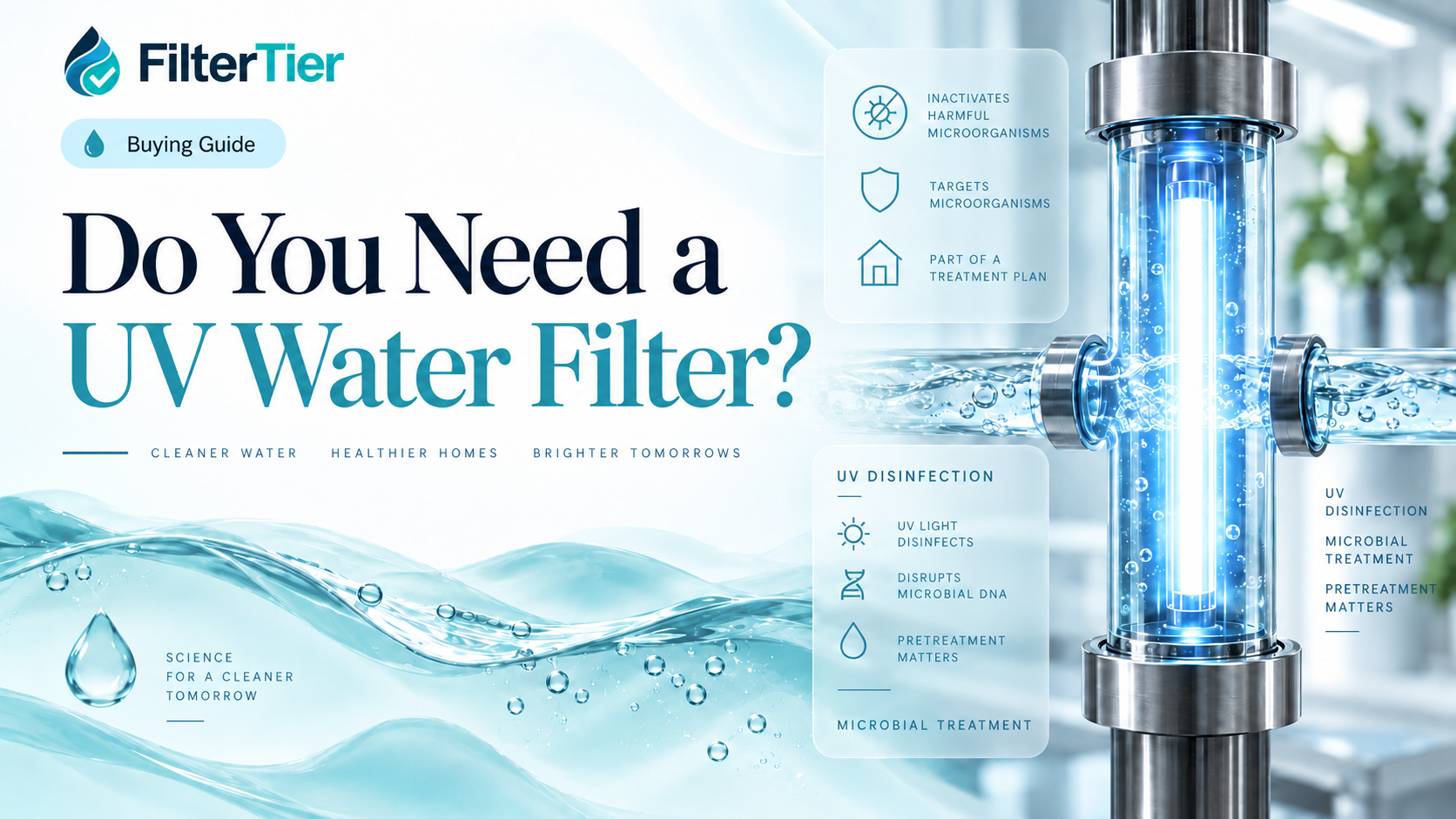
Whole-house UV makes sense when microbial disinfection is a real treatment goal. It is most commonly considered for private wells, homes with a history of bacteria detections, properties vulnerable to flooding or surface-water intrusion, or treatment trains where an additional disinfection barrier is justified. UV is not a universal water purifier and it does not replace filtration, softening or chemical-contaminant treatment.
The easiest way to understand UV is to separate what it does extremely well from what it does not do at all. UV can inactivate microorganisms when the system delivers an appropriate dose through sufficiently clear water. It does not physically remove sediment, hardness, metals, PFAS, nitrate or most dissolved chemicals.
What does a UV water system actually do?
Residential UV systems expose flowing water to ultraviolet light inside a reactor chamber. The UV energy damages the genetic material of microorganisms so they can no longer reproduce effectively.
That makes UV a disinfection technology rather than a filter. Water passes through the reactor without the contaminants being trapped in a cartridge.
The effectiveness of the process depends on UV dose, water clarity, reactor design, lamp output and flow rate.
Why UV dose matters
UV performance is not described meaningfully by lamp wattage alone. What matters is the UV dose delivered to the water, which depends on intensity and exposure time.
If water moves too quickly through a reactor, exposure time decreases. If the lamp output is low or the quartz sleeve is fouled, intensity can decrease. If the water blocks UV light because of turbidity, color or certain dissolved constituents, effective dose can also fall.
This is why a single headline GPM number can be misleading unless you know the dose and water-transmittance assumptions behind it.
What UV does not remove
Standard residential UV does not remove:
- PFAS;
- lead;
- arsenic;
- nitrate;
- hardness;
- iron;
- manganese;
- sediment;
- chlorine or chloramine;
- most dissolved organic chemicals.
If those are your concerns, UV needs to be combined with appropriate filtration, softening or other treatment.
When is UV most useful?
UV can make sense in several common scenarios.
Private wells
Private wells can be vulnerable to microbiological contamination depending on well construction, groundwater conditions, flooding, nearby septic systems, surface intrusion and maintenance. UV is often used as a final barrier after appropriate pretreatment.
Homes with previous bacteria detections
If testing has identified coliform or other microbiological concerns, UV may be part of the treatment response after the underlying source is investigated and the well or plumbing is properly addressed.
Seasonal or vulnerable water sources
Properties affected by flooding, shallow wells or changing surface conditions may use UV as an added disinfection barrier.
Final barrier after filtration
Some treatment trains use UV after sediment, iron, carbon, softening or other stages so the water reaching the UV reactor is clear and easier to disinfect reliably.
When UV is usually not the first treatment to buy
UV is not usually the first answer when the complaint is:
- hard water;
- chlorine taste;
- PFAS;
- lead;
- iron staining;
- sulfur odor caused by nonmicrobial well chemistry;
- arsenic;
- sediment;
- low pH.
Those problems require different treatment technologies.
Municipal water and UV
Public water systems already use disinfection and maintain a disinfectant strategy through the distribution system. For most municipal-water homes, adding UV is not automatically necessary.
There can be special circumstances where a homeowner wants an additional microbiological barrier, but that decision should be based on a defined reason rather than the assumption that municipal water is untreated.
Why private well owners consider UV more often
A private well does not have the same utility-operated disinfection and distribution controls as a public system. The property owner is responsible for testing and treatment.
That makes UV attractive because it can provide continuous disinfection without adding a chemical residual to the water.
However, UV does not fix the source of contamination. If a well is repeatedly testing positive for bacteria because of poor construction, a cracked cap, surface infiltration or a failing septic system, those problems still need attention.
UV should not be used to ignore a failing well
Disinfection is not a substitute for fixing structural or source-water problems. A contaminated well should be inspected and, when appropriate, disinfected or repaired according to professional and public-health guidance.
UV can provide a useful final barrier, but it should not become an excuse to leave an obviously compromised water source unchanged.
Why turbidity and sediment matter
UV light has to reach microorganisms. Suspended particles can shield microbes from the light or reduce UV transmission.
If water is visibly cloudy or contains heavy sediment, the first treatment problem is often pretreatment. A sediment filter, backwashing filter or other stage may be needed before UV.
Installing UV on dirty water can create false confidence because the lamp may be operating while effective disinfection is compromised.
What is UV transmittance?
UV transmittance, often abbreviated UVT, describes how well UV light passes through the water. Clear water with high UVT allows more light to reach microorganisms. Colored or turbid water can have lower UVT.
Manufacturers may publish flow ratings based on an assumed UVT. If your water is substantially different, the actual delivered dose at that flow may be different.
Why iron and manganese can be a problem before UV
Iron and manganese can create color, particles and deposits. They can also foul the quartz sleeve, reducing the amount of UV reaching the water.
On well water with measurable iron or manganese, those issues may need treatment before UV.
Why hardness can increase UV maintenance
Hard water can deposit scale on the quartz sleeve. Scale acts like a barrier between the lamp and the water, reducing UV transmission.
A home with severe hardness may need more frequent sleeve cleaning or upstream hardness treatment.
Why tannins and color matter
Natural organic color can reduce UV transmission even when water does not contain obvious suspended sediment. If the water is tea-colored or has known tannins, that issue may need treatment before UV.
UV flow ratings are not all comparable
A manufacturer may list different flow rates at different UV doses. One reactor might be advertised as 16 GPM at a lower dose but only 7 GPM at a higher dose.
If you compare only the largest headline flow, you can overestimate real disinfection capacity.
FilterTier’s whole-house UV ranking uses dose-specific flow where the data is available instead of treating every maximum-GPM number as equivalent.
What is NSF/ANSI 55?
NSF/ANSI 55 is a standard associated with ultraviolet microbiological water-treatment systems. Certification scope and class matter, so consumers should look at the exact listed model rather than assuming every UV product from a brand carries the same certification.
A product can also have validation or testing from other recognized programs depending on the application.
See FilterTier’s certification guide for the difference between an exact listed product and general marketing language.
Class A vs. Class B concepts
Different UV classifications can correspond to different intended applications and performance levels. The exact product documentation should explain the intended use.
Do not choose a system solely because “NSF 55” appears somewhere on a family page. Verify the exact model and the class or performance scope.
What monitoring features should you look for?
Useful UV-system features can include:
- lamp-on indicator;
- audible alarm;
- visual alarm;
- lamp-life countdown;
- UV intensity sensor;
- flow control;
- solenoid shutoff option;
- remote monitoring on some systems.
Monitoring does not improve a poorly sized reactor, but it helps you know when the equipment is not operating normally.
Why a lamp that is glowing can still be overdue
UV lamps can continue to produce visible light after their germicidal UV output has declined below the level assumed in the reactor’s design.
That is why lamp replacement should follow the manufacturer’s interval rather than a visual “it still lights up” check.
Quartz sleeve maintenance
The lamp is usually isolated from water by a quartz sleeve. Mineral scale, iron deposits or other fouling can build on the sleeve and reduce UV transmission.
Inspect and clean the sleeve according to the manufacturer’s maintenance instructions. Some systems use sensors that can help identify declining UV intensity, but physical inspection is still important.
How often should UV lamps be replaced?
Follow the exact manufacturer schedule. Many residential systems use an annual-type replacement cycle, but the exact interval and lamp technology can vary.
Do not generalize one brand’s schedule to every UV reactor.
Do UV systems require a filter cartridge?
The UV reactor itself may not, but the complete installation often includes sediment filtration or other pretreatment. Those cartridges have separate maintenance schedules.
A “low-maintenance” UV system can still be part of a multi-stage treatment train with several service items.
Where should UV be installed?
UV is generally placed after treatment stages that could improve water clarity and reduce fouling. A common well-water sequence might look like:
Incoming well water → sediment/iron/pH treatment as needed → softener if needed → fine filtration → UV → home distribution.
The exact order depends on water chemistry and equipment requirements. Follow manufacturer instructions and professional design guidance.
Why UV is often the final treatment stage
Installing UV near the end of the treatment train helps ensure the water entering the reactor is as clear as practical. It also minimizes the amount of plumbing between final disinfection and household distribution.
Should carbon be installed before or after UV?
Often carbon filtration is placed before UV when carbon is part of the whole-house treatment train, but the correct order depends on the complete design. The important point is that the water entering UV should meet the reactor’s requirements.
Does UV add anything to the water?
UV does not normally add a disinfectant chemical or residual to the water. That is one reason it is attractive for private wells.
The tradeoff is that there is no lasting disinfectant residual after the reactor. If downstream plumbing becomes contaminated, UV at the entry point does not create a chlorine-like residual throughout the system.
What happens during a power outage?
Most residential UV systems depend on electricity. During a power outage, the lamp is off and disinfection stops.
Homes where continuous disinfection is critical may consider backup power, shutoff valves or other fail-safe approaches.
Should a UV system shut off water when the lamp fails?
A fail-safe shutoff can be useful when untreated water should not pass during a lamp failure or alarm. Not every household wants automatic shutoff because it can interrupt all water service.
Consider the risk, application and monitoring strategy.
What size UV system do you need?
Size the reactor around realistic simultaneous household flow at the dose you care about. Do not size only by number of bedrooms or bathrooms.
Think about:
- number of simultaneous showers;
- washing machine fill;
- dishwasher;
- large tub;
- other high-flow fixtures;
- well pump delivery rate;
- pressure drop through pretreatment.
Use FilterTier’s flow-sizing guide for a broader framework.
Why oversizing UV can be useful—but not unlimited
A reactor with more capacity than your expected peak flow can provide margin and lower pressure drop. However, there is little reason to buy an extremely large commercial unit for a modest home if it adds unnecessary cost and complexity.
Why undersizing is risky
If household flow exceeds the reactor’s rated flow at the intended dose, delivered UV dose can drop. The system may still pass water, but disinfection performance may not match the verified rating.
UV and well-pump cycling
Well systems can deliver variable flow depending on pressure tank and pump operation. UV should be sized for maximum expected flow, not just average flow.
UV and tankless water heaters
UV is usually installed on the cold-water main before branch distribution, not specifically around a tankless heater. Hardness control for the heater is a separate treatment question.
Does UV improve taste?
Usually not directly. Taste and odor are more commonly addressed with carbon filtration or by treating the source of sulfur, iron or other water-quality issues.
Does UV remove sulfur smell?
Not necessarily. Rotten-egg odor can have several causes, including hydrogen sulfide in well water or bacteria associated with a water heater. UV should not be selected solely because water smells like sulfur.
Does UV remove iron bacteria?
UV can inactivate microorganisms passing through the reactor, but iron-bacteria problems can involve biofilm and deposits in wells, plumbing and equipment. Treatment may require cleaning, shock disinfection and iron control in addition to UV.
Does UV kill Giardia or Cryptosporidium?
UV can be effective against microorganisms when the reactor delivers the appropriate validated dose. Exact claims should be verified against the product’s certification or validation.
Do not extrapolate from a generic “kills bacteria” marketing statement to every pathogen.
UV vs. chlorination
Both can be used for disinfection, but they work differently.
| Factor | UV | Chlorination |
|---|---|---|
| Adds chemical residual | No | Yes |
| Requires clear water | Yes, strongly | Still affected by water quality |
| Provides downstream residual protection | No | Yes |
| Routine supplies | Lamps/sleeve service | Chemical feed |
| Contact tank potentially needed | No conventional disinfectant contact tank | Often yes depending on design |
The better approach depends on the water problem and system design.
UV vs. ozone
Ozone is another advanced treatment technology used in some water systems. It can oxidize contaminants and disinfect, but residential ozone systems are more complex than simple point-of-entry UV and should be professionally designed.
UV vs. reverse osmosis
They solve different problems. UV disinfects microorganisms. RO removes many dissolved contaminants by membrane separation. A drinking-water RO system does not replace whole-house disinfection when the source is microbiologically unsafe, and UV does not replace RO for dissolved chemical treatment.
Can UV be used with a water softener?
Yes. In hard-water homes, softening before UV can reduce scale formation on the quartz sleeve. The exact treatment order should follow the system design.
Can UV be used with a PFAS filter?
Yes. A PFAS filter can address chemical treatment while UV addresses microbial risk. Each stage must be sized for the household flow, and the lowest-flow stage can become the bottleneck.
Can UV be installed on city water?
Yes, but “can” is not the same as “needs to be.” Municipal systems already use regulated disinfection strategies. Add UV only when you have a defined reason and understand the maintenance burden.
How much maintenance does UV really require?
A realistic maintenance list can include:
- lamp replacement;
- quartz sleeve cleaning;
- sleeve replacement if damaged or heavily etched;
- sensor cleaning on monitored systems;
- prefilter replacement;
- checking alarms;
- verifying electrical operation;
- sanitizing downstream plumbing after certain contamination events.
That is not excessive, but it is not zero.
Ownership cost beyond the purchase price
Estimate:
- UV unit;
- installation;
- replacement lamps;
- replacement sleeves;
- prefilters;
- electricity;
- service calls;
- monitoring sensors or replacement parts.
A cheaper reactor with expensive proprietary lamps can cost more over time than a higher-priced system with readily available parts.
What should a good UV warranty cover?
Look at coverage for:
- reactor chamber;
- controller;
- ballast;
- sensors;
- electrical components;
- manufacturing defects.
Lamps and sleeves are often treated as consumables or have different coverage.
Common UV buying mistakes
Mistake 1: buying by maximum GPM alone
Maximum hydraulic flow may not equal validated disinfection flow.
Mistake 2: ignoring pretreatment
Turbidity, iron, hardness and color can reduce UV effectiveness or increase maintenance.
Mistake 3: assuming UV removes chemicals
UV is not a PFAS, lead, nitrate or hardness filter.
Mistake 4: forgetting power outages
No power usually means no UV disinfection.
Mistake 5: treating a glowing lamp as proof of performance
Lamp age matters even when visible light remains.
Mistake 6: buying a nonmonitored system for a high-risk application
For some households, alarms or intensity monitoring can be valuable.
Example: clean well water with bacteria history
A home has clear well water, modest hardness, no iron problem and a previous bacteria detection. After the well is inspected and disinfected, the homeowner wants an ongoing barrier.
A properly sized UV reactor with basic sediment prefiltration may be a logical addition if the water meets UVT and other application requirements.
Example: dirty well water with iron and sulfur
A different home has orange staining, sediment, sulfur odor and occasional bacteria detections. Installing UV first is not enough.
The system may need sediment, iron/sulfur treatment, possibly pH adjustment or softening, and then UV at the end. The exact order depends on testing.
Example: municipal water with chlorine taste
A city-water homeowner dislikes chlorine taste and assumes UV is the “cleanest” treatment. UV would not solve the taste problem. Carbon filtration is more relevant.
Frequently asked questions
Do I need UV if I have city water?
Usually not automatically. Public systems already disinfect water. Add UV only for a defined reason.
Do I need UV if I have a private well?
Not every well requires UV, but wells with microbiological risk can benefit from an appropriately designed disinfection barrier after testing and pretreatment.
Does UV remove PFAS?
No standard residential UV claim should be assumed to remove PFAS.
Does UV remove chlorine?
Not as a standard residential treatment objective. Carbon filtration is typically used for chlorine reduction.
Does UV soften water?
No.
Will UV fix sulfur odor?
Not necessarily. Diagnose the sulfur source first.
Can I install UV myself?
Some systems are mechanically straightforward, but correct sizing, electrical work, pretreatment and plumbing sanitation matter. Use a professional if you are uncertain.
How do I know whether UV is working?
Controller status, alarms, lamp-life monitoring and intensity sensors can provide operational information. Water testing can verify microbiological outcomes when needed.
What happens if I forget to change the lamp?
The lamp may continue glowing while germicidal output declines. Follow the manufacturer’s replacement interval.
Should UV go before or after my softener?
Often after the softener and other pretreatment, but follow the complete system design and manufacturer requirements.
A practical UV buying checklist
- Test the water and identify the microbiological concern.
- Fix well-construction or contamination-source problems when possible.
- Measure or evaluate turbidity, iron, manganese, hardness and color.
- Determine realistic household peak flow.
- Compare dose-specific flow ratings.
- Check exact certification or validation.
- Choose appropriate alarms and monitoring.
- Plan sediment or other pretreatment.
- Budget for lamp and sleeve service.
- Consider power-outage protection if continuous treatment is important.
How FilterTier evaluates UV systems
FilterTier scores UV systems for the job they actually perform. We do not penalize a UV reactor because it does not remove PFAS or hardness. Instead, relevant factors include microbiological treatment evidence, dose-specific flow, certification or validation, monitoring, maintenance, price, warranty, installation and documentation quality.
That category-sensitive approach prevents a disinfection product from being judged like a carbon filter.
Compare current models in the Best Whole-House UV Systems ranking or browse the system database.
What this means for you
UV is a specialized technology with a clear strength: microbiological disinfection. It should be selected when that is actually the problem you need to solve.
If your water is dirty, hard, iron-rich or chemically contaminated, address those issues with appropriate treatment rather than expecting UV to do everything. Size the reactor by dose-specific household flow, maintain the lamp and sleeve, and use monitoring appropriate to the risk.
For a private well with microbiological concerns, UV can be an excellent final barrier when the upstream water is properly treated. For a municipal-water home trying to remove chlorine, hardness or PFAS, another technology is usually the more relevant first step.
Use Find My Filter to combine UV with the rest of your water-treatment needs, and check What’s in My Water? if you are on a public system and want utility context before buying equipment.
Why microbiological testing can still matter after UV is installed
A controller can tell you the lamp is operating, but it does not directly prove the entire water system is microbiologically clean. Periodic testing can provide confirmation, especially for private wells with a history of contamination.
If post-UV samples remain positive, investigate sampling technique, downstream plumbing contamination, pretreatment, flow and reactor operation.
Downstream plumbing can be re-contaminated
UV treats water as it passes through the reactor. It does not leave a disinfectant residual in the pipes. If downstream plumbing contains biofilm or becomes contaminated during service, the UV unit cannot disinfect water that has already passed it.
Proper system sanitation after installation or contamination events can therefore matter.
Why flow restrictors can be important in UV systems
A correctly selected flow-control device can help prevent water from exceeding the reactor’s validated flow. Removing or bypassing a restrictor to improve pressure can undermine treatment performance.
How lamp warm-up and cycling differ by system
Most residential UV systems are designed to keep the lamp on continuously rather than switching with every faucet use. Frequent on/off cycling can shorten lamp life in some designs. Follow the manufacturer’s operating instructions.
Why controller replacement cost matters
UV ownership cost is not only lamps. Electronic ballasts, controllers and sensors can fail over a long service life. Before buying, check the price and availability of these components.
UV system comparison checklist
| Factor | What to verify |
|---|---|
| Dose-specific flow | GPM at the dose you need |
| Water-quality assumptions | UVT, turbidity and pretreatment limits |
| Certification/validation | Exact model and scope |
| Monitoring | Lamp alarm, intensity sensor, shutoff options |
| Lamp interval | Exact replacement schedule |
| Sleeve maintenance | Cleaning and replacement burden |
| Replacement cost | Lamp, sleeve, controller, sensor |
| Warranty | Reactor vs electronics vs consumables |
When a larger UV reactor is worth the money
Upsizing makes sense when household peak flow is close to the smaller reactor’s limit, when you want more pressure margin, or when a larger model provides the desired dose at a higher verified flow.
Upsizing simply for the biggest headline number is less useful.
How to interpret a bacteria result before buying UV
A positive total-coliform result can be a sign that the well or plumbing needs investigation, but the exact organism, sampling method and repeat-test result matter. One contaminated sample bottle or faucet aerator can create misleading results.
Follow laboratory and public-health guidance for confirmatory sampling and well disinfection. UV can be part of the long-term solution, but the source should still be understood.
Why sample location matters after UV
If you test immediately after the UV reactor, you are evaluating treatment at the reactor outlet. If you test at a distant faucet, you are also evaluating downstream plumbing. Both can be useful, but they answer different questions.
How a vacation property changes UV maintenance
Seasonal homes may sit unused for long periods. Stagnation, power shutoffs and winterization can affect the treatment system. Before reopening, inspect the UV equipment, verify lamp life, service pretreatment and follow appropriate flushing or sanitation procedures.
How to compare UV systems by ownership cost
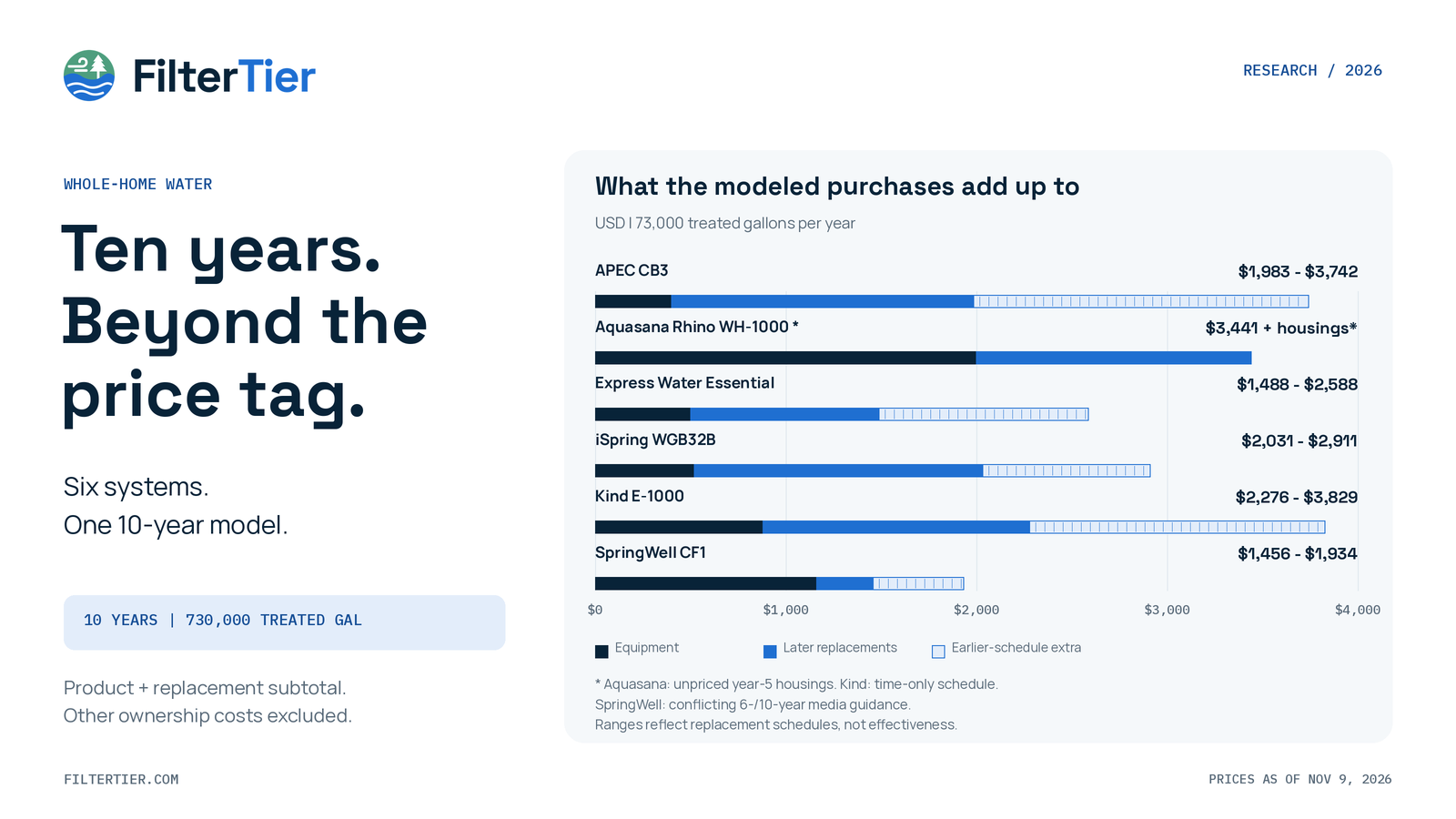
Calculate at least five years of lamps, sleeves, prefilters and likely electronic parts. A low purchase price can be offset by expensive proprietary lamps. Conversely, a premium reactor may justify its price with stronger monitoring, certification and easier service.
UV and emergency preparedness
If the home relies on UV for microbiological safety, plan for power outages and equipment failure. Keep appropriate bottled water or another emergency supply, know what alarms mean, and understand whether the system has an automatic shutoff.
Why UV should have a visible service record
Attach a tag to the system showing lamp installation date, sleeve-cleaning date and next service date. This is especially useful when a home changes owners or several household members share maintenance responsibility.
Final UV selection questions
- What microorganism risk am I treating?
- Is the well/source problem also being corrected?
- What is the water’s turbidity and UV transmittance?
- What pretreatment is needed?
- What flow is verified at the desired dose?
- Does the exact model have recognized certification or validation?
- What happens during power loss?
- How will I know the lamp or intensity is inadequate?
- What does five years of maintenance cost?
How to decide whether UV belongs in your treatment train at all
Before adding UV, write down the exact risk you are trying to control and the evidence that the risk exists. If the answer is only “I want the cleanest water possible,” stop and test first. UV is valuable when there is a microbiological reason for it, but it also creates lamp, sleeve, electrical and monitoring responsibilities. The best treatment train is not the one with the most equipment; it is the one in which every stage has a defined job.
If bacteria risk is confirmed and the source water can be properly pretreated, UV can be an excellent final barrier. If the problem is chemical, mineral or aesthetic, put the budget toward the technology that actually addresses that problem.