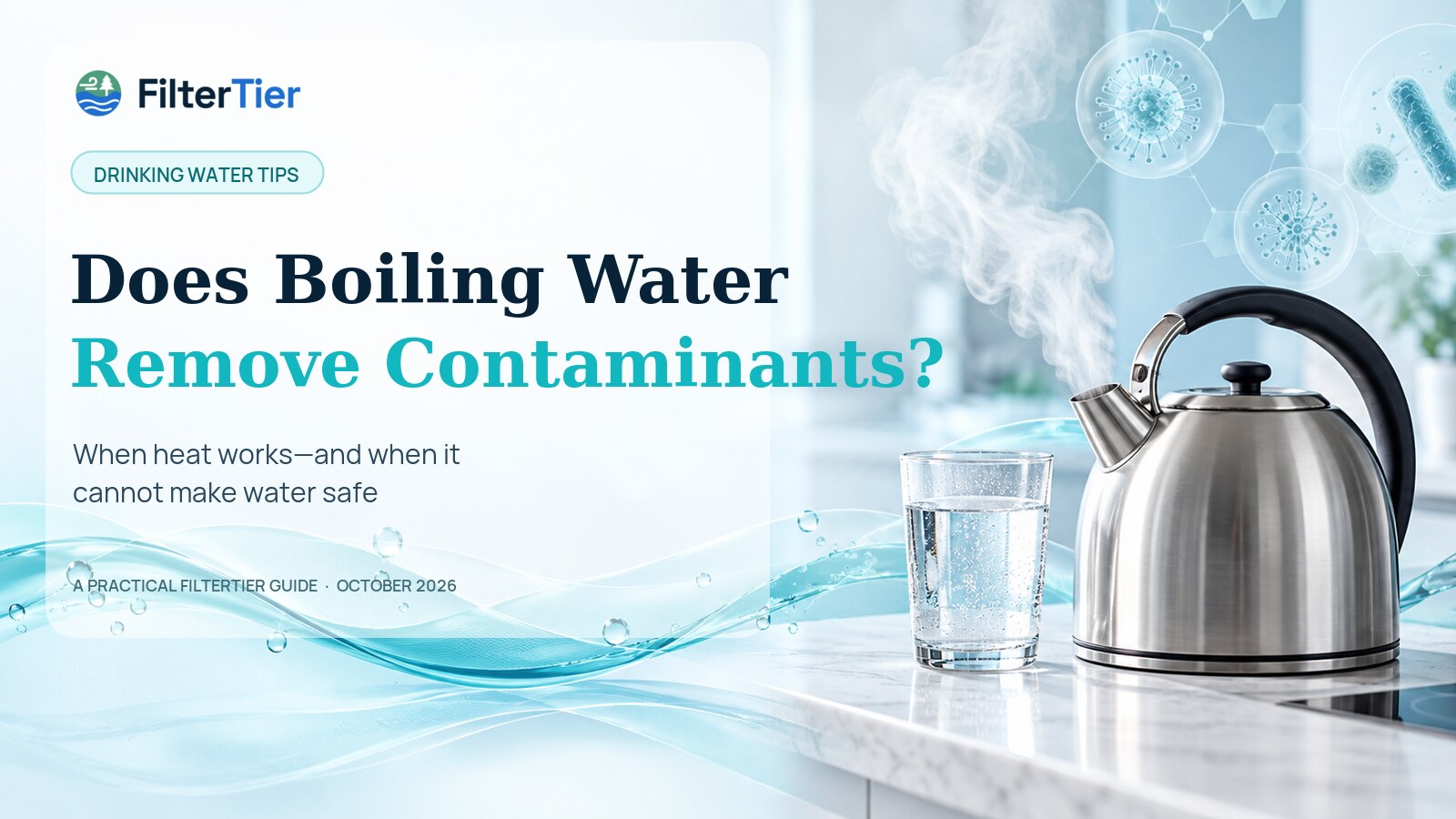
Boiling water is highly effective for killing disease-causing germs, but it does not remove most dissolved chemicals, metals, salts, or PFAS. During a boil-water advisory, use the exact instructions from your utility or health department. If officials issue a “do not drink” or “do not use” advisory because of chemicals or toxins, boiling is not the solution and may make some contaminants more concentrated as water evaporates.
The practical rule is simple: boil water when the problem is microbial and authorities tell you to boil; use a different safe water source or a treatment certified for the specific contaminant when the problem is chemical. The words in the advisory matter more than the appearance, taste, or smell of the water.
What to know in 60 seconds
- Boiling works against germs. A rolling boil can inactivate disease-causing bacteria, viruses, and parasites when the recommended time is followed.
- Boiling is not broad contaminant removal. It does not remove lead, nitrate, arsenic, salts, hardness minerals, PFAS, or most other dissolved chemicals.
- Evaporation can raise the concentration of nonvolatile contaminants. Less water remains while the contaminant stays behind.
- A boil-water advisory is different from a do-not-drink advisory. Boiling is intended for microbial risk; it cannot make water containing fuel, toxic chemicals, or radioactive material safe.
- A household filter does not automatically replace boiling. CDC advises boiling even filtered tap water during a boil-water advisory unless the issuing authority gives different instructions.
- Distillation is not the same as boiling a pot of water. A distiller captures and condenses vapor as a separate product stream; ordinary boiling leaves the water and most dissolved contaminants in the same pot.
Does boiling water remove contaminants?
It depends on what “contaminant” means. Boiling is a disinfection step, not a universal purification step. Heat can inactivate microorganisms that might cause illness. It generally does not physically separate dissolved lead, nitrate, arsenic, fluoride, sodium, hardness minerals, PFAS, and many other chemicals from the water you will drink.
This distinction is why public notices use different instructions. A utility may issue a boil-water advisory after a pressure loss, main break, treatment interruption, or test result that creates concern about microbes entering the distribution system. A chemical spill or toxic contamination event may instead lead to a do-not-drink or do-not-use notice. The second situation requires a different water source and incident-specific direction, not a longer boil.
| Water concern | What boiling does | What it does not do | Best next step |
|---|---|---|---|
| Bacteria, viruses, and parasites | Proper boiling can inactivate disease-causing organisms. | It does not remove sediment, metals, salts, or chemicals that may also be present. | Follow the local boil-water notice, including time, cooling, storage, and permitted uses. |
| Lead | No meaningful lead-removal benefit. | Lead remains in the water and may become more concentrated as water evaporates. | Use an alternate safe source or a correctly maintained filter certified for lead reduction, following official instructions. |
| Nitrate | No nitrate-removal benefit. | Nitrate is not destroyed by boiling and can become more concentrated. | Use a safe alternative source and obtain testing or treatment guidance from the relevant authority. |
| PFAS | No established household boiling solution. | Heating does not provide a practical way to remove PFAS from drinking water. | Use source-specific guidance and, if treatment is appropriate, verify exact-product PFAS certification and maintenance requirements. |
| Arsenic, hardness, sodium, and other dissolved minerals | Usually no removal. | Dissolved material remains behind when some water evaporates. | Test first, then match a treatment process to the exact water chemistry. |
| Fuel, solvents, toxins, or radioactive material | Boiling cannot be assumed to make the water safe. | Heat may not destroy the hazard; some volatile chemicals may create an inhalation concern. | Do not use the water unless incident authorities explicitly state a permitted use. Obtain water from an approved source. |
Why boiling works for germs
Microorganisms are living or biologically active agents whose essential structures and processes can be disrupted by sufficient heat. CDC describes boiling as the best way to kill germs in water during an emergency. EPA similarly states that boiling can kill pathogenic bacteria, viruses, and protozoa. The result depends on reaching a true rolling boil and following the recommended time, not merely warming the water until bubbles appear around the edge.
Boiling is especially useful in an emergency because the process is easy to understand, does not require measuring a disinfectant dose, and can be performed with common household equipment. It is also why utilities use a boil-water notice as a precaution when a loss of pressure or other system condition creates a credible pathway for microbial contamination, even if no one has confirmed that every tap contains a pathogen.
Disinfection, however, is not the same as removal. The organisms may be inactivated, but the water does not pass through a separation process that carries dissolved solids into another waste stream. A pot of boiled water remains a pot containing nearly all the dissolved material it held before heating.
Cloudy water needs a preliminary step
If water is cloudy, CDC and EPA advise letting it settle or filtering it through a clean cloth, paper towel, or coffee filter before boiling. That preliminary filtration removes some visible particles and helps make the disinfection step more reliable. It is not a substitute for boiling, and it does not establish that dissolved chemicals have been removed.
Draw off the clearer water without stirring up settled material. Then follow the current local instructions. If the notice says the water may contain fuel, a toxic chemical, or another hazard that boiling cannot address, do not perform a home experiment. Use an approved alternate source and wait for incident-specific direction.
How to boil water correctly during an advisory
Use the notice issued for your address as the controlling instruction. Generic federal guidance is helpful, but local officials know the reason for the notice, the affected area, the system status, and when the advisory has been lifted.
- Check that the advisory applies to your water system and location. A ZIP code may contain more than one utility. Confirm the utility name, affected streets or pressure zone, issue time, and latest update.
- Use clear water. If the water is cloudy, allow particles to settle and filter the clearer water through a clean cloth, paper towel, or coffee filter.
- Bring the water to a full rolling boil. A rolling boil is vigorous across the surface; a few bubbles around the pot are not enough.
- Maintain the required time. Current CDC consumer guidance says to boil for one minute and for three minutes above 6,500 feet. EPA emergency guidance uses three minutes above 5,000 feet. When thresholds differ, use the duration in your local notice; if it is unclear, contact the issuing authority rather than choosing the shorter interpretation.
- Let the water cool naturally. Avoid adding ice made before or during the advisory unless officials confirm that it came from a safe source.
- Store it in a clean, sanitized container with a tight cover. Do not dip hands, cups, or utensils into the container. Pour from it instead.
- Label and separate it if needed. In a busy household, make it obvious which container holds prepared drinking water and which water is not intended for consumption.
Boil only the amount your household can handle safely. Large, heavy pots create a burn risk, particularly when carried across a kitchen. Use stable cookware, keep children away from the stove, and allow adequate cooling time. The point is safe water, not producing the largest possible batch at once.
Why federal altitude instructions are not identical
Water boils at a lower temperature as elevation increases, so high-altitude guidance uses a longer boil. CDC’s current general emergency page sets the longer duration above 6,500 feet, while EPA’s emergency-disinfection page sets it above 5,000 feet. This is not a reason to disregard the advisory. It is a reason to follow the exact local instruction, which can account for local elevation and the agency’s protocol.
If your notice simply says “boil” without a time, consult the utility or health department page linked in the notice. Do not rely on a cropped social-media image that may be old or may apply to a different service area.
Boil-water, do-not-drink, and do-not-use notices are different
The fastest way to choose the right action is to read the notice type before doing anything to the water. CDC separates drinking-water advisories into three broad categories.
Boil-water advisory
A boil-water advisory addresses actual or possible germs. The notice typically directs customers to use commercially bottled water or properly boiled water for drinking, cooking, making beverages, brushing teeth, preparing food, and making ice. It may also give instructions for dishwashing, bathing, handwashing, infant feeding, and pets.
Boil tap water even if it passed through a typical refrigerator filter, faucet filter, whole-home filter, or pitcher unless the issuing authority explicitly says otherwise. Most consumer filters are not designed, tested, installed, and maintained as validated microbial barriers for an emergency notice. A filter can also become part of the post-advisory cleanup instructions.
Do-not-drink advisory
A do-not-drink advisory may be issued when the water is or could be contaminated with a harmful chemical or toxin. Boiling cannot be assumed to make that water safe and may increase the concentration of a nonvolatile contaminant. Use commercially bottled water or another source approved by the responsible authority for drinking and food preparation. Follow the notice for bathing, cleaning, laundry, toilet flushing, and other uses; permitted uses depend on the hazard.
Do-not-use advisory
A do-not-use advisory is more restrictive. CDC describes it as a situation in which swallowing, touching, or otherwise contacting the water could be dangerous. Do not use the water for any purpose until the authority says a specific use is allowed. Boiling, filtering, or adding disinfectant at home does not cancel the notice.
FilterTier’s What’s in My Water? tool can help identify the public system associated with a ZIP code and provide baseline utility context. It is not a live emergency-notification service. During an active event, the utility, state regulator, local health department, and emergency-management notices take priority.
What boiling does not remove
Boiling changes temperature and removes some water as vapor. It does not provide the selective adsorption, ion exchange, membrane separation, or waste-stream removal used by many water-treatment systems. That is why a chemical-specific problem needs chemical-specific evidence.
Lead
EPA states plainly that boiling water does not remove lead. Lead can enter drinking water through service lines, solder, faucets, or other plumbing materials. Because you cannot reliably see, taste, or smell dissolved lead, a clear glass does not rule it out. If lead is the concern, testing and source-specific guidance matter.
EPA advises using cold water for drinking, cooking, and preparing baby formula rather than starting with hot tap water. If a filter is part of the response, it should be evaluated by an accredited third-party certification body for lead reduction, installed on the correct line, used within its temperature limits, and maintained on schedule. See FilterTier’s lead in tap water guide, lead contaminant page, and NSF/ANSI 53 overview for the distinctions among testing, treatment claims, and certification.
Nitrate
Boiling does not reduce nitrate. EPA’s nitrate guidance warns that the concentration can become higher because water evaporates while nitrate remains. This is especially important for private wells and for households receiving a nitrate notice. A longer boil is not extra protection; it moves in the wrong direction for this contaminant.
Do not select a treatment based on the word “filter” alone. Common carbon pitchers are not a nitrate solution. Testing, correctly designed treatment, ongoing maintenance, and follow-up testing are needed. FilterTier’s nitrate page summarizes the contaminant and treatment context, but local public-health or well guidance should control an active notice.
PFAS
Heating or boiling is not a practical household method for removing PFAS. EPA’s current consumer guidance instead points people toward exact filters certified to reduce PFAS, while also cautioning that certification standards and federal drinking-water limits are not identical concepts. A product’s certification must be checked for the exact model and reduction claim.
Activated carbon, ion exchange, and reverse osmosis can be relevant treatment processes, but performance depends on system design, influent concentration, contact time, flow, competing contaminants, installation, and replacement timing. Do not infer an exact-product PFAS claim merely because the unit contains carbon or a membrane. Use the PFAS contaminant page and PFAS treatment comparison to understand those distinctions.
Arsenic, salts, hardness, and dissolved solids
Ordinary boiling does not separate most dissolved inorganic material from the water that remains in the pot. Calcium and magnesium associated with hardness can leave scale on cookware and heating elements. Sodium and many other dissolved solids remain. Arsenic requires testing and treatment chosen for the form of arsenic and the broader water chemistry.
The visible scale left by repeated boiling is evidence that minerals did not disappear. It is not proof that the water contains a particular hazardous concentration, and it should not be used to diagnose one contaminant. For private wells, use a certified laboratory and choose treatment from the actual result rather than from scale, taste, staining, or a countertop meter alone.
Fuel, solvents, pesticides, and other volatile chemicals
EPA and CDC warn that water containing fuel or toxic chemicals cannot be made safe by boiling or ordinary disinfection. Some chemicals can volatilize when heated, creating a possible inhalation concern as well as a drinking-water concern. Do not boil suspect fuel- or solvent-contaminated water indoors unless the incident authority specifically instructs you to do so—which would be unusual.
Use commercially bottled water or another approved source, ventilate or avoid the affected area according to official instructions, and wait for clearance. A home smell test is not reliable: some hazardous chemicals have little odor at relevant concentrations, while harmless aesthetic compounds can have a strong odor.
Boiling is not distillation
This is one of the most common misunderstandings. Both processes heat water, but they collect different outputs.
When you boil a pot and then drink the water remaining in that pot, most dissolved contaminants remain with the liquid. When a distiller operates, it boils water, captures the vapor, cools that vapor, and collects the condensed water in a separate container. The concentrated residue remains in the boiling chamber and is discarded during cleaning.
Even distillation is not automatically a universal solution. EPA’s WaterSense treatment guide notes that some volatile organic compounds, pesticides, or volatile solvents may not be removed by some distillers, and inactive cooling components can create maintenance concerns. Distillation is energy-intensive and requires cleaning. As with every technology, verify the exact system, contaminants covered, operation instructions, and certification.
A pot with a lid is not a distiller unless it is designed to capture, route, condense, and separately collect vapor safely. Improvised steam collection creates scalding and contamination risks and should not be treated as an emergency shortcut.
Boiling versus a household water filter
Boiling and filtration answer different questions. Boiling is a short-term microbial disinfection method. A filter is a device with defined media or membranes intended to reduce specified substances under stated conditions. Neither one should be assumed to cover the other’s job.
| Method | Typical strength | Main limitation | Evidence to check |
|---|---|---|---|
| Boiling | Emergency inactivation of disease-causing organisms | Does not remove most dissolved chemicals and metals | Current utility or health-department advisory |
| Activated carbon | Taste, odor, chlorine, and specific certified organic-chemical claims | Not a universal barrier; performance depends on claim, flow, capacity, and replacement | Exact model certification and performance data sheet |
| Reverse osmosis | Membrane reduction of many dissolved contaminants | Produces reject water, needs pressure and maintenance, and claims vary by model | NSF/ANSI 58 or other exact-product certification and manufacturer documentation |
| Ultraviolet disinfection | Microbial treatment when water is sufficiently clear and the system is properly designed | Does not remove dissolved chemicals or sediment; requires power and maintenance | Exact-product validation, dose conditions, prefiltration, lamp and sleeve requirements |
| Distillation | Separates condensed vapor from many nonvolatile dissolved contaminants | Energy use, slow output, cleaning, and possible limits for volatile compounds | Exact model instructions and NSF/ANSI 62 certification where applicable |
During an official boil-water advisory, CDC says to boil filtered tap water too. A typical pitcher, refrigerator cartridge, or whole-home carbon tank is not evidence that the water is microbiologically safe. If your home has a specialized system designed and validated for microbial protection, still follow the notice until the utility or health department confirms how your system should be handled.
After the notice is lifted, the issuing authority may recommend flushing plumbing, discarding ice, cleaning faucet aerators, replacing filters, sanitizing softeners or treatment equipment, and running appliances. Follow those instructions and the equipment manufacturer’s procedure. Do not invent a bleach dose for a complex system.
What should you use boiled water for?
A boil-water notice commonly applies to activities that can bring tap water into the mouth or into food. Use properly boiled and cooled water, or commercially bottled water, for drinking, coffee and tea, cooking, rinsing produce, brushing teeth, mixing beverages, making ice, and preparing foods that will not receive adequate cooking afterward.
Ice and refrigerator dispensers
Turn off or avoid automatic ice production during the advisory unless the local notice says the supply is safe. Ice made from affected water remains affected; freezing is not disinfection. Discard ice produced during the advisory and follow post-advisory flushing and filter instructions for the refrigerator.
Coffee makers and kettles
Do not assume a coffee maker reaches and holds the required rolling-boil condition. Some machines heat water below boiling or move it through too quickly. Use water that has already been boiled according to the notice, or use an appliance only if officials confirm that its process satisfies the instructions.
Infant feeding
CDC says breastfeeding is the best option during a boil-water advisory and recommends ready-to-use formula when possible for formula-fed infants. Follow the child’s clinician and the local notice. Do not start with hot water from the tap, and do not assume that boiling solves lead, nitrate, or another chemical concern. Infant-formula preparation combines water safety, formula-handling, and burn-prevention issues, so use authoritative instructions rather than a generic online ratio.
Pets
Give pets commercially bottled water or properly boiled water that has cooled when CDC or the local notice includes pet use. Animals can be affected by germs and chemicals too. Do not allow pets to drink from toilets, puddles, or outdoor containers that may have been exposed to the same event.
Dishwashing and cleaning
Instructions vary with the advisory and dishwasher. A notice may allow a dishwasher with a sanitizing cycle or a final rinse that reaches a specified temperature, while another notice may require a different method. Handwashing dishes may require boiled or disinfected water for the final rinse. Follow the local notice rather than applying a rule from a different incident.
Bathing and handwashing
During many boil-water advisories, bathing is allowed if water is not swallowed, with extra caution for babies and young children. Handwashing with soap and tap water may be allowed, depending on the event. Do-not-use notices are different and may prohibit contact. Read the permitted-use section instead of assuming that “unsafe to drink” means unsafe—or safe—for every other activity.
Five common boiling mistakes
1. Boiling longer to remove chemicals
A longer boil does not turn a disinfection method into a chemical-removal process. It can reduce water volume and increase the concentration of lead, nitrate, salts, or other nonvolatile substances.
2. Treating every advisory as a boil-water advisory
“Do not drink” and “do not use” are not stronger ways of saying “boil first.” They identify different actions. If the notice says not to drink, use another approved source. If it says not to use, avoid the listed contact and household uses.
3. Assuming clear water is safe
Many microbes and dissolved contaminants do not change the water’s color. Conversely, discoloration can have several causes and is not a complete diagnosis. Use notices, utility information, and laboratory testing—not appearance alone.
4. Trusting a filter without checking the exact claim
A carbon filter may be certified for chlorine taste and odor but not lead, PFAS, nitrate, or microorganisms. Certification applies to the exact product and claim, not to every device made by a brand or every filter using the same general media.
5. Recontaminating water after boiling
Boiled water can be contaminated by a dirty container, lid, scoop, hand, or counter. Cool it safely, store it covered, pour rather than dip, and clean the container according to emergency guidance.
A practical decision guide
- Identify the water source. Public utility, private well, building system, tanker, or another source may have different responsibilities and notices.
- Identify the instruction. Look for “boil water,” “do not drink,” “do not use,” or no active notice.
- Identify the suspected hazard. Germs, lead, nitrate, PFAS, arsenic, fuel, salt, hardness, or an unknown concern require different evidence.
- Use the safest immediate source. Under an advisory, this is often commercially bottled water or properly prepared water as specified by officials.
- Use treatment only for a verified purpose. Match the exact contaminant to a certified or otherwise validated system and its operating conditions.
- Plan maintenance and confirmation. Filters expire, membranes foul, UV lamps age, and plumbing can reintroduce contaminants. Retesting may be necessary for a private well or known home-specific problem.
If there is no advisory and your goal is to understand routine tap-water quality, start with your actual utility, Consumer Confidence Report, service-line information, and home-specific risks. FilterTier’s tap-water safety guide explains that process. If you are choosing a household system, use the whole-home water finder only after identifying the concern; a product recommendation cannot replace testing or an emergency notice.
What this means for your household
Keep a short response plan where everyone can find it:
- Know your water utility and save its official alert page.
- Keep enough approved drinking water for a short interruption if practical.
- Know whether anyone in the household has needs that make water disruptions harder to manage.
- Keep clean, food-safe storage containers with tight covers.
- During an advisory, stop ice production and label unsafe taps if confusion is likely.
- Read the notice type before boiling anything.
- After the advisory ends, follow flushing, ice, appliance, and filter instructions before returning to normal use.
For a routine chemical concern, do not make boiling a daily substitute for evidence. A certified laboratory result, a utility report, and an exact-product treatment claim are far more useful. If the concern is lead, nitrate, PFAS, arsenic, or another health-related contaminant, contact the utility, state drinking-water authority, local health department, or a qualified water professional as appropriate.
Frequently asked questions
Does boiling tap water make it purified water?
No. Proper boiling disinfects against germs, but the water still contains most dissolved minerals, salts, metals, and chemicals. Purification is not one universal process; it depends on which contaminants are being removed and how performance is verified.
Does boiling remove chlorine?
Heating and standing can reduce some volatile chlorine residual and change taste, but this is not a reliable way to address every disinfectant or disinfection byproduct. Chloramine is more persistent than free chlorine, and neither taste nor odor establishes chemical safety. For routine taste concerns, identify whether the utility uses chlorine or chloramine and verify an exact filter’s claim and capacity.
Does boiling remove lead?
No. EPA states that boiling water does not remove lead. Start with cold tap water, follow flushing advice from the utility when applicable, and use an exact filter certified for lead reduction if officials recommend filtration.
Does boiling remove nitrate?
No. Nitrate remains while water evaporates, so the concentration can increase. Use a safe alternative source and follow public-health or private-well guidance.
Does boiling remove PFAS?
No practical household boiling method removes PFAS from drinking water. Use source-specific guidance and verify exact-product certification for PFAS reduction if a filter is part of the response.
Should I boil water that already went through a pitcher or refrigerator filter?
Yes during a boil-water advisory, unless the issuing authority explicitly gives different instructions. CDC advises boiling filtered tap water because ordinary household filters should not be assumed to make microbiologically suspect water safe.
Can I use hot water from the tap to save time?
Use cold tap water and then heat it. EPA recommends cold water for drinking and cooking when lead is a concern because hot water can dissolve lead more readily from plumbing. Starting with hot tap water also does not satisfy an advisory by itself.
Can I boil water in a microwave?
A microwave can overheat water unevenly and create a serious scald risk when the container is moved or disturbed. Follow the local notice and use a method that lets you observe and safely maintain a rolling boil. If an authority provides microwave-specific instructions, follow them exactly.
How long is boiled water safe to store?
Storage depends on container sanitation, temperature, handling, and the instructions in the emergency guidance. Cool the water, store it in a clean sanitized container with a tight cover, and avoid dipping into it. When an advisory provides a storage period, use that period. Replace water that may have been contaminated during handling.
When can I stop boiling?
Stop only when the authority that issued the advisory says it has been lifted for your service area. A neighbor’s water looking clear, a social post, or the return of pressure is not enough. Follow any post-advisory flushing and appliance instructions before using water normally.
Sources and methodology
This guide was reviewed against current primary federal guidance available on October 13, 2026. The central emergency-use instructions come from CDC’s How to Make Water Safe in an Emergency and Drinking Water Advisories overview, together with EPA’s Emergency Disinfection of Drinking Water. Chemical-specific statements were checked against EPA guidance for lead, nitrate, and PFAS filtration. Treatment distinctions were reviewed against EPA’s WaterSense guide to selecting water-treatment systems.
FilterTier does not convert one agency’s general guidance into a rule for every incident. Local notices control because they identify the actual hazard, affected area, permitted uses, boil time, and post-advisory steps. Product treatment statements in this article describe process categories; they are not claims that every product using that process treats every contaminant.
Bottom line
Boiling is a powerful, targeted emergency tool for germs. It is not a universal contaminant-removal method. Read the advisory type, follow the current local instructions, and use another approved water source when chemicals, toxins, fuel, or radioactive material are involved. For routine lead, nitrate, PFAS, arsenic, or other contaminant concerns, test or verify the source and choose treatment based on exact evidence—not on the assumption that heat makes every form of water contamination disappear.
FilterTier provides consumer research and decision support, not medical advice or emergency direction. During an active water event, follow your water utility, health department, regulator, and emergency-management instructions.
Sources
- CDC: How to Make Water Safe in an Emergency — reviewed October 13, 2026.
- CDC: Drinking Water Advisories—An Overview — reviewed October 13, 2026.
- EPA: Emergency Disinfection of Drinking Water — last updated February 24, 2026; reviewed October 13, 2026.
- EPA: Does Boiling Water Remove Lead? — last updated October 28, 2025; reviewed October 13, 2026.
- EPA: Will Boiling My Water Help? (Nitrate) — reviewed October 13, 2026.
- EPA: Reducing PFAS in Your Drinking Water with a Home Filter — reviewed October 13, 2026.
- EPA WaterSense: Guide to Selecting Water Treatment Systems — November 2024; reviewed October 13, 2026.