
Most public tap water in the United States is regulated and routinely tested, but “safe” is not a single yes-or-no label that applies equally to every home. Your utility’s source water, treatment plant, distribution network, service line, plumbing, fixtures and even your water heater can all influence what reaches your glass. The most useful question is not simply “Is tap water safe?” but “What do I know about the water system serving this address, and what could change between the treatment plant and my faucet?”
For most households on municipal water, the fastest way to get a useful answer is to combine three things: the public water utility’s records, information about the building or home itself, and targeted testing when there is a reason to investigate further. That approach is far more reliable than judging water by taste, color, social-media posts or national headlines that may have little to do with your local system.
What “safe tap water” actually means
Public drinking-water systems operate under federal and state drinking-water rules, and utilities are required to monitor regulated contaminants, report results and notify customers when certain problems occur. That does not mean every regulated contaminant must be literally absent from water. Drinking-water regulation generally works through limits, treatment requirements, monitoring rules and action levels that are intended to keep public water within established standards.
It is also important to separate system-level compliance from home-level exposure. A utility can meet its treatment and monitoring obligations while one house has a plumbing-related problem. Lead is the classic example: much of the lead that appears at a faucet comes from service lines, solder or premise plumbing rather than the source water entering the treatment plant. Similar distinctions matter for sediment, corrosion, metals and building-specific stagnation.
That is why FilterTier treats utility data as a starting point rather than a complete diagnosis of one home.
Start with the correct water utility
If you are on public water, the first step is identifying the actual utility serving the property. This sounds simple, but ZIP codes can contain multiple systems, and municipal boundaries do not always line up perfectly with utility service areas. A city may be served by one large system, several smaller systems, or a wholesaler plus local distribution utilities.
FilterTier’s What’s in My Water? tool is designed to help with this by connecting a ZIP code to public water-system records and then presenting utility identity, water source, violations, lead information, PFAS screening context and other data when available. When multiple utilities can serve the same ZIP, the right answer may require confirming your bill, address or utility name.
Do not assume the biggest nearby utility is yours. The wrong system can lead you to the wrong contaminant profile and the wrong treatment decision.
Read the Consumer Confidence Report, but know its limits
Public water systems publish Consumer Confidence Reports, often called annual water-quality reports. These reports typically summarize source water, detected regulated contaminants, compliance information, treatment methods and other required disclosures. They are valuable because they come directly from the utility and present information in a format intended for customers.
However, annual reports are summaries. They may not capture every short-term event that occurred after the reporting period, and they are not a substitute for real-time advisory notices. A current boil-water advisory, treatment interruption or emergency notice may be published separately on a utility, city or health-department website.
For a current picture, use the annual report for baseline understanding and check recent utility or regulator notices for active issues.
Five things to look for first in a water report
You do not need to interpret every chemical name on the first pass. Start with the categories that most directly affect household decisions.
1. Current violations or advisories
Look for open health-based violations, boil-water advisories, do-not-drink notices or other active instructions. Then confirm whether an older issue has been resolved. A historical violation and a current active violation are not the same thing, and FilterTier intentionally labels those separately.
2. Lead information
Lead sampling is particularly important because the plumbing between the water main and your faucet can matter as much as the water source. A utility’s lead sampling result is not a test of your exact home. If your service-line material is unknown or your building has older plumbing, home-specific testing may still be appropriate even when the utility’s overall results look good.
3. PFAS monitoring
PFAS data may come from regulatory monitoring, national monitoring programs or utility testing. A detected PFAS concentration can be useful for understanding whether PFAS is present in the system, but a monitoring result should not automatically be described as a violation unless the relevant regulator or utility identifies it that way.
FilterTier separates PFAS screening signals from formal compliance status for exactly this reason.
4. Source water
Groundwater and surface-water systems face different treatment challenges. Surface water may be more exposed to runoff and seasonal changes, while groundwater can carry naturally occurring minerals, hardness, iron, manganese, arsenic or other geological constituents depending on location.
5. Treatment and distribution context
Chlorine, chloramine, corrosion control, filtration, softening and other utility treatment choices help explain what you may notice at the tap. If a utility uses chloramine rather than free chlorine, for example, that can affect which home filtration media is most appropriate.
Why your house can change the water after treatment
The water leaving a treatment plant is not necessarily identical to the water you collect from a kitchen faucet hours or days later. Distribution mains, service lines, building plumbing and fixtures all create opportunities for water chemistry to change.
Long periods of stagnation can increase contact time between water and plumbing materials. Hot-water systems can accumulate sediment. Old galvanized pipes can release rust or metals. Corrosion can mobilize lead from older components. New plumbing can also temporarily affect taste or metal concentrations.
Apartment buildings and large commercial buildings add another layer because water may travel through extensive internal plumbing before it reaches a specific unit.
This is why a public water-quality report should answer, “What is happening at the utility level?” while a home test answers, “What is happening at this faucet under these conditions?”
Lead is the best example of why home-specific testing matters
Lead does not usually enter drinking water because a utility intentionally sends lead-containing water through the system. It commonly enters after treated water contacts lead service lines, solder, brass components or older plumbing materials.
A utility’s corrosion-control program can reduce the tendency of lead to leach, but the actual plumbing at each property still matters. Two neighboring homes on the same main can have different service-line materials and therefore different lead risk profiles.
If you own an older home, do not know the service-line material, are planning major plumbing work, or have a reason to be especially cautious about lead exposure, a properly collected tap-water sample can provide information that a system-wide average cannot.
For more context, FilterTier links water-quality data to relevant contaminant information and treatment evidence rather than treating every detected issue as a reason to buy equipment immediately.
PFAS: monitoring, limits and treatment are three separate questions
PFAS has become one of the most confusing drinking-water topics because the word is used to describe a large family of chemicals, multiple monitoring programs, changing regulatory requirements and many different treatment claims.
When you see PFAS data, ask three separate questions:
- Was PFAS detected? This is a monitoring question.
- Is the system in violation of an applicable requirement? This is a compliance question.
- What treatment has evidence for the specific PFAS compounds and flow conditions? This is a treatment question.
Those questions should not be collapsed into one. A detection is not automatically a violation, and a filter containing carbon is not automatically verified for every PFAS compound.
FilterTier’s PFAS filter evidence guide explains how to separate exact-system certification from component testing and manufacturer marketing claims.
What about chlorine and chloramine?
Disinfectants are intentionally used by public water systems to control microorganisms. They can also affect taste and odor, and some homeowners choose carbon filtration primarily to improve those aesthetic characteristics.
Chlorine and chloramine are not interchangeable from a home-filtration standpoint. Some media and system designs are better suited to chloramine reduction than others. If your utility uses chloramine, look for exact product evidence rather than assuming every carbon filter will perform equally.
A strong chlorine taste does not, by itself, prove the water is unsafe. Likewise, water with no noticeable disinfectant taste is not automatically safer.
Hardness is a plumbing and comfort issue, not the same as contamination
Hardness is mainly associated with dissolved calcium and magnesium. It can create scale, spotting, soap inefficiency and appliance buildup, but it is not the same category of problem as lead, pathogens or PFAS.
This distinction matters because a water softener is not a universal contaminant filter. A true ion-exchange softener removes hardness ions, while a salt-free conditioner is intended to change scale behavior without conventionally softening the water.
If hard water is your main issue, see FilterTier’s water softener vs. salt-free conditioner guide before buying a combined system that may be solving several different problems at once.
Private wells require a different mindset
A private well is not managed like a municipal water system. The homeowner is generally responsible for testing, treatment and maintenance. That makes periodic testing much more important.
Well-water conditions can be influenced by local geology, septic systems, agriculture, nearby industry, flooding, surface runoff, well construction and seasonal groundwater changes. One well can differ significantly from another nearby well.
Common well-water concerns include bacteria, nitrate, arsenic, iron, manganese, hardness, low pH, sulfur odor and sediment, but the right test panel depends on local conditions.
Do not select a well-water system based only on odor or color. Iron, sulfur, manganese and low pH can overlap in ways that change which equipment should be installed and in what order.
When should you test your own water?
Testing makes the most sense when it can change a decision. Consider testing when:
- you use a private well;
- your home has older or unknown plumbing;
- the service-line material is unknown;
- you are concerned about lead at a specific tap;
- water suddenly changes color, taste or odor;
- you receive a local water advisory;
- there has been flooding or a well-system problem;
- you are buying expensive treatment equipment;
- a household member has a specific reason to minimize exposure to a contaminant;
- you want to verify that an installed treatment system is working as intended.
Testing before treatment helps prevent buying equipment for the wrong problem. Testing after treatment can help verify whether the system is delivering the intended result.
Home test kits vs. certified laboratory testing
Home test strips and simple field kits can be useful for rough screening of some parameters such as hardness, chlorine or pH. They are less appropriate when you need a precise answer for low-level contaminants, regulatory comparisons or major purchasing decisions.
For lead, PFAS, arsenic, nitrate and other important contaminants, a qualified laboratory and correct sample collection procedure can provide more reliable information.
The sample method matters. For example, a first-draw lead sample and a flushed sample answer different questions about where lead may be entering the water.
Do not let one test number create false certainty
A water sample is a snapshot under specific conditions. Concentrations can vary with season, treatment changes, plumbing stagnation and sampling method. That does not make testing useless; it means the result should be interpreted in context.
For a persistent concern, repeated or targeted sampling may be more informative than one random result.
What if the water looks brown, yellow or cloudy?
Discoloration can have multiple causes. Utility main flushing, pipe disturbances, rust, sediment and plumbing work can all create temporary changes in appearance. Cloudiness can sometimes be caused by harmless air bubbles, while persistent discoloration may warrant investigation.
If the change is sudden, widespread or accompanied by an official notice, check the utility’s website or contact the utility before assuming the problem originates inside your home.
If only one faucet is affected, the cause may be local to that fixture or branch line.
What if the water smells like sulfur?
A rotten-egg odor is often associated with hydrogen sulfide or sulfur-related bacteria, but the source matters. If the odor appears only in hot water, the water heater may be involved. If both hot and cold water are affected, the source may be the well or incoming supply.
Testing and diagnosis should come before purchasing an iron/sulfur system because several treatment methods exist and performance depends on concentration, pH, flow and other water chemistry.
What if the water tastes metallic?
Metallic taste can be associated with plumbing materials, iron, copper, corrosion or other factors. Taste alone cannot identify the contaminant or concentration. A targeted test is more useful than guessing.
What if the water smells strongly of chlorine?
Disinfectant taste or odor can be noticeable even when a utility is operating normally. Carbon filtration may improve taste and odor, but the correct media depends partly on whether the utility uses chlorine or chloramine.
If the odor is suddenly much stronger than usual, it is reasonable to check for utility notices or maintenance activity.
When a boil-water advisory is issued
A boil-water advisory is an instruction from a utility or public-health authority that customers should take specific precautions because microbiological safety may be uncertain. It can be triggered by events such as pressure loss, treatment problems or contamination concerns.
Follow the exact local instructions. Do not assume a normal carbon filter makes water safe during a boil-water advisory. Many household filters are not designed or certified to disinfect water.
Once the advisory is lifted, the utility may provide flushing or appliance instructions.
When a “do not drink” advisory is different
Some contamination events require instructions that differ from boiling. In certain chemical contamination scenarios, boiling may not solve the problem and could potentially concentrate nonvolatile contaminants. Follow official instructions rather than applying a generic boil-water response to every event.
FilterTier’s monthly water-news process is designed to distinguish boil-water advisories, do-not-drink notices, current violations and resolved events so the language remains accurate.
Does bottled water automatically mean safer water?
No. Bottled water can be extremely useful during emergencies, travel or a temporary advisory, but “bottled” is not a universal quality category. Different bottled-water products use different sources and treatment methods.
For routine use, a well-characterized public water supply plus appropriate home treatment can be more economical and generate less packaging waste.
Should everyone install a whole-house filter?
No. Treatment should solve a defined problem. Installing equipment simply because untreated tap water feels uncomfortable can create unnecessary cost, maintenance and pressure drop.
A whole-house carbon filter may be worthwhile for chlorine, chloramine, taste, odor or specific contaminant goals when the exact system has appropriate evidence. A softener makes sense for hardness. A UV system addresses microbial disinfection. Reverse osmosis addresses a different group of dissolved contaminants.
The right question is: What problem are we treating, at what flow, with what evidence?
Why exact-product evidence matters
Water-treatment marketing often uses phrases such as “NSF certified,” “tested to NSF standards,” “uses certified media,” or “third-party tested.” Those statements can describe very different things.
Check whether the exact assembled system is certified, a component is certified, the media was tested, or the manufacturer is making an unsupported marketing claim. FilterTier’s certification guide explains the distinction.
Do not confuse point-of-use and whole-house performance
A small drinking-water filter can treat water at a low flow with long contact time. A whole-house filter may need to handle 10 to 20 gallons per minute or more. The same media can behave differently when system size, flow and contact time change.
If a contaminant matters enough to drive a purchase, verify the treatment claim at the flow you actually need.
How to think about service flow
Whole-house treatment should be sized around realistic simultaneous demand. Bathroom count alone is not enough. Two showers, a washing machine and a faucet operating at the same time can create a much higher flow requirement than average daily consumption suggests.
FilterTier’s whole-house filter sizing guide explains how service flow, peak flow and pressure drop differ.
A water-treatment system can create problems if it is poorly maintained
A filter is not a permanent magic box. Clogged cartridges can reduce pressure. Exhausted media may no longer provide the intended treatment. UV lamps and sleeves need service. Softener settings can drift from actual water conditions. Reverse-osmosis membranes and prefilters need replacement.
Before buying a system, look at recurring maintenance, not just the purchase price.
How often should filters be changed?
There is no universal schedule. Filter life depends on product capacity, water use, contaminant load and pressure drop. A prefilter may need replacement several times a year while a large media tank runs for many years.
See How Often Should You Change a Whole House Water Filter? for a maintenance framework.
How to decide whether a water problem is utility-wide or home-specific
Use clues:
- If neighbors and the utility report the same issue, it is more likely system-wide.
- If only one faucet is affected, start with that fixture.
- If only hot water is affected, inspect the water heater and hot-water plumbing.
- If the issue begins immediately after plumbing work, investigate the affected plumbing.
- If the issue appears after utility flushing or a main break, check utility notices.
This simple troubleshooting can prevent unnecessary treatment purchases.
Questions renters should ask
Renters often have less control over treatment equipment and service-line replacement, but they can still gather useful information. Ask the landlord or property manager about building age, recent plumbing work, water-heater maintenance and known service-line material. Review the utility report independently.
Point-of-use filtration may be more practical than whole-house treatment in a rental, but verify the exact filter claim for the contaminant you care about.
Questions homebuyers should ask before closing
Water quality is often overlooked during a home purchase. Useful questions include:
- Is the property on public water or a private well?
- If public, which utility serves it?
- If a well, when was it last tested?
- What treatment equipment is installed?
- How old is the equipment?
- Are replacement cartridges or service records available?
- What material is the service line?
- Has the home had recurring iron, sulfur, hardness or pressure problems?
Existing treatment equipment should not automatically be interpreted as evidence that the water is unsafe. It may have been installed for taste, hardness or convenience.
Questions for families with infants or pregnancy concerns
Some households have a lower tolerance for uncertainty around contaminants such as lead or nitrate. In those situations, targeted laboratory testing and guidance from appropriate public-health professionals can make more sense than relying only on general utility averages.
FilterTier can help interpret treatment evidence, but it does not replace medical guidance or individualized risk advice.
What to do after a home test finds something
Do not jump directly to the most expensive whole-house system. Confirm:
- the contaminant and concentration;
- whether the sample method was appropriate;
- whether the source is utility water, well water or home plumbing;
- whether treatment is needed at one faucet or throughout the home;
- which technologies are appropriate;
- which exact products have evidence at the required flow and capacity.
Sometimes the correct solution is plumbing replacement rather than filtration. Sometimes it is point-of-use treatment. Sometimes it is whole-house treatment. The source of the problem determines the best intervention.
How to compare water filters without getting lost in marketing
Use a consistent checklist:
| Question | Why it matters |
|---|---|
| What exact contaminant is treated? | Prevents broad media claims from replacing product evidence. |
| Is the exact system certified? | Clarifies whether evidence applies to the full product. |
| What is the rated service flow? | Shows whether treatment fits household demand. |
| What is the rated capacity? | Helps estimate replacement timing and cost. |
| What maintenance is required? | Determines real ownership burden. |
| What is the warranty? | Clarifies long-term equipment risk. |
| What are the tradeoffs? | No treatment system is best for every water problem. |
FilterTier’s system database, rankings and WaterScore methodology are built around those questions.
How often should you re-check your water?
For public water, review the annual utility report and pay attention to active notices. For private wells, testing frequency should reflect local guidance, household risk factors, well history and changes in surrounding conditions.
Re-testing also makes sense after treatment-system changes, plumbing changes, flooding, a known contamination event or an unexpected change in water quality.
Common mistakes people make when evaluating tap water
Mistake 1: assuming clear water is clean water
Many contaminants are invisible, odorless and tasteless.
Mistake 2: assuming bad taste means dangerous water
Aesthetic issues can be unpleasant without indicating an acute health risk.
Mistake 3: treating a national headline as a local diagnosis
Your utility may have a completely different source, treatment process and contaminant profile.
Mistake 4: buying treatment before identifying the problem
This can lead to expensive equipment that does not address the actual contaminant.
Mistake 5: treating a media claim as a product certification
Exact-system evidence matters.
Mistake 6: ignoring service flow
A product can have strong contaminant evidence and still be a poor fit if it restricts household flow.
Mistake 7: forgetting maintenance
Treatment performance depends on replacing or servicing components when required.
Frequently asked questions
Is tap water in the United States generally safe to drink?
Public water systems are regulated and monitored, but local conditions differ. The useful answer depends on your specific utility, current compliance status, your home’s plumbing and any home-specific test results.
Can I tell if my water is safe by taste?
No. Taste and odor can provide clues, but many important contaminants have no obvious sensory signal.
Should I boil water if I am worried about PFAS or lead?
Boiling is primarily a microbiological safety measure used in specific advisory situations. It should not be assumed to remove dissolved chemical contaminants. Follow official instructions for the contaminant or event involved.
Does a refrigerator filter make tap water safe?
A refrigerator filter can improve taste and may have specific reduction claims, but performance depends on the exact model. Check its certification and replace it on schedule.
Is bottled water always safer than tap?
No. Bottled water can be useful, especially in emergencies, but bottled products vary by source and treatment. It is not automatically superior to a well-managed public water supply.
Do I need a whole-house filter if my utility has no violations?
Not necessarily. You may still choose treatment for taste, hardness or a home-specific concern, but the absence of a violation does not create a treatment requirement by itself.
Can a water softener remove PFAS or lead?
A standard ion-exchange water softener is designed for hardness. It should not be assumed to provide verified PFAS or lead reduction unless the exact product has evidence for that claim.
Can UV remove chemicals?
Standard residential UV is used for microbial disinfection, not broad chemical removal.
How do I know if my house has a lead service line?
Some utilities maintain service-line inventories or provide identification guidance. The utility or a qualified plumber can help verify material when it is uncertain.
What is the best first step if I am worried about my water?
Identify your water source and utility, review current public records, consider home-specific plumbing risks and test when the answer will affect a health or treatment decision.
A practical decision tree
If you are on public water: identify the utility → review current reports/advisories → evaluate plumbing/service line → test if needed → choose targeted treatment.
If you are on a private well: test the well → identify treatment priorities → size equipment for flow and water chemistry → verify treatment performance → maintain and retest.
If the issue is only at one faucet: inspect the fixture and local plumbing before treating the entire home.
If the issue is only hot water: investigate the water heater and hot-water system.
If there is an active advisory: follow official instructions first; do not improvise a home-treatment response.
What this means for you
The safest way to think about tap water is evidence first. Start with the utility, not the product. Separate public-system data from home plumbing. Use testing when it can answer a question the public data cannot. Then choose treatment that matches a confirmed problem, realistic household flow and exact product evidence.
For most households, this avoids two expensive mistakes: buying equipment for a problem you do not have, and buying the wrong technology for a problem you do have.
Start with What’s in My Water?. If treatment appears useful, compare current systems in the FilterTier database, review category rankings, or use Find My Filter to narrow the options around your water source and household demand.
How to evaluate local water news without overreacting
Water-quality news can be difficult to interpret because headlines often compress several very different situations into one alarming phrase. A monitoring detection, a treatment change, a boil-water advisory, a formal health-based violation and a long-resolved historical problem are not interchangeable.
When you see a local story, ask five questions before changing what you drink or buying treatment:
- What agency or utility is the primary source?
- Is the issue current or historical?
- Is it an advisory, a violation, a monitoring result or an investigation?
- Which customers or service area are affected?
- What action are officials actually recommending?
This approach helps you avoid two common mistakes: ignoring a meaningful current problem because “the water usually passes,” or spending money on equipment because of an old issue that has already been resolved.
Why national “worst water” lists are a poor substitute for local data
National lists can be useful for raising awareness, but they often mix different time periods, contaminants, utility sizes and scoring methods. A city can appear on a list because of one historical event while a smaller nearby utility has a completely different current profile.
Your own utility, service line and building are more relevant than a generalized city reputation. FilterTier city reports are designed around specific public-water-system identifiers rather than broad metro-area labels for that reason.
How seasonal changes can affect tap water
Water can taste or smell different at different times of year without necessarily becoming unsafe. Surface-water systems can experience seasonal source-water changes, algae-related taste and odor issues, temperature shifts and changes in organic matter. Utilities may also change treatment operations in response.
Private wells can change seasonally too. Heavy rain, drought, irrigation and groundwater-level changes can influence sediment, mineral concentrations and microbiological risk.
If a recurring seasonal change is only aesthetic, treatment may be optional. If testing or official notices identify a health concern, the response should be based on that evidence.
Why stagnation changes first-draw water
Water that sits in plumbing overnight has more contact time with pipes, solder, fixtures and other materials. That is why first-draw samples are useful for evaluating certain plumbing-related contaminants such as lead.
After extended stagnation, flushing a fixture can change the chemistry of the sample. This does not mean flushing permanently fixes the underlying plumbing issue; it simply changes which water is being collected.
If you are sampling for a specific contaminant, follow the laboratory or regulator’s collection instructions rather than creating your own method.
What flushing can and cannot do
Flushing can remove stagnant water and may clear temporary sediment after plumbing or utility work. It can also bring fresher water from the main into the home.
Flushing does not permanently remove a lead service line, correct a contaminated well, or replace treatment for a persistent contaminant. Think of it as a situational tool rather than a universal treatment method.
Why hot tap water is a different drinking-water question
For drinking and cooking, cold tap water is generally the better starting point because hot water has spent time in the water heater and can interact differently with plumbing and accumulated sediment. Heating can also concentrate certain minerals through evaporation in some applications.
If you need hot water for cooking, start with cold tap water and heat it rather than assuming water from the hot tap is preferable.
Water heaters can create their own water-quality clues
If odor, discoloration or sediment appears only in hot water, investigate the water heater. Sediment accumulation, anode-rod reactions and temperature conditions can change hot-water quality even when cold water is normal.
That distinction can save you from installing a whole-house system for a problem that exists only inside one appliance.
How plumbing renovations can temporarily affect water
After plumbing work, new pipes, solder, flux, disturbed sediment or shutoff-valve operation can temporarily change taste, color or metal levels. Follow proper flushing instructions and consider testing when a health-relevant material such as lead could be involved.
If the issue persists, investigate rather than assuming “new plumbing smell” will always disappear on its own.
What renters can do when the landlord controls the plumbing
Renters may not be able to replace service lines or install whole-house equipment, but they can still identify the utility, review public records, ask about building plumbing, test the drinking-water faucet and use point-of-use treatment when appropriate and allowed.
For building-wide issues, documentation matters. A laboratory result and clear communication with the property owner can be more effective than guessing from taste or appearance.
What homeowners should document before calling a plumber or water professional
- Whether the issue affects hot, cold or both.
- Whether it affects one fixture or the entire house.
- When it started.
- Whether neighbors report the same issue.
- Recent utility work or notices.
- Any existing treatment equipment.
- Photos of discoloration or sediment.
- Water-test results if available.
This information narrows the problem quickly and helps avoid unnecessary equipment proposals.
How to think about water quality after a main break
Main breaks can reduce pressure, disturb sediment and sometimes trigger boil-water advisories. Follow the utility’s instructions and wait for official clearance when an advisory is issued.
After service is restored, utilities may recommend flushing fixtures. A temporary burst of discolored water after a main break does not automatically mean a long-term contaminant problem, but persistent issues should be reported.
How to think about water quality after flooding
Flooding can create significant risk for private wells because surface water can enter or contaminate the well system. Follow local health-department guidance for inspection, disinfection and testing before resuming normal use.
Municipal systems may also issue advisories when flooding affects treatment or distribution. Again, the correct response comes from the official notice rather than a generic water-filter recommendation.
How to think about “emerging contaminants”
New contaminants enter public discussion before there is always a mature regulatory framework. Monitoring may expand, analytical methods may improve, and treatment evidence can evolve quickly.
For emerging contaminants, distinguish detection from established health guidance and formal compliance requirements. Products may also begin making treatment claims before standardized certification catches up, which makes transparency especially important.
Why a low detection limit can make water look “worse” over time
As laboratories become capable of measuring smaller concentrations, reports can show detections that older methods could not see. That does not necessarily mean the contaminant suddenly appeared or increased dramatically.
Trend interpretation should account for analytical method, sampling location and reporting limits.
What a good home water-quality record looks like
Keep a folder with:
- annual utility reports;
- home laboratory results;
- service-line information;
- filter installation and replacement dates;
- treatment-system manuals;
- photos or notes from unusual events;
- well-service records if applicable.
This record becomes valuable when you sell the home, change treatment equipment or notice a new problem years later.
When not to buy treatment
There are situations where the evidence simply does not justify equipment. If the utility data is good, home plumbing is modern, testing shows no issue and you like the water, doing nothing can be a reasonable decision.
Water treatment is not automatically healthier because more stages are installed. Every stage adds cost, maintenance and potential pressure loss.
When treatment clearly makes sense
Treatment becomes easier to justify when there is a confirmed problem, a strong aesthetic preference or a defined equipment-protection goal and an exact technology that addresses it. The best systems solve specific problems rather than vague anxiety.
Final tap-water safety checklist
- Confirm your actual water source and utility.
- Read the latest water-quality report.
- Check for current advisories.
- Review lead and PFAS context separately.
- Consider the age and material of your service line and plumbing.
- Test when the decision matters.
- Separate aesthetic concerns from health concerns.
- Match technology to the confirmed problem.
- Verify exact-product evidence.
- Size treatment for real household flow.
- Plan maintenance before purchase.
- Recheck the water when conditions materially change.
How to build a home-specific water risk profile
A useful water risk profile is not a fear list. It is a structured inventory of what could plausibly matter at your address. Start with source water, then move inward toward the faucet.
For public water, record the utility, source type, current violations, disinfectant, lead-service-line information and recent PFAS monitoring. For a private well, record well depth and age if known, nearby septic or agricultural activity, prior laboratory results and any flooding history.
Then document the home itself: construction year, service-line material, plumbing type, water heater age, known corrosion, treatment equipment and recurring water-quality complaints. This turns a vague question—“Is my water safe?”—into a list of specific things that can actually be checked.
Why plumbing age alone is not a diagnosis
An older home deserves more attention, but age does not automatically mean unsafe water. Many older homes have had service lines, fixtures and interior plumbing replaced. Some newer homes can still have water-quality issues related to construction debris, corrosion, private wells or local source water.
Use age as a reason to investigate, not as proof of contamination.
How to interpret a clean laboratory result
A clean result is reassuring for the parameters tested under the sampling conditions used. It does not prove that every possible contaminant is absent or that concentrations never change.
That is why test selection matters. A basic mineral panel does not answer PFAS. A bacteria test does not answer arsenic. A first-draw lead test answers a different question than a flushed sample.
Testing should be designed around the reason you are testing.
How to interpret a positive laboratory result
First confirm the units, reporting limit and sample method. Then compare the result with the appropriate regulatory or health guidance rather than a random internet threshold. If the result is surprising or would drive a major treatment decision, confirmatory testing can be valuable.
For a private well, investigate the source as well as treatment. For plumbing-related contaminants, consider whether plumbing replacement or corrosion control is more direct than filtration.
Why local geology matters for private wells
Groundwater dissolves minerals and naturally occurring constituents from rock and soil. That means two regions can have very different well-water concerns even when the wells look and taste similar.
Arsenic, hardness, iron, manganese, fluoride and other naturally occurring constituents can be strongly influenced by geology. Local health departments and state agencies often provide better guidance for well testing than generic national panels.
How septic systems can affect wells
Improperly located, failing or overloaded septic systems can create microbiological or nitrate concerns for nearby wells. Good well construction and separation distances reduce risk, but testing is still important.
If a well suddenly develops bacteria detections, do not jump immediately to permanent UV without evaluating the well and surrounding sources.
How road salt and urban runoff can affect water concerns
In some regions, road salt and urban runoff can influence groundwater or surface-water chemistry. Chloride and sodium may increase over time near heavily salted road networks. This is another example of why local trend data can be more useful than national averages.
How household treatment can change test results
Always record whether a sample was collected before or after treatment. Testing after a softener tells you about treated hardness, while testing before the softener tells you what the equipment is receiving. Testing after a carbon filter tells you treatment performance, not raw utility water.
When troubleshooting, paired before-and-after samples can be extremely informative.
Why bypass valves are useful for diagnosis
A properly installed bypass can help compare treated and untreated water. If a taste issue disappears on bypass, the treatment system may be involved. If the issue remains, the cause may be elsewhere.
Do not bypass treatment that is required for a known safety issue without following appropriate precautions.
How to decide whether an issue deserves immediate action
Prioritize active official advisories, confirmed health-relevant contaminants, microbiological positives on a well, and sudden severe changes in water quality. Aesthetic issues such as mild hardness or chlorine taste can usually be evaluated less urgently.
This triage prevents minor nuisance issues from receiving the same response as a true drinking-water emergency.
A 30-minute water-quality review
- Find your water bill and confirm the utility.
- Open the latest utility water-quality report.
- Check the utility website for current advisories.
- Search for service-line inventory information.
- Note the home age and known plumbing materials.
- List existing filters or softeners.
- Write down any current taste, odor, staining or pressure issues.
- Decide whether testing would answer a question the public data cannot.
This basic review is often enough to prevent an unnecessary impulse purchase.
How FilterTier uses water data without pretending it is a home test
FilterTier city and ZIP-based reports summarize public-system data. They are useful for identifying the utility, understanding system-level issues and connecting water concerns to relevant treatment categories.
They are not represented as a laboratory test of your faucet. That distinction is important for lead, building plumbing and other home-specific conditions.
Why the best water decision may be “test first”
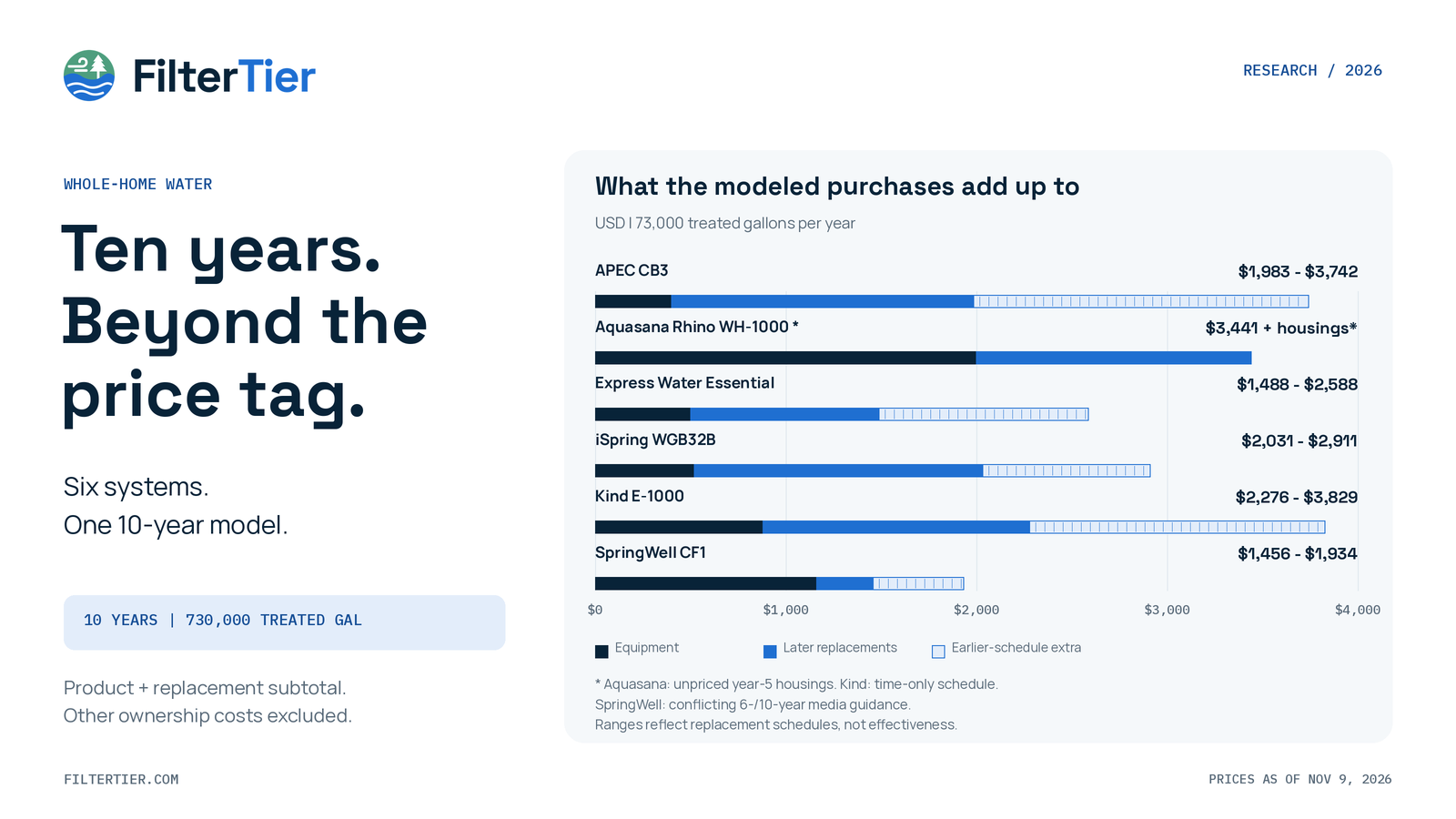
Water-treatment systems can cost hundreds or thousands of dollars. When the contaminant is uncertain, spending a smaller amount on a qualified laboratory test can save far more by preventing the wrong equipment purchase.
Testing is especially valuable when a seller is proposing a complex bundle based mainly on a quick sales demonstration rather than a comprehensive water analysis.
Questions to ask any water-treatment salesperson
- What exact water result justifies this treatment stage?
- Which exact model are you recommending?
- What contaminant evidence applies to that model?
- What is the service flow?
- What is the pressure drop?
- What will I replace each year?
- What will ownership cost over five years?
- Is any part of the system unnecessary if my water test changes?
A good recommendation should survive these questions.