
There is no universal replacement interval for a whole-house water filter. Some sediment cartridges may need attention every few months, carbon cartridges can last longer, specialty lead or PFAS cartridges may have a specific rated capacity, and large media tanks can run for years before the main media is replaced. The right schedule comes from the exact product, the amount of water your household uses, the contaminant load, and how the system behaves in the real world.
That is why “change it every six months” and “this filter lasts ten years” can both be true statements about different components in different systems. The mistake is applying one schedule to every whole-house filter.
The short answer: replace by capacity, condition and performance
A good replacement plan uses three signals together:
- Rated capacity or manufacturer interval. This gives you the product’s intended service life.
- Actual condition. Pressure drop, visible sediment, fouling or alarms may force earlier service.
- Treatment performance. If the system no longer meets its intended treatment goal, it needs service regardless of the calendar.
For systems with certified contaminant-reduction claims, the rated capacity tied to that claim matters especially. Do not assume the same reduction performance continues indefinitely beyond the tested capacity.
Why whole-house filter life varies so much
Filter life is essentially a loading problem. Water carries particles, chemicals, minerals and other constituents into the filter. The amount of material the filter sees depends on both concentration and total water volume.
A small household with clean municipal water may get long life from a sediment cartridge. A large household on a well with heavy sediment may clog the same cartridge quickly. A carbon filter handling light chlorine at moderate flow may last much longer than one dealing with heavy organic loading at high daily use.
That is why household context matters more than a generic maintenance chart.
The six variables that most affect replacement timing
1. Total water use
The more water that passes through a filter, the faster it consumes gallon-based capacity. Household size is one driver, but lifestyle matters too. Irrigation, large tubs, frequent laundry, guests and high-use appliances can increase total use.
2. Contaminant concentration
A filter seeing high chlorine, heavy sediment, iron, sulfur or other loading may exhaust or foul faster than the same filter used on relatively clean water.
3. Particle size and sediment load
Sediment cartridges can plug rapidly when they are used as the first line of defense on dirty water. A reusable spin-down filter ahead of a finer cartridge can sometimes extend the life of downstream media by removing larger particles first.
4. Service flow
High flow changes both pressure drop and treatment contact time. A cartridge used at a higher flow may experience different real-world performance than one operating well below its maximum.
5. Water chemistry
pH, hardness, iron, manganese and other parameters can affect fouling and media performance. Well-water systems in particular should be designed around actual chemistry rather than generic assumptions.
6. Maintenance of upstream equipment
A failed prefilter, poorly maintained softener or neglected well system can shift extra loading onto downstream filters.
Common whole-house filter types and their maintenance patterns
| Filter or treatment type | Typical maintenance pattern | Main warning signs |
|---|---|---|
| Spin-down sediment prefilter | Flush or clean regularly; screen often reusable | Visible buildup, reduced flow |
| Disposable sediment cartridge | Replace based on pressure drop, dirt load and schedule | Low pressure, dark cartridge |
| Carbon cartridge | Replace by gallon capacity or time | Taste/odor return, rated capacity reached |
| Specialty lead/PFAS cartridge | Follow exact rated contaminant capacity | End-of-life monitor, capacity reached |
| Large carbon media tank | Often multi-year media life | Capacity reached, treatment breakthrough |
| Backwashing iron/sulfur filter | Valve service and media replacement at longer intervals | Odor/iron return, poor backwash |
| Water softener | Salt, cleaning, valve maintenance, resin over long term | Hardness return, salt bridge, poor regeneration |
| UV system | Lamp replacement and quartz-sleeve service | Alarm, lamp age, sleeve fouling |
| Reverse osmosis | Prefilters/postfilters more often; membrane less often | Low production, quality change, pressure issues |
Sediment filters: the most variable replacement schedule
Sediment filters are often the first stage in a whole-house system and can have the most variable service life. On relatively clean municipal water, a cartridge may remain usable for months. On a well with heavy sand, silt or rust, the same cartridge could plug much sooner.
Pressure drop is usually the most important practical indicator. If shower pressure falls noticeably and the cartridge is visibly loaded, waiting for an arbitrary date can make the entire system frustrating to use.
For clear housings, visual inspection helps. For opaque housings, a pressure gauge before and after the filter can provide a more objective signal.
Micron rating changes how quickly a sediment cartridge loads
A finer cartridge catches smaller particles but may clog faster. A coarse prefilter can protect a finer downstream stage. The right sequence depends on the particle size and how much sediment is present.
Using an extremely fine cartridge as the first stage on dirty well water can create unnecessary pressure problems. In that situation, staged filtration may be more appropriate.
Carbon cartridges: capacity matters more than appearance
A carbon cartridge can look clean even after its adsorption capacity has been consumed. Unlike a sediment filter, visual appearance may tell you very little about chemical treatment performance.
For chlorine, chloramine, VOC or other claims, use the manufacturer’s rated capacity and exact claim as a starting point. If the product carries a third-party certification, follow the capacity tied to that certification.
Do not assume that water still tasting good means every certified contaminant claim is still being met.
Why large media tanks can last much longer
Large whole-house carbon tanks contain much more treatment media than a cartridge, so they can often handle far more water before media replacement. Some systems are marketed around multi-year or very high gallon capacities.
That does not mean the entire system is maintenance-free for that period. Many tank systems still have sediment prefilters, control valves, bypass valves or other components that require periodic attention.
Whenever you see a “10-year” or “1,000,000-gallon” claim, ask whether it applies to the main tank, the prefilter, the entire system or only a specific treatment stage.
PFAS and lead filters: do not stretch certified capacity
For health-effect claims such as lead or PFAS reduction, rated capacity should be treated conservatively. If a cartridge is certified for a specific reduction through a stated number of gallons, do not assume the claim remains valid after that point just because water still flows through it.
This is one reason FilterTier distinguishes product evidence from marketing language. A filter that uses a media known to adsorb PFAS is not automatically the same as an exact system certified for PFAS reduction through a defined capacity.
See PFAS Filter Claims: Certification, Testing and Marketing Explained for more detail.
UV systems do not have a “filter change” in the usual sense
UV disinfection systems need lamp replacement and quartz-sleeve maintenance rather than contaminant-filter media replacement. The lamp can continue to glow even when its useful UV output has declined, so service should follow the manufacturer’s schedule rather than visual appearance alone.
Sleeve fouling can also reduce UV transmission. Hardness, iron or other water-quality problems upstream can increase maintenance burden.
If your treatment train includes UV, keep a separate UV maintenance log instead of lumping it into the same schedule as carbon or sediment cartridges.
Water softeners have a completely different maintenance pattern
A water softener does not use a disposable “filter” in the same way a sediment or carbon cartridge does. Salt-based ion-exchange systems regenerate their resin repeatedly. Routine maintenance includes maintaining salt, preventing salt bridges, keeping the brine system functional and occasionally cleaning or servicing valves and resin.
If a combined whole-house system includes a softener plus filtration, each stage has its own maintenance schedule.
What pressure drop tells you
Pressure drop is one of the best real-world indicators that a particulate filter is becoming restrictive. If the pressure before the filter is healthy but drops substantially after it, the filter may be loading.
Some systems publish clean pressure-drop data at a given flow. Over time, the pressure drop can increase as the cartridge collects material.
For homeowners who care about stable shower performance, gauges on both sides of a filter can make maintenance far more objective.
Do not confuse peak flow with acceptable flow through a dirty filter
A cartridge may be advertised with a maximum flow rate when new. That does not mean it will maintain the same pressure and treatment performance as it loads with sediment.
Whole-house design should consider both clean-system flow and how maintenance affects pressure over time.
How to estimate filter life from gallon capacity
If a filter is rated for a specific number of gallons, you can estimate service life by dividing rated capacity by average daily household water use.
Example:
- Rated capacity: 100,000 gallons
- Estimated household use: 300 gallons per day
- Simple calculation: 100,000 ÷ 300 = about 333 days
That is not a guarantee. High contaminant loading, pressure drop, seasonal changes or product-specific limits may require earlier replacement. The calculation is useful because it translates a large gallon number into a household timescale.
How to estimate daily water use
The most accurate method is your water meter or utility bill. Look at total consumption over a representative period and divide by the number of days. Avoid using a month with unusual irrigation, guests or leaks if you want an indoor-use estimate.
For wells without easy metering, household-size estimates can provide a rough starting point, but installing a flow monitor gives better long-term information.
What if a product gives both years and gallons?
Use whichever limit comes first when the manufacturer frames it that way. A system may say “up to five years or 500,000 gallons,” which means a high-use household may reach the gallon limit sooner.
If the product has a contaminant certification tied to capacity, follow the certified limit even if a broader marketing claim implies longer use.
Why household size is only a rough shortcut
Two four-person households can use very different amounts of water. One may take short showers and have efficient appliances; another may have large tubs, frequent laundry, irrigation and guests.
Household size is useful for initial sizing, but actual meter data is better for predicting replacement timing.
Signs a sediment or carbon filter needs attention
- Noticeably lower shower pressure
- Slower tub or appliance filling
- Visible cartridge discoloration or sediment
- Return of chlorine taste or odor
- Return of a previously controlled nuisance issue
- System alarm or end-of-life indicator
- Rated gallon capacity reached
- Water test shows treatment is no longer meeting the target
Not every sign applies to every filter type. A lead or PFAS cartridge may need replacement at rated capacity even if pressure is still fine and water tastes normal.
Why “taste returned” is not a sufficient health-effect test
People often use taste or smell as an informal filter-change signal. That can be useful for aesthetic chlorine removal, but it is not a reliable indicator for invisible contaminants such as lead or PFAS.
Follow the evidence and capacity tied to the exact claim.
What happens if you wait too long?
Depending on the filter, overdue service can cause:
- reduced pressure;
- reduced flow;
- treatment breakthrough;
- higher pressure differential across the housing;
- increased load on downstream equipment;
- unexpected maintenance costs;
- false confidence that a certified treatment claim is still being delivered.
The exact risk depends on the media and system design.
Can you change filters too early?
Yes. Replacing cartridges unnecessarily increases cost and waste. If a sediment filter is still clean, pressure is stable and the manufacturer’s capacity has not been reached, an arbitrary early replacement may provide little benefit.
The goal is not maximum replacement frequency. It is reliable treatment with reasonable cost.
How to build a maintenance schedule for a multi-stage system
List every serviceable component separately. For example:
| Component | Track | Trigger |
|---|---|---|
| Spin-down prefilter | Flush date | Visible buildup / schedule |
| Sediment cartridge | Install date and pressure drop | Pressure or schedule |
| Carbon cartridge | Install date and gallons | Capacity or time |
| Media tank | Install date and total gallons | Rated capacity |
| UV lamp | Lamp age | Manufacturer interval |
| RO membrane | Quality/production | Performance and schedule |
This prevents the common mistake of treating the whole system as if it has one replacement interval.
Write dates directly on housings
A simple marker note on the cartridge housing can save a lot of guesswork. Record the installation date and, if useful, meter reading. You can also set calendar reminders a few weeks before the expected service window.
Use photos to track sediment loading
If you have a clear sediment housing, take a photo immediately after installing a new cartridge and another every month. Over time you will learn how quickly your water loads the filter.
This is especially useful for seasonal wells where sediment changes throughout the year.
Should you sanitize the housing during filter changes?
Follow the manufacturer’s instructions. Cartridge changes are an opportunity to inspect housings, O-rings and surfaces for buildup. Clean or sanitize only with procedures and materials appropriate for the system.
Improper chemicals, overtightening or damaged O-rings can create leaks.
Always depressurize before opening a housing
Whole-house filter housings operate under plumbing pressure. Shut off and depressurize the system according to the manufacturer’s procedure before loosening a housing. Use the correct wrench and inspect the O-ring before reassembly.
If you are not comfortable servicing pressurized plumbing, use a plumber or water-treatment professional.
Why O-rings deserve attention
An old, twisted or dry O-ring can cause leaks after a filter change. Keep the correct replacement O-ring on hand and use only lubricant approved for potable-water applications and the specific housing material.
Does a bypass valve help maintenance?
Yes. A well-designed bypass lets you isolate the treatment system for service. Depending on the plumbing layout, it may allow temporary water use while the filter is being serviced.
Do not leave a system bypassed accidentally after maintenance.
What if filter replacements are extremely expensive?
Replacement cost is part of the product decision. A low purchase price can hide a high recurring cost if proprietary cartridges are expensive or replaced frequently.
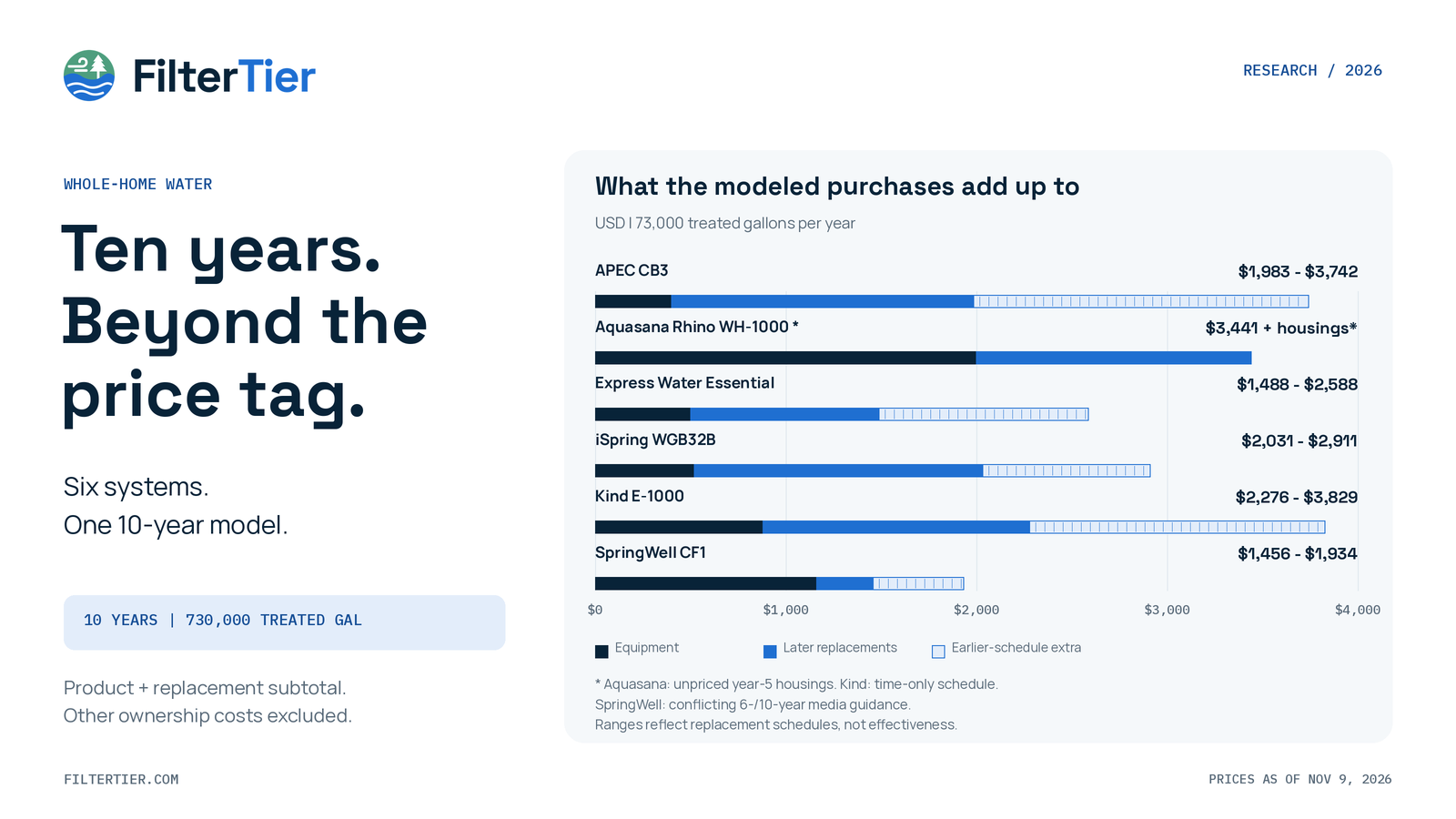
When comparing products, estimate the first five or ten years of ownership. Include cartridges, media, lamps, salt, service and major replacement items.
FilterTier’s maintenance guide and product pages help compare replacement schedules and recurring costs.
Generic vs. proprietary replacement filters
Standard-size housings can provide more cartridge choice, but compatibility is not only about physical dimensions. Flow, micron rating, media, seals and contaminant claims also matter.
Using a third-party cartridge may change the evidence supporting the original system’s performance. If a contaminant certification matters, verify whether it applies with the replacement cartridge you intend to use.
Do replacement filters need certification too?
If a specific contaminant claim is important, the replacement configuration should preserve the evidence behind that claim. A certified system may require a specific cartridge to maintain certified performance.
Do not assume any cartridge that physically fits provides equivalent reduction.
Maintenance and warranties can be connected
Some manufacturers require documented maintenance or approved replacement parts to preserve warranty coverage. Read the warranty terms before substituting components or extending intervals beyond recommendations.
How to evaluate “low-maintenance” systems
Low maintenance should mean more than a marketing label. Ask:
- How often does each component need service?
- Can the homeowner perform the service?
- Are replacement parts proprietary?
- What do they cost?
- Does the system backwash or regenerate?
- Does it require salt?
- Does it have electronics, pumps or lamps?
- What major media replacement is expected over ten years?
A simple large media tank can be lower maintenance than a multi-stage cartridge system, but the correct choice still depends on treatment performance and water conditions.
How well-water conditions can shorten filter life
Wells can carry sediment, iron, manganese, hardness or sulfur-related problems that place a large burden on cartridges. If a small disposable cartridge is repeatedly clogging in weeks, the answer may be a better pretreatment strategy rather than buying cartridges more frequently forever.
Heavy sediment may justify a spin-down or larger sediment stage. Iron may need oxidation and backwashing media. Low pH may require neutralization. The root water problem should drive the solution.
Seasonal filter life is normal
Some households see more sediment after heavy rain, irrigation season or changes in groundwater conditions. Your maintenance schedule may therefore be different in spring than in winter.
Record actual service dates so you can identify patterns.
How municipal changes can affect maintenance
Utility flushing, main work or treatment changes can temporarily increase sediment or change disinfectant conditions. A filter may load faster during those periods.
If several households notice the same change, check utility notices before assuming your equipment has failed.
How to know whether the filter or plumbing is causing low pressure
Compare pressure with the treatment system in service and bypassed, if your system allows safe bypass testing. If pressure improves dramatically on bypass, the treatment train may be restrictive.
If pressure stays poor, the cause may be elsewhere: pressure regulator, well pump, piping, fixture aerators or another plumbing issue.
Flow problems in multi-stage systems
Every stage adds resistance. A sediment cartridge, carbon filter, softener and UV reactor in series can create more total pressure drop than any one component alone.
This is why FilterTier evaluates the weakest or lowest-flow stage in a bundle rather than simply repeating the highest GPM on the marketing page.
See How to Size a Whole-House Water Filter for a deeper explanation.
How replacement timing affects ownership cost
Consider two systems:
- System A costs less upfront but uses a $150 cartridge every six months.
- System B costs more upfront but uses low-cost prefilters and has multi-year media.
After several years, System B may be cheaper to own. Conversely, a very expensive media replacement can erase some of that advantage. The only way to compare fairly is to model recurring maintenance.
A simple five-year cost formula
Add:
- purchase price;
- installation;
- routine cartridges;
- salt or regeneration supplies;
- UV lamps or sleeves;
- major media replacement expected within five years;
- service calls you cannot perform yourself.
Then compare systems on similar treatment goals, not just price.
Frequently asked questions
How often should I change a whole-house sediment filter?
There is no single interval. Replace when pressure drop, visible loading, manufacturer guidance or your established household pattern indicates service is needed.
How often should I change a whole-house carbon filter?
Follow the exact product’s gallon capacity and time recommendation. For certified contaminant claims, do not extend use beyond the rated capacity without evidence.
Can I wait until water tastes bad?
Not if you rely on the filter for a health-effect contaminant. Taste can be useful for aesthetic chlorine treatment but is not a reliable signal for lead, PFAS or many other contaminants.
Does low water pressure always mean the filter is clogged?
No. It can also come from plumbing, a regulator, a well pump, valves or fixtures. Bypass comparison and pressure gauges can help isolate the cause.
Should I replace all stages at once?
Not necessarily. Different stages can have different service lives. Replace according to each component’s needs unless the manufacturer specifies a combined schedule.
Can a dirty sediment filter damage equipment?
A severely restricted filter can reduce flow and increase pressure differential. Proper maintenance helps protect downstream equipment and household performance.
Can I use a cheaper generic cartridge?
Only if the size, material, flow and treatment requirements are compatible. For certified contaminant claims, verify that substitution does not eliminate the evidence supporting the system.
How do I know when a large media tank is exhausted?
Use the manufacturer’s capacity, meter data, water testing and any monitoring features. Visual inspection is usually not useful for sealed media tanks.
What is the easiest way to remember maintenance?
Record dates on the equipment and set recurring calendar reminders. If you have a smart monitor or metered system, use gallon-based alerts where possible.
A maintenance checklist you can actually use
- Identify every replaceable or serviceable component.
- Write down rated capacity and time interval.
- Record installation date.
- Record water-meter reading if gallon capacity matters.
- Check pressure and flow periodically.
- Inspect visible sediment stages.
- Respond to alarms and end-of-life indicators.
- Keep spare O-rings and critical filters on hand.
- Re-test water when treatment performance matters.
- Track actual intervals and refine your schedule over time.
What this means for you
The best filter-change schedule is not a fixed calendar rule. It is a system-specific maintenance plan based on rated capacity, actual water use, water quality, pressure drop and the importance of the treatment claim.
Replace particulate filters when loading affects flow. Replace certified health-effect cartridges within their rated capacity. Service UV, softeners and RO systems according to their own maintenance needs. And treat every stage in a multi-stage system as a separate component unless the manufacturer specifically says otherwise.
Before buying a system, compare not only the purchase price but also the replacement schedule and ten-year ownership burden. Use FilterTier’s system database and maintenance and warranty guide to compare documented upkeep alongside current seller pricing.
How filter-life marketing can create unrealistic expectations
Long-life claims are attractive because they simplify ownership, but they often refer to one component under stated conditions. A tank may contain media rated for years while the sediment cartridge ahead of it needs several changes every year. A filter family may advertise a very high gallon capacity while the exact contaminant claim has a much lower certified capacity.
When you see a long-life claim, identify the component, contaminant, test flow and conditions tied to it.
How to compare two replacement schedules fairly
Convert both products into annualized cost. If Filter A costs $100 and lasts six months, its annual cartridge cost is roughly $200. If Filter B costs $350 and lasts three years, its annualized cost is about $117 before considering any other components.
This simple calculation can reverse the apparent value of two systems.
Why inventory availability matters
A proprietary cartridge is only convenient if you can actually buy it when needed. Before choosing a system, check whether replacement filters are widely stocked, sold only through dealers, or frequently unavailable.
A system that performs well but becomes unusable because its replacement part disappears can create long-term ownership risk.
Keep one critical replacement on hand
For households that rely heavily on a specialty filter, keeping one unopened replacement cartridge can prevent a scramble when the current filter reaches capacity. Store cartridges according to manufacturer instructions and avoid accumulating years of stock that may become outdated.
How vacation homes change maintenance
A second home may use very little total water but experience long stagnation periods. Calendar-based replacement can therefore matter differently than gallon capacity. UV systems and certain cartridges may still have age-based service requirements even when water use is low.
How a new baby or larger household changes filter life
When occupancy increases, daily gallons can rise sharply. A cartridge that once lasted a year may reach capacity sooner. Recalculate expected life when household size or routines change.
What to do when a cartridge clogs far earlier than expected
Do not simply accept constant replacement. Investigate the reason. Heavy sediment, pipe corrosion, well problems or utility disturbance may be overloading the filter. Better pretreatment can reduce long-term cost and pressure problems.
What to do when a filter lasts much longer than expected
Do not assume it can be used indefinitely. Some treatment claims have time limits, bacteriological concerns, capacity limits or manufacturer replacement schedules that matter even when pressure is still good.
Maintenance records improve future system selection
If you know that your current sediment cartridge clogs every three months and your household uses 250 gallons per day, that information is extremely valuable when comparing a replacement system. Real maintenance history is better than generic sizing assumptions.
Why filter replacement should be part of the purchase decision
Before buying a system, find the replacement cartridge, confirm its current price and check whether it is actually available. If you cannot easily identify the part number and replacement process before purchase, ownership may be harder than the marketing suggests.
A clear replacement ecosystem is a meaningful product advantage.