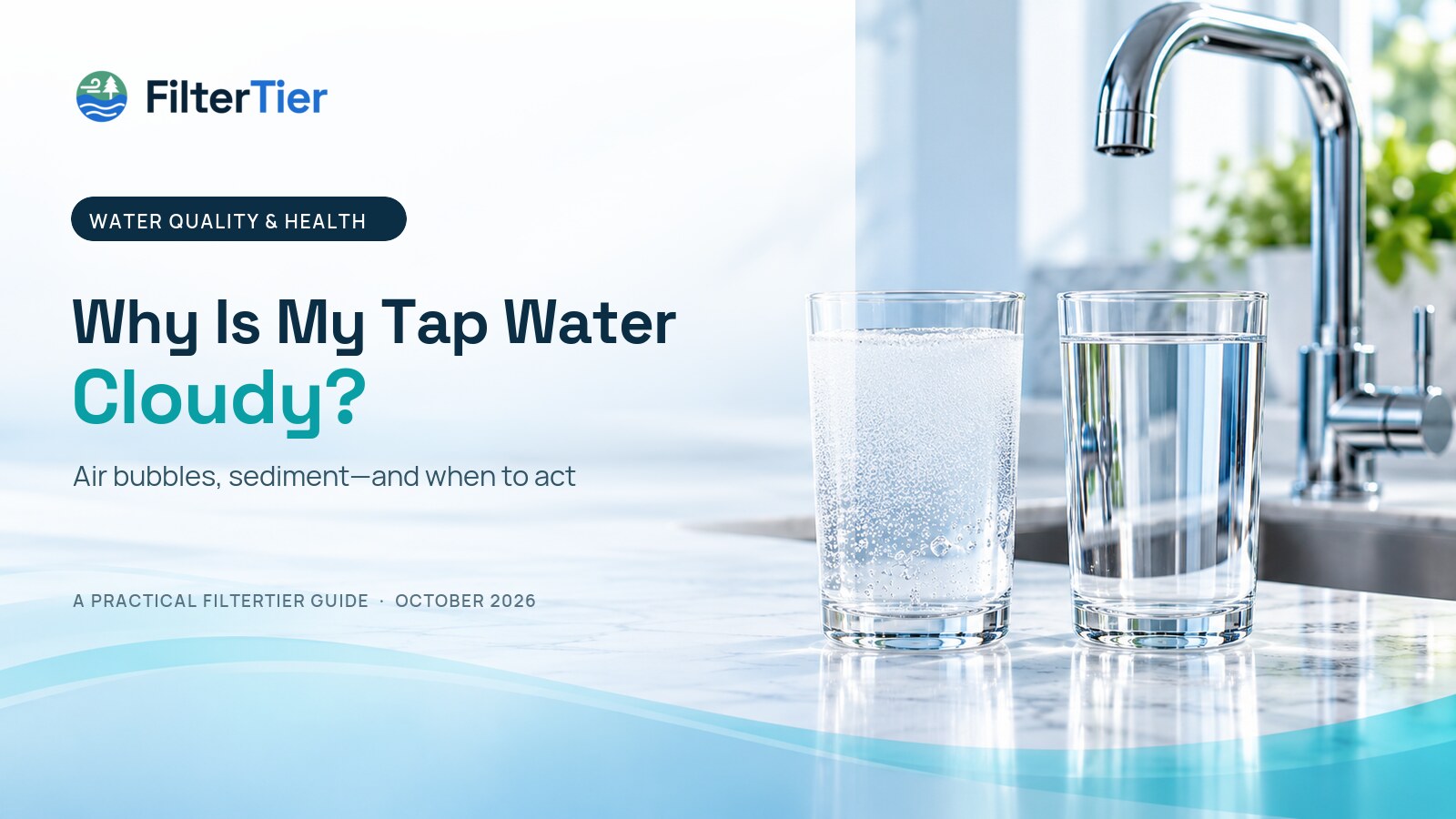
Cloudy tap water is often harmless trapped air—especially when a glass clears from the bottom upward within a few minutes. If the cloudiness persists, settles as particles, comes with an unusual color or odor, appears only at one faucet, or follows flooding or a loss of pressure, treat it as a different problem. Compare hot and cold water, check more than one tap, look for an official utility notice, and contact your water provider or a qualified plumber when the pattern does not resolve.
The appearance alone cannot prove that water is safe or unsafe. Clear water can contain contaminants you cannot see, while water whitened by tiny air bubbles can still meet drinking-water standards. The useful question is not simply “Is cloudy water bad?” It is “What pattern does it follow, and what should I do next?” This guide gives you a practical way to answer that without guessing or buying a filter before you know the cause.
Cloudy tap water at a glance
| What you observe | Most likely explanation | Best next step |
|---|---|---|
| White or milky water clears from the bottom upward in one to five minutes | Tiny air bubbles coming out of solution as pressure drops | Let the glass stand; compare several cold taps and check for recent main work |
| Cloudiness does not clear, or particles settle to the bottom | Sediment, mineral scale, plumbing debris, or another suspended material | Stop guessing; compare taps, photograph a sample, and contact the utility or a plumber |
| Yellow, orange, red, or brown water | Often iron, manganese, rust, or disturbed main sediment | Avoid laundry and food preparation until clear; check utility guidance before flushing |
| Only the hot water is cloudy or discolored | Water heater, hot-water piping, temperature, or scale issue | Check cold water first; have the heater and hot-water system evaluated if it persists |
| Only one faucet is affected | Aerator, fixture, or nearby branch plumbing | Clean the aerator and compare water before and after the aerator |
| Many taps and nearby homes are affected | Distribution-system pressure change, flushing, main break, or utility work | Check the utility’s alert page and call the water-quality line |
| Cloudiness follows a flood, well damage, sewage backup, or official advisory | Potential contamination that cannot be identified by appearance | Follow the exact health-department or utility notice; arrange appropriate testing |
This table is a triage tool, not a laboratory result. If your utility has issued a boil-water, do-not-drink, or do-not-use notice, that notice overrides general advice. The U.S. Environmental Protection Agency distinguishes among these advisories because the correct response depends on the hazard. Boiling can inactivate many disease-causing microorganisms, but it does not remove heavy metals, salts, or most chemical contaminants.
First, do the clear-glass test
The simplest useful check takes a clean, transparent glass and a few minutes.
- Use the cold-water tap. Hot water introduces the water heater and temperature as extra variables.
- Fill a clean glass and place it on a counter under good light.
- Watch the bottom, middle, and top for several minutes.
- Repeat at a second cold tap, ideally on another floor or near where the water service enters the home.
- Note whether the water clears, whether solid material settles, and whether there is unusual color or odor.
If it clears from the bottom upward
That pattern strongly suggests entrained air. The water at the bottom becomes clear first because small bubbles rise and escape at the surface. The U.S. Geological Survey explains that water under pressure can hold more dissolved air; when water leaves the faucet and returns to atmospheric pressure, the gas forms visible bubbles. Colder water can also hold more dissolved air, so the effect may become more noticeable when source water is cold and then warms in household plumbing.
Air-related cloudiness often appears after utility work, a pressure change, plumbing repairs, or changes in seasonal water temperature. It may affect several nearby homes. If the glass becomes fully clear, leaves no residue, smells normal, and no advisory is active, the visual effect itself is generally not a health concern. You do not need a treatment device merely to remove temporary air bubbles.
If particles fall or remain suspended
Material that settles, floats, or remains after the bubbles should have disappeared is not behaving like dissolved air. It may be mineral sediment, scale from a water heater, corrosion products, debris from an aerator, carbon fines from a newly installed filter, or material disturbed in a water main. Its identity cannot be confirmed by looking at it in a glass.
Save a photo against a white background and record the time, which faucets are affected, and whether the water was hot or cold. Those details are more useful to a utility or plumber than a broad description such as “dirty water.” If you can see recurring solids, avoid drinking the affected water until the provider or an appropriate professional has helped identify the cause.
If the entire glass stays uniformly cloudy
Persistent haze deserves follow-up. True turbidity means light is being scattered by suspended matter. EPA describes turbidity as a measure of water clarity; clay, silt, organic matter, algae, and microorganisms can contribute. For a public water system, turbidity is monitored and managed at the treatment and system level. A homeowner cannot convert a visual impression in a glass into a reliable turbidity measurement.
Call your utility if the water remains cloudy across several cold taps or if neighbors see the same thing. If only your home is affected, the cause is more likely within the service line or building plumbing. Private-well owners should use a certified laboratory and local health-department guidance, particularly after flooding, repairs, a sudden change in water level, or damage to the wellhead.
Why air makes water look white
Water in a distribution main is pressurized. Gases can remain dissolved while the water is under pressure, much as carbon dioxide remains dissolved in a sealed carbonated drink. Opening a faucet reduces the pressure. If the water contains more dissolved air than is stable at the new pressure and temperature, microscopic bubbles form. Millions of bubbles scatter light and make the water look gray, white, or milky.
The bubbles rise. That is why the lower part of a glass clears before the upper part. The effect is often strongest immediately after filling and fades without treatment. A faucet aerator can add visible bubbles too, although aerator bubbles are usually larger and disappear quickly. Cleaning a clogged aerator may help when only one fixture looks different.
Do not confuse the absence of cloudiness with proof of purity. Lead, nitrate, PFAS, many pesticides, and microorganisms may be invisible. Conversely, visible air does not mean that a hidden contaminant is present. Appearance is one line of evidence; Consumer Confidence Reports, official notices, and targeted laboratory tests answer different questions. You can start with FilterTier’s What’s in My Water lookup and our guide to reading a Consumer Confidence Report when you want to understand your local system’s reported results.
Cloudy water, turbidity, and safety are not the same thing
People often use “cloudy” and “turbid” as synonyms, but context matters. A glass whitened by air is visually cloudy even though the bubbles disappear. Turbidity in water-quality practice refers to suspended material that scatters light and is measured with an instrument. High turbidity at a treatment plant can interfere with disinfection and can indicate problems that a utility must address. A few seconds of air bubbles at a kitchen sink is not the same observation.
EPA’s secondary drinking-water standards also cover aesthetic effects such as color, odor, and taste. These federal secondary standards are generally non-enforceable guidelines, although states may adopt their own enforceable requirements. Aesthetic changes can still be important. They may reveal corrosion, mineral deposits, plumbing deterioration, or a distribution disturbance even when the material is not itself an acute health hazard.
The practical rule is to use the pattern, not one snapshot. Ask:
- Does it clear, and in which direction?
- Is the cold water affected, the hot water, or both?
- Does it happen at one faucet or throughout the building?
- Did it begin after utility work, a repair, a filter change, a storm, or a long vacancy?
- Is there color, odor, oily sheen, grit, or floating material?
- Is an official advisory active?
Those observations separate harmless air from cases that need utility, plumbing, or health-department attention.
A step-by-step decision process
1. Check official alerts before running water
Search your water provider’s website, text-alert system, or verified social channel for a main break, flushing notice, pressure loss, boil-water advisory, or do-not-use notice. Use the utility name shown on your bill; city boundaries and water-service boundaries do not always match. If an advisory exists, follow its instructions exactly rather than a generic internet checklist.
A boil-water advisory usually addresses a microbial risk or loss of system integrity. A do-not-drink notice may involve a chemical or toxin that boiling will not correct. A do-not-use notice can prohibit even bathing or flushing, depending on the incident. EPA’s emergency guidance emphasizes that boiling does not destroy heavy metals, salts, or most other chemicals. More heat is not automatically safer.
2. Start with cold water
Use cold water for diagnosis and for drinking or cooking. If cold water is clear but hot water is cloudy, the problem is probably downstream of the point where cold water enters the water heater. Heat releases dissolved gases and can loosen scale. The heater’s anode, tank sediment, or nearby hot-water piping may also contribute particles or discoloration.
Do not drain a water heater casually. Hot water can cause severe burns, and improper draining can damage equipment. A licensed plumber can inspect the tank, expansion system, anode, temperature setting, and service history. If a rental property is involved, document the pattern and notify the property manager.
3. Compare more than one fixture
One affected faucet points toward its aerator, supply tube, fixture body, or local branch piping. Several affected faucets point toward building-wide plumbing, the service line, or the utility system. Remove the aerator only if you can do so safely and without damaging the finish; photograph how it fits before disassembly. Rinse screens and remove visible debris, then compare water briefly with the aerator off.
If all taps are affected, ask a nearby neighbor served by the same utility whether they see the same change. A neighborhood pattern is valuable evidence for the utility. A single-building pattern may require the property owner or plumber to inspect common plumbing, a storage tank, pressure equipment, or recent maintenance.
4. Let the sample stand
Observe the glass without stirring. Air rises and disappears. Dense grit falls. Flakes may float, sink slowly, or cling to the sides. An oily-looking surface can sometimes be harmless organic material or iron bacteria in a private well, but it can also indicate petroleum contamination; do not use an appearance trick as a safety test. Report an unusual sheen or fuel-like odor promptly.
Do not taste suspicious water to identify it. Odor checks should also be cautious: waft from a distance rather than inhaling deeply. If the odor resembles fuel, solvent, sewage, or rotten eggs at an unusually strong level, stop using the water for ingestion and contact the utility or health department.
5. Flush only with a reason and an endpoint
Utilities commonly recommend a controlled cold-water flush after a localized discoloration event, but the precise faucet and duration vary. Seattle Public Utilities, Portland Water Bureau, NYC DEP, SFPUC, and other providers publish their own steps. Some advise using a bathtub or faucet without an aerator; others want customers to wait while crews flush mains. During active construction or a hydrant-flushing event, running more water immediately can pull additional sediment into household plumbing.
Follow local instructions. If no notice is posted, contact the provider before letting water run for a long period. Use cold water, avoid laundry until the water is clear, and stop if the condition worsens. Record how long you flushed. Endless flushing wastes water and does not repair a corroding fixture, failing water heater, or recurring distribution problem.
6. Escalate when the pattern does not fit air
Contact the water utility when multiple cold taps stay cloudy, neighbors are affected, pressure changed, water is colored, or visible sediment recurs. Ask whether the utility has recent water-quality complaints, hydrant use, main work, a pressure event, or sampling results in your zone. Public utilities can often collect a sample or explain whether the issue stops at the meter.
Call a plumber when the utility confirms its water is clear at the service, only your building is affected, or the issue is isolated to hot water or one fixture. Private-well owners should contact the local health department, a certified laboratory, and when necessary a licensed well professional. Testing should be tied to the event: for example, coliform bacteria after flooding or a sanitary repair, and metals when corrosion or mineral staining is suspected.
What different colors and particles can mean
White or gray
White water that clears bottom-to-top is usually air. White flakes that remain may be calcium carbonate scale from a water heater or plumbing. Some utilities suggest placing a particle in vinegar as an informal clue because carbonate scale may react or dissolve, but this does not establish water safety. A new carbon filter can also release gray or black fines until it is flushed according to the manufacturer’s installation instructions.
Yellow, orange, red, or brown
These colors often involve iron, manganese, rust, or sediment disturbed by a change in flow. Main breaks, firefighting, hydrant testing, and scheduled flushing can reverse or accelerate flow and lift deposits from distribution pipes. NYC DEP describes iron and manganese particles settled in pressurized mains as a common cause of temporary discoloration. Madison Water Utility similarly notes that naturally occurring iron and manganese can accumulate and be stirred up by flushing, fire suppression, breaks, and contractor work.
Do not wash light-colored laundry while water is discolored; iron and manganese can stain fabric. Avoid using the water for drinking and food preparation until it runs clear and the utility has confirmed no advisory applies. If only your building is affected, corrosion in premise plumbing or the water heater becomes more likely. Learn more about iron in water, manganese in water, and sediment before choosing treatment.
Blue or green
Blue-green staining or water can point toward copper corrosion, a fixture product, or a plumbing treatment issue. Stop using visibly blue or green water for drinking and cooking and contact the utility and a plumber. Do not assume a countertop carbon filter will fix it. The cause may require corrosion control, plumbing repair, or laboratory testing for copper and related parameters.
Black specks
Black particles can come from manganese deposits, deteriorating rubber components, flexible supply lines, faucet washers, a water heater, or carbon media from a filter. Texture and location matter: particles at one faucet after a filter change suggest a different source from black water at every fixture in a neighborhood. Clean the aerator, compare unfiltered and filtered outlets, and document whether the particles smear, crumble, or feel gritty. Let a professional identify the source before replacing treatment equipment.
Sand-like grit
Grit may be distribution sediment, mineral scale, construction debris, or material from a private well. Sudden sand after well work, drought, flooding, or a drop in water level warrants inspection of the well and pump system. Vermont Department of Health advises well owners to contact a licensed well driller if cloudiness, air, or heavy sediment does not clear after appropriate flushing. Recurrent grit can damage valves and appliances even when it is not acutely toxic.
Common situations and what changes the diagnosis
After a water-main break or utility repair
Air can enter the line when a main is emptied and refilled. Pressure and flow changes can also disturb mineral deposits. The same event may therefore cause white bubbles in one home and colored sediment in another. Check the utility notice for the affected area, the restoration time, and flushing instructions. If pressure was lost, the utility may collect bacteriological samples before lifting an advisory.
Wait for the all-clear before cleaning faucet aerators, ice makers, refrigerator lines, or treatment devices. Otherwise, you can draw sediment into small passages or filters. When service is restored, flush in the order the utility specifies.
During winter or rapid temperature changes
Cold source water can hold more dissolved air. As it warms in indoor plumbing and exits the pressurized system, bubbles form. The result can look dramatic but disappear in minutes. Seasonal recurrence, normal odor, and bottom-up clearing all support the air explanation.
If the cloudiness persists year-round or leaves residue, do not attribute it to temperature indefinitely. Repeat the glass test and report the exact behavior.
After a vacation or long vacancy
Water that has sat in building plumbing may pick up metals, disinfectant byproducts, or odors. Air can also collect after plumbing work or pressure changes. EPA recommends using cold water for drinking and cooking and following local guidance on flushing after stagnation. A one-time, purposeful flush is different from using hot water from the tap for beverages.
For schools, childcare facilities, and buildings with known lead-containing plumbing, use an established flushing and sampling plan rather than an improvised routine. Appearance does not reveal lead. FilterTier’s broader guide on how to check local tap-water quality explains the roles of reports, notices, and home testing.
After installing or changing a filter
New carbon filters often require flushing to remove loose carbon fines and trapped air. Follow the manufacturer’s exact volume or time instructions. A newly pressurized reverse-osmosis tank may also release air during startup. This does not justify ignoring persistent particles, leaks, unusual tastes, or performance changes.
Compare a sample before the device with one after it. If only treated water is affected, isolate and service the device. Verify cartridge orientation, seals, sanitation steps, and compatibility. Do not bypass treatment when a health advisory requires it unless the utility or manufacturer confirms the appropriate procedure.
Only the hot water looks cloudy
Heat reduces gas solubility, so hot water may show more bubbles. A heater can also accumulate mineral scale and corrosion products. Compare a freshly drawn cold sample, a hot sample, and a cold sample allowed to reach room temperature. Persistent hot-side particles, odor, noise, or discoloration call for heater service.
Rotten-egg odor only in hot water can involve reactions at the water-heater anode or microbial growth in the heater, while the same odor in cold and hot water may point toward the source water. Because corrective steps can involve scalding risk and gas or electrical connections, use a qualified professional.
Private well water after heavy rain or flooding
Cloudiness after a storm is not a harmless-air assumption. Floodwater can enter through a damaged cap, casing, seal, or nearby ground. Sediment and changing well levels can disturb the aquifer or equipment. Do not rely on a clear-glass result to exclude bacteria or chemicals. Follow state or local health-department instructions for disinfection, flushing, and certified-laboratory sampling.
If the well was submerged, damaged, or near a sewage release, use an alternative safe water source until the responsible authority says the system is ready for use. A home treatment device does not substitute for restoring sanitary integrity.
When to stop using the water
Stop using the water for drinking, cooking, brushing teeth, ice, infant formula, and pet consumption while you get official guidance when any of the following applies:
- An active boil-water, do-not-drink, or do-not-use notice covers your address.
- The water has a fuel, solvent, pesticide, sewage, or strongly chemical odor.
- There is visible blue, green, oily, or unknown contamination.
- Cloudiness began after flooding, a sewage backup, cross-connection event, well damage, or loss of pressure.
- People in the home develop gastrointestinal or other symptoms that might be linked to the water.
- The utility or health department tells you not to use it.
Seek medical advice for symptoms rather than trying to diagnose exposure from the water’s appearance. Infants, pregnant people, older adults, and anyone with a weakened immune system may need more cautious advice from a clinician and health department.
If a notice tells you to boil water, follow its time, cooling, and storage instructions. EPA’s general emergency-disinfection guidance says to bring clear water to a rolling boil for one minute, but local instructions control and high elevations may require different handling. If a notice involves nitrate, fuel, metals, toxins, or another chemical, boiling can be ineffective and may concentrate some contaminants as water evaporates.
When home testing is worth it
A broad, inexpensive “test everything” strip rarely answers a cloudy-water question. Choose tests based on the source, event, plumbing, and official advice.
| Situation | Testing or evidence to prioritize | Who can help |
|---|---|---|
| Public water; neighborhood-wide event | Utility operational records, zone sampling, advisory status | Water provider or local health department |
| Private well after flood or repair | Total coliform and E. coli; other tests directed by local conditions | Certified lab, health department, licensed well professional |
| Blue-green water or staining | Copper, pH, alkalinity, corrosion indicators | Certified lab, utility, licensed plumber |
| Brown or black recurring sediment | Iron, manganese, turbidity, and inspection of plumbing or well equipment | Utility or certified lab plus plumber/well professional |
| Concern about lead | Properly collected lead sample from the specific tap | State-certified laboratory and local lead program |
| Only water after a filter is affected | Before/after comparison, installation review, targeted lab test if needed | Manufacturer, certified lab, qualified installer |
Use a laboratory certified by your state for drinking-water analysis. Sampling technique matters: first-draw and flushed lead samples answer different questions, bacteria bottles must remain sterile, and holding times can be short. Tell the lab what happened before ordering the panel. A good lab will not treat “cloudy” as a complete test request.
For public water, your annual report provides system-wide results, not necessarily what happens inside your home’s plumbing. A targeted tap sample may be useful when the concern is building-specific. For private wells, establish a routine testing schedule and add event-driven tests after flooding, repairs, or a sudden change in taste, odor, color, or clarity.
Will a water filter fix cloudy water?
Not necessarily. Air bubbles require no filter. Sediment requires a different treatment approach from dissolved iron, manganese, hardness, microorganisms, or corrosion. Buying a device based only on a cloudy appearance can waste money, hide an underlying plumbing problem, or create maintenance you did not need.
Sediment filters
A mechanical sediment cartridge can capture particles larger than its rated pore size. It can protect downstream equipment when laboratory results and inspection confirm a particle problem. The correct micron rating depends on the particle distribution and desired flow. Too fine a cartridge can clog quickly and reduce pressure; too coarse a cartridge may not solve the visible issue. Recurrent main sediment should still be reported to the utility.
Activated carbon
Activated carbon is commonly used for chlorine taste and odor and certain organic compounds, depending on the product’s certification and design. It does not remove harmless dissolved air and is not a universal solution for metals, minerals, nitrate, or microorganisms. Fresh carbon media may itself shed harmless black fines until properly flushed.
Water softeners and iron treatment
Ion-exchange softeners address hardness and may remove limited amounts of certain forms of dissolved iron or manganese when designed and maintained for that purpose. They are not sediment filters or disinfectors. Oxidation and filtration systems for iron or manganese must be matched to the water chemistry, including pH, oxygen, competing minerals, and whether the metal is dissolved or particulate.
Reverse osmosis
Point-of-use reverse osmosis can reduce many dissolved contaminants when the system is certified for the relevant claims and maintained correctly. It is not the first response to air bubbles or a distribution-system disturbance, and it treats only the connected outlet. A new or serviced RO system may temporarily show bubbles as trapped air leaves the unit.
Ultraviolet disinfection
UV can inactivate certain microorganisms when the system delivers the validated dose and the water meets pretreatment requirements. Turbidity and particles can shield microorganisms from UV light, so a cloudy private-well problem must be diagnosed and treated upstream. UV does not remove sediment, chemicals, or metals.
When shopping, look for a certification tied to the exact reduction claim, not just a generic “tested” statement. NSF/ANSI 42 generally covers aesthetic effects such as chlorine taste and odor and particulate classes; NSF/ANSI 53 covers specified health-effect reductions; NSF/ANSI 58 applies to reverse-osmosis systems. Certification does not mean every product removes every contaminant within a standard. Read the certified performance data sheet and confirm the model number.
Common mistakes to avoid
Assuming every white glass is contaminated
The bottom-up clearing test can prevent unnecessary alarm. Air bubbles are common, especially after pressure or temperature changes. Still, the test is only evidence for air; it does not certify the water against invisible contaminants.
Assuming every clear glass is safe
Many regulated contaminants have no visible signal. Use official reports, notices, and appropriate tests. Do not wait for water to look unusual before addressing a known lead service line, well-testing schedule, or active advisory.
Boiling without knowing the advisory type
Boiling is a microbial control step, not a universal purification method. It does not remove heavy metals, salts, or most chemicals. In a do-not-use incident, even boiling and bathing may be prohibited.
Running hot water to “flush faster”
Hot water can draw from heater sediment and dissolve metals more readily. Diagnose and flush with cold water unless official instructions say otherwise. Avoid sending discolored water into a water heater, dishwasher, washing machine, ice maker, or fine filter.
Flushing for hours without calling anyone
A short controlled flush may be appropriate. An endless one is not a diagnosis. If water does not clear in the timeframe your provider recommends, stop and call. Save water and preserve evidence of the problem.
Buying a filter before identifying the cause
A sediment cartridge cannot correct dissolved copper corrosion, and carbon cannot remove entrained air. Match treatment to a verified problem and a certified claim. Maintenance and replacement costs are part of the decision.
What this means for your home
If your cold tap turns a glass milky and then clears cleanly from the bottom upward, trapped air is the leading explanation. Document it once, check for a utility notice, and let the system settle. There is usually no reason to purchase treatment for that visual effect alone.
If cloudiness persists or leaves material behind, narrow the source before acting. Compare cold and hot water, one tap and several taps, and your home with a neighbor’s. That simple matrix tells you whether to start with the utility, an aerator, the water heater, building plumbing, or a private-well professional.
If the water is colored, smells strongly unusual, follows a flood or pressure loss, or is covered by an advisory, pause use and follow official instructions. Do not let the apparent simplicity of “cloudy water” hide an event that needs testing. And do not let harmless air bubbles push you into a filter purchase that cannot change the cause.
The best decision sequence is: observe, check alerts, isolate the source, contact the responsible professional, test when warranted, and treat only the confirmed problem.
Frequently asked questions
Is cloudy tap water safe to drink?
Water that clears from the bottom up within a few minutes is usually cloudy because of harmless air bubbles. That observation does not prove the water meets every health standard, and persistent haze, particles, color, strong odor, or an official advisory require a different response. Check your utility’s alerts and contact it if the pattern is new or unresolved.
Why is my water cloudy only in winter?
Cold water can hold more dissolved air. When cold, pressurized water enters warmer household plumbing and exits the faucet, tiny bubbles can form. Seasonal bottom-up clearing supports this explanation.
Why is only my hot water cloudy?
Heating encourages dissolved gas to escape, and the water heater can contribute scale or corrosion products. Compare cold and hot samples. If hot water leaves particles, has odor, or stays discolored, arrange heater inspection.
Can a faucet aerator make water cloudy?
Yes. Aerators intentionally mix air with the stream and can make bubbles. A clogged or damaged aerator can also trap debris. If only one faucet is affected, clean the aerator and briefly compare the water with it removed.
Does cloudy water mean high hardness?
Not by itself. Hard water can leave white scale and spots, but freshly drawn milky water that clears quickly is more consistent with air. Hardness is measured with a water test, not by looking at bubbles.
Should I boil cloudy water?
Only when the utility or health department issues a boil-water instruction or an emergency authority directs you to do so. Boiling does not remove sediment, metals, salts, or most chemicals. For a do-not-drink or do-not-use notice, boiling may be the wrong action.
How long should I run the faucet?
Use the duration and faucet specified by your utility. Guidance varies by system and event. If no instruction is posted, call before running water for a long time. Stop if the condition worsens or fails to clear.
When should I call the water utility?
Call when several cold taps are affected, neighbors see the same change, pressure has changed, discoloration or sediment persists, or you suspect a main break. Give the address, start time, hot-versus-cold pattern, affected fixtures, color, odor, and whether the glass clears.
When should I call a plumber?
Call when the utility confirms the distribution water is clear but your building remains affected, when only hot water is involved, when one fixture repeatedly sheds particles, or when leaks, pressure problems, corrosion, or heater issues are present.
What should private-well owners do?
Treat sudden cloudiness after flooding, drought, repair, or well damage as an event that may require inspection and laboratory testing. Contact the local health department and a licensed well professional. Appearance alone cannot rule out bacteria or chemicals.
Primary sources and further reading
- U.S. Geological Survey: Why is my drinking water cloudy?
- Seattle Public Utilities: Cloudy Water
- Portland Water Bureau: Troubleshooting discolored drinking water
- NYC Department of Environmental Protection: Drinking Water FAQs
- San Francisco Public Utilities Commission: Dirty or discolored water
- U.S. EPA: Emergency Disinfection of Drinking Water
- U.S. EPA: Water Decontamination FAQs for Customers
- U.S. EPA: Secondary Drinking Water Standards
- Michigan EGLE: Common Drinking Water Quality Concerns
- Vermont Department of Health: Drought and Your Well
Reviewed October 17, 2026. This guide provides general water-quality education and does not replace instructions from your water utility, health department, certified laboratory, plumber, well professional, or clinician.