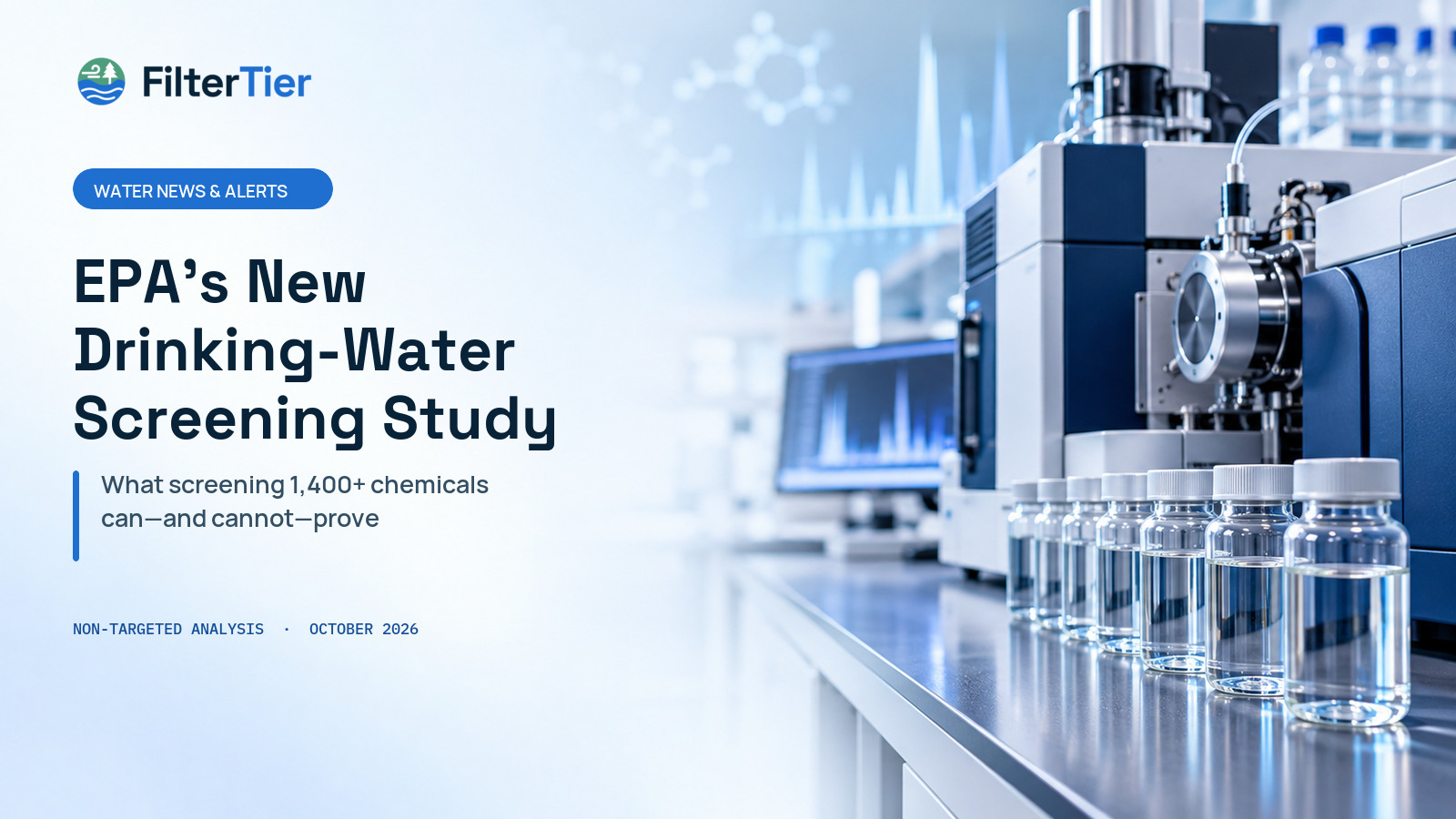
EPA’s new drinking-water study is a broad discovery project, not a finding that 1,400 chemicals are in anyone’s tap water. Announced on September 9, 2026, the study will use non-targeted analysis (NTA) to compare drinking-water samples with a custom screening library of more than 1,400 emerging contaminants. EPA says the library includes more than 1,000 pesticides and pesticide metabolites, more than 250 pharmaceuticals and personal-care products, more than 70 per- and polyfluoroalkyl substances (PFAS), and other chemicals. The agency plans to collect samples from several locations in different metropolitan areas.
The distinction that matters most is this: NTA can produce possible chemical identities across a much wider field than a conventional targeted test, but EPA’s study document says it does not tell researchers how much of a chemical is present. A possible match also requires comparison with known reference standards before the identity is confirmed. The announcement is important because it may reveal blind spots and help EPA decide what deserves closer study. It is not a national compliance survey, a new drinking-water standard, a health-risk determination, or a reason by itself to conclude that a water supply is unsafe.
This guide explains what EPA announced, how the screening works, what the results could mean, what they cannot establish, and what households can sensibly do now.
What EPA announced at a glance
| Question | Answer based on EPA’s published materials |
|---|---|
| What is the project? | A research study titled “Occurrence of Emerging Contaminants in Drinking Water Using Non-Targeted Analysis.” |
| When was it announced? | September 9, 2026. |
| What will EPA analyze? | Drinking-water samples collected from several locations in different metropolitan areas. |
| How broad is the screening library? | More than 1,400 chemicals, including 1,000+ pesticides and metabolites, 250+ pharmaceuticals and personal-care products, 70+ PFAS, and other emerging contaminants. |
| What method will EPA use? | Non-targeted analysis supported by high-resolution mass spectrometry and a custom chemical screening library. |
| Can the first screen measure concentration? | No. EPA’s study document says NTA can indicate that a chemical is present but does not say how much is present. |
| Is this a compliance program? | No. It is a research study. Compliance monitoring uses defined requirements and approved analytical methods for regulated contaminants. |
| Does a possible match mean a health risk? | No. Identity, concentration, exposure, toxicity, and applicable health or legal benchmarks all matter. |
EPA’s September 9 announcement describes NTA as a way to scan for thousands of potential pollutants rather than measuring only a small set of specifically requested chemicals. The agency’s accompanying study document and screening-library list provide the most useful technical details.
Why the “1,400+ chemicals” headline needs careful reading
The number describes the size of EPA’s screening library. It does not describe the number of chemicals found in a sample, a city, or the national drinking-water supply. A library is a reference collection: the analytical system observes features in a sample, and researchers compare those observations with profiles associated with chemicals in the library. It is similar in principle to searching a large catalog for plausible matches. A large catalog expands what researchers can look for; it does not guarantee that the catalog’s entries are present.
Four different quantities are easy to blur together:
- Library size: how many chemical profiles are available for comparison.
- Analytical features: signals generated by the instrument from a sample.
- Possible identities: chemicals that may explain particular features.
- Confirmed findings: identities supported by comparison with appropriate reference standards and quality-control evidence.
Those are not interchangeable. Nor does confirmation alone answer the next questions: what concentration was present, whether the result is reproducible, how often people are exposed, whether the concentration approaches a health-based value, or whether a drinking-water rule applies.
This is why FilterTier will not translate “screening 1,400+ chemicals” into “EPA found 1,400 contaminants.” EPA has not said that. The scientifically useful news is that the search space is unusually broad and may help researchers discover which chemicals merit the slower work of confirmation, measurement, occurrence assessment, toxicology, and risk evaluation.
How non-targeted analysis differs from a conventional water test
Most drinking-water tests are targeted. The laboratory begins with a defined list of analytes and a validated method designed to identify and quantify those analytes within known performance limits. If a utility is monitoring for arsenic, nitrate, or a regulated disinfection byproduct, the question is specified before the bottle reaches the instrument.
Non-targeted analysis reverses much of that logic. Researchers collect a richer instrument record and then ask what chemical identities might explain the observed signals. EPA’s NTA research materials describe high-resolution mass spectrometry as a tool that can examine a larger chemical space than traditional targeted methods. The tradeoff is greater uncertainty: a broad scan can surface candidates that a short list would miss, but it usually does not begin with the same analyte-specific confirmation and quantitative calibration as a targeted compliance measurement.
| Feature | Targeted analysis | Non-targeted analysis |
|---|---|---|
| Starting question | “How much of these named chemicals is present?” | “What chemical signals appear to be present?” |
| Scope | Defined analyte list | Broad scan across detectable features and reference information |
| Typical output | Confirmed identity and measured concentration for each analyte, subject to method limits | Features and proposed identities with varying confidence; follow-up may be required |
| Strength | Reproducible measurement for known targets | Discovery beyond the usual target list |
| Main limitation | Cannot report a chemical that was never targeted by the method | Identity and concentration may remain uncertain without standards and targeted confirmation |
| Best use | Compliance, routine monitoring, exposure measurement, treatment verification | Research, prioritization, suspect screening, discovery of possible unknowns |
Neither approach is universally better. They answer different questions. Broad discovery can identify what targeted programs should investigate next; targeted methods can then provide the concentrations and quality assurance needed for exposure assessment, regulation, or treatment decisions.
What the instrument actually sees
A high-resolution mass spectrometer does not display a row of product labels or instantly identify every molecule. It separates and measures ions by properties such as mass-to-charge ratio, often alongside retention time and fragmentation patterns. The result is a complex set of signals. Software and researchers compare those signals with reference information to generate candidate identities.
Real samples make the work harder. Drinking water contains minerals, treatment residuals, natural organic matter, and other matrix components. Chemicals may ionize well or poorly. Some compounds transform during treatment or in the environment. Different molecules can share similar formulas or fragments. A signal may have multiple plausible explanations, and a chemical outside the library may remain unknown.
EPA’s study materials describe two related outputs. First, researchers will use the custom library to identify emerging contaminants. Second, they will build a database of unknown chemicals for further identification. That second objective is important: “unknown” does not necessarily mean newly manufactured, uniquely dangerous, or never studied. It means the available evidence is insufficient to assign a confident identity at that stage.
Why reference standards matter
A reference standard is an authenticated sample of a known chemical. Researchers can run it under comparable conditions and ask whether its behavior matches the candidate signal. EPA states that NTA produces a list of possible chemicals and that researchers compare those possibilities with known reference standards to confirm identities. Confidence can increase when exact mass, isotope pattern, retention time, and fragmentation behavior align.
Standards are not available or affordable for every candidate, and some compounds are unstable or difficult to synthesize. That means a study can legitimately report findings at different confidence levels. Readers should look for the language EPA uses in future results: “feature,” “possible,” “probable,” and “confirmed” do not carry the same evidentiary weight.
What is in EPA’s screening library?
EPA’s September study document groups the more than 1,400 entries into four high-level categories. The published totals are not a prediction about what researchers will find.
| Library category | Published size | Why researchers may care |
|---|---|---|
| Pesticides and pesticide metabolites | 1,000+ | Use patterns, runoff, persistence, and transformation can create diverse parent chemicals and breakdown products. |
| Pharmaceuticals and personal-care products | 250+ | Some compounds can enter wastewater through human use or disposal and may be incompletely removed before water returns to the environment. |
| PFAS | 70+ | PFAS is a large chemical family; targeted methods cover defined subsets, while broader research can examine additional candidates. |
| Other emerging contaminants | Not separately totaled in the overview | Allows screening beyond the three named categories. |
“Emerging contaminant” is also easy to misunderstand. It does not automatically mean a chemical was invented recently or that EPA has determined it is hazardous at the observed level. The phrase is commonly used for substances whose occurrence, analytical detection, health information, or regulatory significance is still developing.
Pesticides and metabolites
The largest library category is pesticides and their metabolites. A metabolite or transformation product can form after a parent pesticide is changed by sunlight, microbes, water chemistry, treatment, or biological processes. Searching only for a parent compound can therefore miss part of the chemical story.
But a broad pesticide match does not establish an agricultural source, illegal use, or a health threshold exceedance. Researchers need confirmation, concentration data, sampling context, and evidence about transport and exposure. Seasonal application and rainfall can also influence occurrence, so a result from one sampling event may not characterize a full year.
Pharmaceuticals and personal-care products
Pharmaceuticals can reach wastewater after use and excretion or improper disposal. Personal-care-product ingredients have many pathways. Environmental occurrence is not the same as a therapeutic dose, and the ability to detect very low levels has advanced substantially.
EPA released 2026 Human Health Benchmarks for Pharmaceuticals alongside the draft Sixth Contaminant Candidate List work. The agency says these non-enforceable values can help states, utilities, and others interpret detections and decide whether further investigation may be appropriate. EPA also cautions that detecting a chemical at a low level does not necessarily mean it presents a health risk. The benchmark is context for a measured concentration; it is not a substitute for concentration data, and it is not a federal drinking-water regulation.
PFAS
PFAS includes thousands of fluorinated substances with different structures and properties. EPA’s screening library includes more than 70 PFAS, but the number should not be compared casually with a targeted laboratory panel. Methods capture different slices of the PFAS universe, with different sample preparation, detection, identification, and reporting rules.
If future NTA work proposes a PFAS identity, the useful follow-up questions will include whether it was confirmed with a standard, whether a quantitative targeted method exists, what concentration was measured, and whether the compound is covered by an applicable rule or health value. Our guide to PFAS filter claims, certification, and marketing explains why broad “removes PFAS” language should be checked against a product’s exact certification and reduction data.
What EPA’s study can reveal—and what it cannot
What it can do
- Broaden discovery. EPA can look beyond the small lists used in individual targeted methods.
- Generate priorities. Repeated or credible findings can point researchers toward chemicals that deserve targeted method development, toxicology, or occurrence studies.
- Expose analytical blind spots. Unknown features can show where existing libraries and standards are incomplete.
- Connect research programs. Results may inform future prioritization work related to the Contaminant Candidate List, unregulated contaminant monitoring, or other research.
- Improve future methods. Confirmed identities and archived spectra can strengthen reference libraries and make later investigations more efficient.
What it cannot do by itself
- Describe every U.S. water system. EPA says it will sample several locations in different metropolitan areas, not every utility or household.
- Measure concentration in the initial NTA result. EPA’s project document explicitly says the method can indicate presence but not how much is present.
- Prove a health risk. Risk depends on hazard and exposure, including concentration, duration, route, and population susceptibility.
- Establish a violation. A violation is tied to an applicable requirement, defined monitoring, and the relevant legal and technical record.
- Create a new standard. Research evidence can inform policy, but a drinking-water regulation follows a separate statutory and administrative process.
- Identify every chemical in a sample. Instrument response, sample preparation, library coverage, and available standards all constrain what can be seen and confirmed.
- Prove a source. Finding a compound does not, on its own, establish where it came from.
The appropriate mental model is a funnel. NTA puts many candidates at the wide top. Quality review, reference standards, targeted quantification, repeat sampling, occurrence analysis, toxicology, and exposure assessment progressively narrow the field. Regulatory decisions, if warranted, come much later.
NTA, CCL 6, UCMR 6, and drinking-water rules are different programs
EPA says the new study complements two other 2026 initiatives: the draft Sixth Contaminant Candidate List (CCL 6) and the proposed Sixth Unregulated Contaminant Monitoring Rule (UCMR 6). These programs interact, but they are not synonyms.
| Program or step | Main purpose | 2026 scope described by EPA | What it is not |
|---|---|---|---|
| NTA drinking-water study | Broad discovery and identification research | Screen samples from several locations against a 1,400+ chemical library and investigate unknowns | Not national compliance monitoring and not quantitative by itself |
| Draft CCL 6 | Identify unregulated contaminants that are known or anticipated to occur and may require regulation | 75 chemicals, four chemical groups, and nine microbes | Listing is not a drinking-water limit |
| Proposed UCMR 6 | Collect standardized occurrence data to inform future decisions | Proposes monitoring for 30 chemical contaminants from 2028 through 2030 | Monitoring does not itself establish a maximum contaminant level |
| National Primary Drinking Water Regulation | Set enforceable federal requirements under the Safe Drinking Water Act | Contaminant-specific rulemaking with analytical, treatment, cost, occurrence, and health considerations | Not created by a press release, research screen, CCL listing, or UCMR detection alone |
Draft CCL 6: a priority list, not a limit
EPA announced the draft CCL 6 on April 2, 2026. The draft includes 75 chemicals, nine microbial contaminants, and four groups: microplastics, pharmaceuticals, PFAS, and disinfection byproducts. The CCL identifies contaminants not subject to a proposed or promulgated national primary drinking-water regulation that may require future regulation. A place on the list means EPA is prioritizing evaluation. It does not mean the agency has set a legal concentration or concluded that all listed contaminants must be regulated.
The CCL process can lead to a regulatory determination, but that determination is another decision point. EPA evaluates health effects, occurrence, and the opportunity for public-health risk reduction. The new NTA study may strengthen the evidence base, particularly by identifying candidates whose occurrence has been poorly characterized.
Proposed UCMR 6: standardized occurrence monitoring
EPA proposed UCMR 6 on July 1, 2026. The proposal calls for sample collection for 30 chemical contaminants from 2028 through 2030 using EPA-developed analytical methods. Large public water systems would participate, and a nationally representative set of smaller systems would be included subject to congressional funding and laboratory capacity.
UCMR is targeted and standardized. It asks participating systems to test for the specified contaminants using the prescribed methods, producing concentration and occurrence data that can support future decisions. That is different from an exploratory NTA scan. If the NTA study identifies a promising candidate, method development and a future monitoring program could eventually provide the quantitative evidence needed to understand national occurrence.
How to read future study results without overreacting
EPA had not published drinking-water results from this new study as of October 25, 2026. When results appear, the headline will matter less than the methods and qualifiers. Use this checklist.
1. Was the chemical merely suspected or confirmed?
Look for the stated identification confidence and whether an authentic reference standard was used. A formula match or library similarity is useful screening evidence, but it is not always a unique identity. Isomers can share the same molecular formula while differing in structure and behavior.
2. Was a concentration measured?
Presence without concentration cannot be compared with a health benchmark, maximum contaminant level, or treatment target. If researchers performed follow-up targeted analysis, note the method, units, reporting limit, detection limit, and uncertainty. Parts per trillion and parts per billion differ by a factor of one thousand.
3. How many samples and locations were involved?
A finding in one sample is not a national prevalence estimate. Review the number of systems, source-water types, seasons, treatment configurations, and repeat samples. EPA’s current description—several locations in different metropolitan areas—signals useful exploratory coverage, not a probability sample of every U.S. system.
4. Was the sample source water or finished water?
Source water enters a treatment plant; finished water leaves after treatment. Distribution-system and premise-plumbing samples answer still different questions. Treatment can remove, transform, or occasionally form chemicals. A result should be interpreted at the point where the sample was collected.
5. Were blanks and quality controls clean?
Trace analysis is sensitive to contamination from bottles, tubing, laboratory materials, solvents, and handling. Method blanks, field blanks, duplicates, spikes, and internal standards help distinguish a sample result from background contamination or analytical variability. Strong reports describe how these controls were used.
6. Is there a health or regulatory comparison value?
Some chemicals have enforceable drinking-water standards. Others have health advisories, benchmarks, screening levels, or no authoritative drinking-water value. Those categories carry different legal and scientific meanings. A screening value can guide investigation, but it should not be described as a violation threshold.
7. Does the comparison value match the population and exposure?
EPA’s pharmaceutical benchmark program includes values for the general population and, where appropriate, bottle-fed infants. A comparison must match the chemical, units, exposure assumptions, and relevant population. A surface-water ecological benchmark or occupational limit is not automatically suitable for household drinking water.
Does detection mean the water is unsafe?
No. Modern instruments can detect extraordinarily small amounts, and detection is only the first fact in a risk assessment. A complete interpretation needs at least:
- a sufficiently confident chemical identity;
- a defensible concentration;
- information about frequency and duration of exposure;
- toxicity or health-effect evidence;
- the population and life stage being considered;
- an appropriate comparison value, if one exists; and
- uncertainty and quality-control information.
EPA makes the same point in its Human Health Benchmarks for Pesticides and Pharmaceuticals: the detection of a chemical at a low level does not necessarily indicate a health risk. The benchmarks are not regulations and are not legally enforceable. They are tools for interpreting monitoring data and prioritizing additional work.
The reverse is also important. Lack of an NTA match does not prove that no unregulated chemical is present. A compound may be outside the library, below the method’s response, lost during extraction, incompatible with the analytical platform, or hidden by the sample matrix. “Not detected” always means “not detected under these sampling and analytical conditions.”
What the study could change for utilities and researchers
For water professionals, the study’s most valuable product may be prioritization rather than a final list of answers. A credible signal repeated across locations can justify investing in a quantitative method. Confirmed identities can be added to reference libraries. Unknown features can be ranked by frequency, signal intensity, persistence through treatment, or structural clues. Researchers can then combine occurrence evidence with toxicology and exposure data.
Utilities should resist the temptation to communicate preliminary NTA features as finished risk findings. A good public explanation separates:
- what the instrument observed;
- how confidently a chemical was identified;
- whether concentration was measured;
- what health or legal reference applies; and
- what confirmatory work is underway.
If EPA publishes location-specific data, utilities can pair it with source-water knowledge, treatment information, and existing targeted monitoring. Results may also help utilities decide whether pilot treatment studies or additional sampling are justified. Because NTA platforms and workflows vary, cross-study comparisons should be made only after checking methods, detection coverage, and reporting conventions.
What households should do now
The study announcement does not require an emergency response. It provides a reason to improve how we ask questions about local water.
Start with your utility’s Consumer Confidence Report
Community water systems publish an annual Consumer Confidence Report, also called a water quality report. It summarizes regulated contaminant monitoring, violations, source information, and required notices. Find your report through your utility or use FilterTier’s What’s in My Water? tool to reach local water information.
A Consumer Confidence Report does not cover every unregulated chemical, and annual tables can lag the newest sampling. Still, it is the best first document for understanding the system that actually serves your address. Our guide to checking whether your tap water is safe explains how to combine the report with public notices, state records, and household-specific information.
Ask precise questions
If the NTA study or another report raises a concern, ask the utility or state drinking-water program:
- Was our system sampled, and at what point in the treatment or distribution process?
- Was the result a screening match or a reference-standard confirmation?
- Was a targeted concentration measured, and in what units?
- Was the finding repeated in another sample?
- Is there an EPA or state health value for this chemical?
- What treatment processes are in use, and is follow-up sampling planned?
Those questions turn a vague detection headline into evidence you can evaluate.
Use targeted testing for a targeted decision
Home testing is most useful when you have a defined reason: a private well near a known source, a utility notice, a plumbing concern, a health-department recommendation, or a need to verify a treatment system. Choose a laboratory accredited by your state or the relevant accreditation authority for the exact analyte and method. Ask about the sample container, preservation, holding time, reporting limit, and whether the result is quantitative.
Mail-order strips and inexpensive sensors can be helpful for a few basic properties, but they cannot reproduce high-resolution mass spectrometry or validate thousands of chemical identities. A generic total-dissolved-solids reading does not tell you whether PFAS, a pharmaceutical, or a pesticide is present.
Do not buy a filter for “1,400 chemicals”
No single treatment claim follows from the size of EPA’s library. Treatment depends on the chemical’s properties and concentration, water chemistry, flow rate, media, system design, maintenance, and verified performance. Activated carbon may reduce many organic chemicals, while ion exchange or reverse osmosis may be appropriate for other targets. No technology removes everything under every condition.
Begin with the contaminant you need to reduce. Then look for a current certification or performance data that names that contaminant or a clearly relevant surrogate, states the test conditions and capacity, and matches the product model. Learn how to separate evidence from broad advertising in PFAS certification versus marketing claims. If PFAS is the specific concern, see our PFAS contaminant guide before comparing systems.
Private wells need a different plan
Private wells are generally not regulated under the federal Safe Drinking Water Act in the same way as public water systems, and their owners are responsible for testing and maintenance. Routine well panels commonly focus on bacteria, nitrate, and locally relevant inorganic contaminants. Additional testing should reflect nearby land use, spills, state guidance, well construction, and local geology.
A nationwide research announcement is not a useful substitute for a local risk assessment. Contact your state health or environmental agency, county health department, or extension service for an analyte list and accredited laboratories appropriate to your area.
Common claims about the study: fact check
| Claim | Verdict | What the evidence supports |
|---|---|---|
| “EPA found 1,400 chemicals in tap water.” | False | EPA built a screening library containing more than 1,400 chemicals. That is the search space, not a result count. |
| “Every U.S. water system will be tested.” | False | EPA says samples will come from several locations in different metropolitan areas. |
| “The study will measure how much of every chemical is present.” | False | EPA says NTA can indicate presence but does not determine how much is present. Targeted follow-up is needed for quantitation. |
| “A detected chemical means a violation.” | False | A violation requires an applicable requirement and the relevant compliance evidence. Many library chemicals are unregulated. |
| “A low-level detection automatically means a health risk.” | False | Identity, concentration, exposure, toxicity, and an appropriate benchmark all matter. |
| “Non-targeted analysis can help discover chemicals conventional panels miss.” | True, with limits | It scans a broader chemical space, but proposed identities and unknown features require careful confirmation and interpretation. |
| “The study could influence future EPA priorities.” | Reasonable | EPA says the work complements CCL 6 and proposed UCMR 6 and will help prioritize future actions. |
Frequently asked questions
Did EPA discover 1,400 contaminants in drinking water?
No. The figure refers to the size of EPA’s custom chemical screening library. EPA announced a study that will compare drinking-water samples with that library. It had not published study results as of October 25, 2026.
Where will EPA collect samples?
EPA’s public study document says “several locations in different metropolitan areas.” It does not describe the project as a survey of every public water system. Readers should wait for the sampling plan or results before drawing conclusions about geographic representativeness.
Can NTA show how much of a chemical is in water?
Not in the form described for this study. EPA says NTA can tell a researcher that a chemical is present but does not tell the researcher how much is present. Quantitative follow-up generally requires a targeted method, calibration standards, and analyte-specific quality control.
What is an “unknown chemical” in NTA?
It is an instrument feature that has not yet been assigned a sufficiently confident chemical identity. The feature may correspond to a known chemical absent from the library, a transformation product, an isomer, background contamination, or another explanation. Unknown does not itself describe toxicity.
Are the 70+ PFAS in the library regulated?
No. Library inclusion and regulation are separate. EPA has federal drinking-water requirements for specified PFAS, while the broader PFAS family contains many additional compounds. A future screening match should be evaluated by exact identity, confirmation status, concentration, and applicable federal or state requirements.
Does a pharmaceutical detection mean medicine is present at a therapeutic dose?
No. Environmental analytical methods may detect concentrations far below a medicinal dose. Interpretation requires a measured concentration and a relevant health benchmark or toxicological assessment. EPA’s 2026 pharmaceutical benchmarks are screening tools, not enforceable standards.
Should I install reverse osmosis because of this announcement?
Not based on the announcement alone. A treatment decision should start with a confirmed local contaminant and a product whose performance for that contaminant is independently certified or otherwise supported by credible, model-specific data. Installation, wastewater, maintenance, capacity, and water chemistry also matter.
How is this different from UCMR monitoring?
UCMR uses specified analytical methods to gather standardized occurrence and concentration data for a defined list of unregulated contaminants. The new NTA study is broader and exploratory. Proposed UCMR 6 would monitor 30 chemical contaminants from 2028 through 2030.
When will EPA publish results?
The September announcement and public project document explain the objectives and library, but they do not provide a public results-release date. FilterTier will evaluate results when EPA publishes enough information to assess sampling, identification confidence, quality control, and any quantitative follow-up.
What this means for you
EPA’s study is meaningful because water research has usually been constrained by the chemicals analysts already knew to request. Non-targeted analysis can widen that view, identify plausible candidates, and preserve unknown signals for future work. The custom library—more than 1,400 pesticides, metabolites, pharmaceuticals, personal-care compounds, PFAS, and other contaminants—makes the search unusually broad.
It is equally important not to skip the steps between discovery and decision. The study is not a finding that 1,400 chemicals occur in drinking water. It will not represent every system. Its initial NTA output will not provide concentration. A possible identity is not automatically a confirmed identity, and a confirmed identity is not automatically a health risk or violation.
For households, the practical path remains local: read your Consumer Confidence Report, follow public notices, ask whether a finding was confirmed and quantified, use accredited targeted testing when there is a defined reason, and choose treatment only for a verified need. For researchers and utilities, the study can build a better map of what to investigate next. That is a substantial contribution—provided the map is not mistaken for the destination.
Sources
- U.S. EPA — EPA Launches Cutting-Edge Scientific Study to Strengthen the Nation’s Understanding of Potential Pollutants in Drinking Water (September 9, 2026; page updated October 22, 2026)
- U.S. EPA — Occurrence of Emerging Contaminants in Drinking Water Using Non-Targeted Analysis (September 2026)
- U.S. EPA — Proposed Sixth Unregulated Contaminant Monitoring Rule (proposed July 1, 2026)
- U.S. EPA — Draft Contaminant Candidate List 6 (April 2, 2026)
- U.S. EPA — Human Health Benchmarks for Pesticides and Pharmaceuticals (2026)