
Activated carbon, catalytic carbon, and KDF are often grouped together on whole-house filter product pages, but they are not interchangeable treatment media. Granular activated carbon is widely used for chlorine, taste, odor, and many organic compounds. Catalytic carbon is a modified form of activated carbon designed to improve reaction kinetics for harder-to-treat compounds such as chloramine and hydrogen sulfide in some applications. KDF is a copper-zinc redox media used mainly as a supporting stage for chlorine, certain metals, and media-protection functions. The right choice depends on the contaminant, contact time, service flow, water chemistry, and the exact product evidence—not the number of media names listed in a marketing diagram.
This guide explains what each media type does, where it tends to work well, where it is commonly overstated, and how to compare systems that use one or more of these materials. It is intentionally technology-focused rather than a “best filter” ranking. For current product recommendations, see the relevant FilterTier rankings; for exact models, use the system database.
What to know before comparing filter media
- Media type does not equal product performance. Two filters containing activated carbon can have very different capacity and flow because media quantity, particle size, bed depth, tank size, channeling, and contact time differ.
- Chlorine and chloramine are different treatment problems. Standard activated carbon can be very effective for chlorine, while chloramine often requires more contact time or media designed for faster catalytic reactions.
- KDF is usually a supporting media, not a complete whole-house treatment system by itself.
- Exact claims matter. A system using carbon media should not automatically be assumed to reduce PFAS, VOCs, lead, or every contaminant commonly associated with carbon.
- Flow is part of treatment. A media bed that performs well at 5 GPM may not provide the same reduction at 15 GPM unless the system is sized for it.
What is activated carbon?
Activated carbon is a porous adsorptive material typically made from carbon-rich feedstocks such as coconut shell, coal, or wood. During manufacturing, the material is processed to create a very large internal surface area. Water passes through the carbon and certain compounds are attracted to and held on that surface.
Adsorption is different from simple mechanical filtration. A sediment filter physically screens particles based on size. Carbon interacts chemically and physically with dissolved compounds. The effectiveness of that interaction depends on the compound, carbon type, surface chemistry, water temperature, competing contaminants, and contact time.
Granular activated carbon versus carbon block
Whole-house media tanks commonly use granular activated carbon, often abbreviated GAC. Drinking-water cartridges frequently use carbon block, in which powdered carbon is compressed or bonded into a dense structure. Carbon block can provide controlled flow paths and fine particulate filtration, but it can also create more pressure drop. GAC tanks can support higher whole-house flow with lower restriction, but their performance depends heavily on bed depth and contact time.
Neither format is universally superior. A dense carbon block may carry a strong exact-product contaminant certification at modest flow, while a large GAC tank may offer high whole-house service flow and long chlorine capacity. The application determines which architecture is appropriate.
What does standard activated carbon reduce?
Activated carbon is widely used for chlorine reduction, taste, odor, and a range of organic compounds. It can also be part of treatment strategies for certain PFAS, pesticides, solvents, and other organics, but the specific reduction depends on the exact media and product design.
For household decision-making, think of standard activated carbon as a strong general-purpose adsorptive technology with especially common use for chlorine and aesthetic improvement. Do not interpret “contains activated carbon” as proof of every possible carbon-related claim.
Why chlorine is relatively straightforward for carbon
Free chlorine reacts readily with activated carbon. This is one reason large carbon tanks can often treat municipal chlorine at useful whole-house flow rates when they contain enough media. The process still consumes carbon capacity over time, and very high flow can reduce contact, but chlorine is generally one of the easier disinfectants for carbon treatment.
Why chloramine is more difficult
Chloramine is intentionally more stable than free chlorine. That stability helps utilities maintain a disinfectant residual over long distribution systems, but it also makes chloramine slower to react with ordinary activated carbon. A system designed only around chlorine capacity may not provide equivalent chloramine reduction at the same flow.
This is where catalytic carbon is often considered.
What is catalytic carbon?
Catalytic carbon is activated carbon whose surface chemistry has been modified or selected to accelerate certain reactions. It retains the adsorptive properties of carbon while improving catalytic activity for specific treatment challenges.
In residential water treatment, catalytic carbon is commonly marketed for chloramine, hydrogen sulfide, and sometimes certain oxidation-reduction reactions. The most important point is that “catalytic” describes media functionality, not a complete guarantee of system performance.
Why catalytic carbon can help with chloramine
Chloramine reduction requires breaking chemical bonds and often benefits from faster surface reaction kinetics. Catalytic carbon can accelerate these reactions compared with conventional GAC, making it useful when a system needs to reduce chloramine at practical flow rates.
That does not mean a small catalytic-carbon tank will automatically outperform a very large conventional carbon bed under every condition. Media volume, water chemistry, flow, and contact time still matter.
Catalytic carbon and hydrogen sulfide
Catalytic carbon can be used in some hydrogen-sulfide treatment strategies, especially when oxidation conditions are appropriate. But sulfur odor in well water can come from different sources and concentrations. A catalytic-carbon system should not be selected from odor alone without testing the water and understanding the treatment design.
What is KDF media?
KDF is a high-purity copper-zinc alloy media that works through oxidation-reduction, or redox, reactions. Depending on the specific KDF formulation and application, it can help reduce chlorine and certain dissolved metals, and it is often used to support other media.
KDF is dense and comparatively expensive, so residential whole-house filters generally use it in smaller quantities rather than filling an entire large tank with it. It is frequently layered with carbon or incorporated into cartridges.
Why KDF is often paired with carbon
KDF can take some oxidative load ahead of carbon and can help change the chemical form of certain contaminants. In some designs, this can protect the carbon or extend useful media life. The combination can make sense, but it should still be evaluated as a complete system rather than by counting the number of media layers.
Does KDF remove heavy metals?
KDF media can reduce certain dissolved metals under suitable conditions, but claims vary by KDF formulation, water chemistry, and product design. A generic statement that “KDF removes heavy metals” is too broad for a consumer purchase decision. Look for exact-product testing or certification for the metal that matters to you.
Activated carbon vs catalytic carbon vs KDF at a glance
| Media | Primary role | Typical strengths | Common limitations |
|---|---|---|---|
| Granular activated carbon | Adsorption | Chlorine, taste/odor, many organics; scalable for whole-house flow | Chloramine can require more contact time; performance varies widely by bed size and media |
| Catalytic carbon | Adsorption + catalytic reaction | Chloramine, chlorine, some sulfur-related applications, organics | Still depends on media volume, flow, and water chemistry; “catalytic” alone is not a verified claim |
| KDF | Redox support media | Chlorine support, some metal reduction, media-protection roles | Dense/costly; usually used as one stage rather than the complete treatment solution |
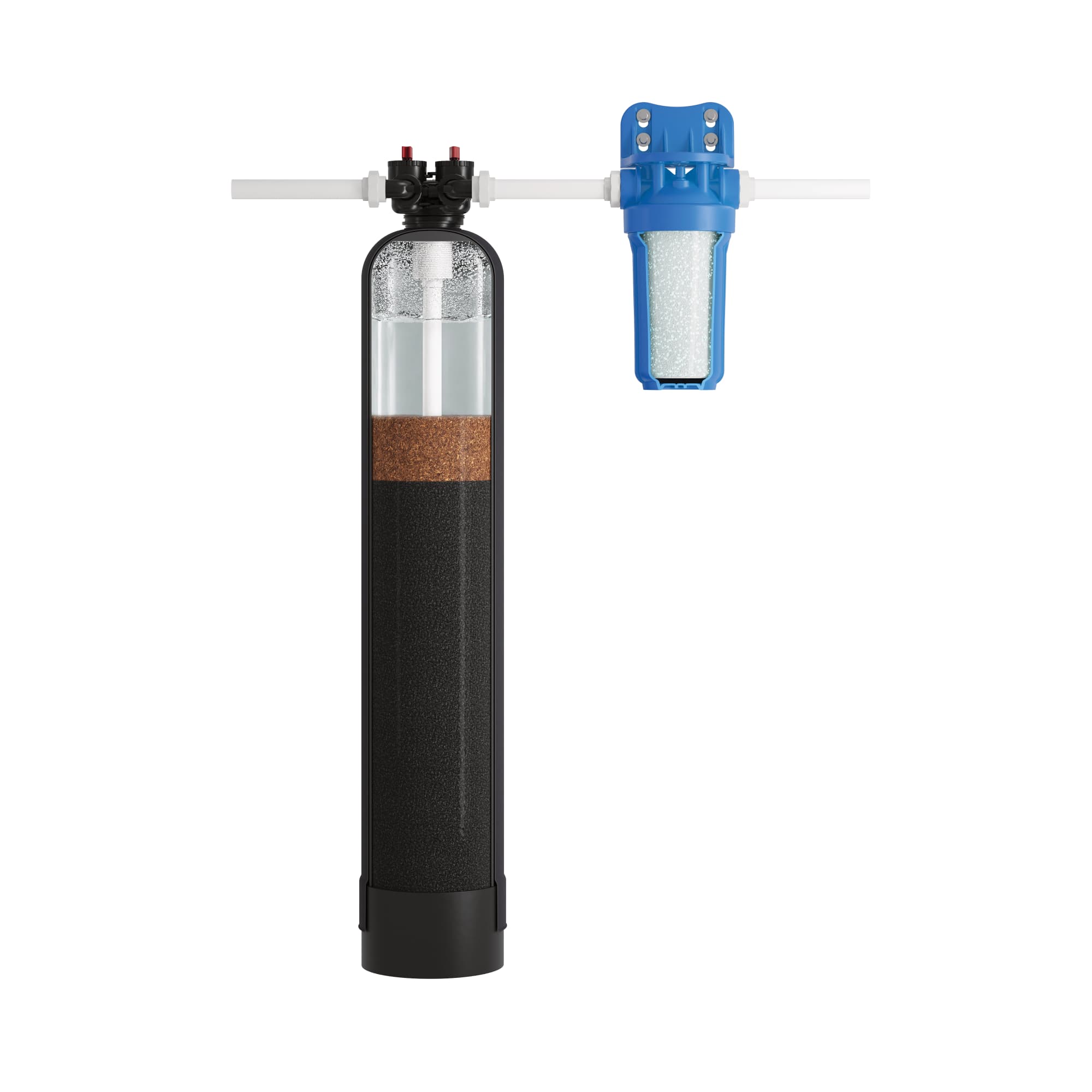
Why empty-bed contact time matters
One of the most useful concepts for understanding media tanks is empty-bed contact time, often abbreviated EBCT. It is a way to estimate how long water is in contact with the media bed based on tank volume and flow.
Longer contact time generally gives adsorption and catalytic reactions more opportunity to occur. If you double flow through the same tank, contact time decreases. If you increase media volume while keeping flow constant, contact time increases.
This is why a product can physically pass 20 GPM yet have better contaminant performance at 8 or 10 GPM. Hydraulic maximum and treatment flow are not necessarily the same number.
Why EBCT is especially relevant to chloramine
Because chloramine reacts more slowly than free chlorine, treatment often benefits from longer contact or catalytic media. A chloramine-focused system therefore needs to be sized differently from a simple chlorine taste-and-odor system.
Why tank diameter and bed depth matter
A larger tank can contain more media, but geometry matters. Water needs to distribute through the bed rather than channel along a narrow path. Control valves, distributors, gravel underbeds, and media layering can all influence flow behavior.
A tall deep bed can improve contact, while a wide tank can lower velocity. Good system design balances these factors with service flow and backwash requirements.
Does more media always mean better performance?
More media usually provides more capacity and contact potential, but it is not a complete quality metric. Poor flow distribution, inadequate backwash, low-quality media, or a treatment claim unsupported by testing can still produce a weak product.
Compare media quantity with:
- exact contaminant claims;
- service flow;
- pressure drop;
- backwash requirements;
- replacement interval;
- independent certification or testing;
- installation and maintenance.
Coconut-shell carbon vs coal-based carbon
Activated carbon can be produced from different feedstocks. Coconut-shell carbon typically has a high proportion of smaller pores, while coal-based carbons can have a broader pore structure. Different pore distributions can favor different compounds.
Marketing sometimes turns feedstock into a simplistic ranking—such as “coconut is always better.” That is not reliable. The correct carbon depends on the target contaminant and system design. Exact product evidence matters more than a feedstock slogan.
Catalytic carbon is not a certification category
“Catalytic carbon” is a media description. It does not tell you whether the complete system is NSF, WQA, or IAPMO certified for chloramine or any other contaminant. If the claim matters, verify the listing for the exact model.
See NSF 42 vs 53 vs 401 vs 44 vs 55 vs 58 for a broader explanation of certification standards.
KDF 55 vs KDF 85 and other formulations
KDF media is sold in different formulations intended for different applications. KDF 55 is commonly associated with chlorine and water-treatment support, while KDF 85 is commonly associated with iron and hydrogen sulfide applications. There are other formulations as well.
Consumers do not need to memorize every product number, but they should recognize that “contains KDF” is incomplete information. Ask which KDF media is used, how much is present, and what exact claim is supported.
Can these media remove PFAS?
Activated carbon can be an important PFAS treatment technology, especially for certain longer-chain PFAS compounds. Catalytic carbon may also adsorb PFAS because it is still activated carbon. However, PFAS performance is highly dependent on media, water chemistry, contact time, and capacity.
KDF should not be treated as the primary PFAS technology.
For PFAS specifically, see How PFAS Is Removed: GAC vs Ion Exchange vs Reverse Osmosis and PFAS Certification vs PFAS Marketing Claims.
Can these media remove lead?
Some carbon-block products are certified for lead reduction, often using specific adsorptive additives or highly controlled cartridge designs. That does not mean every loose carbon tank removes lead to the same standard. KDF may have certain metal-reduction capabilities, but again the exact product claim matters.
If lead is your primary concern, start with a test and choose a product with exact lead-reduction evidence. See Lead in Tap Water: What the Numbers Mean and How to Reduce It.
Can carbon remove hardness?
No. Standard carbon filtration does not conventionally remove calcium and magnesium hardness. If a bundle includes carbon plus a softener or salt-free conditioner, those are separate treatment stages.
This is one of the most common sources of confusion in whole-house bundles: the carbon stage may handle chlorine, while the softener handles hardness.
Can carbon remove iron?
Carbon is not usually the primary treatment for significant iron. Some systems use catalytic media or oxidation processes that can help under certain conditions, but iron treatment should be based on iron concentration, form, pH, and other well-water chemistry.
For private wells, test before selecting equipment. See Private Well Water Testing: What to Test Before Buying a Filter.
Can catalytic carbon remove sulfur odor?
It can be part of some hydrogen-sulfide treatment designs, but sulfur odor has multiple causes. If odor appears only in hot water, the water heater may be involved. If it is present in both hot and cold well water, the source may be dissolved hydrogen sulfide or sulfur-related bacteria.
A proper treatment plan may require oxidation, backwashing media, catalytic carbon, or another approach. Testing and diagnosis come first.
Why backwashing matters in media tanks
Backwashing reverses flow through the media bed to lift, clean, and reclassify the media. Some carbon systems are non-backwashing, while others use automatic control valves.
Backwashing can reduce channeling and flush accumulated particles, but it also requires sufficient source flow. An oversized tank on a weak well pump may not backwash correctly.
Does KDF require special flow conditions?
KDF is dense and can compact. Product design needs to account for this. In many systems, KDF is mixed or layered with other media rather than used as a deep standalone bed. Cartridge designs may use KDF granules in a controlled chamber.
How chloramine changes whole-house system sizing
If your utility uses chloramine, do not assume a chlorine-rated tank is adequate at the same service flow. A system may need catalytic carbon, more media, lower flow, or a specific tested design.
Check your utility report or contact the utility to determine which disinfectant is used. The What’s in My Water? tool can help you identify the utility and review public data.
How to read a media stack diagram
Manufacturers often show layered diagrams with sediment media, KDF, carbon, catalytic carbon, scale-control media, and specialty resins. The diagram can be useful, but it is not a substitute for performance data.
Ask these questions:
- How much of each media is actually in the system?
- Which media is responsible for each claim?
- What is the service flow?
- What contaminant claim is tested or certified?
- What is the rated capacity?
- What does the maintenance schedule require?
Why “seven stages” does not necessarily beat “two stages”
Stage count is a marketing-friendly number. A large, well-sized carbon bed plus sediment protection can outperform a small multi-stage cartridge that contains tiny quantities of several media. More stages can also add pressure drop and maintenance.
Judge treatment architecture, not the number of labels in the cutaway.
Whole-house carbon tank vs carbon cartridge
A large tank generally provides more media and lower pressure drop at high flow. A carbon cartridge can provide a controlled, replaceable media block and may carry stronger exact-product certifications for certain contaminants.
The tradeoff is capacity, flow, maintenance, and evidence. For a deeper comparison, see Big Blue Cartridge Filter vs Media Tank Filter.
How to compare carbon systems by capacity
Capacity claims should be tied to the contaminant. A one-million-gallon chlorine-capacity claim should not automatically be interpreted as a one-million-gallon PFAS or VOC capacity.
If the product has a certification or independent test, identify the capacity at which the specific claim was evaluated.
Why pressure drop belongs in the comparison
Dense cartridges and fine media can create restriction. Large tanks may have lower pressure drop, but valve and distributor size still matter. Whole-house treatment should preserve acceptable pressure during realistic simultaneous use.
See Will a Whole-House Water Filter Reduce Water Pressure? and Rated Flow vs Peak Flow for the hydraulic side of the decision.
How to compare carbon systems by maintenance
Maintenance can range from changing a cartridge every few months to replacing tank media every several years. KDF-containing cartridges may have their own replacement schedule. Backwashing tanks have valves and drain cycles to maintain.
There is no universal “low-maintenance carbon system.” Compare actual service tasks and replacement costs.
Example scenario: municipal chlorine, moderate household flow
A four-person home uses city water with free chlorine, no significant hardness concern, and peak indoor demand around 9 GPM. A properly sized GAC tank may be an excellent fit if the primary goal is chlorine taste and odor reduction throughout the home.
Adding catalytic carbon or KDF may not provide meaningful extra value unless another treatment goal justifies it.
Example scenario: municipal chloramine
A similar home receives chloraminated water. Now the treatment challenge changes. Catalytic carbon, greater media volume, or a specific chloramine-rated system may be more appropriate. The service flow should be checked against the actual chloramine claim rather than a generic maximum GPM.
Example scenario: private well with sulfur odor
A well-water home has rotten-egg odor, iron staining, and sediment. Buying a carbon/KDF cartridge from the symptom alone is risky. The water should be tested for iron, manganese, pH, sulfur-related conditions, bacteria, and other relevant parameters. The final treatment may use oxidation and backwashing media rather than a simple carbon tank.
Example scenario: PFAS concern on city water
A homeowner sees PFAS detections in utility monitoring. A generic carbon tank may reduce PFAS, but the decision should focus on exact PFAS evidence, flow, capacity, and replacement. A certified specialty cartridge or point-of-use RO could be stronger options depending on treatment scope.
Common mistakes when comparing media
Mistake 1: assuming every carbon filter removes the same contaminants
Carbon is a technology family, not a universal performance guarantee.
Mistake 2: assuming catalytic carbon means certified chloramine removal
Media type and certification are separate.
Mistake 3: treating KDF as a complete heavy-metal solution
Verify exact-product evidence for the specific metal.
Mistake 4: ignoring contact time
High flow can reduce treatment opportunity.
Mistake 5: buying by stage count
Media quantity and evidence matter more than the number of layers shown.
Mistake 6: using chlorine capacity as a capacity for every other contaminant
Each claim can have a different breakthrough profile.
Mistake 7: forgetting replacement cost
A sophisticated cartridge can become expensive if replaced frequently.
How FilterTier evaluates these media in WaterScore
FilterTier does not award a high score simply because a product contains activated carbon, catalytic carbon, or KDF. We look at treatment fit, evidence, service flow, maintenance, value, architecture, warranty, installation, and transparency.
A simple carbon tank with strong documentation can outperform a complex multi-media system with vague claims. Conversely, a sophisticated catalytic-carbon system may be the better fit for chloramine when it has evidence and adequate flow.
Questions to ask before buying
- Does my utility use chlorine or chloramine?
- What contaminant am I actually trying to reduce?
- How much carbon or catalytic carbon is in the system?
- Which KDF formulation is used and why?
- What is the normal service flow?
- What is the pressure drop?
- What exact claims are certified or independently tested?
- What is the capacity for those claims?
- What needs replacement and how often?
- Does the system require backwashing?
- If on a well, can the pump supply the required backwash flow?
Frequently asked questions
Is catalytic carbon better than activated carbon?
Not universally. Catalytic carbon can be better for certain harder-to-react compounds such as chloramine, while conventional activated carbon may be entirely adequate for chlorine and many organic contaminants.
Is KDF better than carbon?
They perform different functions. KDF is usually a support media, while carbon provides broad adsorption capacity.
Do I need KDF in a whole-house filter?
Not automatically. It can be useful for specific treatment or media-protection goals, but a well-designed carbon system can work without it.
Does catalytic carbon remove PFAS?
It can adsorb PFAS because it is activated carbon, but exact performance depends on the system. Verify PFAS-specific evidence.
Does KDF remove lead?
KDF media can interact with certain dissolved metals, but you should not assume lead reduction without exact product evidence or certification.
Can carbon soften water?
No. Conventional carbon does not remove calcium and magnesium hardness.
Does carbon remove iron?
Not as a general primary treatment for significant iron. Well-water iron usually needs treatment selected from actual test results.
How long does carbon last?
It depends on media quantity, water use, contaminant loading, and the specific claim. Tank media may last years; cartridges may be replaced much more often.
How do I know whether my city uses chloramine?
Check the utility’s Consumer Confidence Report, treatment information, or contact the utility directly.
What is the simplest good setup for chlorine?
Often a properly sized sediment-protected carbon system is enough when free chlorine is the main concern and the exact system supports the needed household flow.
Decision framework
Choose standard activated carbon when:
- free chlorine, taste, odor, and general organic adsorption are the main goals;
- you can provide enough media and contact time;
- whole-house flow and low pressure drop matter.
Consider catalytic carbon when:
- your utility uses chloramine;
- the treatment goal benefits from faster catalytic reaction;
- the exact system has documentation for the claim.
Consider KDF as a support stage when:
- the system design uses it for a specific redox or media-protection role;
- there is evidence supporting the metal or disinfectant claim;
- the architecture and maintenance make sense.
What this means for you
Do not choose a whole-house filter by counting media names. Activated carbon, catalytic carbon, and KDF each have legitimate uses, but the media only become meaningful when they are placed in a system with enough quantity, contact time, flow capacity, and evidence.
Start with your water source and contaminant goal. Confirm chlorine versus chloramine. If you are on a private well, test the water before selecting treatment. Then compare the exact product on service flow, claim-specific capacity, maintenance, and certification.
Use What’s in My Water? to identify your public-water context, browse exact systems, and use Find My Filter to narrow treatment around your household flow and priorities.
Primary references
- U.S. EPA — Ground Water and Drinking Water
- U.S. EPA — Safe Drinking Water Act
- NSF — Standards for Water Treatment Systems
How media quality, particle size, and manufacturing affect performance
Two bags of activated carbon can share the same generic label and still behave differently. Activation method, ash content, pore distribution, particle size, hardness, moisture, and surface chemistry can all influence performance. Finer particles can create more accessible surface area but may increase pressure drop or produce more fines. Harder carbon can resist physical breakdown during backwashing and shipping. Media specifications matter most when they are connected to the contaminant and hydraulic requirements of the finished system.
This is another reason not to compare systems only by phrases such as “premium coconut carbon” or “catalytic blend.” Those descriptions can be useful, but they are not substitutes for exact product capacity, flow data, or third-party evidence.
Why water temperature can change carbon performance
Adsorption behavior can vary with temperature. Residential water is not maintained at one laboratory temperature all year, and seasonal source-water temperatures can change. For many household applications this does not create a dramatic day-to-day difference, but it is one reason laboratory results should be interpreted as performance under defined test conditions rather than an absolute result under every possible installation condition.
How pH can influence treatment
pH can affect contaminant chemistry, media surface behavior, and oxidation-reduction reactions. KDF applications in particular can be sensitive to water chemistry, while sulfur and metal treatment often depends heavily on pH. If a private well has unusually low or high pH, treatment should be designed around that chemistry rather than added as an afterthought.
What happens when multiple contaminants compete for carbon
Real water contains many dissolved compounds at once. Those compounds can compete for adsorption sites. A carbon bed that is challenged by several organic compounds can have different capacity than one treating relatively clean water with only chlorine. This is one reason capacity is not simply a property of the media; it is a property of the media under specific water conditions and operating conditions.
Why prefiltration can extend carbon life
Sediment does not consume carbon in the same way dissolved organics do, but heavy particulate loading can clog the bed, increase pressure drop, or contribute to channeling. A coarse sediment stage ahead of a carbon system can therefore protect hydraulic performance. On wells with significant sediment, staged pretreatment may be more important than adding another specialty media to the carbon tank.
Why carbon fines appear after installation
New carbon systems often require flushing because transport and handling can create small carbon particles, commonly called fines. Proper startup flushing clears those particles and prepares the bed for normal use. Dark water immediately after installation does not necessarily mean the carbon is defective, but the system should be flushed according to the manufacturer’s instructions before normal household use.
How bacterial growth relates to carbon filters
Activated carbon removes disinfectant residual and provides a large surface area. In some systems, especially point-of-use filters, this can create conditions where bacteria can grow if filters are not replaced and handled properly. Whole-house systems also need appropriate installation and maintenance. Carbon is not a disinfectant simply because it improves water taste.
If microbial safety is a concern, choose a treatment strategy designed for that purpose. On private wells, UV or another disinfection method may be relevant after proper pretreatment and testing.
Why silver-treated carbon is not the same as disinfection
Some carbon media include silver or other bacteriostatic treatments intended to limit bacterial growth in the media. That should not be interpreted as whole-water microbial disinfection unless the exact product carries an appropriate claim. “Bacteriostatic media” and “disinfection system” are different concepts.
Can carbon remove fluoride?
Standard activated carbon should not generally be selected for fluoride reduction. Specialty media, activated alumina, reverse osmosis, or other technologies may be considered depending on the application. This example illustrates a broader rule: knowing that carbon is “good for chemicals” is not specific enough to choose treatment.
Can carbon remove nitrate?
Standard carbon is not the primary technology for nitrate. Reverse osmosis or nitrate-selective ion exchange are more common treatment approaches when nitrate reduction is required. Private-well nitrate concerns should be confirmed by laboratory testing.
Can carbon remove arsenic?
Standard carbon is not a universal arsenic solution. Arsenic treatment depends on oxidation state, water chemistry, and the media or membrane technology used. Well owners should test first and select treatment based on the actual arsenic form and concentration.
Can KDF replace a softener?
No. KDF is not a conventional hardness-removal technology. A standard ion-exchange softener removes calcium and magnesium hardness. If a system contains KDF and claims scale benefits, that should not be confused with actual softening unless the complete system includes a separate softening or conditioning stage.
How to think about media replacement in a large tank
Large carbon tanks can be rebedded rather than discarded. Media replacement usually involves removing spent media, inspecting the distributor and tank, and installing new media. This can extend the useful life of the tank and valve, but labor can be significant. Some direct-to-consumer systems are sold as replace-the-whole-tank products instead. Compare the long-term service model before buying.
How to estimate annualized media cost
Suppose System A costs $1,200 and requires a $500 media replacement every five years, while System B costs $800 but uses $180 cartridges every six months. Ignoring installation and other maintenance, System A’s media cost averages about $100 per year after the initial purchase, while System B’s cartridge cost averages about $360 per year. The less expensive purchase can become the more expensive ownership model.
Use How Much Does a Whole-House Water Filter Really Cost Over 10 Years? to compare the full ownership picture.
How a homeowner should evaluate a carbon system in five minutes
- Identify the utility disinfectant: chlorine or chloramine.
- Identify the main treatment goal beyond taste and odor.
- Find the system’s media quantity and tank or cartridge dimensions.
- Find the service flow and any certified contaminant flow.
- Find exact certifications or test reports.
- Find the contaminant-specific capacity, not just the biggest gallon number.
- Find the replacement cost and interval.
- Check whether backwashing is required.
- Check pressure-drop information if available.
- Compare those facts with your actual household demand.
What installers should confirm before recommending carbon media
A good installer should know the source water, disinfectant type, peak household flow, pipe size, incoming pressure, sediment conditions, and any well-water chemistry that could interfere with treatment. Recommending the same carbon tank to every house because it is the installer’s preferred product is not a treatment design.
What changes when the home has very high flow
Large homes, multiple simultaneous showers, body sprays, and large tub fillers can push whole-house flow well beyond the conditions used for many standard residential filters. High-flow homes may need larger media tanks, parallel treatment, or a different architecture. Preserving pressure is only part of the problem; treatment contact time must also remain adequate.
What changes when the home has very low flow
Low household demand can make a large carbon tank hydraulically easy to operate, but oversized backwashing equipment may still require sufficient flow during cleaning. On private wells, check that the pump can meet the backwash requirement even if normal household use is modest.
Why transparency is part of product quality
A brand that publishes media quantity, tank size, service flow, pressure drop, replacement instructions, and exact certification listings gives consumers more useful information than a brand that lists only “7-stage premium filtration” and a maximum GPM. Documentation does not guarantee superior treatment, but it makes the product easier to evaluate and maintain responsibly.
When a simple carbon system is enough
If you have municipal water with free chlorine, modest sediment, acceptable hardness, no confirmed contaminant requiring specialty treatment, and a primary goal of improving taste and odor throughout the home, a properly sized carbon system can be a very straightforward solution. Adding KDF, UV, softening, or PFAS cartridges without a reason can increase cost and maintenance without improving the outcome you care about.
When a carbon system is not enough
Carbon should not be asked to solve every water problem. Hardness, nitrate, arsenic, severe iron, microbiological contamination, and other conditions can require different technologies. The correct whole-house system may combine several stages, but each stage should exist for a reason supported by water data.
Final comparison checklist
| Question | Why it matters |
|---|---|
| Free chlorine or chloramine? | Changes media and contact-time requirements |
| Standard or catalytic carbon? | Defines the intended reaction/adsorption role |
| KDF present? | Ask what specific support function it serves |
| Media quantity? | Influences capacity and contact time |
| Service flow? | Determines fit for household demand |
| Claim-specific flow? | Shows the flow tied to contaminant performance |
| Claim-specific capacity? | Helps estimate replacement timing |
| Pressure drop? | Protects shower and appliance performance |
| Backwash requirement? | Must match water source and drain capacity |
| Exact certification/testing? | Separates evidence from media marketing |